Tag Archives: Archaeology

Bears, Humans and Deer: disambiguation at last.

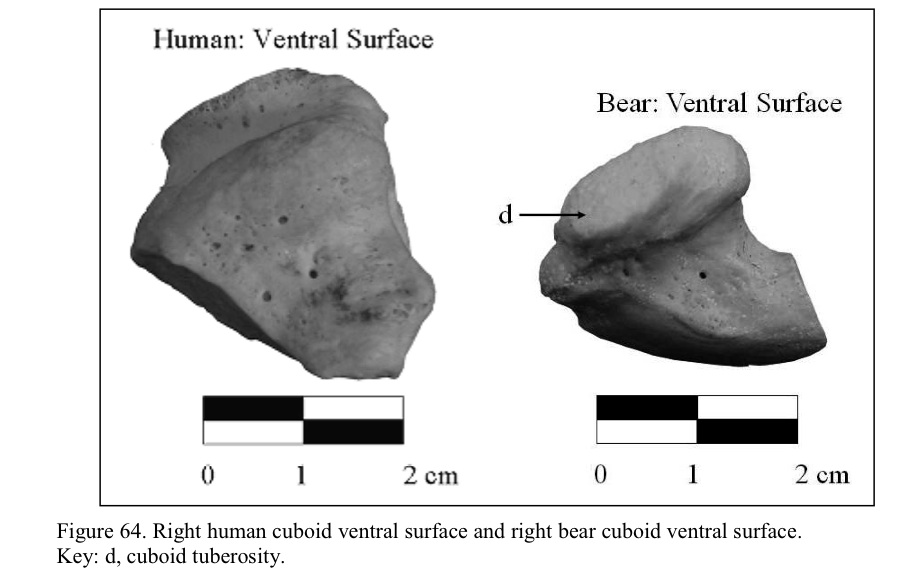
Human and Bear cuboid bones compared. Source: Smart 2009.

Some graduate theses are clearly meant to be both a research excercise and produce a demonstrably useful document.  I’m not saying these are any better than any other kind of thesis, but they do have an aura of public service and virtue about them.  The best example of these which I have seen recently is Tamela Smart’s 2009  Carpals and tarsals of mule deer, black bear and human: an osteology guide for the archaeologist.  If you click here it will start an automatic download of the 3.7 meg PDF from Western Washington University (unfortunately, no way to link to a download page).  (edit: try this link instead)

The premise of this research is that despite obvious differences on the outside, there are surprising similarities between the hand/wrist and ankle/foot bones (carpals and tarsals) of bears, deer, and humans.

Continue reading

Caribou Metatarsal Hide Scraper

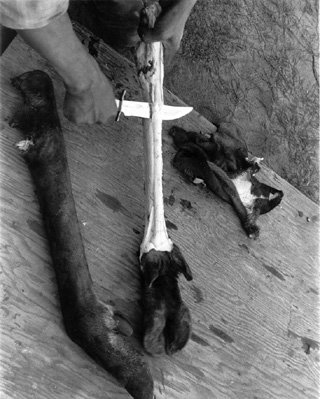
John Shea stripping ligaments from a caribou metatarsal in preparation for making a hide scraper. Source: SFU.ca

I haven’t really mined the SFU Archaeology museum website yet – they seem to have had a bit of a makeover recently, though many of their online resources are achieving “vintage” status.  One such is the photo-essay on making a hide scraper from a caribou metatarsal, or the long, straight bone between the caribou ankle and its hoof – the long bone of the foot (ungulates walk on their tip toes).

The essay is a series of over 20 pictures showing step-by-step the process of making the scraper:

Continue reading

Northwest Research Obsidian Studies Lab

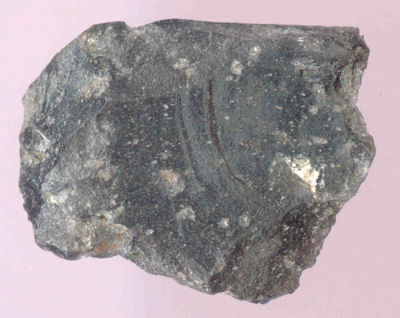
A flake of obsidian from DhRr-18, southern British Columbia. This visually-distinctive glass is from the Mount Garibaldi obsidian source.

Obsidian is a kind of volcanic glass and was highly prized for making certain kinds of stone tools.  Obsidian forms at places of relatively small outflows of magma, or liquid rock.  Small flows can cool quickly, which allows the formation of a glassy crystalline structure ideal for stone tool manufacture.  Small flows also represent a small sample of well-mixed magma, and thus each little patch of obsidian may share a very distinctive chemical signature.  This signature, usually identified by trace elements such as Strontium, Zirconium, Yttrium and Rubidium, then allows for the chemical fingerprinting of each source.  Any obsidian artifact found, whether at a source or not, can also be “fingerprinted” and then compared to a catalogue of known obsidian ources.  Since the artifacts don’t move around on their own but only through the agency of humans, the distribution of obsidian artifacts is a proxy measure for the movement and interaction of people.  When you have hundreds or thousands of such artifacts and a large database of known sources, then you can start to see large scale, long-term social interaction emerge from the silent archaeological record.  Most obsidian isn’t visually distinctive enough to sort out by eye alone, so these geochemical methods are essential.

So far, so Archaeology 101.  I was really happy to find that Oregon’s Northwest Research Obsidian Studies Laboratory has a web site not which not only solicits business, but is a highly educational and informative site about many aspects of obsidian analysis, with a focus on the Northwest. Continue reading

Arrow from Tsitsutl Peak Glacier, Western B.C.

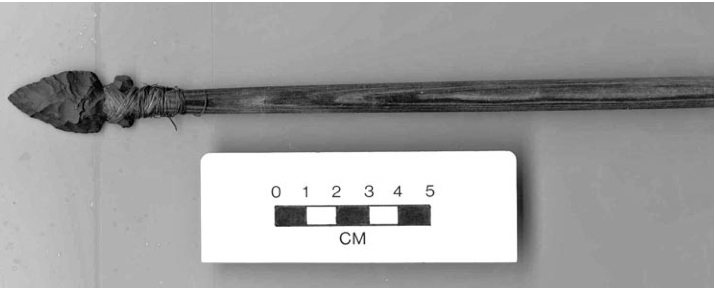
400 year old arrow or dart from Tsitsutl glacier, B.C. Source: Keddie and Nelson: 2005.

In 1924, a land surveyor found an arrow at an elevation of 2,100 metres near Tsitsutl Peak in west-central British Columbia (map).  The arrow made its way to the Royal BC Museum where it lay for over 80 years, until a timely inquiry and increased awareness of ice-patch archaeology stimulated a small research program.  This research, initiated by RBCM curator Grant Keddie and reported in the Canadian Journal of Archaeology (Keddie and Nelson 2005), establishes that the arrow is about 400 years old.

Continue reading

Webber’s Village in Nootka Sound: Original Watercolour

Painting of a village in Nootka Sound, 1778, by John Webber. Source: State Library of New South Wales. Click for larger original.

Yesterday I linked to the original watercolour of a 1778 Nootka Sound house interior by John Webber, which is the basis for the widely reproduced engraving.  Today we can take a look at Webber’s original painting of a Nootka Sound village, presumably Yuquot but not so labelled, as found at the State Library of New South Wales (though yesterday’s post brought forth questions as to whether these are watercolours or coloured engravings – see the comments).  The first and most important point is, see that lumpy, dissected landform in front of the houses?  That, my friends, is what an active shell midden looks like.  No wonder they can be such stratigraphic nightmares.

Continue reading

Puget Sound Clovis

In Red: Surface Finds of Clovis Projectile Points. After Croes et al. 2008.

I posted yesterday about the Manis Mastodon site and its possible status as a pre-Clovis site on the Olympic Peninsula.  Clovis projectile points are so distinctive that most archaeologists have no problem assigning even an isolated find of such a point, lacking in any kind of stratigraphic context or any associated dates, to the Clovis archaeological culture.  We know from sites elsewhere in North America that Clovis dates to a pretty narrow window, perhaps only 13,200 to 12,800 calendar years ago.  It has always been very closely associated with the ice-free corridor route for the First Peopling of the Americas and is predominantly known from classic sites in places like Colorado, New Mexico and Texas. So it may come as a surprise to some that Clovis is pretty well represented in Puget Sound and north to Bellingham Bay, although only from surface or other finds without provenience.

Continue reading

Association for Washington Archaeology

9,000 year old stone tools from Colville National Forest, Washington. Source: The Spokesman-Review.

I was a little surprised (and probably shouldn’t be) to find out there was an organization called the Association for Washington Archaeology – equivalent to the Archaeological Society of B.C.  They have a journal (equivalent to The Midden), and are clearly a respected avocational archaeology organization.  They have a pretty low profile, obviously: but partly this must be another symptom of the poor cross-border communication between BC, Alaska, Washington, and Oregon  – the core jurisdictions bounding the Northwest Coast.  They even have a blog called Washington Archaeology, which is only a few weeks old.  Their own link to it is both hidden under a “feedback button” and is broken: I hope that linking it here helps people find it.  There’s not much there yet, but it did lead me to a nice news roundup on the Tse-whit-zen site, and also to an interesting story on a 9,000 year old site in the Colville National Forest, near a town called Republic – just south of the Canadian border close to Grand Forks BC. (map).  Continue reading

A Portal to Online Graduate Theses and Dissertations

If you look up you should see two more links have been added along the header of this page, just above the banner picture.

ARCHAEOLOGY THESES is a page of links to freely-available, online PDF copies of graduate dissertations and theses on Northwest Archaeology subjects (with a few palaeo-environment theses thrown in for fun).

OTHER THESES is a similar page, but where the focus is on Northwest Anthropology, First Nations Studies, History and related disciplines.

I am planning another page which will be for online archaeological, ethnographic and historic documents of note, in particular “classic” ethnographic works and major site reports which have been intentionally posted in online contexts.  Probably this will be a few weeks yet.

The impetus for these pages is that I have often said the M.A. thesis in particular is a significant backbone of B.C. Archaeology, and the dissertation even more so.  For years these substantial works languished on library shelves.  Now, libraries are increasingly making them available online, free to the public and the academy alike – that is, not behind password protection.

However, you have to know how to look, and where to look, and often you need to know in advance what you are looking for, in order to find this stuff.  I thought it would be useful to have a very simple portal for these graduate works.  Not only does this make them browsable by the more hardcore of my blog readers, but it will get them some google-love!

Not all theses ever written are available online (mine isn’t!):  as it notes on the pages, there are programs in place at UVIC and UBC to digitize their back-catalogue of theses and dissertations.  It would be great if institutions like Calgary, Toronto and McMaster could get their dSpaces full, and open. Unless, of course, they are ashamed of the quality of their graduate student work 😉

So, these pages will be updated periodically. I am not vouching for the quality of any of the ones I linked — indeed a few of them are exceptionally poorly reasoned,  naive, unsupported, badly written, or long-winded efforts -and  in at least one case, all of the above!  Most are very solid though, in my estimation, and a few are truly excellent.  If you know of useful and relevant graduate work that is freely available and not yet linked, let me know in a comment below, or send me an email qmackie [at] gmail.com.  In the meantime, happy browsing.

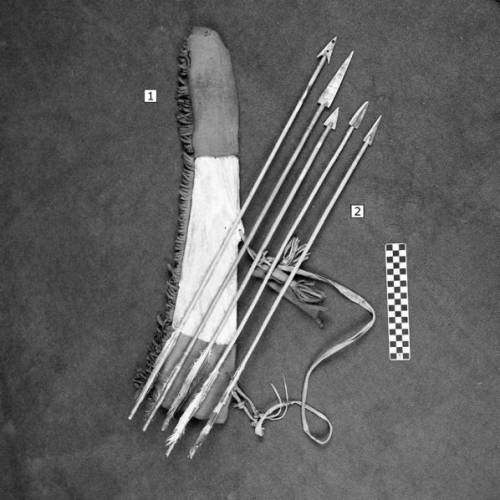
Five Frogs’ Quiver

Five Frogs' quiver with five metal-tipped arrows. Source: WSU

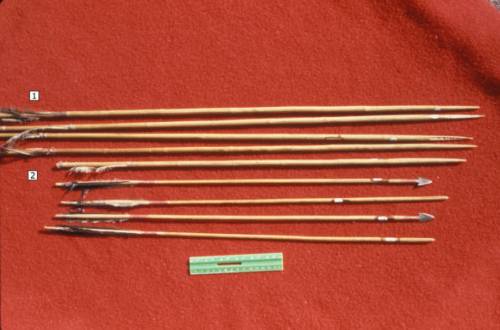
The quiver and set of arrows above is from the McWhorter Collection at Washington State University.  It belonged to the Nez Perce warrior Pahka Pahtahank (Five Frogs), who fell in battle in 1877.  Ten arrows in total were in the quiver: five with metal tips, and five with plain wooden tips – or, more likely, unhafted (probably prepared for a side-hafting method).  The wooden five are illustrated below. What I find interesting about this quiver is that no two of the five metal-tipped arrows are the same.  Archaeologists are very prone to a simple “projectile point sociology” whereby the styles of (usually, stone) projectile points are used as proxies for archaeological cultures, or ethnic groups, or as temporal markers:  ‘The side-notch people”;  “The corner notch phase”.

It is therefore a little sobering when we see ethnographic instances of an apparently cavalier attitude towards stylistic consistency.  Sometimes, (at least rarely) being a little sober is a useful mindset.   Did the different arrowheads make no difference to accuracy, or to penetration, or even to their definition as “suitable arrows”?  What are the archaeological implications of Five Frogs’ diverse arrows?  In a classic paper, Polly Wiessner (1983) noted several mechanisms for a similar Kalahari case, including hunters exchanging arrows with each other as a sign of respect and affection.  Closer to home, Glen MacKay, in his excellent UVIC M.A. thesis, suggested diverse projectile points in a short occupation site in The Yukon was a technological mediation of kinship unease:

Was the ‘arbitrary’ technical choice of hafting techniques a subtle way for young men living matrilocally to express their discontent with this institution, a means of communicating a desire to return to the people with whom they learned to make spear points and hunt? Several contextual details fiom the KdVo-5 hunting stand support this proposition…..

Emotion in archaeological interpretation!  Stamp it out.

Tips of Five Frogs' wooden arrows. Source: WSU

The top five arrows are from Five Frogs' quiver. The bottom four are from another Nez Perce warrior, Yellow Wolf (Hemene MoxMox), made as deliberate replicas. Source: WSU/

References:

Wiessner, Polly   1983.  Style and Social Information in Kalahari San Projectile Points.  American Antiquity, Vol. 48, No. 2 (Apr., 1983), pp. 253-276

MacKay, Glen R.   2004.  The Nii’ii hunting stand site : understanding technological practice as social practice in subarctic prehistory.  Unpublished M.A. thesis, Department of Anthropology, University of Victoria.  Download.

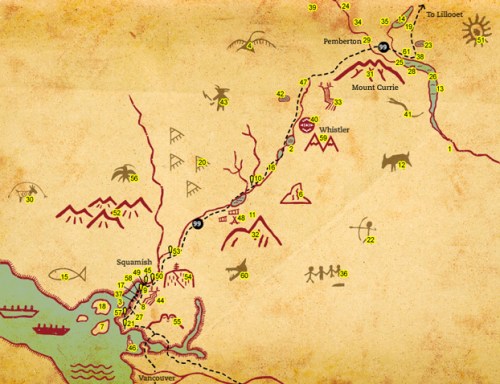
Squamish and Lil’wat Cultural Journey

Squamish Lil’wat Cultural Journeys Map. Click to go to the site.

The Squamish and Lil’wat First Nations have jointly produced a really nice website which explores the cultural landscape of their traditional territories, which lie just north of Vancouver. Edit: it looks like their website now sells kitchen products – obviously they did not keep their registration up to date.

The interactive map has dozens of “clickable” elements, taking you to place name information, to the description of rock art motifs, and to landscape features imbued with stories from history and the supernatural.  Some of these include simple but effective animations, and the overall site design is clean and harmonious.

It seems that seven highway pullouts have also been designed with this information: aboriginal cultural tourism out on the land is something I have long thought has enormous potential in B.C.  Looking at a book or a website is one thing, but having the information available, provided by the First Nations, at the place where the story happened or the traditional use occurred, seems like it would be very effective, and popular, way of educating the public about the thousands of years of cultural history on either side of the Olympics.

Supernatural serpent emerging from Ts’zil (Mt. Currie). Screenshot from culturaljourney.ca