‘Namgis Arborglyph

Dawn Cramer inspects an arborglyph deep in the heart of the Nimpkish Valley.  Photo courtesy of the 'Namgis Nation via Jim Stafford

Dawn Cramer inspects an arborglyph deep in the heart of the Nimpkish Valley. Photo courtesy of the ‘Namgis Nation via Jim Stafford

Hard on the heels of my recent post on a newly discovered arborglyph in Klahoose traditional territory, I’ve heard of another one in ‘Namgis territory, in the Nimpkish Valley on Northeastern Vancouver Island.  Local archaeologist and friend of this blog Jim Stafford, who owns the well-regarded Coast Interior Archaeology company (which has a long relationship with the ‘Namgis), sent me the following note and some photographs which are cleared for publication here.  There is also an account of the arborglyph in this PDF document (a newsletter) from the ‘Namgis. Jim writes:

Please find attached images of the arborglyph we found recently in the heart of the Nimpkish Valley.  The photos are provided courtesy of the ‘Namgis Nation and Dawn Cranmer is pictured in two of the photos.  I’ve also included an image of a ‘bark board’ we found nearby with Lee Waddams pictured. Continue reading

Klahoose Arborglyph

Klahoose Arborglyph Ceremony. Source: Klahoose First Nation.

Klahoose Arborglyph Ceremony. Source: Klahoose First Nation.

There has been a mini-flurry of new arborglyphs found in BC – well two of them –  but they are extraordinarily rare.  First up for this blog is the example above, which comes from Klahoose First Nation territory, roughly around Toba Inlet in the extreme NE corner of the Salish Sea (map).  This human face was carved into a tree some time in the 19th century.  It’s in rather stunning condition, setting aside the cut block it finds itself in.  Risk of blowdown is probably why, after appropriate ceremony, it has been moved to the Klahoose offices at T’oq (Squirrel Cove).  As the page describes:

The Klahoose Cultural Leader Norman Harry Sr. and a Tla’amin Cultural Leader Erik Blaney witnessed and performed a ceremony to ensure cultural protocol was observed. The heartfelt moments before the tree was harvested was both moving and surreal on that snowy winter Friday. Needless to say that the emotional event was a historical moment for those who witnessed.

Continue reading

Controversy at Cherry Point site WA, 45WH1

Foreshore near 45WH1.  Source: Re-Sources.

Foreshore near 45WH1. Source: Re-Sources.

I haven’t been following the story at all, but there seems to be quite the controversy going on at Cherry Point, not far north of Bellingham on the coast of Washington State (map).  This large site, in Lummi Nation territory and known to them as Xwe’ chi’ eXen, has seen a lot of archaeological work over the years: about 300 cubic metres was  excavated in a series of WWU fieldschools in the 1970s and 80s under the direction of Garland Grabert. Dating back to at least 3500 years old, has some unusual features, such as being on a wave cut bank over a cobble beach with unusual offshore topography, suggesting proximity to a reef-netting site.

As its site number indicates, it’s the first site recorded by archaeologists in Whatcom County – which usually means it’s a very prominent site.  Indeed, it’s both culturally and scientifically important, and, unfortunately, has seen a lot of impact and is currently threatened. The source of the problem is a major coal port which is being planned. Interestingly enough, when the developer jumped the gun and started core-sampling the site before authorization, they were  taken to court and recently fined 1.6 million dollars.  Which is a lot of dollars. Continue reading

Final Qwu?gwes wet site report is available for download

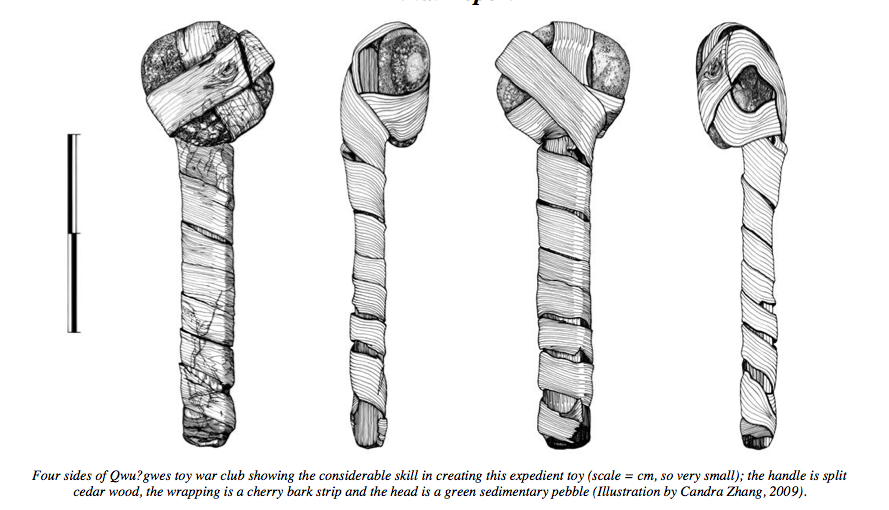
Toy war club from Qwu?gwes site.  Source: Qwu?gwes Report.

Toy war club from Qwu?gwes site. Source: Qwu?gwes Report. Click to enlarge.

Dale Croes kindly sent me a link to the final report for the Qwu?gwes wet site (45TN240), which is  is located on Mud Bay at the southern end of Eld Inlet, Puget Sound, near Olympia, Washington (map). The site was apparently first occupied about 800 years ago.  This report, hosted at NewsWARP, checks in at almost 1,000 pages and about 80 megs, and is the product of more than 10 years of field-school and collaborative research with the Squaxin Tribe.  There look to be about two dozen authors. If you’re not up for the whole thing right away,  there’s a much shorter executive summary you can download here. But it’s a really impressive report covering everything from stone to bone to wood, bark, root, wood I.D., ethnobotany, paleo-seismology, fishtraps, and more.  It’s very clearly written at an accessible, non-technical  level, largely by students. I’ll pick out a few of many highlights below. Continue reading

Harpoon Arrows

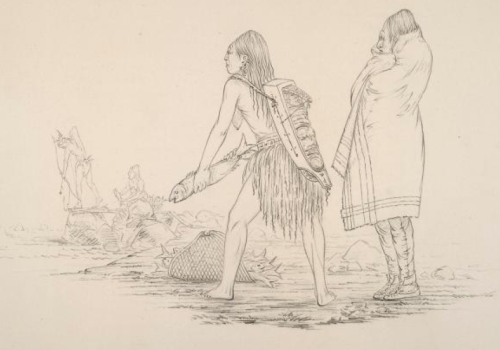
Fishing at the Dalles, 1850, pencil drawing by George Catlin. Source: NYPL.

Fishing at the Dalles, 1850, pencil drawing by George Catlin. Source: NYPL.

I’m probably the last person to get the memo that you can fire a harpoon with a bow and arrow.  In fact,  I only just got my head around firing a harpoon with an atlatl.  Anyway, take a squint at the picture above – the figure in the lower left background is clearly shooting a harpoon-arrow from his bow.  The picture is from about 1850 and is a pencil drawing of a scene at The Dalles, on the Columbia River.  I’ll take a closer look at this picture below. Continue reading

Essay on the CBC – Stone Bowl Auction Controversy

Screenshot of iPINCH website

Screenshot of iPINCH website

I’ve posted a couple of times (1, 2) on the proposed, callous use of a seated human figure bowl as a reality TV show prop.  Well, worse than a prop, since the idea is to auction off this sensitive cultural property in pursuit of TV ratings and the advertizing dollars which follow.  It’s sort of unfathomably insensitive and stupid, doubly maddening since it’s the CBC, a crown corporation and an entity which really should know better.

Anyway, there’s an interesting and insightful essay by Emily Benson on the IPinCH blog which adds a lot of thoughtful commentary and context for this issue:

The example of the seated human figure bowl and media discussions around it, reflect a broader set of questions and issues related to historical and contemporary relations between Indigenous peoples and settlers in Canada. This case reflects the importance of challenging both public and anthropological conceptions regarding the treatment of Indigenous peoples’ cultural heritage.  Explicitly recognizing the relationship of descendant communities to their ancestral /sacred sites and objects, and their rights regarding their cultural heritage, are fundamental to doing so. Key to shifting these perspectives are recognizing the significance of cultural heritage sites and objects to living peoples, and their rights to make decisions regarding their heritage.

It’s part of IPinCH‘s* occasional series “Appropriation of the Month” – most entries are not about the NW Coast but nonetheless many readers here will find a lot of food for thought over there.  I particularly encourage you to go over and leave some comments on the bowl issue!

ASBC Victoria October Talk: Morley Eldridge on New Methods in Archaeological Excavation

Prince Rupert point cloud from Millennia blog

Prince Rupert digital point cloud showing relationship between hearths and shell-bearing layers, from Millennia blog. Source: http://millennia-research.com/stacked-box-hearths-in-3d/

A NEW METHODOLOGY FOR ARCHAEOLOGICAL EXCAVATION: MITIGATIVE EXCAVATION OF GBTO-13 AND GBTO-54,PRINCE RUPERT

Morley Eldridge, Millennia Research

The next ASBC Victoria public talk is by UVic’s own Morley Eldridge, who is also principal of well-known and well-respected archaeological consulting firm.  Morley has been doing some exciting new methods of in-field digital recording, with application in Prince Rupert Harbour. It also seems there will be a show and tell of artifacts at this meeting. Further, I’ve been meaning to post on this and I will!  Promise!  But Morley et al are cutting in on my turf with a sweet new blog found here.

Anyway, I’ve seen some of this from Roger and Morley at the SAA in Hawaii and it was kick-ass.

The meeting is Tuesday October 15, 2013, 7:30 pm at the Pacific Forestry Centre, 506 West Burnside Road.  Map.  Free and open to the public.

Click continue to read the abstract.

Continue reading

Archaeological project blog from shíshálh territory

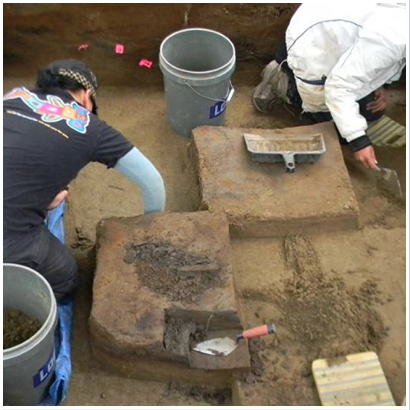
    Archaeologists in shíshálh territory using iPads during excavation. Source: http://shishalharchaeology.wordpress.com/

Archaeologists in shíshálh territory using iPads during excavation. Source: http://shishalharchaeology.wordpress.com/

Last summer we had a good discussion of the vast number of beads coming from some human burials being excavated in shíshálh territory (Sechelt). Tose finds are part of a larger joint research program between the shíshálh Nation, National Museum of Civilization, and the University of Toronto, which has resumed and has a blog.

Continue reading

Yukon College Fieldschool Websites

Remains of the Mud Monster

Remains of the Mud Monster. Source: facebook.

I think it’s just wound down, but the recurring Yukon College fieldschool “methods in subarctic ethnography and archaeology” spawned some good websites and blog entries.  This fieldschool, convened by Norm Easton, has been happening for quite a few years now.  It has inspired a lot of students, including some from these parts, as well as made major contributions to anthropological knowledge in the broad sense of the term.

This year there was an active facebook page on which, among many other things, are posted thousands of photographs.  I checked and I don’t think you need to be on facebook to read these pages.  Four students also started blogs to track their experiences.  Of these, Yankee in the Yukon never really got off the ground with only two fairly short pieces.  Yukon Adventures also only had two posts, but these are well written, longer reflections of the leadup to the project. Archaeology Adventures had more posts, but is primarily a photo blog – evocative photos but with relatively little context – the surface finds of the blogging world!  It’s great to see students putting their thoughts and pictures out there beyond their own facebook udpdates – each of which is a bit of a walled garden relative to the rest of the internet.

The most sustained blog, one that is successful by any standard, is Yukonic.

Excavations at Little John Site.  source: facebook.

Excavations at Little John Site. source: facebook.

Here you will find dozens of well-written and reflective entries from “Kalista”, a student from rural Alberta,  who tracks the highs and lows, the trivia and depth, the raw and the cooked of the fieldschool experience.  Consider how she comes to say goodbye:

Because while the Archaeology was cool: hearths, obsidian flakes, a rodent tooth, bone fragments, and a preliminary or perhaps heavily eroded side-notched point in addition to other student’s impressive finds of blades, a complete bison heel bone, a perhaps 13000+ year old game-changer biface, and the admittedly really cool, very old squirrel bones, behind all of those things except perhaps some of the bones, is people. The cultural material only exists because of people. Accordingly, it is the people that made my experience in Beaver Creek. People like Leslie, Chelsea, Tamika, Eddy, Blake, Bessie, Wilfred, Louis and Robert, Eldred, Jessica, Pat, Pat’s wife (whose name unfortunately always evades me), Jolinda, Ryan, Glen, other Glen, Marilyn, DJ, Mike, Tristain, Leon, Tayla, Tom, Forrest, Ian, Martha, Julius, Susie, Selena, Roland, Star, Derrick, Ken, Doug, many more people and names I am forgetting, and of course Ruth and David. A list of names that may be forgotten corresponding to a community of people I intend never to forget.

Luckily, Tamika had the great idea to have hers and Eddy’s birthday celebration before we left so there was a nice gathering that unfortunately ended with goodbyes. The birthday party felt like home: copious amounts of food, the older people eating first, and three types of dessert (because one just isn’t enough).

It felt like home because of the parallel’s to my own family’s celebrations but also due to the welcome we were afforded in our time at the Little John Site: our welcome sign the first day, countless visits, teaching us Upper Tanana and how to make birch bark baskets, shotgun and rifle shooting, ball games, numerous other activities; their way of life. As David said, we are now ambassadors of their culture and if possible, I hope to be able to show some of the character the White River First Nation showed us.

No, I am not good at goodbyes. What do you say? How do you thank enough, wish well enough people who did so much yet you may never see again? Consequently of these thoughts, I am a most awkward person at goodbyes and perhaps do not look like I feel much, but as I put this goodbye on paper, I could cry.

It’s strongly to the credit of the fieldschool leaders (Norm especially, no doubt, but I am sure he has cultivated a cast of characters….) that the experience is more about people than about things.  Archaeology is always, or should always, be about people, not things, and if you can’t see the people in the present then what hope for finding them in the past?
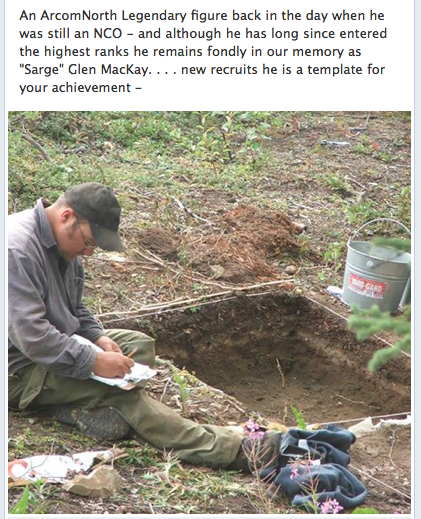
The inimitable Glen  showing off his chops.

Speaking of “people”: the inimitable Glen showing off his chops.

More on Stone Bowls and Reality Shows

Screenshot from Times-Colonist of Qualicum bowl which may be subjected to reality TV auction by CBC.

Screenshot from Times-Colonist of Qualicum bowl which may be subjected to reality TV auction by CBC.  Click to enlarge.

The Times-Colonist has another article (PDF) on the seated human figure bowl which may go up for auction as part of a crass CBC reality TV show. The new article has some good information about the bowl from Grant Keddie and reactions from the B.C. Archaeology Branch and the CBC.  Thanks to twoeyes for posting this article in comments in the prior post; I thought it needed a new entry of its own.

The bowl was apparently found in Qualicum Beach in 1988, and is known to the Royal BC Museum – it has been photographed by them (see screenshot above).  I’m not sure if there has been any publications about this bowl, if the Qualicum First Nation knew about it before this mini-controversy, or what has been said to the owner about the importance of the item. The Times-Colonist does have some interesting quotes from those involved.

Continue reading