ASBC Victoria talk: Tue Feb 18, Nicole Westre on Hiikwis Fauna

UVIC Students excavating at Hiikwis Site, Barkley Sound.

UVIC Students excavating at Hiikwis Site, Barkley Sound.

They didn’t do it just for the Halibut: A faunal analysis of the Hiikwis site complex (DfSh-15 & DfSh-16), Barkley Sound.

Nicole Westre

Tuesday, February 18, 2014, 7:30 pm
Cornett Building B129
(North End of Cornett building)
University of Victoria

As always, the ASBC talks are free and open to the public.

Abstract:

The Hiikwis site complex (DfSh-15 and DfSh-16) consists of two village sites in inner Barkley Sound, occupied continuously for nearly 3000 years until the 1900s. Excavated between 2008 and 2010, the site complex has gained attention as the only Barkley Sound village site to contain a significant flaked stone assemblage in late contexts. My talk, however, focuses on sampled vertebrate faunal remains recovered from the site, which are unique among Barkley Sound sites as well. The bird and whale assemblages will be discussed, as will salmon exploitation. In general, Barkley Sound sites suggest that salmon did not become an important resource in the area until only about 800 years ago. This observation challenges the idea that complex Northwest Coast societies emerged as a result of salmon preservation for winter consumption as long as 3500 years ago. Does the Hiikwis site complex follow the typical Barkley Sound pattern, or do the bones tell a different story?
Continue reading

Upcoming archaeology talks in Nanaimo

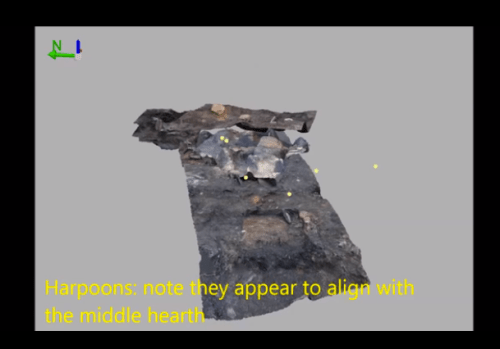
Millennia hearth model screenshot.

Millennia hearth model screenshot from video. Click to go to blog post and view video.

I’ve been asked to post about some upcoming talks in Nanaimo with archaeological interest.  Below I list the talks, which are all co-sponsored to one degree or another between VIU and the Nanaimo ASBC chapter.  The linked posters below give you more information about parking, times, room numbers, abstracts, bios, etc.  All these talks are free and open to the public. For further information then contact mail@asbcnanaimo.ca .

I know many of you are stuck in other lovely places in the world and can’t make it, but for those more local then the details follow.

First up – in just a day or two – is Morley Eldridge of Millennia Research, speaking on his cool uses of digital technology in site recording and excavation.  This is really cool stuff and probably the way of the future for at least some scales of archaeological research. There’s  sneak preview of some of the new methods on the Millennia Blog.

Lecture: A New Methodology for Archaeological Excavation: Mitigative Excavation of GbTo-13 and GbTo-54, Prince Rupert.

Date: Thursday February 6, 2014

Location: VIU Nanaimo campus, Building 356, Lecture Hall 109 (Education/Social Sciences) Time: 11:30 AM – 1:00 PM
ASBC Members, Students and the Public Free! Everyone Welcome.  More instructions on the poster (PDF)

The other talks are by Andrew Martindale (UBC) and Quentin Mackie (UVIC) (no relation).  Details below:

Continue reading

ASBC Victoria January Meeting: Tom Bown & Historical Archaeology, Tuesday Jan 21st

Please note the new location for this talk (below) – ASBC Victoria is no longer at the Pacific Forestry Centee

Tom Bown
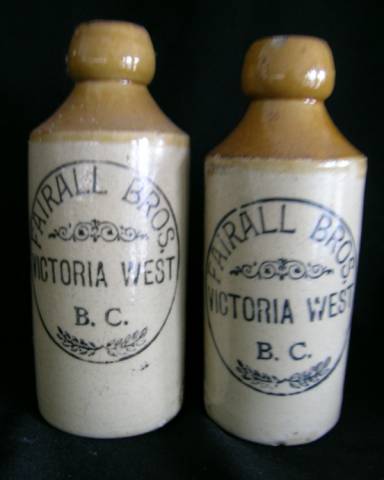
A Trail of Empties

Tuesday, January 21, 2014,
7:30 pm

Cornett B129, UVic

Abstract: Global expansion from the 17th century on could likely be studied just by the trail of bottles left behind. Fortunately glass preserves well and, based on the style and method of manufacture, can offer some very precise dating tools. In an archeological context glass fragments are often the first indication of contact or trade with the outside world. They can also offer information about a site and the people who lived there. During the talk I will offer an overview of how to identify and date glass bottles along with some “hands on” examples.

Feel free to bring bottles of your own for possible identification.

My spies in the UVIC Anthropology Department tell me they are really happy to be the new host for the ASBC, and are very grateful to the Pacific Forestry Centre for their many years of hospitality.  Instructions and a map to Cornett Building B129, UVIC are below.

Continue reading

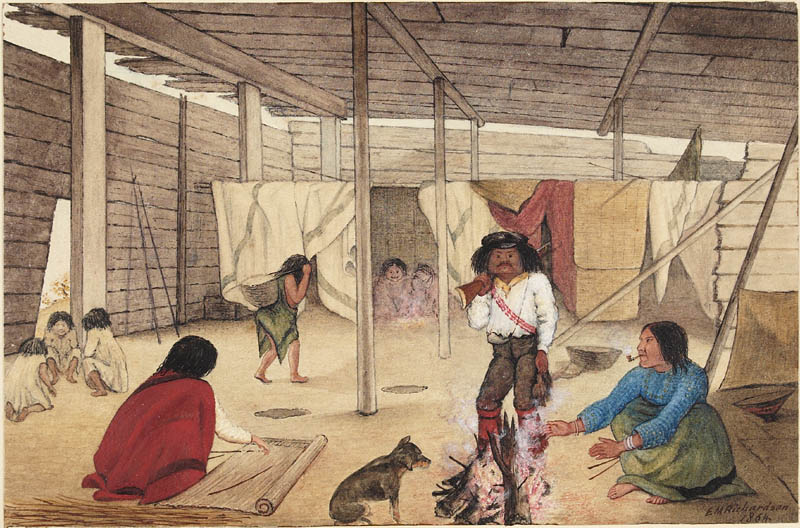
Interior of a Coast Salish Longhouse, 1864

Interior of a Salish Longhouse, 1864. Watercolour by Edward Mallott Richardson.  Locale uknown. Source: Canadian Archives.  Click to enlarge.

Interior of a Salish Longhouse, 1864. Watercolour by Edward Mallott Richardson. Locale uknown. Source: Canadian Archives. Click to enlarge.

Following on from the post about the Salish mausoleum, here is a companion painting by Edward Mallott Richardson from the same year, depicting the interior of a house.  It’s a curious painting, seemingly devoid of close detail.  Where are all the drying fish?!  But at the same time it shows some features of interest which may be worth discussing.  Note the fellow with the gun has a powderhorn, for example, and the basket behind him looks like one of those rectangular coiled ones, only with a tumpline, as shown by the woman entering on the left.  On the far right is a semi-conical object that might be a hat, sitting on a platform within a small compartment.

Continue reading

A Coast Salish Mausoleum, 1864

A Salish Grave, 1864. Watercolour by Edward M. Richardson. No specific locale given. Source: CollectionsCanada.gc.ca

A Salish Grave, 1864. Watercolour by Edward M. Richardson. No specific locale given. Source: CollectionsCanada.gc.ca  Click to enlarge slightly.

“Grave House” is one of those archaeological terms which render slightly creepy a feature that is more or less an everyday experience: the mausoleum, a house for the dead, filled with coffins.

This is a fascinating image I hadn’t come across before: a very early image of a Coast Salish mausoleum.  It highlights the artistry and vividness of these features better than the few sketches or early photographs do. The accompanying text at the Canadian Archives is:

Subject depicts grave boxes in a grave house with guardian figures. The grave house is covered with a roof of wooden planks but has no walls. At the front of the house stands six guardian figures. There are flags to the left and right of the house. On the left hand side of the house a tent is set up and clothes are hanging. A shotgun hangs from the front beam of the house. Item was up for auction in the September 28, 1970 Christie’s sale in Calgary. Lot 31.

The image isn’t very high-resolution but there are still some things to talk about – and there is another Richardson painting I’ll link to in a day or two. (edit: here) Continue reading

Tagging along with Archaeologists in Quatsino Sound

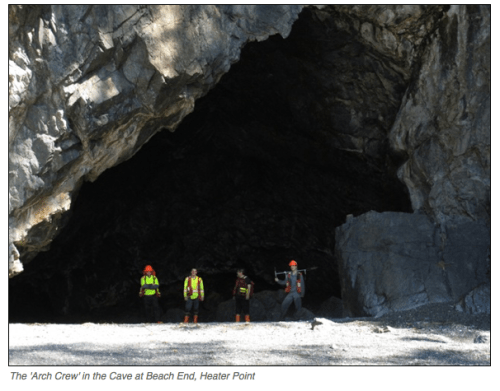
Quatsino - Cave at Heater Point. Source: bcmarinetrails.org

Archaeology Crew at Quatsino: Cave at Heater Point. Source: bcmarinetrails.org

How does the general public perceive archaeologists?  There’s a lot of ways to get at this question, not least the comments section of any newspaper article!  But a positive and slightly unusual perspective is found in this article by Stephanie Meinke at the BC Marine Trails website.  In the course of establishing some new marine trails in the Quatsino Sound area of NW Vancouver Island (map), concern arose that there might be archaeological sites at some of the campsites. Kayakers generally having solid ethics about leaving no trace, but all the same there might be some unintentional impacts.  So an archaeological consulting team (Kennedy Richard and Morgan Bartlett) was hired to assess these spots with potential impact. They were guided by Stephanie and by Janis Leach of Recreation Sites and Trails BC, as well as by two field assistants from the Quatsino First Nation: Mark Wallas and Mark Hunt.

The article gives something of a participant-observation view of the archaeological consulting business in its coastal survey guise, as well as some nice pictures of gorgeous scenery.

Continue reading

Northwest Anthropology Conference (NWAC) is in Bellingham, March 26-29, 2014

Screenshot from NWAC 2014 page.

Screenshot from NWAC 2014 page.

Just a quick service note to help get the word out: the NW Anthropology Conference 2014 is coming up, conveniently located in Bellingham, Washington.  It will run Wed March 26 through Saturday March 29th, 2014. This is usually an excellent conference.  It often skews a little to the archaeology side of anthropology, but the theme this year is “Anthropologists Connecting” which should stimulate a broad attendance:

Anthropologists make connections between communities, generations, biology and culture, past and present, and with each other.

It appears the conference is being organized out of the fine Department of Anthropology at Western Washington University, co-ordinated by Dr. Sarah Campbell.  Session proposals and paper submissions are still open, so get yours in.  If you have a a session arranged and want to troll for presenters, then feel free to put a comment in here: one of my seven readers might rise to the bait. (you know who you are).

Tlingit War Helmet Rediscovered after 100 years

Tlingit war helmet recently rediscovred in Springfield Science Museum.  Source: SSM.

Tlingit war helmet recently rediscovered in Springfield Science Museum. Source: SSM.

This is the kind of cool story that makes me want to poke around in all the community museums I see.  A fantastic Tlingit war helmet has been recently rediscovered in the backroom of a museum in Springfield, Massachussests.  The helmet was accessioned in 1899 as an “Aleutian hat” and the designation was never questioned until now.  The news article about it suggests only 95 of these helmets are known, with the largest collections found in Russia.  They are part of an elaborate system of armour known from the contact and early historic period in Tlingit territory (Southeast Alaska – Alaska Panhandle).

Continue reading

Images of Nootka Island People, 1787

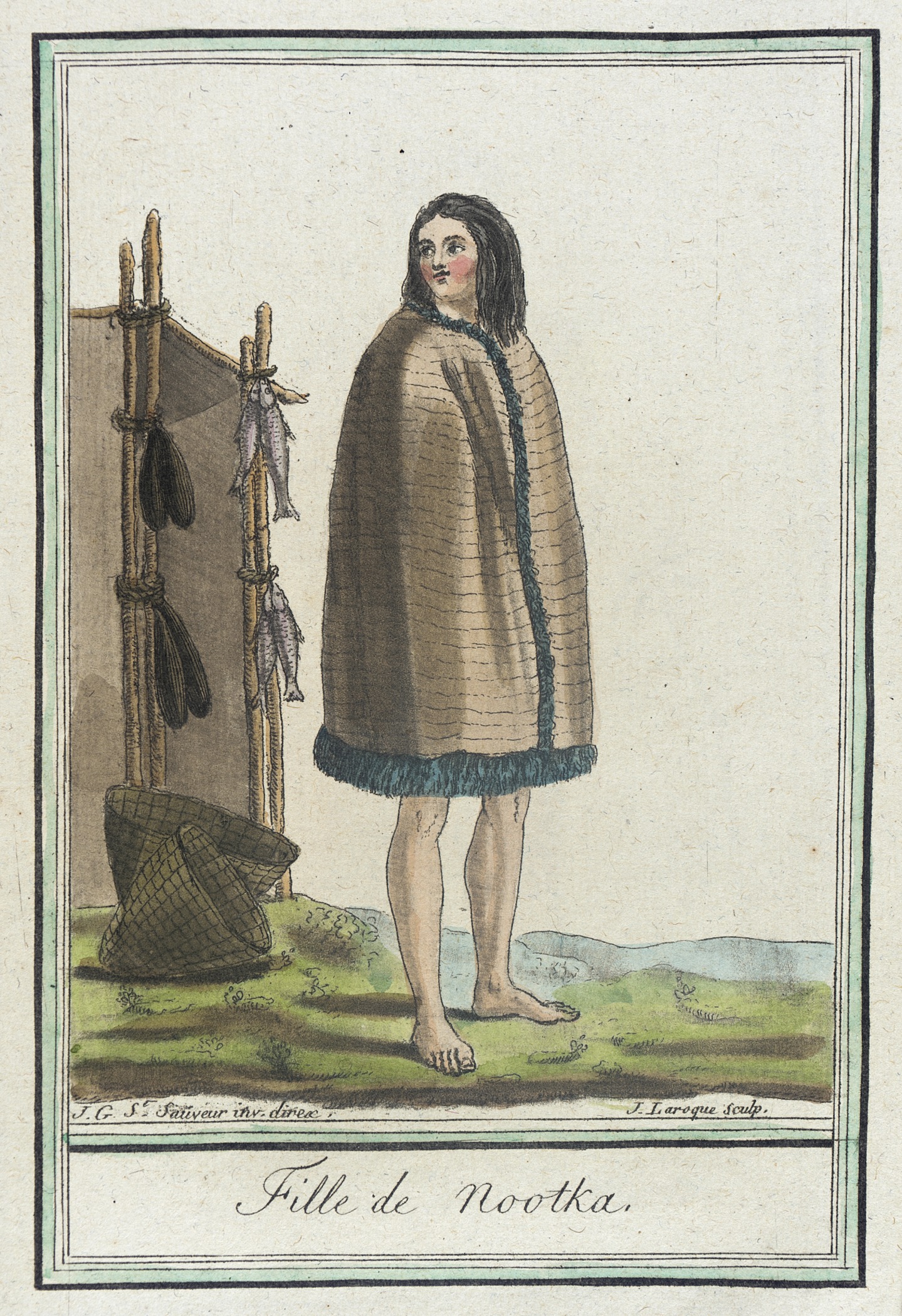
Nootka Sound girl, 1787.  by de Saint-Sauveur, source: LACMA.

Nootka island girl, 1787. by de Saint-Sauveur, source: LACMA.

I found some interesting images at the Los Angeles County Museum of Art. These come from a book published in 1787: Costumes civils actuels de tous les peuples, volume 4: Americas by Jacques Grasset de Saint-Sauveur (1757-1810).  Needless to say, it’s one of the earliest publications with NW Coast content, comprising four plates and 14 pages of “customs” of Nootka Island (Nuu-chah-nulth territory). I’m not entirely sure where Grasset de Saint-Sauveur would have got his inspiration from – Cook’s journals most likely?  You can see all the plates from the four volumes at the LACMA (great images from around the world), or you can read and download the entire book here.  But why bother, when I extract the information for you below.

Continue reading

Weir on the River Koeye

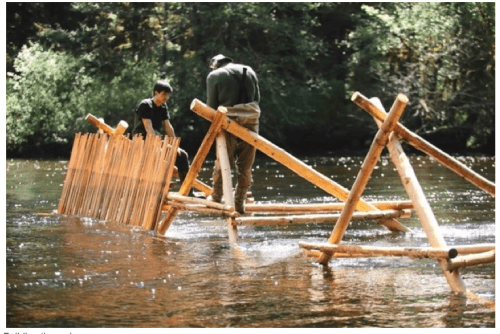
Building Koeye Weir. Photo by Grant Callegari via indiegogo.

Building Koeye Weir. Photo by Grant Callegari via indiegogo.

There’s a pretty amazing new construction on the  on the Koeye River (pronounced roughly “kwaay”) on the central coast of B.C. (map).  A team has built a traditional style wooden-weir across the river, and are using it for fishery management – trapping, counting, measuring, and gently releasing salmon at the end (and start) of their life cycle. The construction has been documented at the willatlas.com blog, including some amazing photos, and there are posts on the Hakai Beach Institute blog as well. Even better, there is a short documentary.  This is actually is a teaser for a longer documentary, which is in the fund-raising stage, and I don’t mind using this blog as a platform to bring this really great project to people’s attention.  You can see their fundraising page here.

Continue reading