Society of Ethnobiology Conference: Coming to Victoria

Top notches in a standing western red cedar tree, the result of extracting one or more planks.

Dana sent me a note that the 33rd annual meeting of the Society of Ethnobiology “The Meeting Place: Integrating Ethnobiological Knowledge”, will be held 5–8 May, 2010, in Victoria.I believe some “rockwashy” types are helping out with the organization.  It sounds like a great conference and a chance to build networks between plant people and rock people and bone people – and we sure do need a lot more archaeology of plants out here on the NW Coast, where bones and stones still rule the day.

This year’s conference theme celebrates the potential of ethnobiology to bridge disciplines, ideas, and communities, and to foster an understanding of the connections between the biological and cultural worlds.

In addition to our usual dazzling line up of papers and sessions, here’s a preview of some of the other special events:

  • Wednesday night welcome reception in the First Nations gallery at the Royal British Columbia Museum
  • Special discussion sessions on: Teaching science through ethnobiology, Ethnobiology and ethics, Communicating environmental knowledge through media, Indigenous people’s food systems, and more!
  • Thursday night poster reception at the just opened First People’s House at the University of Victoria
  • Six! fabulous field trip options
  • A banquet of traditional B.C. First Nation’s food followed by a presentation of the Atla’kima “Spirits of the Forest” dance by Kwakwaka’wakw Longhouse dancers

This year’s meetings will be back-to-back with the International Society of Ethnobiology congress in nearby Tofino, B.C., May 9–14.

Haida Gwaii is now just Haida Gwaii

a.k.a., The-Islands-Coming-Out-Of-Concealment.

The thinnest possible news report from the Times-Colonist says that the BC Government will now use “Haida Gwaii” in all official contexts, rather than “The Queen Charlotte Islands”.  Presumably this means it will be changed in the official BC Gazetteer but so far it shows no such change this calendar year.  More from the Globe and Mail:

“The change is a very important symbolic gesture,” said Guujaaw, president of the Haida Nation. (Guujaaw goes by one name.) “That’s the land that gave us our life and culture. It’s the proper name.”

Robert Finch, chief executive officer of the Monarchist League of Canada, said he was surprised and disappointed by the B.C. government’s decision. “They assume that they’re doing a good thing, but they’re erasing a very big part of Canada’s heritage.”

I wonder if Robert Finch has even the faintest idea of how clueless he sounds, how arrogant and absurd and, frankly, irrelevant.  Maybe if he spent more time thinking about the Crown’s broken promises to aboriginal people he would be less likely to spout such verbal tripe.

Anyway, this will simplify journal articles, where it will no longer be necessary to footnote the name “Queen Charlotte Islands” or refer to “locally known as Haida Gwaii and henceforth referred to thusly”.  Meanwhile, enjoy the picture above: coming home through north Juan Perez Sound.

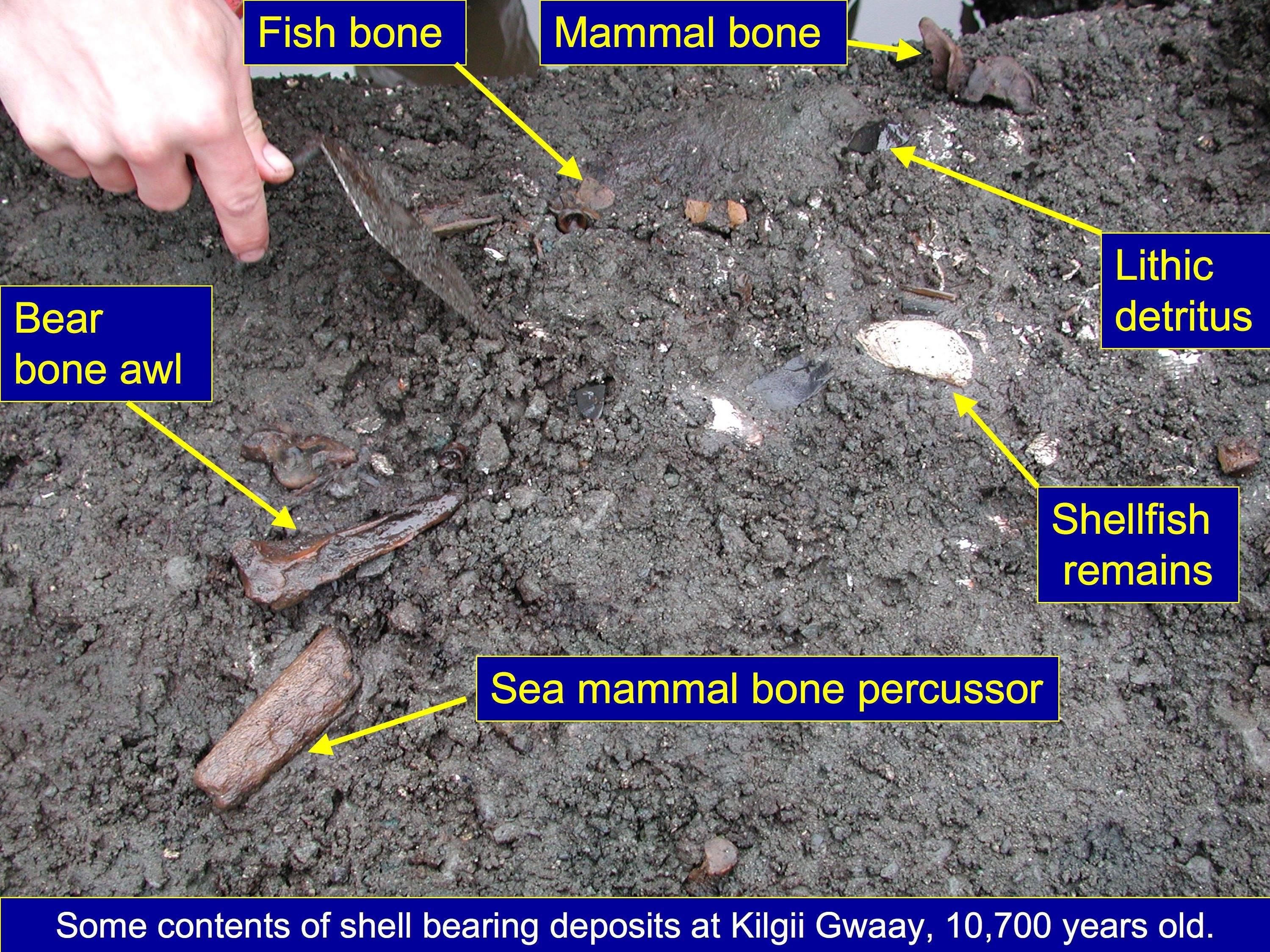
Annotation: Kilgii Gwaay excavations.

Excavation at Kilgii Gwaay, southern Haida Gwaii.

I’ve found that individual powerpoint slides can be saved as JPG images, complete with their annotations.  Since I have a lot of these I may share some.  The above shows excavation in the shell-rich component of the intertidal site at Kilgii Gwaay.  The combination of shellfish remains and saturation in slightly alkaline sea water has produced remarkable preservation for a site which is firmly dated via about 20 carbon samples to 9450 14C BP, or around 10,700 calendar years ago.  In this picture you can see some of the evidence: bone tools, stone tools, and the remains of shellfish, fish and mammals which, together with birds, formed the basis of the diet at this summertime camp.

Continue reading

Raven-Walking & Geological Transformation

Haida History starts at least 14,500 years ago. (Image credit: Daryl Fedje).

Three things we know about Haida Gwaii:

1.  About 14,500 calendar years ago it was a temperate tundra environment, with no trees.  The first trees, pine, appear about 14,000 years ago and there is progressive forest infilling thereafter, with the modern species mixture in place by about 3,000 years ago.

2. It has an impoverished suite of large land mammals – historically, these were limited to black bear, caribou, marten, ermine, a vole and a shrew.  We know that 13,000 years ago there were also deer and brown bear on the islands, and quite likely other species as well.

3.  It used to be much larger than in the present.  With lower sea levels at the end of the last ice age, Hecate Strait was largely dry land, exposing a large, unglaciated, coastal plain that became rapidly flooded.

It seems to me that we can add a fourth thing we know:

Continue reading

Northwest Anthropology Conference: NWAC 2010

The web site for NWAC 2010, to be hosted at Central Washington University March 24 – 27, 2010 in Ellensburg, Washington,  is up and running.  NWAC is a great conference which we were lucky to host in Victoria a couple of years ago.  In case you are wondering where Ellensburg is (no offence), it’s just to the east of the Cascades from Seattle, north of Yakima, about a 350 km drive from Victoria: map.

The theme of this year’s conference is the very welcome “At a Crossroads”:

Anthropology at the Crossroads” is the theme for the Northwest Anthropology Conference (NWAC), Ellensburg, Washington, March 24 – 27, 2010. While all submissions will be considered, this conference will offer opportunities for multiple perspectives on where we are as a discipline, society, and species, with a special emphasis on people and the environment. The “Anthropology at the Crossroads” conference will include symposia and presentations on subjects from archaeology, cultural and linguistic anthropology, paleoanthropology, primatology, medical anthropology, visual anthropology, and others. We invite submitters to use their own preposition in describing their presentation/symposia as “Anthropology at/of/on/etc the Crossroads.” Studying the past, understanding the present, and preparing for the future, makes Anthropology even more relevant today as the discipline continues to assert the importance of an appreciation for culturally diverse modes of interacting with our environment. Thus, this conference is a crossroads where the exchange of ideas better prepares us, our students, and our work to serve the communities we live in as we maintain our commitment to exchanging and transmitting our under-standings of all people, in all places, and at all times. “Anthropology at the Crossroads” also implies interaction among sub-disciplines and communities in an integrated fashion and in this manner encourages self reflection on the relevance of Anthropology today at a moment when we appear to be at several global crossroads.

Chief Thunder Voice

Bing Crosby being invested as Squamish Chief Thunder Voice.

In 1948, Bing Crosby, then a first-rank international star, visited Vancouver – and ended up being invested as Squamish Chief Thunder Voice, among other civic performances.  The Vancouver City Archives has the video (1.00 minute in).

By the way, what is up with coastal First Nations adopting feather war bonnets?  Is this a kind of weird double reverse emulation: trying to look more stereotypically Chiefly in the eyes of the majority population?  Is it intra-aboriginal cultural appropriation?  Or do they just look freakin’ awesome?  Note the tomahawk as well in the picture above.  Someone should write a paper on “Plains Paraphernalia as  Signifiers of Rank on the Historic Northwest Coast”.  Or maybe they have, already.  I’d read it.

Quantitative Zooarchaeology Blog

killer, qmackie, and archaeomath: three people who like fish (maybe just a little too much).

It’s a niche blog for sure, but at archaeomath someone is writing a series of highly detailed posts on quantitative zooarchaeology, with an emphasis on fish bone.  The posts on inference of net gauge, intensification of fishing practice, and estimation of MNI are particularly interesting and definitely relevant to the Northwest Coast.  Anyone who can introduce their blog with: “The purpose of this blog is to share my experiences using various mathematical tools to address archeological problems that interest me. Mathematical models, when done well, make assumptions explicit and clarify how processes operate” has my admiration and appreciation.  Anonymous Faunal Analyst with your Geospatially Ambiguous Shell Midden and Bones of Unspecified Taxa: we salute you!

Tlingit, Dene and Eskimo Metallurgy (1969)

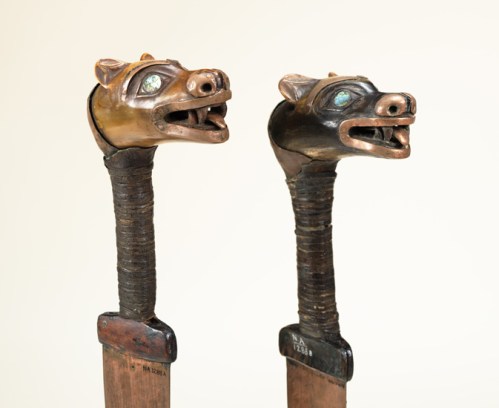
Tlingit dagger hafts, Kluckwan, Alaska. Purchased by George Gordon from Louis Shotridge at the Portland Fair, 1905. Penn Museum Objects NA1288a/b.

From the excellent University of Pennsylvannia Museum website, you can download back issues of their magazine “Expedition”, including this article on aboriginal metallurgy in Northwest North America (PDF).  The caption below is from that article: the two astonishing daggers being described are shown above.  Seriously, this is metalwork of the highest order, reminiscent of, say, Mycenaean pieces.

1969 caption describing the two daggers, above.

Peavies, pickaroons, hookaroons and skid tongs

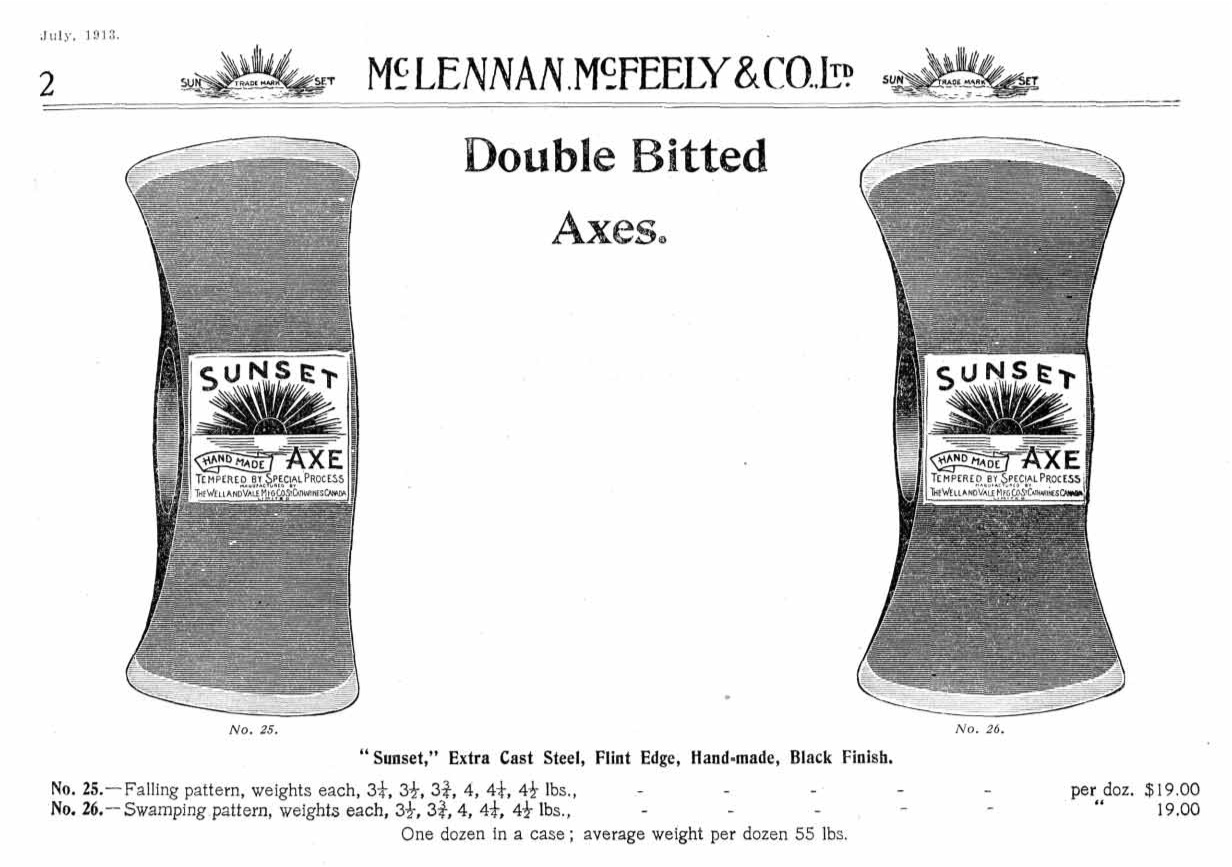
Double-bitted axes, available by the case.

It’s pretty common to run into historic industrial equipment when doing archaeological work in BC, especially logging equipment.  The Vancouver City archives has put the entire McLennan, McFeely & Co. Ltd Catalogue 1908-14 online, albeit in a somewhat awkward format (hey guys, why not just post a single PDF as well?) (edit: see comments below).  This catalogue would have been the ordering bible for many remote logging, mining and cannery outfits up and down the coast, the remains of which are often lying atop shell middens or strewn in the intertidal zone.  Altogether, the Vancouver City Archives and the Burnaby Village Museum have put  more than 1,500 pages of historic merchandise, as well as ordering and shipping information and price lists. Click on an image and it brings up a legible PDF of that single page.

Continue reading

Death of Richard Antoun

Professor Richard Antoun. via ZeroAnthropology.

It was very disturbing to hear of the violent death of SUNY-Binghamton Anthropology Professor Emeritus Richard Antoun yesterday.  Professor Antoun was stabbed in his office by a graduate student, apparently one who had done poorly on their candidacy exams.  I’ve known some tightly wrapped graduate students, but the idea one of them could pull out a knife and stab me to death is, uh, “worrisome”.  Professor Antoun was a close friend of my current boss, and my heart goes out to her as well.  There is a pretty full roundup of this terrible news and an euology from a former student over at ZeroAnthropology.