Category Archives: Vancouver Island

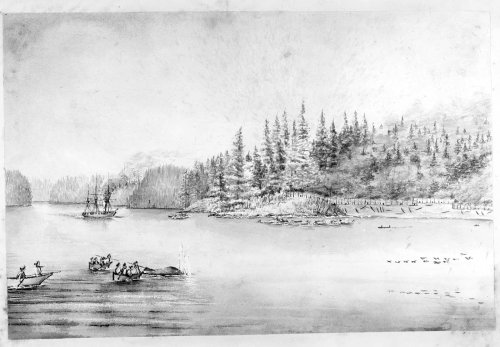
Webber in Nootka Sound, 1778

Detail of a Nootka Sound watercolour by John Webber, 1778. Click to enlarge. Source: British Museum.

From the British Museum, a superb watercolour:

Nootka Sound, on the Pacific coast of Vancouver Island in Canada, was discovered by Captain Cook in his two ships, Resolution and Discovery in 1778. This drawing records this bay and some of its inhabitants. It is drawn in ink, pencil and wash and watercolours. The artist, John Webber (1751-93), accompanied Captain Cook on his third voyage of exploration in the South Seas and Pacific Ocean, which lasted for four years from 1776 to 1780. Webber was one of several artists employed to record the peoples, animals birds, fishes, plants and landscapes of the newly discovered Pacific Islands.

The written descriptions of the location are confirmed by the drawing. It is severe and inhospitable. High cliffs, rocks that reach right down into the sea, and the jagged shore line gave it a ‘melancholy appearance’. The terrible weather, which left the trees ‘mutilated by rough gales’ contrasted greatly with the tropical scenes ans palm trees enjoyed by the explorers in Tahiti.

Webber also drew the native people. Their clothing, basically the same for men as for women, consisted of a woven cloth, fastened at the shoulder or neck. According to Captain Cook, the cloth was the bark of the pine tree, beaten flat like a sort of rough felt. The head was covered with a conical hat made of matting. It is probable that Webber modified the drawing for the sake of decency and for public viewing. Cook described the men’s dress as generally bare in the ‘… Middles, nor are they ashamed to appear naked’.

It’s not clear what the kneeling man on the right is doing: is he using a mussel shell to dig?  Several harpoons complete with foreshafts seem to be visible.  It is a skillful and atmospheric rendering of Nuu-chah-nulth life shortly after first contact with Europeans.


March ASBC Talk: GvonP on UP Art

UVIC's own, Langford's own, Genevieve von Petzinger. Source: Goldstream News-Gazette

I had the pleasure of serving on this month’s ASBC speaker’s graduate committee and I know if you are in the Victoria area you will be entertained and educated at this talk – which unfortunately I can’t make due to pre-existing public speaking commitments of my own.  Genevieve has recently been featured on the cover of New Scientist magazine and there has been something of a global storm of publicity stemming from her Master’s research.

ARCHAEOLOGICAL SOCIETY OF BRITISH COLUMBIA, VICTORIA CHAPTER

March 2010 Monthly Meeting: Tuesday, March 16, 2010, 7:30 pm

Pacific Forestry Centre, 506 West Burnside Road.

The talk is free and open to the public.

Genevieve von Petzinger

Making the Abstract Concrete: The Place of Geometric Signs in French Upper Paleolithic Cave Art.

In Paleolithic cave art, geometric signs tend to outnumber figurative images and yet, they remain relatively understudied. To address this gap in our knowledge, I compiled a digital catalogue of all known geometric signs found in parietal art in France, and then trended the results looking for patterns of continuity and change over time and space. I focused on parietal art, as I could be certain of its provenance, and picked France as my region due to its abundance of decorated sites and its natural boundaries of water and mountain ranges. The database is searchable by a variety of criteria such as sign category, method of production, date range, site type, geographical coordinates and region. It is now being converted into an online resource. To provide a visual dimension, it includes a selection of linked photographs and reproductions of the different signs. In this thesis, I detail the chronological and regional patterning in sign type and frequency and the implications of these patterns for understanding where, when and why the making of these signs was meaningful to the Pleistocene peoples who created them.

(editor’s note: you can download her thesis free of charge here)

Biography Having been interested in the cognitive evolution of modern humans since her undergraduate days at the University of Victoria, Genevieve von Petzinger was finally able to explore this in more depth at the Master’s level. Working with Dr April Nowell, again at the University of Victoria, she was able to pursue this interest, and received her MA in June 2009. Using the geometric signs of Upper Paleolithic rock art, Genevieve discovered some very interesting information about these early examples of symbolic behaviour, and presented her findings at the Paleoanthropology Society meeting in Chicago, Illinois in April 2009. This presentation was the catalyst for her research being featured as the Feb. 20th, 2010 cover story in New Scientist magazine. This exposure then led to a strong media follow-up, which included an interview on the Discovery Channel, a feature in the Tuttoscienze supplemental of La Stampa in Italy, an article in the Globe and Mail, and a full page feature in the Vancouver Sun, as well many other popular press articles and radio interviews in French and English, both nationally and internationally. While being slightly overwhelmed by all the attention, Genevieve has been very excited about the positive response, and is just thrilled that other people want to hear her talk about her favourite subject!

For information, phone 384-6059 or e-mail asbcvictoria@gmail.com

Media Links

http://www.newscientist.com/article/mg20527481.200-the-writing-on-the-cave-wall.html?full=true

http://www.timescolonist.com/news/UVic+researcher+taps+into+cave+language/2599510/story.html

Ucluelet, 1859

"Euclueliat village, Barclay Sound, Vancouver Island, N.W. Coast. H.M.S. Satellite" pen and ink and watercolor drawing 1859 Mar. Source: Yale. Click for original, click through for large size.

The above is a rendering of Ucluelet Inlet on the west coast of Vancouver Island, made in 1859.  You can clearly see the aboriginal village to the right. Artfully, the artist has caught a whale hunt at the exact moment of harpooning in the foreground.   I’ve zoomed in on the village below.

Detail of Ucluelet Inlet village.

Interestingly, the next picture in this folio from Yale University is labelled as a “Songhee” Village (below), yet rather than a Victoria area settlement, it fairly clearly shows what I think is another Ucluelet-area village, with the distinctive saddle-shaped hill to the east side of the inlet.  (The trees are different which makes me think it is a different one than above) Anyway, nothing earth-shaking but I had never seen these historic drawings before.

Songhee? Village. North West Coast Vancouver Island. Barclay Sound. H.M.S. Satellite." pen and ink and watercolor drawing 1859 Mar. Source: Yale. Click for original, then click through for large size.

A Saanich Peninsula short-faced bear

Post removed by request.

Continue reading

Reminder: RBCM Open House

If you are in Victoria, this is a reminder that the RBCM open house is today and tomorrow, at which they will explain about their “zoning application”, which I hope means they will also be ready to explain what they plan on doing with the rezoned land (I commented on this previously).  I see in today’s Times-Colonist they lost $491,000 last year, and are projecting no travelling shows until 2012, except the Terracotta Army.  That and the British Museum exhibit each cost about 3 million dollars to mount, as an off-the-shelf travelling exhibit here for a few months.  How much permanent exhibit could one buy for $3,00,000, which would pay for itself every day of the year?  I know they have been forced into a particular niche by funding constraints and all – but it seems to me they are in a financial and existential crisis.  Therefore I hope they are sincere about gathering meaningful public input because I suspect regular readers of this blog have a lot to say about it.

When:  March 6 & 7 2010
Where:  Royal BC Museum
675 Belleville Street
Newcombe Conference Hall

What to Expect: Open House hours between Noon – 3:00 pm.  Zoning project team members will be on-site to answer any questions, and/or have a conversation with you about zoning the Royal BC Museum site.

dSpace: Adams on Gabriola Petroglyphs

Gabriola Petroglyph Design Elements. Source: Adams 2003.

One recent M.A. thesis I was really looking forward to reading is by Amanda Adams entitled Visions cast on stone : a stylistic analysis of the petroglyphs of Gabriola Island, B.C., from UBC Anthropology 2003, and available for free download here.

I was particularly interested to read the instructions she received on proper deportment when visiting the rock art:

Sites were visited in a manner and with a personal code of conduct adhering to Snuneymuxw wishes. Petroglyph sites were not visited at either dawn or dusk. A respectful demeanor was expected as was an “open heart and mind” (Bill Seward, Snuneymuxw elder, personal communication 2002). I was asked to give my full attention to the petroglyphs and their sacredness, not allowing daily distractions to interfere with my concentration on the ancient imagery. These expectations were met to the best of my ability. (18-19)

While many archaeologists are under the impression that there is little to no ethnographic information about petroglyphs, I have long felt that more likely such knowledge is private or highly privileged and not readily shareable.  In this self-serving sense, it was gratifying to see that Adams was able to record some such information:

Snuneymuxw Elder, Bill Seward, asserts that many petroglyphs were made by shamans, hunters and vision seekers (personal communication 2002) while Elder Ellen White maintains that the carvings were places where people both sought and gained power. She explained that “men would be stripped – even in cold weather and laid on top of each petroglyph – learning the spirit world, connecting to the area.” She also noted that the pitted ‘dots’ surrounding several of the carvings were “points of access”, places where one could dip their fingers into pools of “energy” and reservoirs of strength (Archaeology Forum group tour 2002).  (p 13)

Another welcome aspect of Adams’ thesis is her direct comparison to portable art.  Continue reading

Cliff Painting by Marianne Nicolson

Marianne Nicolson is a member of the Dzawada’enuxw Tribe of the Kwakwaka’wakw First Nations.  She is an internationally-known contemporary artist, and a Ph.D. candidate in the Departments of Linguistics and Anthropology at the University of Victoria.  Her work is outstanding and profound and if you get a chance to see her studio pieces, then by all means do so.

One work you will not be seeing in a gallery anytime soon is her massive pictograph, Cliff Painting, near the head of Kingcome Inlet in her traditional territory (map).  The work is over 15 metres high by 10 metres wide, emblazoned on a prominent cliff as you round the final corner heading into Kingcome (video, scroll down).  It formed the focal point of the book by Judith Williams Two Wolves at the Dawn of Time, which is highly recommended.  Painted using scaffolds lowered from above the cliff, the work is a profound statement of power and energy.  The image is of a “copper“, a large shield-shaped symbol of chiefly power, family prestige and spiritual inheritance, among many more nuanced meanings.  Many pictographs on the coast are fading away, rinsed by sun and rain, vandalized even.  This massive pictograph takes a stance for all the past, present, and future powers of the Kwakwaka’wakw First Nation.

Cliff Painting in Progress. Source: The Medicine Project.

Major expansion at the Royal B.C. Museum?

Proposed changes to the RBCM: the clear white structure to the back left is the new curatorial tower & archives; to the right is a new entrance and multi-functional area. Source: Times-Colonist.

The Victoria Times-Colonist had a story Saturday that the Royal B.C. Museum is proposing a major expansion, in which theirs quare footage would more than double, from 379,000 to 895,000 square feet.  The curatorial tower and the low-rise archives building on the NW side of the block would be demolished, replaced by a new multi-function complex which would also form the entrance to the museum.  The collections and curatorial facilities, and the archives, would move to a new 14 story building to the south of the current museum.  The RBCM C.E.O, Pauline Rafferty (an archaeologist by training) notes that ““We are now at a crossroads.  We have outgrown our on-site storage facilities and significant artifacts are stored below sea level.”  The article estimates the cost will be in the hundreds of millions of dollars which is easy to believe. The Times-Colonist weighs in with a strong editorial of support, citing the collapse of the Cologne archives last year with irreparable damage to the history of that City.  So: no-brainer, right?

Continue reading

ASBC Talk: Tuesday, February 16th

Surveyors in the Uplands development, Victoria, using a burial cairn as a surveying aid. Source; BC Archives.

ARCHAEOLOGICAL SOCIETY OF BRITISH COLUMBIA, VICTORIA, February 2010 MEETING

Feb. 16, 2010, 7:30 pm

Pacific Forestry Centre, 506 West Burnside Road, Victoria, B.C.

Darcy Mathews

The Powerful Dead: The Rocky Point Cemetery and Straits Salish Identity.

Burial cairns and mounds are two types of pre-contact burial features in the Strait of Georgia region of south-western British Columbia. More than a millennium ago, the Straits Salish people, an ethno-linguistic group centered on present day Victoria, constructed a cairn cemetery at the Rocky Point site. Located 18 km southwest of present-day Victoria, this cemetery has over 300 cairns which occur in a variety of patterned shapes and sizes. Analysis of cairn construction and the use of space within this cemetery suggests that there was a strategic use of both material culture and landscape in Salish mortuary ritual, simultaneously expressing individual, household and perhaps even village-wide group identity. Underlying these statements of identity is the material expression of relationships between the living and the powerful dead, which were carefully navigated through the process of the funerary ritual, of which building cairns and mounds was but one part of a long-term process; a process that may have an antiquity of several thousand years. Biography Darcy Mathews is a PhD candidate at the University of Victoria. Working with the Scia’New First Nation, his ongoing dissertation research focuses on the identification, preservation, and study of pre-contact burial cairn and mound cemeteries in the Strait of Georgia.

For information, phone 384-6059 or e-mail asbcvictoria@gmail.com

“Correct Map of the Gold Diggings”: May 20th, 1858

Detail of 1858 Map of Fraser Gold Diggings. Click for full image.

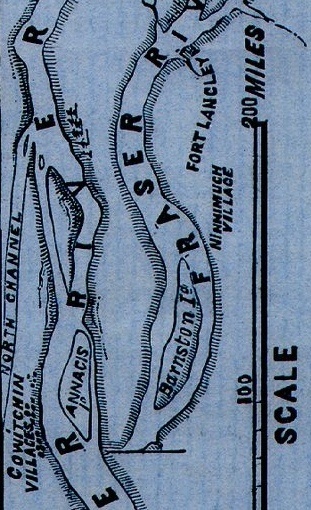
From UBC, this interesting 1858 San Francisco broadsheet “The Pictorial Newsletter of California” (large JPG file).  Most of the text is mundane births and deaths, but the map above from it is a lot of fun.  It’s especially interesting to see the “Cowitchin” Village at New Westminster.  Now, “Cowitchin” was often used as a generic term for many Coast Salish people in the early historic period.  But note too, just upriver at Fort Langley, a “Ninnimuch” Village, presumably Snuneymuxw First Nation, also known historically as the “Nanaimo” people, whose core territory would be on east Central Vancouver Island.  There are lots of reports of Vancouver Island nations paddling up and down past Fort Langley so its not that much of a surprise, but rather a nice testament to the extensive regional trade and, perhaps, permeable social networks in place across the greater Gulf of Georgia. It also makes me think the “Cowitchin Village” might indeed really be Cowichan. It’s notable the “Pinkslitsa River” (Harrison River) is the only lower tributary mapped, probably because it was an important route in and out of the middle Fraser, bypassing the canyon.  It’s a nice map, it’s early, and I’d never seen it before, so thanks to UBC and their Early BC Newspapers page.

Detail of 1858 map showing "Cowitchin" and "Ninnimuch" Villages on Lower Fraser.

From the UBC notes:  Pictorial News Letter of California: for the Steamer John L. Stephens San Francisco: Hutchings & Rosenfield; Charles F. Robbins, Printer, 1858

“Issued exactly one month after the first steamer left San Francisco headed for the Fraser (Bancroft p. 359), this appears to be the first separate publication relating to the Fraser River Gold Rush, and the first map published to illustrate the area for potential gold-seekers.”

You can also download a short PowerPoint file here, and there is an overview essay here.