Category Archives: pics

Fieldwork Picture of the Day 7

Excavations at Collison Bay, 2006

Excavations at Collison Bay, 2006

This is another intertidal dig – the Collison Bay site, which shares a lot of similarities with Kilgii Gwaay.  Both sites date to about 9450 C14 years ago and contain buried deposits in primary context below the modern beach.  While Kilgii Gwaay contains a rich organic assemblage, Collison Bay does not, though there is evidence for a brown palaeosol at varyiong depths.  In and around that palaeosol are numerous pristine lithics: stones tools and flakes that are sharp and clearly have not een rolled on a beach.  One of the striking things about these two sites is they show how a major event like a marine transgression can nonetheless leave intact cultural deposits.  We suspect that much of this has to do with the local topography.  Ideally, a bedrock rock rim allows for a small lagoon to form, creating an interlude of very low wave energy between when sea level rises over the site and when the full weight of waves can start to act on the surrounding shore.  By the time the waves are able to penetrate, the archaeological materials are already several metres below low tide which affords quite a lot of protection.

As with Kilgii Gwaay, working in the intertidal zone poses certain challenges, such as having only a six hour window to work.  In the case of Collison Bay, we compounded the issue by timing the project for when the best tides were in the middle of the night, which meant getting up at midnight and working to dawn in some cases (though we did have some good daytime digging as well).  In this picture you can see we are using electric lights run off a generator while Cynthia does the hard work down on the beach; this is probably around 2.00 in the morning.
Fieldwork Picture of the Day 6

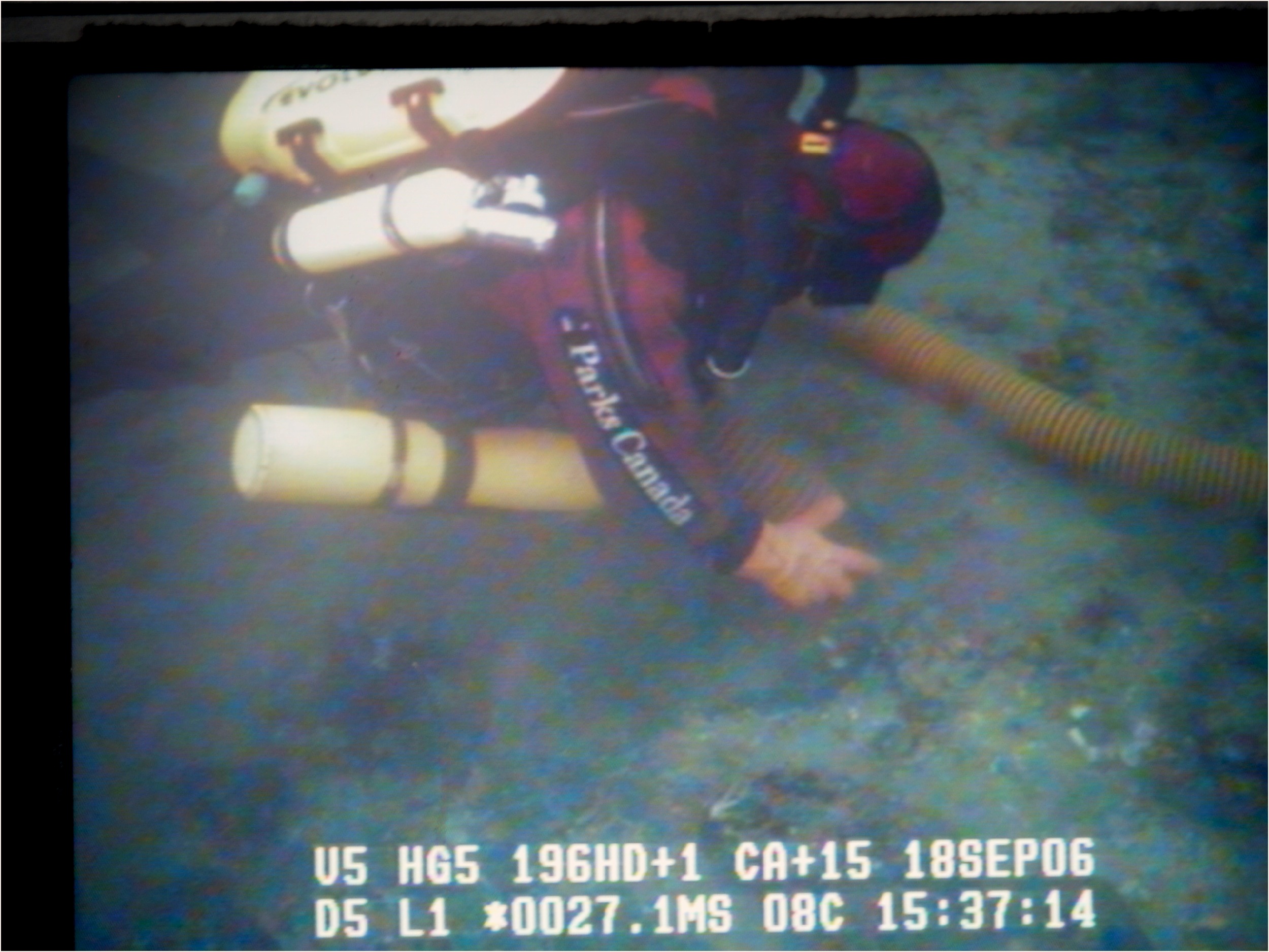
Parks Canada Underwater Archaeologist at Section Cove, 2006

Parks Canada Underwater Archaeologist at Section Cove, 2006

Parks Canada has a great underwater archaeology unit.  They have been coming out to dive on targets we’ve identified on the drowned terrestrial landscape of Haida Gwaii.  This picture shows an archaeologist with a suction hose on the bottom near (though, sadly, not on) the target we identified at the outlet of the lake that formerly sat in Section Cove, near Huxley Island. This target is at about 33 metres below the surface, while the diver here is at about 27 metres down, so on a small bump above ancient landform of interest – not a place with zero potential, but not a huge amount either, we don’t think. The hose sucked out the bottom sediments into a mesh bag which could then be lifted by crane onboard the mother ship, and screened on deck.  Therefore, it was not really a lift hose, but the system worked pretty well though as I say, it was not applied to the precise location of the high potential.  In future years once this dive team perfects their procedures for working in this difficult location and at challenging depths we hope to find some very cool archaeological stuff dating to the terminal Pleistocene / end of the last ice age.

High Resolution Pictures from the Smithsonian

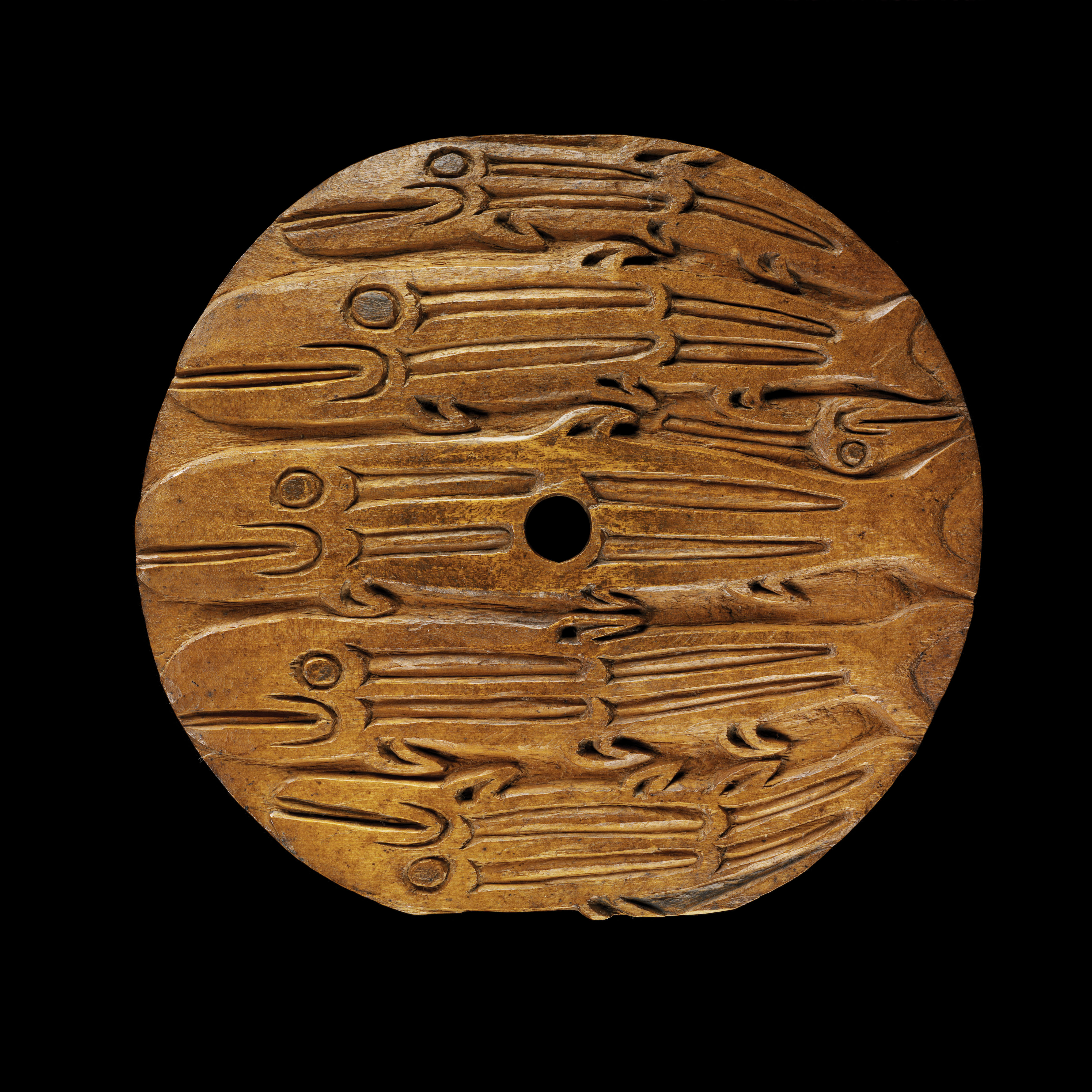
Cowichan Spindle Whorl, ©National Museum of the American Indian, Smithsonian Institution (15/8959)

Cowichan Spindle Whorl, ©National Museum of the American Indian, Smithsonian Institution (15/8959)

These seem to be squirreled away on the website in the “media releases” section at the Smithsonian! It is well worth getting the high-resolution images.  There is one solid, NWC art page here (from where the lovely Cowichan spindle whorl to the left is from)  but additionally here are high resolution pictures of:

an Alutiiq (Koniag) hunter’s hat, ca. 1950  Kodiak Island, Alaska (Spruce root, paint, glass beads, dentalium shells, wool cloth, sea lion whiskers National Museum of the American Indian, Smithsonian Institution Image: 6/9253)

Quinalt woman’s dentalia breastplate ca. 1880 Washington state (Hide, dentalium shells, glass beads, cordage National Museum of the American Indian, Smithsonian Institution Image: 2/7703)

Tlingit Rattle, ca. 1880 Alaska  (Alder or maple wood, hide National Museum of the American Indian, Smithsonian Institution Image: 8/1650AQ)

Raven Steals the Sun (in blown glass! by Preston Singletary (Tlingit) Seattle, Washington, 2003)

Continue reading

Chilliwack Museum and Archives

Chilliwack Museum Accession number 1957.019.084

Chilliwack Museum Accession number 1957.019.084

The Chilliwack Museum (map) has a large, searchable collection of photos online, which they ruin with a huge watermark in the middle.  Seriously, guys, these are ancient artifacts that you are lucky to be curating.  And, your pictures aren’t very good in the first place – many out of focus, or with extensive shadowing.  In any case, for archaeologists, you can click for artifacts made of, or records containing the word,   “stone” (they have a huge number of celts, mauls and abrader stones, as you might imagine since the Fraser Valley is known for these, perhaps because of extensive plowing of former woodlands).  Oddly they don’t seem to have any aboriginal artifacts made of bone, shell, or antler.  Search term “Sto:lo” returns one empty field.  Further they make it almost impossible to link to a specific record or picture. I am putting in a picture I downloaded from their site of an unusual artifact – a ground stone point with a very unusual morphology and material.  They list it made out of serpentine, but from what I can tell, it shows signs of being readily worked, and so may be a softer verson of serpentine, perhaps soapstone.  The shape is like a bronze age arrowhead or something — highly unusual.   Too bad there isn’t a better picture available.  So, all in all, Chilliwack Museum people: you put a lot of time and energy into a resource that is not particularly useful nor does it readily promote the heritage of the Fraser Valley.  I suggest you rework your URL system, remove the watermarks, and update your keywords by adding Sto:lo to appropriate records.  Double-check your raw material “horn” as well.  You have a fantastic collection, share it!

Fieldwork Picture of the Day 5

Submersible at Section Cove

Submersible at Section Cove

A few years back I fulfilled a lifetime ambition by going down in a submersible.  This shows the Nuytten craft “Aquarius” on the surface in front of the warden’s cabin on SW Huxley Island in Gwaii Haanas (map).  We tried diving onto the ancient lake that now lies drowned at 33 metres below sea level,  more or less in front of the cabin.  This lake would have been last exposed to air about 10,000 14C years ago.  We started at about 110 metres down and then worked our way up a palaeo-river channel towards the lake, but unfortunately got off course and ended up a lot closer to the beach than we had anticipated.  These things are flown by a pilot, but the basic navigation is by transponders on the bow and stern of the mother ship which allow triangulation from a known point.  Apparently, not foolproof!  The lake we were diving onto shows huge potential for an archaeological site.  We are thinking there may have been a base camp for bear hunting at Gaadu Din 1 or 2, which are less than a kilometre away.   Possibly, too, there was a sockeye salmon fishing camp here, since the nearby caves contain numerous salmon bones from the late Pleistocene.  Anyway, it was pretty cool to go down in the submersible!

West Vancouver Archives

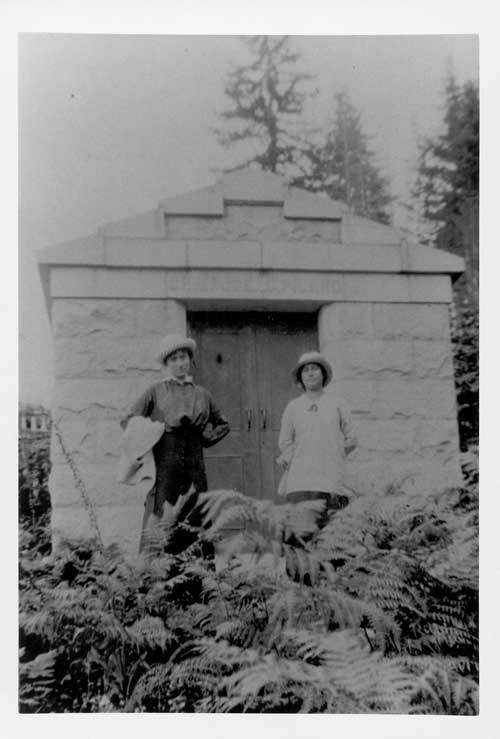
Tomb of Chief Joe Capilano ca. 1917

Visitors to the Tomb of Chief Joe Capilano ca. 1917

Stumbling on the Vancouver Public Library’s photo site the other day got me poking around smaller museums and archives for archaeology and First Nations related stuff.  It turns out there’s a lot out there.  First up is this picture I found at the West Vancouver Museum and Archives.  They have a searchable collection, within which a fair number of digitized historic photos.  A fair amount of stuff is under “First Nations” and “Indian”.  To the left is a remarkable picture of Chief Joe Capilano’s tomb (map).  It’s quite a slab, house-shaped (though not a shed roof house!), but surely it is as close to a mortuary house as it is to traditional Christian mausoleum.     Joe Capilano was a leader of the Sḵwxwú7mesh (Squamish) nation, to whom he was known as Sa7plek.

Sa7plek: Chief Joe Capilano

Sa7plek: Chief Joe Capilano

Apparently, he recieved the title of ‘Chief”  (via recieving the name Kiyapalanexw (Capilano), in order to facilitate his trip to Ottawa and to London, to meet King Edward VII.   The name bestowal was in the belief that he would need a title in order to speak “Chief-to-Chief” with the Prime Minister and the King, or so says wikipedia.  These smaller archives have fairly idisoyncratic interfaces and often the context given is poor.  Nonetheless, I will occasionally, or even frequently, post pictures or other material from them.

Vancouver Public Library Archives

beach-grove-dig

"Archaeologists at Beach Grove, 1962"

The Vancouver Public Library has a nice collection of historical photos online, though the resolution is not great.  Interestingly, there are a number of historical archaeology pictures I had never seen before.   I’m sure someone knows these faces, presumably they include Duff and Borden?  Another picture from Beach Grove (map) shows someone sitting at an ASAB desk (Archaeological Sites Advisory Board).  When surveying at the Milliken Site in about 1986 I remember finding an old desk that was presumably Borden’s – reputedly he had a desk at his digs.  Also, there was a bookshelf out there, in the middle of the woods above the tracks.  The VPL site also has a few pictures of the Eburne (Marpole) midden, including this disturbing closeup one of the human remains visible in the link above.

You can go here and enter the search term “archaeol*”

Fieldwork Picture of the Day 3

Profiling the south wall of the Richardson Island site 2002

Profiling the south wall of the Richardson Island site 2002

The Richardson Island site (map) is a deeply stratified raised beach site.  In this picture, Duncan’s feet are at about 9300 14C years ago, while the top of the gulch is about 8400 14C years ago.  The horizontal 2 X 4 more or less demarcates the lower “Kinggi Complex” from the “Early Moresby Tradition” – the latter being marked by the introduction of bifacial technology to the stone toolkit, but also characterized by continuity between the two in many other regards.  There are some 20 major depositional units in that span, and more than 100 separable layers.  We think the site formation process is of a supra-tidal marine berm which was “pushed uphill” during a period of rising sea level — people lived on top of this berm but would periodically come to the site and find a fresh dump of finely-sorted pea gravels.   Although high-energy, the berm formation was also surprisingly gentle, allowing for numerous features such as hearths and post-moulds to preserve, not to mention pristine flakes which, in some cases could be refit one to another.  The thick reddish band just above Duncan’s head is a major berm deposit which was dumped as a single event, or several shortly-spaced events, around 9200 14C years ago.   Digging this site was a challenge – some of the layers were concreted together like iron and required some chiseling, and colour differences between some layers were often very slight.  Indeed, it became a full body experience as the texture and looseness of the gravels was very important, and on occasion, it was noted that some layers smelled differently than others.

Fieldwork Picture of the Day 2

Daryl watching the tide flow at Kilgii Gwaay.

Daryl watching the tide flow at Kilgii Gwaay.

Another fieldwork picture form the archives. This shows Daryl watching the tide come into our units at Kilgii Gwaay (map) – this is Operation 8a and 8b, if I recall, from 2001.  At first we tried to completely dig out a unit during a single tide window but this was quite rushed, and limiting.  So we tried lining the units with bubblewrap and then just before the tide reached them we would pump them full of water (hose into a bucket in the bottom of the unit) to provide outwards pressure on the sidewalls and to prevent erosion of the unit edge.  This actually worked really well: for the most part the units survived the tidal change and could be pumped out with no trouble.

Fieldwork Picture of the Day

Duncan with his feet in a 12,000 year old bog

Duncan with his feet in a 12,000 year old bog

While doing the Anthro 449 site, I’m finding a lot of pictures I haven’t seen lately, so I might as well post some of them here.  This one shows Duncan digging at Kilgii Gwaay (map) in 2002.  This was an unusual project, working in the intertidal zone between tidal windows — so about 6 hours per day of frenzied activity (read: poor napping) until the unit flooded again.  In this instance, the unit was 4 foot by 4 foot to accomodate the dimensions of plywood shoring.  There wasn’t a lot down in this unit, at least not archaeologically, but we do have a huge sample of woody bits from the organic deposits at the bottom.  In essence, the unit was placed on the edge of an ancient pond that formed post-glacially and  then lived a quiet life in the anonymous southern forests of Haida Gwaii – only to be rudely interrupted around 9450 14C years ago by rising sea levels, which made it attractive for a brief window of human occupation.  So – from a small pond in the forest, to a busy camp site, to a beach, all in a span of about 50 years.  And now, with falling sea levels, back to a beach.  The archaeological site is eroding somewhat, but nonetheless there are patches of intact shell midden and as it shows here, a large amount of terrestrial freshwater-saturated pond splooges under this beach.