Category Archives: pics

New Westminster, 1903

Aboriginal women at New Westminster, 1903.

There is something about the above picture that is so evocative: Native women washing clothes or getting water while in the background the first construction of the Fraser River Bridge at New Westminster rises.  With a different caption this could be the Ganges River, or the Colorado: always women, always squatting, always the back turned to the viewer and the colonial future in the background.

From the idiosyncratic New Westminster online photo archives – this uses the LoC system so you have to search for, say, “Indians” rather than “First Nations”.

New Westminster, ca. 1865

Tattrowel

Inkulkation.

I hereby challenge rockwash to go out and get one of these trowel tattoos.  Or be like Brad and get the coveted Ötzi tattoo.  Or check here for more science tattoo inspiration.  (Ötzi really did have tattoos, BTW).

Icey Dead People.


Pitt Rivers Museum Haida Collection on flickr.com

Any idea what activity is being represented on this Haida argillite carving?

The Pitt Rivers Museum in Oxford is one of the world’s great ethnological museums.  Indeed, it is largely presented as a “museum of a museum”, with artifacts and curios displayed in glass cases in juxtapositions that made sense to anthropologists.  Now I see they are putting some of their collection online – one of many interesting innovations going on at that museum.  The Haida Collection which Cara Krmpotich has worked on consists of 200 really well composed and lit photos on the flickr.com website.  Cara notes that she hopes making this material available in this manner will facilitate its use by Haida people and I expect they will (indeed one person with a Haida name has been commenting on some of the photos).  Coincidentally, I see there has recently been a Haida delegation to the Pitt-Rivers museum.

In any case, the flickr set is a fantastic set of images of Haida art and technology. It would be nice to have the full catalogue information or other information associated with these, or at least a statement that such information is lacking.  While there are visually spectacular items throughout the set, also check these plain spoons from SGang’gwaay, Tanu’uu and Masset,  this bird bone whistle, and this tidy little loop of twine.

Haida wooden labret at Pitt Rivers museum.

The Brooklyn Museum Collection

Tsimshian Skull "Helmet".  Click for higher resolution.

Tsimshian Skull "Helmet". Click for higher resolution.

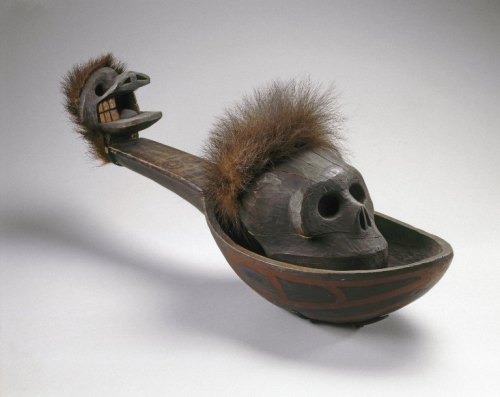
Of all places, the Brooklyn Museum has amassed an impressive suite of NW Coast artifacts and art.  Their online catalogue is mainly lodged under the  “research” and “collections” tabs.  One interesting thing about this collection is that any viewer can ‘tag‘ a picture, building up a folk taxonomy that cross-cuts more traditional museum categories.  This has its advantages of course (e.g., items which are tagged “beards“, or “scary“), but also raises questions about just how comprehensive is any set of results?  And how accurate – this rattle is tagged Tsimshian despite being collected in Bella Bella (Heiltsuk territory).  Still, with a grain of salt it is an idea definitely worth pursuing.  You can also click around on their “visible storage” map.  The images are decent resolution and combined with the tag-surfing possibilities this is a fun and informative site.

Heiltsuk Ladle with Skull. Click for larger resolution.

Heiltsuk Ladle with Skull. Click for larger resolution.

Fieldwork Picture of the Day 9

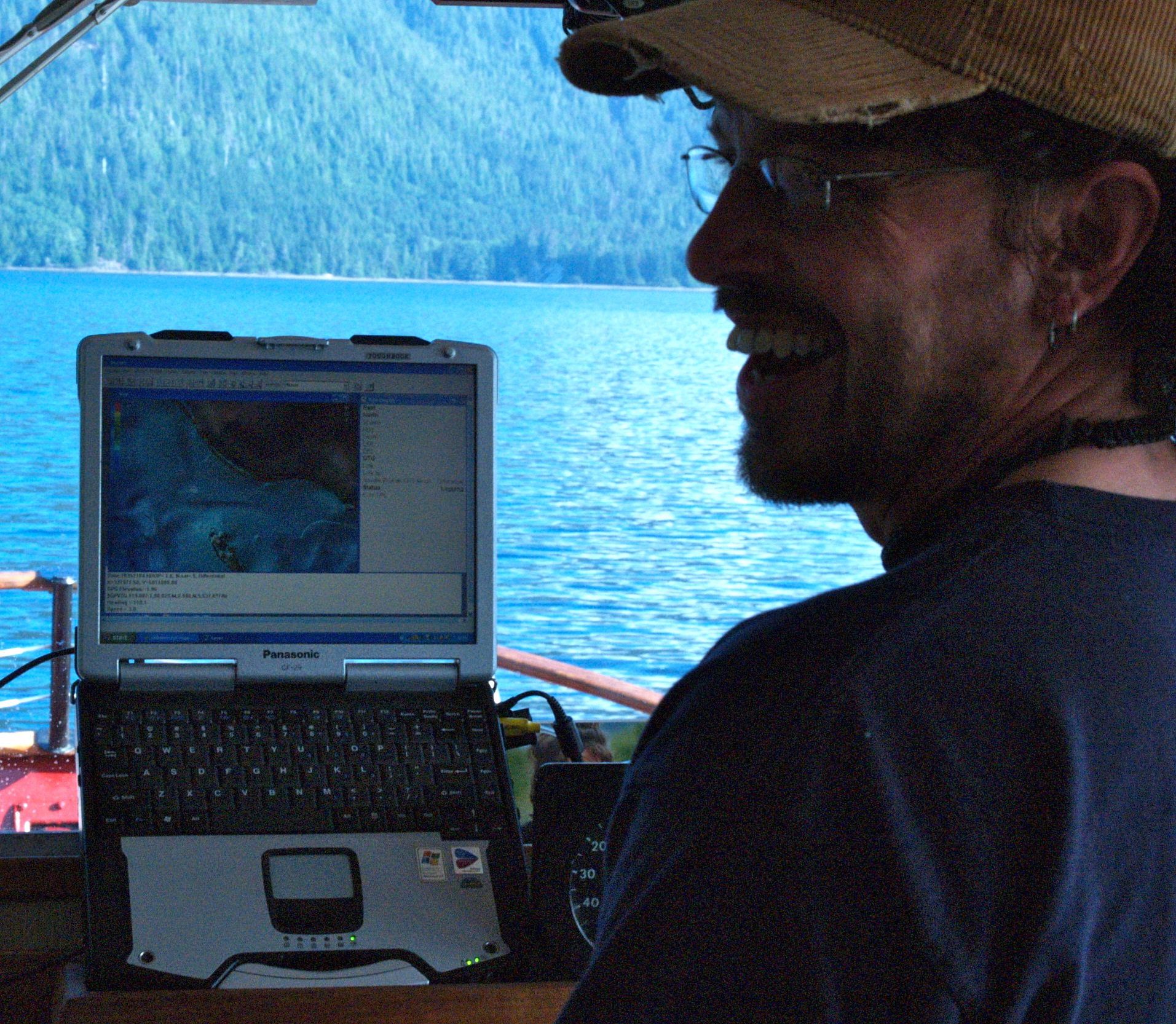
Danny at the helm,  aaaargh Billy.

Danny at the helm, aaaargh Billy.

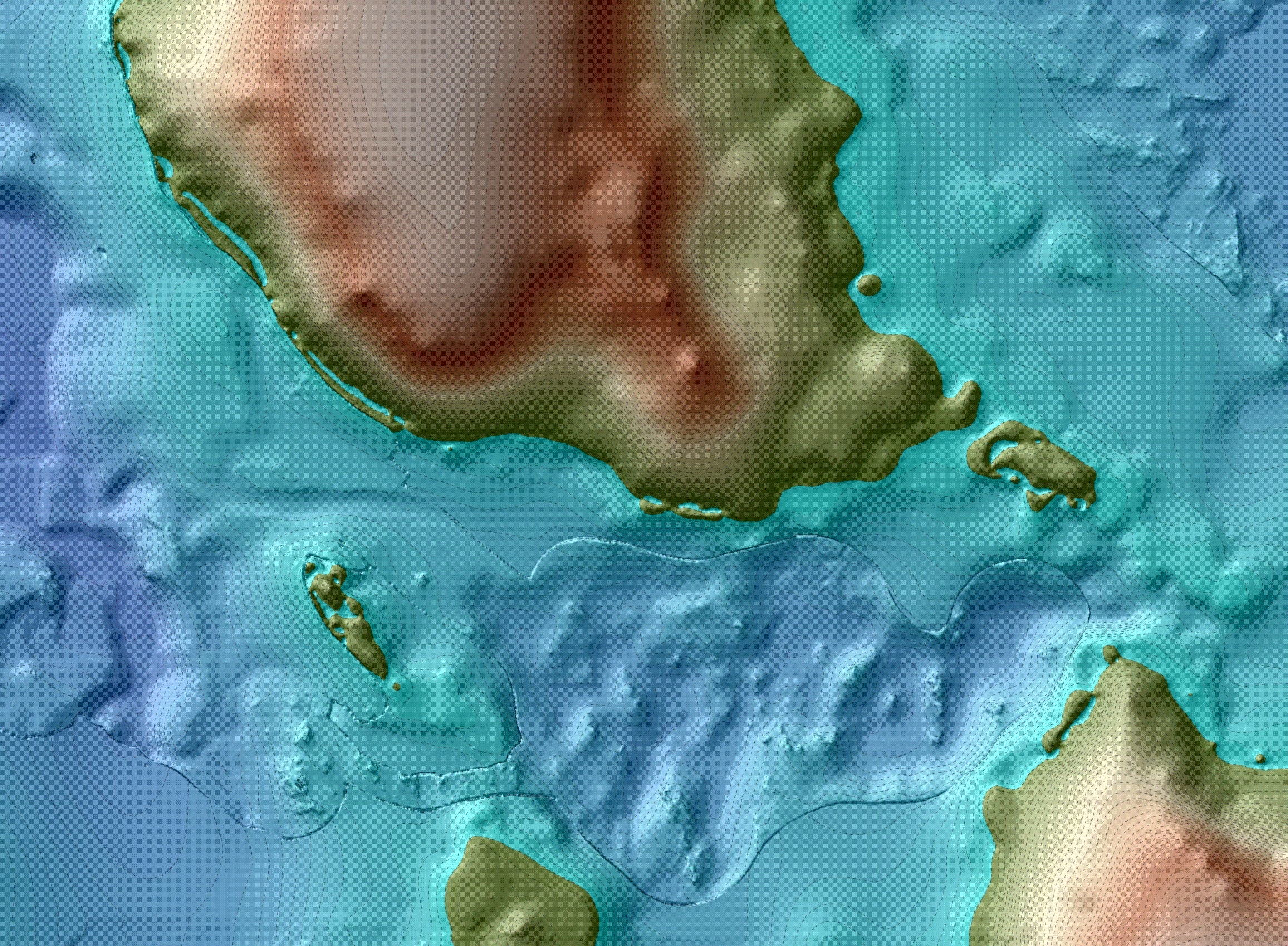
Underwater research at Section Cove, near Gaadu Din. I posted a picture earlier of a diver on the bottom.  Here is a view from topside — Danny, boat skipper, wise-ass and all round rock solid good guy — has a GPS-linked laptop in front of him which is displaying the bathymetry of Section Cove.  (see the image on Danny’s screen here, courtesy of Daryl).  This enables him to tow the sonar fish exactly where required, or, on this occasion, help position a small dredging bucket for bottom sampling purposes.  With differential GPS, you can position the ship to within less than a metre of where you want it, relative to the bottom.  This means measuring the distance between the GPS antenna and the crane and building in an offset, which is trickier than it sounds. The bathymetry is also sub-metre in resolution.  Thus, we can target the bucket exactly where we want it — of course strong currents and bucket flutter can still move it around some.  It has been slow progress on this work but all the pieces are in place for what could be an exciting breakthrough –  a base camp on a small lake, now drowned, dating to sometime older than 11,500 solar years ago would be most welcome considering most of our other sites of this age are rather one-dimensional.

The purpose of the camp could be base camp for bear hunting in the nearby Gaadu Din caves, or more likely sockeye fishing in the lake-stream system that used to flow along the terrain here, under Danny’s  keel.

The lake, the salmon, the cave, the creek.  Green tones are now underwater.

The lake, the salmon, the cave, the creek. Green tones are now underwater. Image prepared by Daryl.

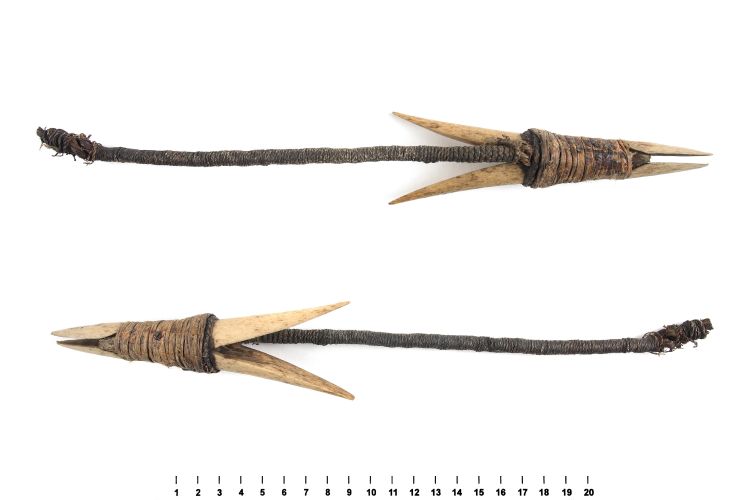
Harpoon Head from the Hunterian

I have to say, I disagree with your description.  Based on size alone, at 14 cm this is much too large to have been for salmon fishing.  Stylistically, fish harpoons tend not to have a blade bed, but rather some kind of cylinder formed by the two valves.  Flat beds such as this one are more consistent with large arming points made of ground slate or ground mussel shell.  If intended for a fish, this would be more suitable for Fraser River sturgeon, say.
But I doubt it.  I’d suggest in size and manufacture this is much more consistent with a sea mammal harpoon head.  I don’t recall seeing any of this size in Coast Salish archaeological sites.  If your provenance traces to Laskey and thus to Cook, I’d suggest it is much more likely to be from the Nuu-chah-nulth (Nootka) area of western Vancouver Island, where Cook occupied himself much of the time he spent on the NW Coast proper, and with which it is stylistically consistent.  Indeed, even without provenance that is where I would assign it.  And I would suggest in size and manufacture it is more likely to be a large sea mammal – probably whale – harpoon head of a kind we describe out here as “Composite Toggling Harpoons”, composed of two valves forming the barbs with an allowance (usually) for an inset arming point.  Something like a sea lion harpoon I would expect to be about 2/3 of this size.   Further, Cook never really had much interaction with Coast Salish groups.
Normally too I would expect the valves on one of this size to be made of antler or of wood (yew, or Douglas fir) and not bone so that is an interesting difference.
Anyway, all this is by way of saying, it appears the lanyard extends up one side, then crosses through the notch (blade bed) to the other side where it fastens.  I’d be interested in knowing if this is the case since it would be an interesting functional design aspect encouraging the harpoon head to toggle when pressure is put on the lanyard.  If you had higher resolution pictures I would love to see them.
Composite Toggling Harpoon with lanyard.

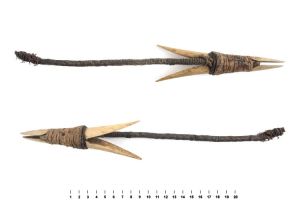
Composite Toggling Harpoon with lanyard.

This item from the Hunterian Museum in Glasgow traces its provenance provisionally to Captain Cook:

This harpoon head has one large split point, with a curved split socket with pointed tips. It has twisted sinew lashing around the middle and a line of vegetable fibre attached. This type of harpoon would have been used to catch salmon and is stylistically attributable to the Salish people of the North West Coast of America. The harpoon was originally accessioned as donated by Dr. G. Turner, however there are no items from the North West Coast on the 1860 donation list. It may be one of the hooks mentioned by Captain John Laskey in his 1813 account of the museum, in which case it may have been collected on one of the three Pacific voyages of Captain James Cook.

I have to say, I disagree with the description. Based on size alone, at 14 cm for the head, this is much too large to have been for salmon fishing. Stylistically, fish harpoons tend not to have a blade bed, but rather some kind of groove formed by the two valves which supports a cylindrical bone point.  Flat beds such as this one are more consistent with large arming points made of ground slate or ground mussel shell. If intended for a fish, this would be more suitable for Fraser River sturgeon, say.

But I doubt it. I’d suggest in size and manufacture this is much more consistent with a sea mammal harpoon head. I don’t recall seeing any of this size in Coast Salish archaeological sites. If the provenance traces to Laskey and thus to Cook, I’d suggest it is much more likely to be from the Nuu-chah-nulth (Nootka) area of western Vancouver Island, where Cook occupied himself much of the time he spent on the NW Coast proper, and with which it is stylistically consistent. Indeed, even without provenance that is where I would assign it.

And I would suggest in size and manufacture it is more likely to be a large sea mammal – probably whale – harpoon head of a kind we describe out here as “Composite Toggling Harpoons”, composed of two valves forming the barbs with an allowance (usually) for an inset arming point. Something like a sea lion harpoon I would expect to be about 2/3 of this size. Further, Cook never really had much interaction with Coast Salish groups.  These harpoons work by an analogous process to the toggles on a duffel coat: insert the toogle narrow-ways, then it turns side-ways and won’t pull through the loop.  For toggle, read “vicious harpoon” and for loop, read “flesh”.  Because most maritime hunting and fishing technologies require immobilization of the prey and retrieval, the technology tends to quite a bit more complex and intricate and well-engineered than terrestrial hunting technology which is more single purpose (kill!).  The composite harpoons are a great example of this.

Normally too I would expect the valves on one of this size to be made of antler or of wood (yew, or Douglas fir) and not land mammal bone so if these valves are land mammal that is an interesting difference.

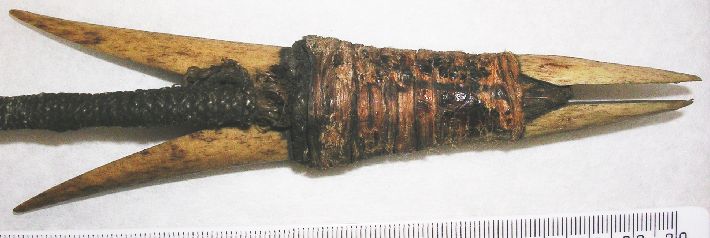
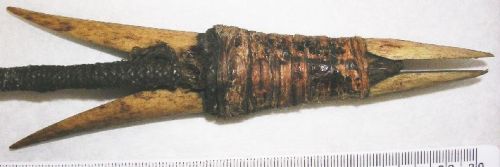
Anyway, all this is by way of saying, it appears the lanyard extends up one side, then crosses through the notch (blade bed) to the other side where it fastens. This would be an interesting functional design aspect encouraging the harpoon head to toggle when tension  is put on the lanyard.  (I emailed the Hunterian to see what they think)
What is that organic matter between the valves? The lanyard?

What is that organic matter between the valves? The lanyard?

University of Washington Digital Collections

Makah codfish spear (or, more accurately, harpoon)

Makah codfish spear (or, more accurately, harpoon)

The University of Washington has a superb digital collection online, transcending all kinds of different historical, archaeological and popular culture niches.  Searching on “artifact” brings up some 583 images (some of which are links to text etc).  These are downloadable and have stable URLs to which one can link. The resolution could be higher, but the pictures are sharp and clean, at least for those ones they have apparently taken themselves, and they don’t plaster watermarks all over them.  Good work.  The amount of metadata is impressive, and the fact that is is clickable renders this site a fantabulous timewaster of the highest order.  To the left, I was just having a discussion with a student about harpooning fish.  I am under the impression that harpoons were used on large lingcod – after the lingcod were lured to the surface using a cunning little shuttlecock-shaped rising float.  This picture is labelled “Makah codfish spear” though it is self-evidently a harpoon and lanyard.  More (vindication) coming from this excellent site as time goes by.

Fieldwork Picture of the Day 8

black bog abbey road

John, Walrus, George and the Sandhill Crane

In which we do our best impression of the Beatles Abbey Road cover on Porcher Island (map).  Lining up like this was necessary because the surface of this bog was so mucky we had to dismantle an old grow-op to make a trail across the surface (yes, we then dismantled our trail).  This bog is a few metres  above sea level, but quite quickly down in the core sample there was a clear break to marine sediments, showing sea level had once been higher than today and then dropped to or past modern.  Carbon dating a piece of sediment from the interface showed sea level had fallen past this point by  10,000 years ago.

Terrestrial (left) overlay marine (right) sediments.

Terrestrial (left) overlay marine (right) sediments.

The picture to the right shows the core sample, with the clear distinction made between the brown, terrestrial, pond deposits to the left (upper) side of the core) while in the right (lower, older) part of the core you can see the sediments turn to a greenish marine clay, which contained small shell fragments and salt-water diatoms.  Taking a number of these core samples from different elevations (and therefore of preumptively different dates of sea level change) allows us to stitch together a curve or graph of sea-level history.  Using this curve, we can then identify ancient coastlines (both underwater and above high tide) with greater certainty and accuracy, allowing for more efficient and productive archaeological survey on these ancient landforms.  On the map linked above, you can see the long linear lakes and ponds paralleling the modern shoreline.  These lakes highlight the former  eastern shores of  Oval Bay at higher sea levels.

Dan Leen’s Petroglyph Page

Heiltsuk Petroglyphs including 2-headed Salmon Spirit

Heiltsuk Petroglyphs including 2-headed "Salmon Spirit"

I was just looking for a picture of a labret and instead found that Dan Leen has a nice page on NW petroglyphs, with lots of superb pictures and action shots of him recording rock art.  I haven’t seen Dan for quite a while, but we spent 10 weeks together on his 30 foot Trimaran “Teredo n.” back in the early 1980s, recording rock art in the Douglas Channel area.  A great trip all around.  I remember spotting this fantastic pictograph near Kemano, before breakfast one day, boat-made bread in one hand, hot coffee in another – I am pretty sure I took the picture since it was just Dan and me on Das Boot for quite some time. Dan is not the most silent guy in the world, and I heard a lot of great stories about his cabin in the Brook’s range of Alaska, his Hobo days, and so forth — so it is extra fun to see pictures of these places and times.  Dan is the most meticulous rock art researcher I have ever worked with, and it is great to see him putting some of his files, and insight online.

Oh yeah, I found the picture of the labret – one of these, almost identical, came out of my unit this afternoon.

Hoko River pictures

Hoko barbed wooden point.

Hoko barbed wooden point.

Edited Feb 17/2010: Fixed the broken links.

October 2018: Hoko pictures are now here.

So, a new school year beckons.  Erk.  As a distraction, treat yourself to the huge photo library of the Hoko River site which was put online by Dale Croes.  A few dead links in there, but some pictures of fantastic artifacts, plus a sense of the project unfolding – slug fest included, as well as a visit from Hoko Site patron and “Clan of the Cave Bear Author” Jean Auel. The pictures are dusty, scanned-in transparencies (I think) which retain sense of nostalgia and the quiet punchiness of colour us old farts remember as fondly as we do the occasional upside-down slide at conferences.   I’ll probably occasionally use the Hoko site as the basis for future posts here.  On the left, a substantial barbed wooden(!!) point from the 2400 year old wet site deposits.