Category Archives: palaeontology

Waatch River: a raised beach site on the Olympic Peninsula

View from West up Waatch River Valley to Neah Bay; Vancouver Island in the distance. Source: Panoramio user Sam Beebe.

The Waatch River flows in a low valley that connects Neah Bay across the Olympic Peninsula to Makah Bay.  When sea levels were higher, it would flood with sea water and turn Cape Flattery into an island.  Interesting, then, to see that an old raised beach site has been found on the Waatch River at an elevation of about 13 metres above, and 2 km away from, the modern shoreline.

Continue reading

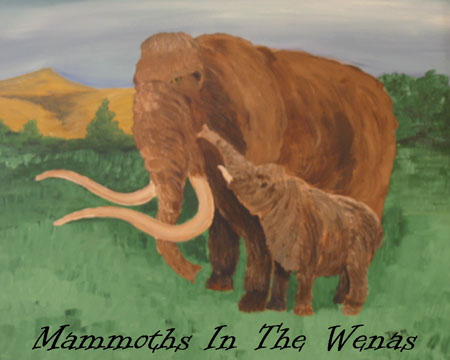
Mammoth Wenas

Mammoth Wenas. Source: CWU.edu; painting by Bronwyn Mayo.

For the past few years, students and faculty from Central Washington University have been excavating terminal Pleistocene fauna, including a partial mammoth skeleton, from the Wenas Creek area just north of Yakima (map), and they have a nice website documenting their work.  Radiocarbon dates on the mammoth came back at 13,400 and 14,000  radiocarbon years ago, or about 16,000 calendar years ago.  Too old for archaeological interest!  Right?

Continue reading

Yank that sucker out!

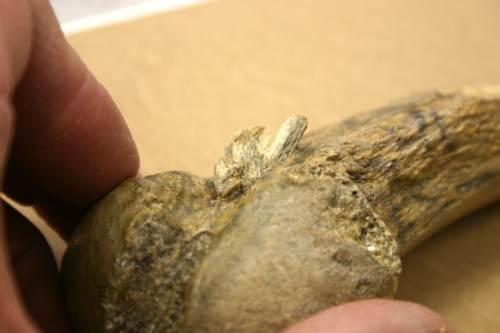
Mastodon rib from Manis site, showing protruding end of an intrusive object. Source: CSFA

The Manis Mastodon site near Sequim on the Olympic Peninsula (map) is one of the great enigmas of Northwest Coast archaeology.  The site has been known since the 1970s and is purportedly a Mastodon kill-butchery site.  With radiocarbon dates (on plant material associated with extinct mastodon) of 13,500 to 13,900 calendar years ago, the site is clearly pre-Clovis.  As a pre-Clovis site on the Northwest Coast, Manis  should be of comparable stature to, say, the Clovis-killer Monte Verde site in Chile, which dates to about 14,500 calendar years ago.

Doubts remain about this site, though, mainly because it is not yet completely reported.  A preliminary report by Gustafson et al. in the Canadian Journal of Archaeology (which I don’t have handy — hey CAA, I know you sell CDs of your back issues, so how hard can it be to put them online?) was equivocal about the association of some flake and cobble tools with the skeleton, and while interesting conclusions were drawn about the fragmentary nature of the skeleton, nothing conclusive was resolved.  This is despite one of the clearest possible “smoking guns” one could hope for in archaeology.

Continue reading

A Saanich Peninsula short-faced bear

Post removed by request.

Continue reading

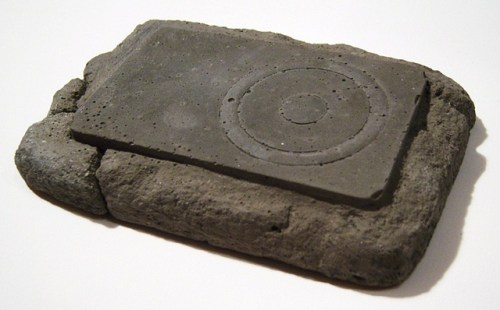
Christopher Locke’s modern fossils.

Egosiliqua malusymphonicus

Christopher Locke is an artist whose work includes a number of fun “modern fossils“, like his palaeofuturistic rendering of an iPod (Egosiliqua malusymphonicus), above, or a Nintendo game controller (Dominaludus sexagentaquad) below.  I take the work to be a slightly sarcastic commentary on the work of palaeontologists and archaeologists as well as on the flukey preservation of ephemera – see his specimen notes alongside each piece at his website.

They are also very reasonably priced — tempting!

Dominaludus sexagentaquad.

Raven-Walking & Geological Transformation

Haida History starts at least 14,500 years ago. (Image credit: Daryl Fedje).

Three things we know about Haida Gwaii:

1.  About 14,500 calendar years ago it was a temperate tundra environment, with no trees.  The first trees, pine, appear about 14,000 years ago and there is progressive forest infilling thereafter, with the modern species mixture in place by about 3,000 years ago.

2. It has an impoverished suite of large land mammals – historically, these were limited to black bear, caribou, marten, ermine, a vole and a shrew.  We know that 13,000 years ago there were also deer and brown bear on the islands, and quite likely other species as well.

3.  It used to be much larger than in the present.  With lower sea levels at the end of the last ice age, Hecate Strait was largely dry land, exposing a large, unglaciated, coastal plain that became rapidly flooded.

It seems to me that we can add a fourth thing we know:

Continue reading

Seward Peninsula Mastodon Tusk – “too old”, therefore Too Old.

Worked 35,000 year old mammoth tusk from Alaska. Note scale! Source: Gelvin-Reymuller et al.

This is getting a little out of the area, but I’ve just run across a report by Gelvin-Reymuller et al.  (download PDF) on the finding of a worked mammoth tusk from the north side of the Seward Peninsula.  That is on the west-central Alaska coast near the closest approach to Asia, and hence smack in the middle of Beringia.  The tusk is interesting in its own right, of course, but doubly so when we see that it was dated to well before the last glacial maximum:

Though the age of the tusk is only peripherally relevant to the significance of the reduction described in this paper, the tusk was sampled for dating. A single bone collagen sample from the tusk was dated by Beta Analytic, Inc. following standard pretreatment and analytical procedures. A 5.2 g of sample was first removed from an inner area, well beneath a surficial treatment of Elmer’s Glue-All which the tusk’s discoverer had initially applied to the surface. The resultant AMS date was 35,150 +/- 530 BP (Beta-189092). …… The latest mammoth remains in mainland Alaska are dated to around 11,400 BP.   Since the age of this tusk places it beyond the range of initial human habitation in the New World, as currently understood, we posit that the tusk was worked by later inhabitants of the area.

The authors note that it is possible to diagnose from the reduction strategies used whether ivory was worked when fresh/green or when already subfossilized,  though curiously they draw no such conclusions about this particular piece.  I find it intriguing how a central Beringian artifact made on a 35,000 year old material is so readily characterized as a recent manufacture.  While this piece would pre-date the earliest known record of extreme NE Asia and while I wouldn’t second-guess the authors nor impugn their motives and while it is certainly possible that a fossil mammoth tusk was worked at a much later date, I’m, uh, just sayin’.   This paper is interesting on a number of levels, not least as an example of stickhandling around competing paradigms.

Detail of working method of Alaskan tusk. Source: Gelvin-Reymuller et al

Paisley Cave Update

Paisley Cave human coprolite dating older than 14,000 cal BP. Source: PBS.

There is a tantalizing news item in a recent edition of Nature indicating that the team led by Dennis Jenkins has found a bone tool in the old layers at Paisley Cave in southern Oregon.  This cave already returned a number of pre-Clovis dates on human coprolites.  Although there was some vociferous opposition to this finding, a vigorous defence of these feces was mounted and to my mind was effective.  (Note that one of those claiming the human poop is actually camel poop posts a slightly hysterical online comment on this Nature news item.  This charge of excess fibre is dealt with in Gilbert et al’s 2009 rebuttal in Science, which is not mentioned in the Nature comment.  Clearly there is a new generation of data-selective Clovis Police being groomed out east.)

Anyway, this bone tool, which I assume will be published soon, is said in the Nature article to date to 14,230 cal. BP, from which I infer a 14C estimation of about 12,250 – exactly contempraneous with the poop.  According to the article,

The dating of the bone tool, and the finding that the sediments encasing it range from 11,930 to 14,480 years old, might put these questions to rest. “You couldn’t ask for better dated stratigraphy,” Jenkins told the Oregon meeting.

Seeing the tool itself will of course be very interesting and hopefully definitive, as there is a long history of bone pseudo-tools in North American archaeology.  So far this date has only been announced at an unspecified “meeting” and peer reviewed publication will be essential to form a final judgment.

You can watch a PBS news clip on the poop discovery from a link here which gives a good idea of the setting of the cave, and also includes nice footage of Luther Cressman!

Camel astragalus from Paisley Cave. Source: U of Oregon.

Reference:

Dalton, Rex. 2009. Oldest American artefact unearthed: Oregon caves yield evidence of continent’s first inhabitants.  Nature: doi:10.1038/news.2009.1058.

Another snag for “Clovis First”

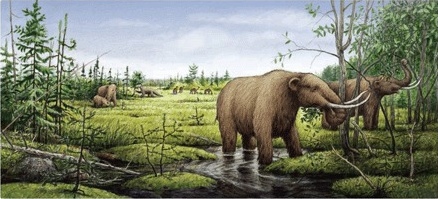
Mastodon! From: Science 20 November 2009

Abundant megafauna are important to the Clovis-First model of the peopling of the Americas because the mechanism for what was considered to be an exceptional event or series of events was overkill of these large, naive, critters .  Overkill led first to localized extirpations (moving the Clovis folks along on a bow-wave of blood) and ultimately to megafaunal extinctions across the hemisphere.

Sad, then, for that particular story and its storytellers, to see recently reported results in Science which track (through samples of dung fungus) a millenium-long decline in mastodon and other megafauna before the arrival of Clovis.  This decline might relate to climate change or to the influence of pre-Clovis humans – it’s too early to say.  But as the graph below shows, the decline set in pre-Clovis at about 14,800 cal B.P., and by the time of Clovis (ca. 13,500 cal B.P.), far from being hyperabundant, herbiferous megafauna seem to have been at a historically low level of population.  Vegetation change (often used to track climate) was a result of this die-back, not the cause of it.   Perhaps this remnant megafauna population was then finished off by Clovis, but that is hardly a bow-wave of blood scenario, but rather a “mopping up” of increasingly scarce game.  Has there ever been as misunderstood an archaeological concoction as the Clovis Culture?

Update: The Guardian has coverage, incongruously illustrated by the RBCM’s life-sized mammoth model.

Reference:

Jacquelyn L. Gill, John W. Williams, Stephen T. Jackson, Katherine B. Lininger, Guy S. Robinson.

Pleistocene Megafaunal Collapse, Novel Plant Communities, and Enhanced Fire Regimes in North America.

Science 20 November 2009: Vol. 326. no. 5956, pp. 1100 – 1103

DOI: 10.1126/science.1179504

Pre-Clovis decline of large herbivores. Source: Science 20 November 2009

Clovis Exceptionalism Craters

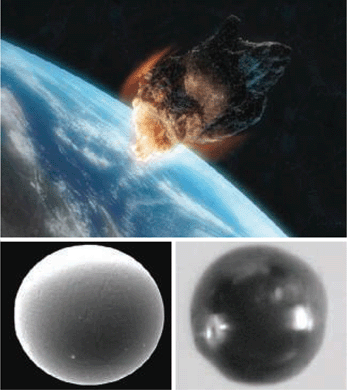
An impactor (top) may have produced magnetic spherules (lower right), but similar spherules (lower left) continually fall from space.

An impactor (top) may have produced magnetic spherules (lower right), but similar spherules (lower left) continually fall from space.

John Hawks has a good writeup about the latest news on the theory put forward a couple of years ago that a comet impacted the Laurentide ice Sheets, overkilling Clovis culture, megafauna, and instigating the Younger Dryas Event to boot.  The new paper by Todd Surovell et al. completely fails to replicate a key bit of support for the theory, namely that magnetic iron spherules, said to be the comet’s smoking gun, were associated with terminal Clovis stratigraphy across the Americas.   Other studies have chipped away at the theory as well. I’m not an expert and it’s hard to judge the state of debate — though as Hawks notes, the paper is unusually unequivocal in its conclusions of ‘no evidence”.

I have to say, I don’t mind seeing more theories of Clovis exceptionalism shot down — it is an unusual archaeological phenomenon to be sure, but it hardly takes white-hot fallout across the Americas to bring it down.  Let’s start looking at Clovis on a more human scale! Enough with the megafaunal overkill models, when the most ubiquitous fauna associated with Clovis are turtles and tortoises.  Enough with the ignoring of plant remains — the Clovis Policemen’s longstanding refusal to accept Monte Verde tells us everything we need to know about their knowledge of ethnobotany.  Enough with the phallocentric failure to look beyond the Clovis Point to see that the rest of lithic Clovis  is pretty much a standard Upper Palaeolithic toolkit.

Smoked mammoth.

Smoked mammoth.

Thinking about that the other day,  I realized that Clovis is (ironically, counter-intuitively) ripe for a post-processualist analysis. Not a critique – an analysis.  Why?  What makes Clovis different is style – widespread projectile point style as a sort of hyperkinetic effort to maintain social cohesion through semiotics, if you like.  When something is so unusual we have to posit its arrival in a river of blood through the parting of a white sea, and then see it off with a rain of fire from heaven, surely it is time to turn it over to the school of archaeology that deals with histories, not generalities.

Surovell TA, Holliday VT, Gingerich JAM, Ketron C, Haynes CV, Jr, Hilman I, Wagner DP, Johnson E, Claeys P. 2009. An independent evaluation of the Younger Dryas extraterrestrial impact hypothesis. Proc Nat Acad Sci USA (early) doi:10.1073/pnas.0907857106 (subscription required)