Category Archives: Northwest Coast

Fieldwork Picture of the Day 8

black bog abbey road

John, Walrus, George and the Sandhill Crane

In which we do our best impression of the Beatles Abbey Road cover on Porcher Island (map).  Lining up like this was necessary because the surface of this bog was so mucky we had to dismantle an old grow-op to make a trail across the surface (yes, we then dismantled our trail).  This bog is a few metres  above sea level, but quite quickly down in the core sample there was a clear break to marine sediments, showing sea level had once been higher than today and then dropped to or past modern.  Carbon dating a piece of sediment from the interface showed sea level had fallen past this point by  10,000 years ago.

Terrestrial (left) overlay marine (right) sediments.

Terrestrial (left) overlay marine (right) sediments.

The picture to the right shows the core sample, with the clear distinction made between the brown, terrestrial, pond deposits to the left (upper) side of the core) while in the right (lower, older) part of the core you can see the sediments turn to a greenish marine clay, which contained small shell fragments and salt-water diatoms.  Taking a number of these core samples from different elevations (and therefore of preumptively different dates of sea level change) allows us to stitch together a curve or graph of sea-level history.  Using this curve, we can then identify ancient coastlines (both underwater and above high tide) with greater certainty and accuracy, allowing for more efficient and productive archaeological survey on these ancient landforms.  On the map linked above, you can see the long linear lakes and ponds paralleling the modern shoreline.  These lakes highlight the former  eastern shores of  Oval Bay at higher sea levels.

Karst Mismanagement in British Columbia

Karst destroyed with approval of karst consultant.

Karst destroyed with approval of karst consultant.

The protection of BC karst landscapes falls into a sort of legal limbo.  There is only weak protection afforded through regulation, and only in some contexts.  If a cave can be shown to have archaeological deposits, it can be afforded very strong protection under the Heritage Conservation Act.  In theory, the HCA can also protect the cave if it has spiritual values to First Nations.  Nonetheless, the practice of karst assessment is controlled by a small cabal of self-appointed experts.  These folks make a living by doing impact assessments, mainly for forestry companies.  The picture at the left shows the results, a magnificent karst bluff destroyed after the karst consultant wrote the area off – from an office 500 miles distant, based on notes provided by a forest company employee.  In the report, archaeological values are dismissed from afar, doubly ridiculous since the karst consultant is notably ignorant about archaeology.  Continue reading

Dan Leen’s Petroglyph Page

Heiltsuk Petroglyphs including 2-headed Salmon Spirit

Heiltsuk Petroglyphs including 2-headed "Salmon Spirit"

I was just looking for a picture of a labret and instead found that Dan Leen has a nice page on NW petroglyphs, with lots of superb pictures and action shots of him recording rock art.  I haven’t seen Dan for quite a while, but we spent 10 weeks together on his 30 foot Trimaran “Teredo n.” back in the early 1980s, recording rock art in the Douglas Channel area.  A great trip all around.  I remember spotting this fantastic pictograph near Kemano, before breakfast one day, boat-made bread in one hand, hot coffee in another – I am pretty sure I took the picture since it was just Dan and me on Das Boot for quite some time. Dan is not the most silent guy in the world, and I heard a lot of great stories about his cabin in the Brook’s range of Alaska, his Hobo days, and so forth — so it is extra fun to see pictures of these places and times.  Dan is the most meticulous rock art researcher I have ever worked with, and it is great to see him putting some of his files, and insight online.

Oh yeah, I found the picture of the labret – one of these, almost identical, came out of my unit this afternoon.

Hoko River pictures

Hoko barbed wooden point.

Hoko barbed wooden point.

Edited Feb 17/2010: Fixed the broken links.

October 2018: Hoko pictures are now here.

So, a new school year beckons.  Erk.  As a distraction, treat yourself to the huge photo library of the Hoko River site which was put online by Dale Croes.  A few dead links in there, but some pictures of fantastic artifacts, plus a sense of the project unfolding – slug fest included, as well as a visit from Hoko Site patron and “Clan of the Cave Bear Author” Jean Auel. The pictures are dusty, scanned-in transparencies (I think) which retain sense of nostalgia and the quiet punchiness of colour us old farts remember as fondly as we do the occasional upside-down slide at conferences.   I’ll probably occasionally use the Hoko site as the basis for future posts here.  On the left, a substantial barbed wooden(!!) point from the 2400 year old wet site deposits.

Fieldwork Picture of the Day 7

Excavations at Collison Bay, 2006

Excavations at Collison Bay, 2006

This is another intertidal dig – the Collison Bay site, which shares a lot of similarities with Kilgii Gwaay.  Both sites date to about 9450 C14 years ago and contain buried deposits in primary context below the modern beach.  While Kilgii Gwaay contains a rich organic assemblage, Collison Bay does not, though there is evidence for a brown palaeosol at varyiong depths.  In and around that palaeosol are numerous pristine lithics: stones tools and flakes that are sharp and clearly have not een rolled on a beach.  One of the striking things about these two sites is they show how a major event like a marine transgression can nonetheless leave intact cultural deposits.  We suspect that much of this has to do with the local topography.  Ideally, a bedrock rock rim allows for a small lagoon to form, creating an interlude of very low wave energy between when sea level rises over the site and when the full weight of waves can start to act on the surrounding shore.  By the time the waves are able to penetrate, the archaeological materials are already several metres below low tide which affords quite a lot of protection.

As with Kilgii Gwaay, working in the intertidal zone poses certain challenges, such as having only a six hour window to work.  In the case of Collison Bay, we compounded the issue by timing the project for when the best tides were in the middle of the night, which meant getting up at midnight and working to dawn in some cases (though we did have some good daytime digging as well).  In this picture you can see we are using electric lights run off a generator while Cynthia does the hard work down on the beach; this is probably around 2.00 in the morning.

High Resolution Pictures from the Smithsonian

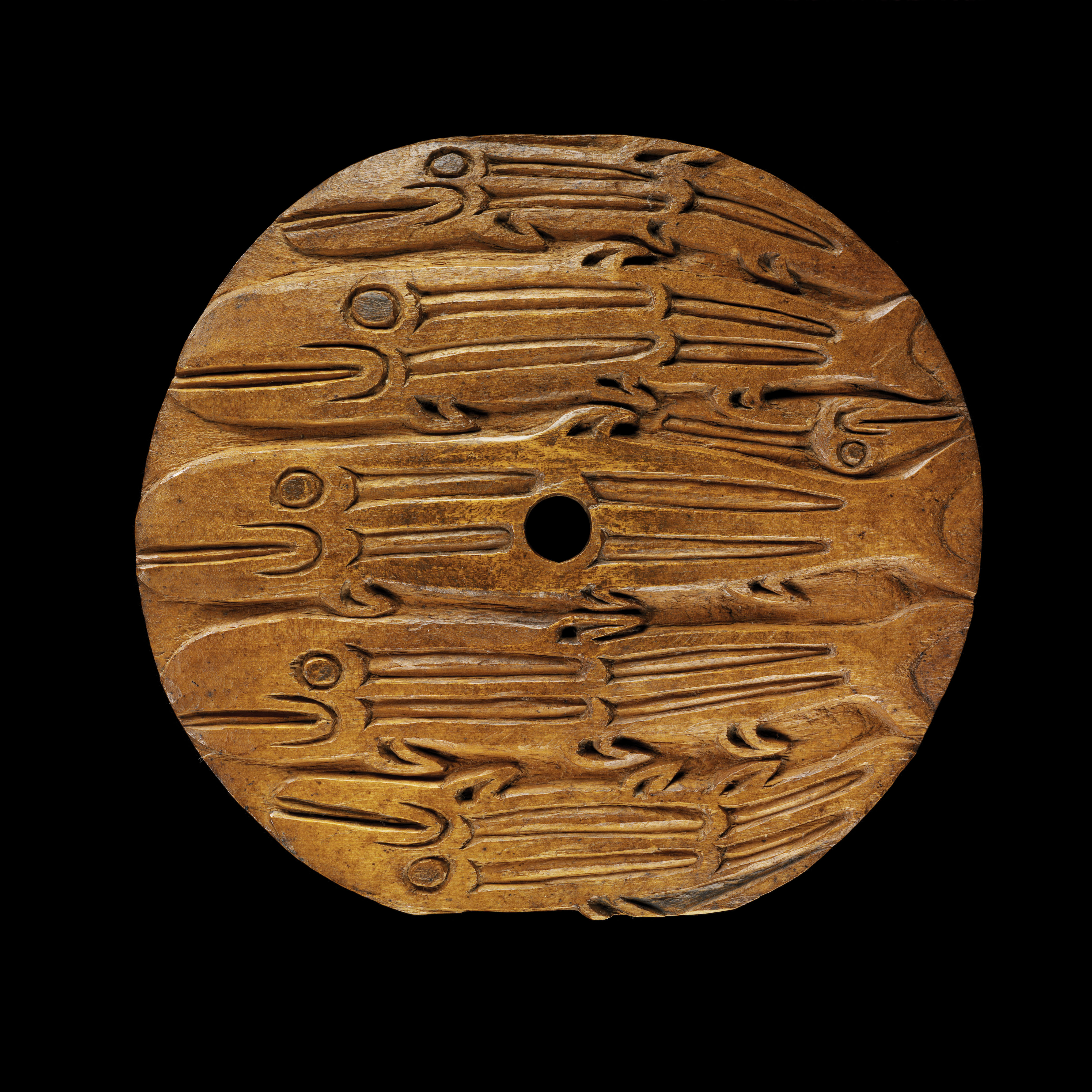
Cowichan Spindle Whorl, ©National Museum of the American Indian, Smithsonian Institution (15/8959)

Cowichan Spindle Whorl, ©National Museum of the American Indian, Smithsonian Institution (15/8959)

These seem to be squirreled away on the website in the “media releases” section at the Smithsonian! It is well worth getting the high-resolution images.  There is one solid, NWC art page here (from where the lovely Cowichan spindle whorl to the left is from)  but additionally here are high resolution pictures of:

an Alutiiq (Koniag) hunter’s hat, ca. 1950  Kodiak Island, Alaska (Spruce root, paint, glass beads, dentalium shells, wool cloth, sea lion whiskers National Museum of the American Indian, Smithsonian Institution Image: 6/9253)

Quinalt woman’s dentalia breastplate ca. 1880 Washington state (Hide, dentalium shells, glass beads, cordage National Museum of the American Indian, Smithsonian Institution Image: 2/7703)

Tlingit Rattle, ca. 1880 Alaska  (Alder or maple wood, hide National Museum of the American Indian, Smithsonian Institution Image: 8/1650AQ)

Raven Steals the Sun (in blown glass! by Preston Singletary (Tlingit) Seattle, Washington, 2003)

Continue reading

Last glaciation of Puget Sound (Quicktime Movie)

This is a nice little animated demonstration of the massive glacial changes in Puget Sound, found via the Burke Museum’s nice Waterlines online exhibit, which is a history of the geo-engineering of Seattle.

Fieldwork Picture of the Day 4

Gaadu Din 2007

Gaadu Din 2007

In 2007 we returned to Gaadu Din 1, a cave on the east side of Huxley Island (map) in Haida Gwaii.  In the front is Jenny (Jinky, Sniffer, Killer), while behind left to right you see her fellow UVIC graduate students Brendan (Binky, Loafer, Skipper, Dumper) and Adrian (Goat-Boy), while to the right is Jordan (Haida Watchman – which is not a nickname!).  The cave entrance can be glimpsed between Brendan and Adrian. Gaadu Din has revealed an incredible record of terminal Pleistocene fauna and artifacts, showing Ancestral Haida winter-time bear hunting as early as 10,600 14C years ago (13,000 calendar years ago).  Among the fauna are black bear, which still live on Haida Gwaii, but also brown (grizzly) bear and coast deer, neither of which were known to be native to these islands (deer are common on Haida Gwaii, but these are historically introduced). The deer in Gaadu Din all date to a narrow time window just prior to the onset of the Younger Dryas cold period, and presumably could not survive those harsh, snowy conditions, and had no way of repopulating the now-remote archipelago after modern climatic conditions arose.

NW Conservation Blog

This is a nice site by an Alaskan conservator, Ellen Carrlee. She gives a ton of information about her work. For example, check out her lengthy discussion of the conservation of an archaeological Tlingit fishtrap – scroll down for pictures. Or, look at this mini-essay on waterlogged wood.

Vancouver Public Library Archives

beach-grove-dig

"Archaeologists at Beach Grove, 1962"

The Vancouver Public Library has a nice collection of historical photos online, though the resolution is not great.  Interestingly, there are a number of historical archaeology pictures I had never seen before.   I’m sure someone knows these faces, presumably they include Duff and Borden?  Another picture from Beach Grove (map) shows someone sitting at an ASAB desk (Archaeological Sites Advisory Board).  When surveying at the Milliken Site in about 1986 I remember finding an old desk that was presumably Borden’s – reputedly he had a desk at his digs.  Also, there was a bookshelf out there, in the middle of the woods above the tracks.  The VPL site also has a few pictures of the Eburne (Marpole) midden, including this disturbing closeup one of the human remains visible in the link above.

You can go here and enter the search term “archaeol*”