Category Archives: Northwest Coast

Yank that sucker out!

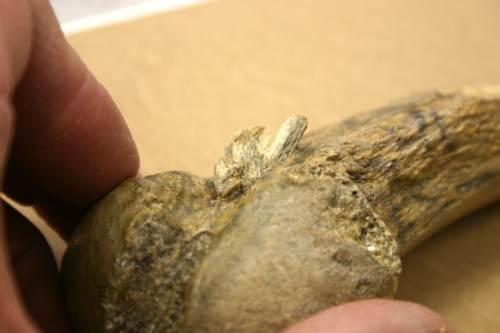
Mastodon rib from Manis site, showing protruding end of an intrusive object. Source: CSFA

The Manis Mastodon site near Sequim on the Olympic Peninsula (map) is one of the great enigmas of Northwest Coast archaeology.  The site has been known since the 1970s and is purportedly a Mastodon kill-butchery site.  With radiocarbon dates (on plant material associated with extinct mastodon) of 13,500 to 13,900 calendar years ago, the site is clearly pre-Clovis.  As a pre-Clovis site on the Northwest Coast, Manis  should be of comparable stature to, say, the Clovis-killer Monte Verde site in Chile, which dates to about 14,500 calendar years ago.

Doubts remain about this site, though, mainly because it is not yet completely reported.  A preliminary report by Gustafson et al. in the Canadian Journal of Archaeology (which I don’t have handy — hey CAA, I know you sell CDs of your back issues, so how hard can it be to put them online?) was equivocal about the association of some flake and cobble tools with the skeleton, and while interesting conclusions were drawn about the fragmentary nature of the skeleton, nothing conclusive was resolved.  This is despite one of the clearest possible “smoking guns” one could hope for in archaeology.

Continue reading

Association for Washington Archaeology

9,000 year old stone tools from Colville National Forest, Washington. Source: The Spokesman-Review.

I was a little surprised (and probably shouldn’t be) to find out there was an organization called the Association for Washington Archaeology – equivalent to the Archaeological Society of B.C.  They have a journal (equivalent to The Midden), and are clearly a respected avocational archaeology organization.  They have a pretty low profile, obviously: but partly this must be another symptom of the poor cross-border communication between BC, Alaska, Washington, and Oregon  – the core jurisdictions bounding the Northwest Coast.  They even have a blog called Washington Archaeology, which is only a few weeks old.  Their own link to it is both hidden under a “feedback button” and is broken: I hope that linking it here helps people find it.  There’s not much there yet, but it did lead me to a nice news roundup on the Tse-whit-zen site, and also to an interesting story on a 9,000 year old site in the Colville National Forest, near a town called Republic – just south of the Canadian border close to Grand Forks BC. (map).  Continue reading

Historic Pamphlets and Booklets on First Nations Topics

Skeena River pole ca. 1920s: On back: ""Named Waum Gana'o 14' high / erected 1845 / 4 Bottom figure, is of the big hog, upside down." Source: USASK."

The University of Saskatchewan has a comprehensive Indigenous Studies portal, with links to a massive corpus of published and unpublished documents – some of which are available online, free of institutional restriction.  One section which I found interesting was the large collection of pamphlets and booklets.  I know this web site isn’t always 100% archaeological – but you can’t separate the practice of archaeology from the social context in which it occurs. Among these pamphlets are:

  • CBC Radio and Department of Indian Affairs 1939: The Indians Speak to Canada (transcript of a remarkable series of 1939 CBC radio broadcasts in which aboriginal people address the nation; Haida representative Rev. Peter Kelly starts on page 28; White Man’s Burden is found in the closing remarks by the Minister of Mines and Resources)

Continue reading

Webber in Nootka Sound, 1778

Detail of a Nootka Sound watercolour by John Webber, 1778. Click to enlarge. Source: British Museum.

From the British Museum, a superb watercolour:

Nootka Sound, on the Pacific coast of Vancouver Island in Canada, was discovered by Captain Cook in his two ships, Resolution and Discovery in 1778. This drawing records this bay and some of its inhabitants. It is drawn in ink, pencil and wash and watercolours. The artist, John Webber (1751-93), accompanied Captain Cook on his third voyage of exploration in the South Seas and Pacific Ocean, which lasted for four years from 1776 to 1780. Webber was one of several artists employed to record the peoples, animals birds, fishes, plants and landscapes of the newly discovered Pacific Islands.

The written descriptions of the location are confirmed by the drawing. It is severe and inhospitable. High cliffs, rocks that reach right down into the sea, and the jagged shore line gave it a ‘melancholy appearance’. The terrible weather, which left the trees ‘mutilated by rough gales’ contrasted greatly with the tropical scenes ans palm trees enjoyed by the explorers in Tahiti.

Webber also drew the native people. Their clothing, basically the same for men as for women, consisted of a woven cloth, fastened at the shoulder or neck. According to Captain Cook, the cloth was the bark of the pine tree, beaten flat like a sort of rough felt. The head was covered with a conical hat made of matting. It is probable that Webber modified the drawing for the sake of decency and for public viewing. Cook described the men’s dress as generally bare in the ‘… Middles, nor are they ashamed to appear naked’.

It’s not clear what the kneeling man on the right is doing: is he using a mussel shell to dig?  Several harpoons complete with foreshafts seem to be visible.  It is a skillful and atmospheric rendering of Nuu-chah-nulth life shortly after first contact with Europeans.


A Portal to Online Graduate Theses and Dissertations

If you look up you should see two more links have been added along the header of this page, just above the banner picture.

ARCHAEOLOGY THESES is a page of links to freely-available, online PDF copies of graduate dissertations and theses on Northwest Archaeology subjects (with a few palaeo-environment theses thrown in for fun).

OTHER THESES is a similar page, but where the focus is on Northwest Anthropology, First Nations Studies, History and related disciplines.

I am planning another page which will be for online archaeological, ethnographic and historic documents of note, in particular “classic” ethnographic works and major site reports which have been intentionally posted in online contexts.  Probably this will be a few weeks yet.

The impetus for these pages is that I have often said the M.A. thesis in particular is a significant backbone of B.C. Archaeology, and the dissertation even more so.  For years these substantial works languished on library shelves.  Now, libraries are increasingly making them available online, free to the public and the academy alike – that is, not behind password protection.

However, you have to know how to look, and where to look, and often you need to know in advance what you are looking for, in order to find this stuff.  I thought it would be useful to have a very simple portal for these graduate works.  Not only does this make them browsable by the more hardcore of my blog readers, but it will get them some google-love!

Not all theses ever written are available online (mine isn’t!):  as it notes on the pages, there are programs in place at UVIC and UBC to digitize their back-catalogue of theses and dissertations.  It would be great if institutions like Calgary, Toronto and McMaster could get their dSpaces full, and open. Unless, of course, they are ashamed of the quality of their graduate student work 😉

So, these pages will be updated periodically. I am not vouching for the quality of any of the ones I linked — indeed a few of them are exceptionally poorly reasoned,  naive, unsupported, badly written, or long-winded efforts -and  in at least one case, all of the above!  Most are very solid though, in my estimation, and a few are truly excellent.  If you know of useful and relevant graduate work that is freely available and not yet linked, let me know in a comment below, or send me an email qmackie [at] gmail.com.  In the meantime, happy browsing.

Thoughts on a WSU Archaeological Perspective

Pioneering WSU archaeologist Richard Daugherty instructs students on the beach at Ozette, late 1960s. Source: WSU.

Washington State University (WSU) has one of the oldest and most notable programs in Northwestern North American archaeology, with pioneers such as Richard Daugherty and William Ackerman leading the way.  The WSU magazine has a nice interview with a number of their distinguished alumni and faculty, including William Andrefsky, Dale Croes, Colin Grier, and Gary Wessen.  There are some interesting quotes in it, notably, to my mind – and perhaps yours, if you are a university nerd like me: Continue reading

One more update on the Museum of Vancouver’s Petroglyph.

Interior Petroglyph now at Museum of Vancouver, while still in Stanley Park ca. 1980. Source: DanLeen.org

I have posted several times recently on a superb interior petroglyph boulder languishing in a shady courtyard at the Museum of Vancouver.  Together with Heather Pringle’s posts on this topic, we seem to have caught the attention of the Board of Directors of the Museum.

One of the Directors, Anthropology Professor Bruce Miller of UBC, called me the other day.  He consented to me posting notes from our conversation.   Continue reading

Making a stone tool, 1893

1893 flint-knapping description by Father Morice. Source: Canadiana.org

Father Adrien-Gabriel Morice was a Catholic missionary working in the Skeena and Bulkley River areas of western British Columbia during the later 19th century.  He is perhaps best known for his documentation and writing system for the “Carrier” (Yinka Dene) language, but he also published a major work entitled Notes Archaeological, Industrial and Technological of the Western Denes, with an Ethnographical Sketch of the Same (1893).  The work is a cornucopia of careful observation mixed with some interesting, and occasionally rather religiously judgmental and speculative, commentaries.  One of the most interesting short passages is excerpted above: Morice records how to make stone tools via flaking.  Because metal tools became widely available in the early historical period and had some superior qualities, such accounts of traditional flaked stone (the bread and butter of archaeological sites) are very rare.  The figure above appears accurate in its description of the slightly awkward-seeming way of holding the stone: I have seen this palm grip used by many contemporary flintknappers.  Elsewhere, Morice records a series of Yinka Dene names for different stones, including chalcedony and obsidian.  You can page through his book, but not download it in entirety, here at Canadiana.org. The illustration above is from Page 65 on the drop down menu.  (Why they don’t just make a link to the whole PDF is beyond me).  There are other informative sections, such as about 10 pages describing the operation of fish-traps and weirs.

Fish trap illustrated in Morice 1893. Source: Canadiana.org

Shopping maul

Maul from the Dundas Collection.  Source: Sotheby's

Tsimshian Maul from the Dundas Collection. Source: Sotheby's

The Dundas collection of Tsimshian objects deserves a week of posts – not just for the stunning beauty and resonance of the art but for the profound issues in heritage management, cultural property ownership, and repatriation ethics which it raises or exemplifies.  I’ve been reading up on it a bit, and at one level the isssue is very simple: these Tsimshian treasures should have been repatriated – not to Canada per se, but to Tsimshian Territory.  At another level, there are complex, interwoven threads of (mutual) respect and ownership which make (and made) for no easy solution.   And no easy solution was reached: the collection was broken up, with the majority of the pieces sold to foreign hands (by foreign, here, I mean non-Tsimshian though I am prepared to argue this).

But for today, I was interested to see the Sotheby’s auction catalogue from the 2006 sale of this collection is still online.  The most interesting piece, of course, is the northern-style maul, seen above.  It sold for a surprising USD $1,320.00.  I wonder if it was in use at the time of collection or if it was already an archaeological specimen.  Collection of such materials from archaeological sites and their sale is, of course, now illegal although so far as I know there is a grandfather clause for older collections pre-dating the modern legislation.  I imagine any maul without such prominent provenance would be worth very little indeed.  Despite fetching far more than I would have imagined, it was a mere snip compared to the mask below which sold for a jaw-dropping USD$1,808,000.00.

Tsimshian Mask from the Dundas Collection. Source: Sotheby's.

Ucluelet, 1859

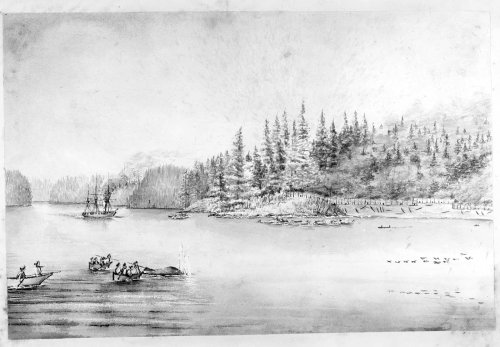
"Euclueliat village, Barclay Sound, Vancouver Island, N.W. Coast. H.M.S. Satellite" pen and ink and watercolor drawing 1859 Mar. Source: Yale. Click for original, click through for large size.

The above is a rendering of Ucluelet Inlet on the west coast of Vancouver Island, made in 1859.  You can clearly see the aboriginal village to the right. Artfully, the artist has caught a whale hunt at the exact moment of harpooning in the foreground.   I’ve zoomed in on the village below.

Detail of Ucluelet Inlet village.

Interestingly, the next picture in this folio from Yale University is labelled as a “Songhee” Village (below), yet rather than a Victoria area settlement, it fairly clearly shows what I think is another Ucluelet-area village, with the distinctive saddle-shaped hill to the east side of the inlet.  (The trees are different which makes me think it is a different one than above) Anyway, nothing earth-shaking but I had never seen these historic drawings before.

Songhee? Village. North West Coast Vancouver Island. Barclay Sound. H.M.S. Satellite." pen and ink and watercolor drawing 1859 Mar. Source: Yale. Click for original, then click through for large size.