Category Archives: Miscellaneous

Archives of “The Native Voice”

Native Voice banner

2018 edit: it appears the PDFs are now only available through the Internet Archive here.

The Native Voice is the official organ of the Native Brotherhood of British Columbia, an organization which has been active since 1931 and continues to do good work, especially in relation to aboriginal fishing rights, and aboriginal fishers themselves.  The NBBC has put PDF copies of  many editions of the Native Voice online from the years 1947-1955.  These archived issues offer a fascinating glimpse into the the mid-20th century state of First Nations politics, and everyday life besides.

To the right, for example, click on the text image to go to an issue wherein the NBBC riffs (positively, in this case) on  a Ruth Benedict article.

The Dionysians Strike Back

The Dionysians Strike Back

It is rare to see such responses (positive or negative) to the Anthropological Literature. Scroll lower in that article for 1947 ‘News from Ahousat”, a statement on segregation in PRince Rupert cinemas, and an odd “humour” column which seems rather offensive and patronizing in retrospect.    I am looking forward to trawling, or trolling, through these archives as the days go by.  Kudos to the NBBC for not only putting these documents online, but for the excellent, clear digitization — clearly someone took care making these files.
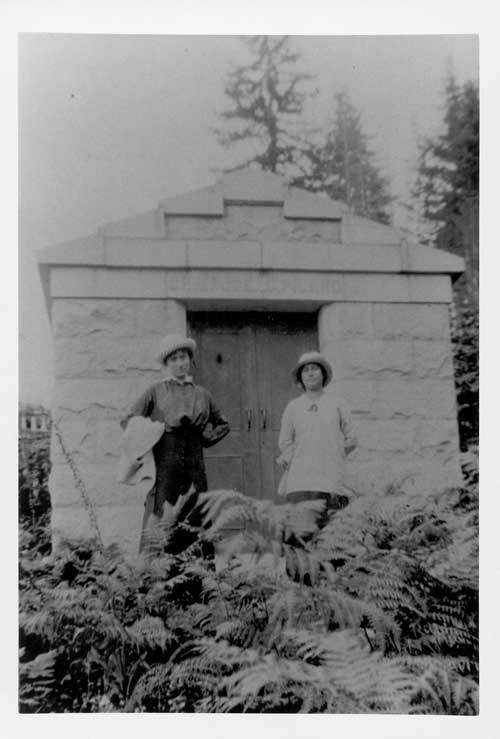
West Vancouver Archives

Tomb of Chief Joe Capilano ca. 1917

Visitors to the Tomb of Chief Joe Capilano ca. 1917

Stumbling on the Vancouver Public Library’s photo site the other day got me poking around smaller museums and archives for archaeology and First Nations related stuff.  It turns out there’s a lot out there.  First up is this picture I found at the West Vancouver Museum and Archives.  They have a searchable collection, within which a fair number of digitized historic photos.  A fair amount of stuff is under “First Nations” and “Indian”.  To the left is a remarkable picture of Chief Joe Capilano’s tomb (map).  It’s quite a slab, house-shaped (though not a shed roof house!), but surely it is as close to a mortuary house as it is to traditional Christian mausoleum.     Joe Capilano was a leader of the Sḵwxwú7mesh (Squamish) nation, to whom he was known as Sa7plek.

Sa7plek: Chief Joe Capilano

Sa7plek: Chief Joe Capilano

Apparently, he recieved the title of ‘Chief”  (via recieving the name Kiyapalanexw (Capilano), in order to facilitate his trip to Ottawa and to London, to meet King Edward VII.   The name bestowal was in the belief that he would need a title in order to speak “Chief-to-Chief” with the Prime Minister and the King, or so says wikipedia.  These smaller archives have fairly idisoyncratic interfaces and often the context given is poor.  Nonetheless, I will occasionally, or even frequently, post pictures or other material from them.

Scary article on overfishing

Every time I focus on this topic it has gotten incrementally worse.

NW Conservation Blog

This is a nice site by an Alaskan conservator, Ellen Carrlee. She gives a ton of information about her work. For example, check out her lengthy discussion of the conservation of an archaeological Tlingit fishtrap – scroll down for pictures. Or, look at this mini-essay on waterlogged wood.

Grover Krantz

Dr Krantz, a professor of Anthropology at WASU, was best known in NW Anthropology circles for his Sasquatch research.  The reputation he gained from this unorthodox pursuit followed him to his involvement with the Kennewick Man case.  Now I find out, via John Hawks, that Grover Krantz was “buried” in a drawer at the Smithsonian Institution, along with his dogs.  The Washington Post has an article and jawdropping slideshow of Krantz’s  skeleton mounted and on display at the Smithsonian, along with his dog, Clyde.  (This older article has some nice background and a picture of Grover and Clyde at rest in their usual home).  Is it any wonder  Umatilla eyebrows were raised about his Kennewick involvement and resistance to repatriation of human remains?