Category Archives: history

Historic Sketchbook of Heywood W. Seton-Karr

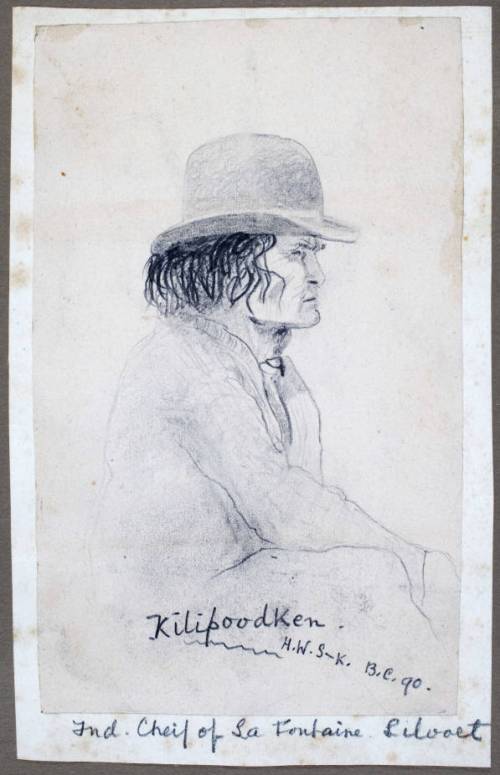
Portrait of Kilipoodken by Heywood Seton-Karr, ca. 1890. Source: Alaska Digital Archives.

I’ve just come across a remarkable sketchbook in the Alaskan digital archives.  It covers the wide-ranging travels of one Heywood W. Seton-Karr, a British Army officer, big game hunter, amateur archaeologist, and talented artist (about whom, more below).  While I could probably fill 10 blog posts from this sketchbook, (and may do so!) a very interesting find is the portrait sketch above.  The caption reads,

Kilipoodken. Ind. [Cheif]  of La Fontaine Libooet. H.W.S-K. B.C.90.

This certainly refers to the Xaxli’p First Nation, also known as the Fountain First Nation, one of the Lillooet (not Libooet!) Tribal Council from the central Fraser River region of British Columbia.  Since googling for “Kilipoodken” only returns the Alaska Digital archives source, it seems to me possible that this mislabelled portrait is unknown to the Xaxli’p Nation, where it is more than likely some of this Chief’s descendants still live.   I hope they find this portrait.

Otherwise, there is much of interest in these sketchbooks. Continue reading

Green cod heads and the case of the missing halibut

Copper kettle full of cod heads. Source: Alaska OHA.

I was feeling sick yesterday and this picture didn’t help: from the Castle Hill excavations at Sitka, Alaska (previously 1, 2) is the nearly complete copper kettle.  Inside, the archaeologists found the green-stained bones from the heads of three codfish (true cods, Gadidae, are 35% of the fish assemblage).  One of the great things about archaeology is to get these tiny slices of life: someone’s kettle of fish, set aside one day 200 years ago.

At a bigger scale, archaeology isn’t always so straightforward though.  Interestingly, from the site as a whole, only 1% of the fish bones are from halibut (11 bones in total).  This is despite the fact that:

Cod dominated the Castle Hill assemblage, and yet, Emmons (1991:148) stated that cod was considered an unimportant part of the Tlingit diet if salmon and halibut were available. Historic records confirm that cod was popular in Sitka, because it was available almost year around (Gibson 1976:40, Khlebnikov 1994). Halibut was also popular because of its year around availability and was sold to the Russians in large numbers. Between 22,000 and 138,000 pounds of halibut were purchased each year from the Tlingit from 1846 to 1866 in addition to the yearly average of 13,000 pounds of halibut the company procured itself (Gibson 1987:94). The emphasis on halibut brought to Sitka and sold to the Russian-American Company would lead to the prediction that halibut should dominate the assemblage, yet this is not the case. It may be a case where cod were readily available and not worthy of special consideration in historic documents.

Two things strike me about this.  One is that the Tlingit, using largely traditional methods at the time, were able to produce up to 138,000 pounds of excess halibut for trading purposes.  That’s a lot of fish.  The other is that so much halibut renders down to so few bones.  Halibut is long known on the NW Coast as being strongly under-represented in archaeological sites, probably because it may have been butchered on the beach and the bones, which separate cleanly from the meat, would end up in the intertidal zone and be washed away or eaten by dogs.  It also seems possible  that the Tlingit were trading in dried, boneless halibut (which makes the tonnage involved all the more impressive).  And certainly the entire site was not excavated, so there may be a mother lode of halibut bones somewhere.  But this case makes an interesting cautionary tale in zooarchaeology: we seldom have an accurate sense of the scale of the incoming fish quantities to compare to what is left in the ground, and when we do, the degree of difference between the written and material records is often quite startling!

Tlingit women and children cleaning fish on the beach, ca. 1907. Ignore the racist caption. Source: U. Washington.

Two Views of Double-Headed Eagles

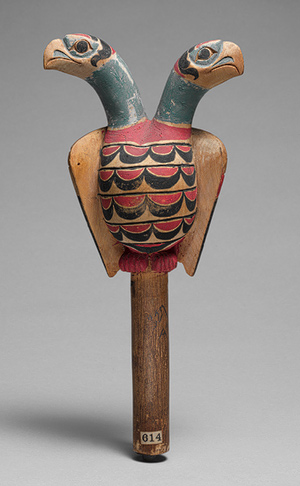
19th century Tlingit double-headed eagle rattle. Source: Metropolitan Museum

The image above is of a Tlingit rattle, with the motif of a double-headed eagle.  With the vast repertoire of supernatural beings who could be invoked in the Northwest Coast art, one could be forgiven for thinking this was another of these figures from the rich mythology and history of the Tlingit people.

In fact, this Tlingit rattle is undoubtedly based on the Imperial Russian coat of arms.  As I noted yesterday, the Russians were the earliest Europeans into many parts of Alaska.   After the Russian-Tlingit Battle of Sitka in 1804, peace talks were conducted and Aleksandr Baranov, the first governor  of colonial Russian Alaska and manager of the Russian-America Company, presented the Kiks.adi Sitka Tlingit leaders with a large medallion, on which was found the Russian imperial symbol (below).

Tlingit accounts of the treaty have been presented by Alex Andrews and Mark Jacobs, Jr. In a transcribed interview, Alex Andrews (1960:6-7) explains that the Indians did not know the value of the plaque presented by the Russians, and it was believed to be a retribution or atonement for the dead. He further stated that Baranov came to Peril Straights to negotiate the treaty. Mark Jacobs account of the treaty was related in a speech at the Second Russian-American Conference in 1987:

It was finally decided by the Kiks.adi’s to return and sit down for the peace talks. It was at this peace treaty that the present Castle Hill was given to Baranov in exchange for a double-headed eagle badge, which is depicted on the totem pole [in Totem Square, Sitka]. It was explained to mean, “From now on and forever, we will be brothers. You look one way and we the other way.” The round knob on the bottom of the totem pole represents Castle Hill. The only piece of real estate ever given to the Russians [emphasis in original document]… The double-headed eagle badge, received from the peace talks, is now in the State of Alaska Museum in Juneau [Jacobs 1987:9].

Since that time, the double-headed eagle has been a  motif widely used in Tlingit art.

I like to think that the Russians did not fully know what they were doing.  Early treaties commonly took advantage of very different indigenous views on the nature of property and land ownership  in order to dispossess people of their land under the fig leaf of western law.  In this case though, I wonder if the shoe is not on the other foot.  Crests were inherited rights on much of the Northwest Coast, yet they could also be traded or shared or given away.  The right to display a Crest was a valuable property right that helped establish a lineage’s relative status.

By acquiring the Crest of the Imperial Russian lineage as compensation for their dead, the Tlingit Chiefs may have in effect subordinated the entire Russian aristocracy: a stunning coup in Tlingit terms.  The Russians may never have noticed that they had become Lesser Chiefs in their own colony.

Imperial Russian medallion presented by Baranov to Sitka chiefs in 1804. Source: Juneau Empire.

The top image is from the small but sweet exhibition of NW Coast musical instruments at the Metropolitan Museum of Art.

Handmade Garnet Musket Ball from New Archangel

Garnet musket ball from excavations at Sitka, Alaska. Source: Alaska OHA.

It is a common trick in archaeology classes to puzzle students with gunflints – part of the sparking mechanism of older muskets – which were made until recent times by the remnants of a European flaked stone industry until modern cartridges replaced them.  However, I had never heard of the use of stone musket balls before — but the picture above shows one made out of garnet, which is a heavy and dense mineral. This specimen is from a historic Tlingit-Russian site in Alaska.  As the caption notes:

“Large garnets can be found in schist… Because of the shortage of lead, the Kolosh [Tlingit]  use them instead of shot to kill sea animals.” [Khlebnikov’s 1817-1832 report, 1976:39]

It is typically ingenious for the Tlingit to have adapted traditional stone working technologies to the new, introduced technologies.

Over much of coastal Alaska the first contact aboriginal people had with Europeans was with Russians, rather than Americans, British, French or Spanish.  One of the most important Russian settlements was Novoarkhangelsk, or New Archangel, founded in 1799 at the present day town of Sitka (map).  The tumultous history of the founding of this outpost near a Tlingit village called Gajaa Héen, its subsequent capture by Tlingit warriors and ransom of Russian captives for 10,000 rubles, and its recapture 1804 by a Russian naval fleet during the “Battle of Sitka” is a subject for another day.

Suffice it to say that, as with all history, archaeology can fill in the stories of the everyday life of people and of events that go unrecorded by pen and paper.  In this respect, it is good to see the Alaska Office of History and Archaeology has a very full, very detailed report available online about archaeological work at “Castle Hill”, the ancient Tlingit fort known as Noow Tlein which subsequently became the cornerstone of the Russian defensive facilities at New Archangel.  You can browse the report chapters here, and the photos here and here.  No doubt I will post more in due course, as there are some extraordinary artifacts found at this site, not least among which is this hand-made toy musket.

The Russians may have won the battle of Sitka, but they eventually left, leaving behind the Sitka Tlingit tribes to continue their journey to the present, where their vibrant culture continues to thrive as this interactive place names map for the modern Town of Sitka makes clear.

Fort at New Arkhangel -- "View of the Establishment at Norfolk Sound," 1805-06 (from a watercolor by G.H. von Langsdorff). Source: Alaska OHA.

PS:  if you are skeptical about that Wikipedia link to the Battle of Sitka, then you can hear about the events in Tlingit here).

Plan of New Archangel, 1804. Fort site is to centre right. Source Alaska OHA.

Raven de La Perouse

Wooden and brass pipe representing Kan Lituya in the form of a Supernatural Frog, and his Bear Slave creating waves in Lituya Bay. Source: de Laguna, Volume. 3

My recent post on the 1786 visit by La Perouse to Tsunami-prone Lituya Bay, Alaska sent me scurrying to download the massive ethnography by Frederica de Laguna entitled Under Mount St. Elia Under Mount Saint Elias: The History and Culture of the Yakutat Tlingit.  As expected, there is a rich oral history of waves in this bay.  From Volume 1, page 94, she says

Emmons (1911, p. 295) recorded Indian beliefs about the dangers of Lituya Bay, caused by:
“… a monster of the deep who dwells in the ocean caverns near the entrance. He is known as Kan Lituya, ‘the Man of Lituya’ [qa htu ‘a?]. He resents any approach to his domain, and all of those whom he destroys become his slaves, and take the form of bears, and from their watch towers on the lofty mountains of the Mt Fairweather range they herald the approach of canoes, and with their master they grasp the surface water and shake it as if it were a sheet, causing tidal waves to rise and engulf the unwary.

De Laguna then continues to discuss an extraordinary wooden smoking pipe, illustrated above:

“This legend of Lituya is illustrated by a carved wooden pipe (fig. 50) [pi. 123], of splendid proportions, which was obtained in 1888 from the chief of the Tuck-tane-ton family of the Hoon-ah Kow [DAqdentan sib of Hoonah], who claimed this bay as his hereditary sea-otter hunting ground. It was used only upon occasions of particular ceremony—when the clan assembled to honor the dead, or to deliberate upon some important question of policy. At one end is shown a froglike figure with eyes of haliotis shell, which represents the Spirit of Lituya [possibly the Frog crest of the sib?], at the other end the bear slave sitting up on his haunches. Between them they hold the entrance of the bay, and the two brass-covered ridges are the tidal waves they have raised, underneath which, cut out of brass, is a canoe with two occupants, that has been engulfed. [Author’s note: This illustration was furnished through the courtesy of Mr George G. Heye, in whose collection the pipe now is.”]

One thng leading to another, I thought I would look into whether the Tlingit story of La Perouse’s visit had been passed on.  As it turns out, the early ethnographer G.T. Emmons records an account given by a Tlingit chief one hundred years after the visit of La Perouse to Lituya Bay.  This gives an indigenous perspective on what must have been an extraordinary series of events for both parties.  This account is well worth reading, so I am reproducing a portion of Emmons (1911) rendering below:

“In 1886, one hundred years after [the vist of la Perouse], Cowee, the principal chief of the Auk qwan of the Tlingit people, living at Sinta-ka- heenee, on Gastineaux Channel, told me the story of the first meeting of his ancestors with the white man, in Lituya Bay, where two boats of the strangers were upset and many of them were drowned. This narrative had been handed down by word of mouth for a century. These people possess no records nor had the chief, who spoke no word of our tongue, ever heard of La Perouse from outside sources; so we can here authenticate by an exact date a most interesting piece of native history in detail, the truth of which is substantiated by the fact that La Perouse was the only one of the early navigators to visit this locality in a large ship and by the attending loss of life in the destruction of his two boats.  Continue reading

Destruction of Kwalate Village

Major landslide scar near Kwalate Village. Source: panoramio user Obslord.

Yesterday’s post about Marianne Nicolson’s powerful pictograph in Kingcome Inlet and the post from a few days ago about the enormous Tsunami in Lituya Bay got me thinking again about recent work in Knight Inlet on the central B.C. Coast (map).

A recent project by a team of geomorphologists and an archaeologist, UVic’s own Duncan McLaren, investigated oral historical accounts about Kwalate Village of the A’wa’etlala and Da’naxda’xw peoples, of the Kwakwaka’wakw First Nations.  The accounts state that a landslide in Knight Inlet triggered a local Tsunami which swept this village away. This account is known anthropologically through a number of sources, including Franz Boas (1910, Kwakiutl Tales):

“About three generations ago, or possibly at an earlier date, a large portion of the mountain opposite Kwalate Point slid into the inlet causing a huge tidal wave which wiped out all of the inhabitants of the village opposite…and the vast slide is noticeable today”.

Of course, the story of the destruction of Kwalate is still told and the dead, unknown in number but perhaps up to one hundred, are still mourned and memorialized in the surrounding communities.  While it is not necessary, or even desirable or possible, for archaeology to confirm oral historical accounts, when that happens it can be of interest to archaeologists and First Nations people alike. Continue reading

Northwest Coast in New Zealand

Masset, ca. 1924. Source: University of Canterbury, NZ.

I found myself poking around in a New Zealand archive at the University of Canterbury the other day and found some nice historic pictures from the NW Coast.  These are assigned to the collection of John Macmillan Brown, an early New Zealand academic and, in retirement, an amateur anthropologist.  I am guessing these pictures were taken by him in retirement.  Most are undated; one carries a date of 1924.  The subjects are familiar yet the views are new – the more we can catalogue the world’s pictures of the NW Coast, the better we can understand the processes of transformation which continue to unfold.

Update: fixed links, sort of.  Note to web types: you should always provide stable URLs, none of this “your search has expired” junk.  If you want your collections used, and you do, because you put them on the web, you need to make it so the results can be bookmarked and shared.  Gosh.

Skidegate ca. 1924. Are those oarlocks on that canoe? Source: University of Canterbury.

La Perouse at Port des Francais (Lituya Bay)

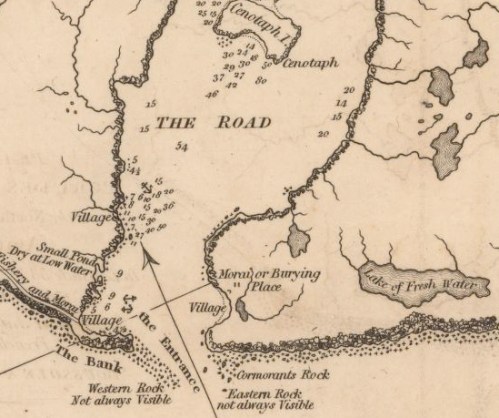
Detail of entrance of Port des Francais. Source: Brown University. Click for zoom version.

Most readers will be very familiar with Captains Vancouver and Cook and some of the other early European explorers of the Northwest Coast.  Less familiar is Jean-François de Galaup, Comte de La Pérouse, (1741-1788), who embarked on a world journey of exploration in 1785:

The French decided to mount a scientific and exploration voyage to rival that of Captain James Cook. Two ships, the Boussole and the Astrolabe, under La Perouse’s command left France in August 1785. They spent the summer of 1786 off the coasts of Alaska looking for a northwest passage then sailed down the west coast of North America in August and September 1786.

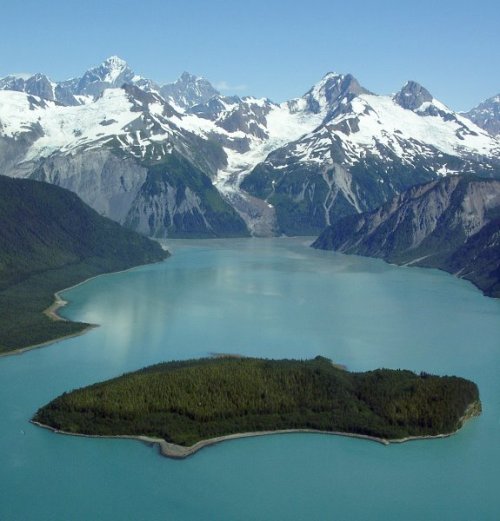
One of their most memorable and tragic periods was the time they spent in Lituya Bay, Alaska, which they called Port des Francais (map).

Lituya Bay, with Cenotaph Island in the foreground. Source; Panoramio user footsnviews.

Their mapping and illustration of Tlingit life are not unknown but also not that easy to find.  I recently came across an interesting site which has the best web presentation of these materials (actually reproduced from a 1798 British edition) I have seen: the images are highly zoomable, and the zoom is fast and crisp and smooth.  Linking to specific images is possible and the links don’t break.  With a little bit of effort, you can download the images (hint: “view source” of the page and search for ‘Size4″).  So zoom right in and see the details of pictures such as this one of a fish camp (are those halibut drying, or Pacific cod?), or this one of both a fine Tlingit dugout, and the construction of a skin vessel, with its seal skin hull removed and placed to one side.  The chart made by La Perouse is here and full of detail (again, these are English re-engravings of the originals).

While spending  time in Lituya Bay, tragedy befell the expedition. From here, an account of La Perouse’s time in Port des Francais:

1786 July Port des Francais / Lituya Bay

The next day, the narrow entrance to an inlet was located to the east of Cape Fairweather. De Pierrevert, from the Boussole, and Flassan, from the Astrolabe, were dispatched in small boats to investigate the inlet. Their favourable reports encouraged a somewhat reluctant La Pérouse to take the ships in. Their first approach was unsuccessful and they tacked offshore through the night before the tide carried them in the next morning. Even then, it was a precarious passage and the ships both nearly were driven onto rocks. They anchored just inside the entrance but La Pérouse was not happy with this spot, it having a shallow, rocky bottom. He sent men off to a find safer anchorage. D’Escures found a better location behind the large island in the inlet and the two ships transferred there. It was 3 July 1786.

Continue reading

Major expansion at the Royal B.C. Museum?

Proposed changes to the RBCM: the clear white structure to the back left is the new curatorial tower & archives; to the right is a new entrance and multi-functional area. Source: Times-Colonist.

The Victoria Times-Colonist had a story Saturday that the Royal B.C. Museum is proposing a major expansion, in which theirs quare footage would more than double, from 379,000 to 895,000 square feet.  The curatorial tower and the low-rise archives building on the NW side of the block would be demolished, replaced by a new multi-function complex which would also form the entrance to the museum.  The collections and curatorial facilities, and the archives, would move to a new 14 story building to the south of the current museum.  The RBCM C.E.O, Pauline Rafferty (an archaeologist by training) notes that ““We are now at a crossroads.  We have outgrown our on-site storage facilities and significant artifacts are stored below sea level.”  The article estimates the cost will be in the hundreds of millions of dollars which is easy to believe. The Times-Colonist weighs in with a strong editorial of support, citing the collapse of the Cologne archives last year with irreparable damage to the history of that City.  So: no-brainer, right?

Continue reading

Boundary Maintenance

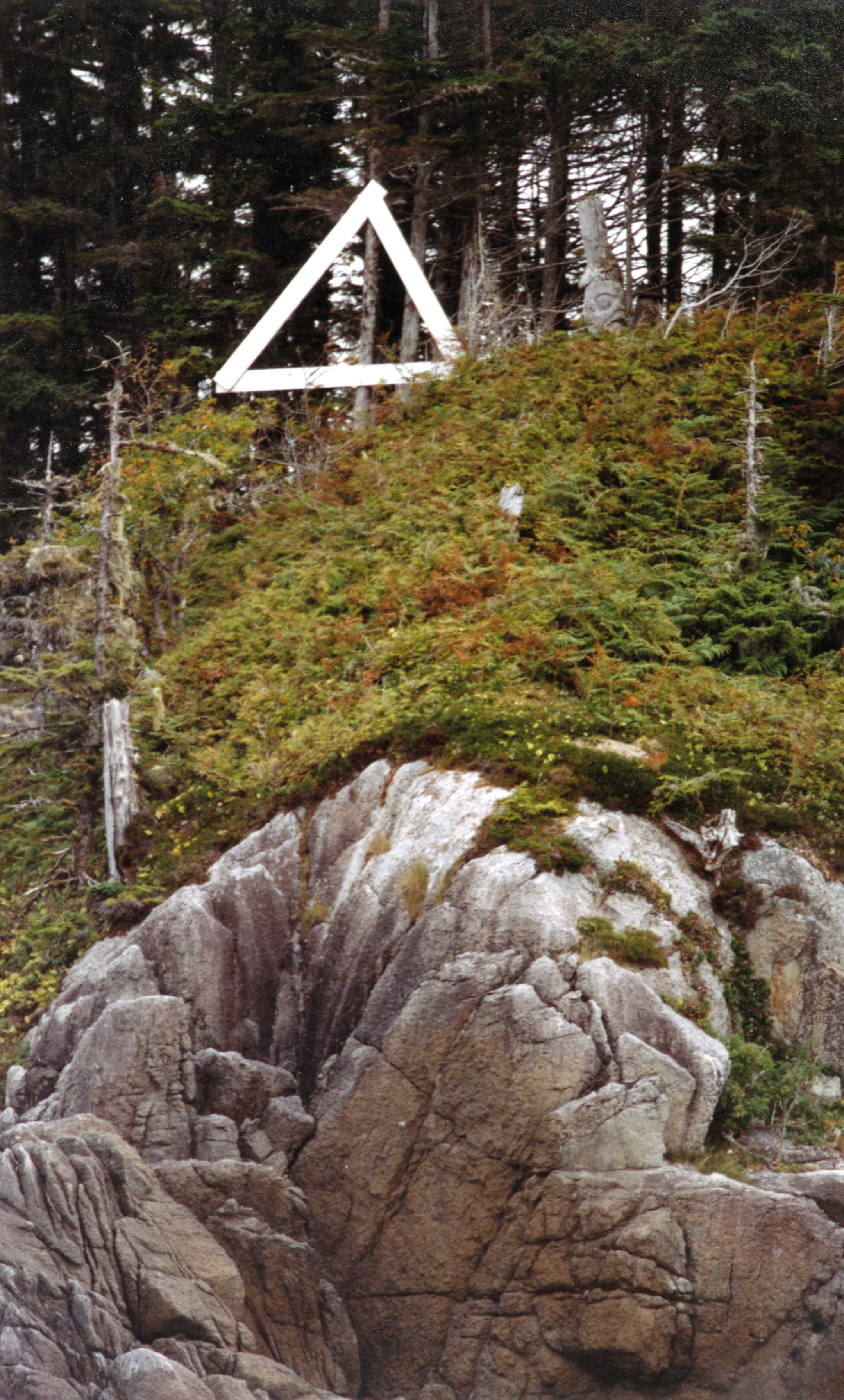
Headland with wooden markers. Click to zoom.

This is one of my favourite pictures of B.C. Archaeology, even though  it doesn’t look like much.  It’s a bit fuzzy: I took it with a zoom lens in about 1985 , rounding a headland in a small boat  on the Central Coast.  In fact, you might think it doesn’t look all that archaeological.  Look closer: sticking up to the right of the white triangle you can see the carved head of a pole.

The white triangle is a standard device used by Fisheries to demarcate the different fishing zones on the coast, for management purposes.  On one side of the triangle there might be different catch limits or closures or seasons of harvest enforced than on the other.

I don’t know much about the pole, but its location on such a prominent headland, facing the open Pacific, next stop Japan, is suggestive it marked a change of territory, a boundary shift, a movement from the control of one lineage or house to another. You don’t often see such a pole away from a village site.

Both wooden markers may ultimately serve the same purpose: boundary maintenance between zones of control; advertisements for power; watchful symbols of formal rights; the means of resource management.  It is intriguing and almost poetic to see them standing, side by side, on the same headland, guarding the same water.

Detail of wooden markers.