Category Archives: First Nations

ASBC Victoria Tue Feb 19th: Coastal Archaeology in Huu-ay-aht territory, Vancouver Island

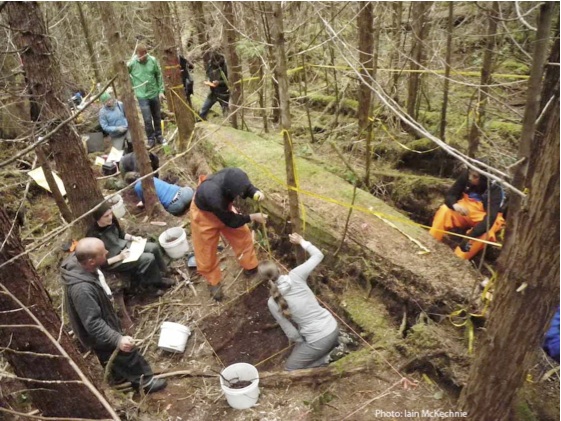
Archaeological work in Huu-ay-aht territory, 2012

Archaeological work in Huu-ay-aht territory, 2012

Quick note to say that the upcoming February meeting of the Victoria Chapter of the Archaeological Society of B.C.  should be a good one (sadly I am back east at the time):

Coastal Field Archaeology in Huu-ay-aht Territory: Highlights from the 2012 Bamfield Marine Science Centre Archaeological Field School

Tuesday February 19th, 2013, 7:30 pm Pacific Forestry Centre,
506 West Burnside Road. map

Free and Open to the Public

Abstract: In July and August of 2012, the Huu-ay-aht First Nation and the Bamfield Marine Science Centre co-hosted a ‘Coastal Field Archaeology’ course on Huu-ay-aht Government Lands in Barkley Sound on western Vancouver Island. Continue reading

Public talks in Vancouver and Victoria

Unusual fish hook fashioned from a canine tooth.  Burnaby Narrows, Haida Gwaii, 2012.  Photo by Jenny Cohen.

Unusual fish hook fashioned from a canine tooth. Ca. 3000 years old, Burnaby Narrows, Haida Gwaii, 2012. Photo by Jenny Cohen.

Quick note to say there are two forthcoming public talks that might be of interest to residents of Vancouver or Victoria.  The Vancouver one is by Dr. Ken Ames, Professor Emeritus at Portland State University, speaking at UBC on Thursday October 18th at 11.30.  The Victoria one is by yours truly, speaking to the Archaeological Society of BC on Tuesday October 16th at 7.30.  Details are below. Continue reading

Jobs on Haida Gwaii and at WSU

Archaeological Science on Haida Gwaii.

Archaeological Science on Haida Gwaii.

So I’ve never posted job ads here before and I may never do so again, but there are two ones posted right now with a lot of potential for readers of this blog: one is an archaeological position with the Council of the Haida Nation (PDF), the other a tenure track position  in archaeological sciences at Washington State University.

Continue reading

BC Archaeology Forum 2012 is October 26-28 in Cranbrook, hosted by Ktunaxa Nation.

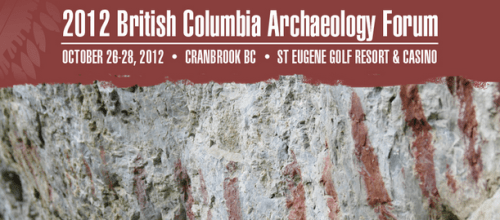
2012 BC Archaeology Forum Announcement screenshot

Screenshot of BC Archaeology Forum Website.

It came up in comments a week or so ago on this blog, but the annual wondering where the archaeology forum is over — it’ll be in Cranbrook October 26-28, with the main day of presentations and a dinner/drumming/dancing on Saturday the 27th. Indeed, the evening festivities are scheduled to go until 1.00 a.m., so it should be a good party.  The Sunday field trip will be to a quarry site. The Ktunaxa First Nation will be hosting, for which they deserve all our thanks.

Continue reading

Bead-rich human burials in shíshálh territory

NW Coast beads

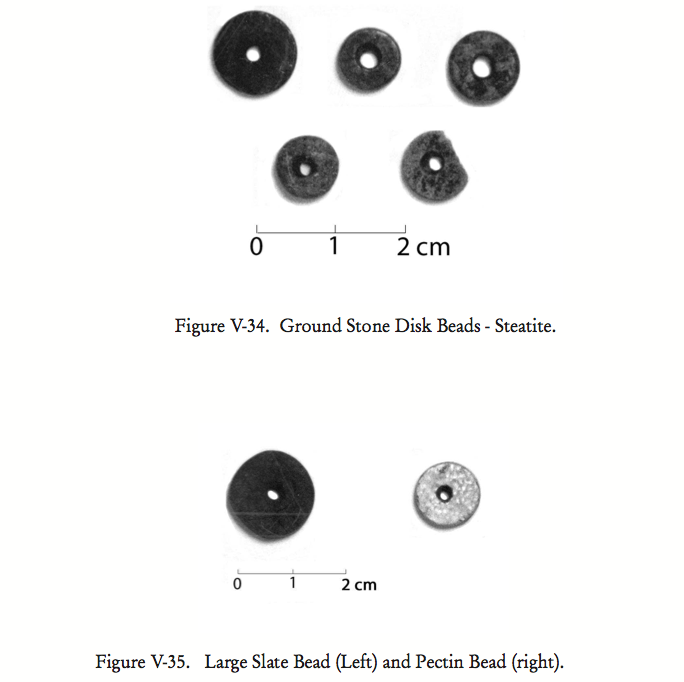
Examples of typical NW Coast archaeological beads, from B. Thom, reference below.

There have been some exciting finds on the Sunshine Coast (northeastern Strait of Georgia) in shíshálh First Nation territory, including a 4,000 year old burial with over 350,000 beads (!), as this short news item explains (PDF).  This is notable for a bunch of reasons:

Firstly, each bead represents a significant investment of labour.  Even if we conservatively say that you can make a small stone or shell bead in 5 minutes, then at 12 beads per hour, the individual was buried with some 29,000 person hours of labour investment.  That’s about 194 person-months of work, or just over 16 years of full time employment for one person.  (Incidentally, the five minutes is less than half the time UVIC’s own Brian Thom estimates from a brief experiment in Chapter V, here.)  However we may conceptualize the concepts of “work” and “effort” and their relationship to wealth or prestige in the past, we can’t just write off the full time labour of one person for 16 years, or 16 people for one year.  That’s a huge investment of time which could otherwise be used for fishing, hunting, gathering, or creating useful or durable technologies such as houses, canoes, or what have you.  Such measures of labour investment are commonly, if sometimes simplistically,  used to gauge the importance of the deceased individual in both life and death.  Apparently, in addition to this individual, there are other burials, including a young woman buried in a similar manner, from the site (DjRw-14).

Continue reading

Highlights from the Kwäday Dän Ts’ìnchi Project

Screenshot from the online document about Kwäday Dän Ts’ìnchi, showing his iron-bladed “man’s tool”, and a small copper bead found with the body. Source: Royal BC Museum.

[Edit Nov 2017: The Book is now available, also through Amazon, etc.]

Many readers of this ever-more occasional blog will be aware of the exciting and profound discovery in 1999 of the well-preserved remains of a young man frozen in a glacier in Northwestern British Columbia.  Found within the traditional territory of the Champagne-Aishihik First Nation, the man was given the name Kwäday Dän Ts’ìnchi, or “Long Ago Person Found.”  In the spirit of discovering what messages from the past that Kwäday Dän Ts’ìnchi might bearing, a remarkable collaborative research project was commenced. Results of this study have been presented at numerous conferences and in the scientific literature, but a landmark event hopefully just around the corner is the publication of a book recounting all the cultural and scientific knowledge borne into the present by this unfortunate young man.

While we wait for the book, it is very exciting to see that the Royal BC Museum has made a non-technical, well-illustrated overview document online which tells the main threads of the story of Kwäday Dän Ts’ìnchi. (edit, try this link instead, RBCM seems to have killed this document?)

Continue reading

BC Archaeology Forum 2011: Squamish, November 11 and 12

Detail of Archaeology Forum announcement. Click for PDF

I recently received the notice that the B.C. Archaeology Forum is to be held this November 11 and 12 in Squamish.  The event will be hosted by the Sḵwxwú7mesh (Squamish) Nation, and is being organized largely by Rudy Reimer/Yumks.  Anyone can register for this event for a highly reasonable $10.00: full information is given in this PDF file. The Forum is a great event, bringing together Consultants, First Nations, Academics and Government Archaeologists in one place to share the latest discoveries and to talk policy and matters relating to the practice of archaeology.  The deadline for presenting is October 28th, but you can decide to simply attend closer to the last minute, I believe.

That said I won’t be making it this year because of an unbreakable commitment.  This highlights an unfortunate part of “Forum Culture” – it is routinely announced only a month or so in advance, even when the location is known much further ahead. Many people have to arrange to take time off, or gain advance permission or funding to travel, organize a ferry load of students, or at least keep their schedule clear for this event.  I think I’ve missed three of the last four for this reason. It’d be great if we could change this, and at least get the location and date out earlier – maybe by the beginning of summer.  Speaking of, next year it would be cool to have it on the Island.  Who’s up for it?

Burnt Embers blog: Oak Bay Cairns Mark Songhees History

Cropped screenshot of detail of cairn marking Sahsima, south Oak Bay. Source: Burnt Embers blog; click to visit.

I recently have started following a wonderful new blog called Burnt Embers.  It’s mostly a photo blog of the author’s surroundings – which appear to be deepest south Oak Bay, which is a municipality adjacent to Victoria, B.C. It’s a wealthy municipality not really known for being sensitive to archaeological concerns or First Nations history: for example, it’s the locale of the rather messy Esplanade controversy I documented last year (1, 2, 3).

Anyway, the blogger at Burnt Embers, one “ehpem”, has recently done a great service by bringing to light a series of attractive cairns, emblazoned with art by Tsartlip artist Charles Elliot (Temoseng), which pay tribute to Songhees and Straits Salish places, history, and names.  As ehpem points out, Oak Bay Council has erected these cairns but provides no other information about them, whether on their website or anywhere else.  They’ve  been sort of bolted onto the Oak Bay landscape.  No matter: ehpem has photographed them beautifully and assembled a great series of pages documenting each one and also created a google map which is really handy for getting around from cairn to cairn. The cairns are, in the order which ehpem documents them:

Sahsima – a transformer stone near the Chinese Cemetery.  Sahsima, meaning “harpoon”, was the original name identified by Songhees elder James Fraser for the point where the Chinese Cemetery is located: Hayls the Transformer, with spirit companions, Raven and Mink, came by in his canoe, frightening away the seal the harpooner had been stalking. The harpooner rebuked them, Hayls turned him to stone as he stood there poised to throw the harpoon, saying “You’ll be the boss for seals … from Sooke to Nanaimo.” Continue reading

Namu Reburials

SFU Archaeology instructor Rudy Reimer holds a small replica of the handmade bentwood boxes that will be used to store ancestral Aboriginal remains. Source: SFU flickr stream.

There have been several newspaper stories recently noting the impending repatriation and reburial of human remains excavated from the famous Namu village site of the Heiltsuk Nation, on the central coast of B.C.   For example, here is one from the Vancouver Sun (PDF), another from the Globe and Mail (PDF) and a media release from Simon Fraser University itself, whose archaeology department conducted most of the excavations at this large site in the 1970s and 1980s, mainly under the direction of Roy Carlson. As ever, each newspaper source contains slightly different information.

Continue reading

Old site on Calvert Island, Central Coast of B.C.

UNBC student Cory Hackett excavates a unit in shell midden (photo credit: B. Alway, via UNBC)

There’s a good, recent article in the Globe and Mail (PDF) on some exciting preliminary findings by Dr Farid Rahemtulla of UNBC at a site on Calvert Island (map).

The site, thought to be the “lost village” of Luxvbalis, is in territory of the Heiltsuk and Wuikinuxv (formerly Oweekeenow/Awikenox) peoples.  The project was intended to re-locate this village, which figures prominently in Oral History.  Continue reading