Category Archives: First Nations

UCLA-Stó:lō Field School at Welqámex

s’iltexwáwtxw

I see UCLA is running a fieldschool again this coming summer in Stó:lō territory at Welqámex, a village site on the  small island in the Fraser River near Hope.  Instruction is by Anthony Graesch (UCLA) and Dave Schaepe  (Stó:lō Research and Resource Management Centre).  The UCLA web site has been down as much as up recently (because it has so  many bells and freakin’ whistles it doesn’t know if it is coming or going — idiot web designers make such fragile shit these days), so you can also check the AIA web site.  Here is a direct link to their pamphlet (PDF).

Note the students wearing protective ochre daubing.

Society of Ethnobiology Conference: Coming to Victoria

Top notches in a standing western red cedar tree, the result of extracting one or more planks.

Dana sent me a note that the 33rd annual meeting of the Society of Ethnobiology “The Meeting Place: Integrating Ethnobiological Knowledge”, will be held 5–8 May, 2010, in Victoria.I believe some “rockwashy” types are helping out with the organization.  It sounds like a great conference and a chance to build networks between plant people and rock people and bone people – and we sure do need a lot more archaeology of plants out here on the NW Coast, where bones and stones still rule the day.

This year’s conference theme celebrates the potential of ethnobiology to bridge disciplines, ideas, and communities, and to foster an understanding of the connections between the biological and cultural worlds.

In addition to our usual dazzling line up of papers and sessions, here’s a preview of some of the other special events:

  • Wednesday night welcome reception in the First Nations gallery at the Royal British Columbia Museum
  • Special discussion sessions on: Teaching science through ethnobiology, Ethnobiology and ethics, Communicating environmental knowledge through media, Indigenous people’s food systems, and more!
  • Thursday night poster reception at the just opened First People’s House at the University of Victoria
  • Six! fabulous field trip options
  • A banquet of traditional B.C. First Nation’s food followed by a presentation of the Atla’kima “Spirits of the Forest” dance by Kwakwaka’wakw Longhouse dancers

This year’s meetings will be back-to-back with the International Society of Ethnobiology congress in nearby Tofino, B.C., May 9–14.

Raven-Walking & Geological Transformation

Haida History starts at least 14,500 years ago. (Image credit: Daryl Fedje).

Three things we know about Haida Gwaii:

1.  About 14,500 calendar years ago it was a temperate tundra environment, with no trees.  The first trees, pine, appear about 14,000 years ago and there is progressive forest infilling thereafter, with the modern species mixture in place by about 3,000 years ago.

2. It has an impoverished suite of large land mammals – historically, these were limited to black bear, caribou, marten, ermine, a vole and a shrew.  We know that 13,000 years ago there were also deer and brown bear on the islands, and quite likely other species as well.

3.  It used to be much larger than in the present.  With lower sea levels at the end of the last ice age, Hecate Strait was largely dry land, exposing a large, unglaciated, coastal plain that became rapidly flooded.

It seems to me that we can add a fourth thing we know:

Continue reading

Northwest Anthropology Conference: NWAC 2010

The web site for NWAC 2010, to be hosted at Central Washington University March 24 – 27, 2010 in Ellensburg, Washington,  is up and running.  NWAC is a great conference which we were lucky to host in Victoria a couple of years ago.  In case you are wondering where Ellensburg is (no offence), it’s just to the east of the Cascades from Seattle, north of Yakima, about a 350 km drive from Victoria: map.

The theme of this year’s conference is the very welcome “At a Crossroads”:

Anthropology at the Crossroads” is the theme for the Northwest Anthropology Conference (NWAC), Ellensburg, Washington, March 24 – 27, 2010. While all submissions will be considered, this conference will offer opportunities for multiple perspectives on where we are as a discipline, society, and species, with a special emphasis on people and the environment. The “Anthropology at the Crossroads” conference will include symposia and presentations on subjects from archaeology, cultural and linguistic anthropology, paleoanthropology, primatology, medical anthropology, visual anthropology, and others. We invite submitters to use their own preposition in describing their presentation/symposia as “Anthropology at/of/on/etc the Crossroads.” Studying the past, understanding the present, and preparing for the future, makes Anthropology even more relevant today as the discipline continues to assert the importance of an appreciation for culturally diverse modes of interacting with our environment. Thus, this conference is a crossroads where the exchange of ideas better prepares us, our students, and our work to serve the communities we live in as we maintain our commitment to exchanging and transmitting our under-standings of all people, in all places, and at all times. “Anthropology at the Crossroads” also implies interaction among sub-disciplines and communities in an integrated fashion and in this manner encourages self reflection on the relevance of Anthropology today at a moment when we appear to be at several global crossroads.

Chief Thunder Voice

Bing Crosby being invested as Squamish Chief Thunder Voice.

In 1948, Bing Crosby, then a first-rank international star, visited Vancouver – and ended up being invested as Squamish Chief Thunder Voice, among other civic performances.  The Vancouver City Archives has the video (1.00 minute in).

By the way, what is up with coastal First Nations adopting feather war bonnets?  Is this a kind of weird double reverse emulation: trying to look more stereotypically Chiefly in the eyes of the majority population?  Is it intra-aboriginal cultural appropriation?  Or do they just look freakin’ awesome?  Note the tomahawk as well in the picture above.  Someone should write a paper on “Plains Paraphernalia as  Signifiers of Rank on the Historic Northwest Coast”.  Or maybe they have, already.  I’d read it.

New Westminster, 1903

Aboriginal women at New Westminster, 1903.

There is something about the above picture that is so evocative: Native women washing clothes or getting water while in the background the first construction of the Fraser River Bridge at New Westminster rises.  With a different caption this could be the Ganges River, or the Colorado: always women, always squatting, always the back turned to the viewer and the colonial future in the background.

From the idiosyncratic New Westminster online photo archives – this uses the LoC system so you have to search for, say, “Indians” rather than “First Nations”.

New Westminster, ca. 1865

Somenos Creek: Update

Somenos Creek site. Picture this with 20 houses on it. Photo credit: anonymous.

Further to my post below, here is another news item on the Somenos Creek (Cowichan Valley) situation.  It mostly rehashes the Times-Colonist piece but does have new comments from Eric and from the developer, notably:

Schmidt, who has tried but failed to have the six-acre site, known as Lot B, rezoned for development, said it would be worth up to $3 million if it weren’t for the presence of the artifacts and burial site.

Timbercrest has built about 300 homes on the land so far and would like to put up another 20 on Lot B.

So, lets see 20/300 = 6.7% of the 100 acres.  The 100 acres was bought in the 1970s.  I am going to go out on a limb and suggest that much less than 1 million was paid for the 100 acres back then.  The current valuation of these six acres would value the entire parcel at 45 million.  Let’s halve that:m 22 million.

So this developer has turned a one million dollar piece of land into a 20 million dollar piece of land.  A 2000% return.  And he wants financial consideration and compensation from the public because he happens to have a legally-protected (and morally protected, I might add) site of the highest archaeological significance on the residual piece?

This is the 21st century: Greed is no longer good, Timbercrest Estates Ltd.  Give the land up, get a tax writeoff, and count your blessings you live in a country that is so extremely friendly to rampant development of land, enabling fortunes to to be made.

MacLeans: Natives and Suits vs. Environmentalists

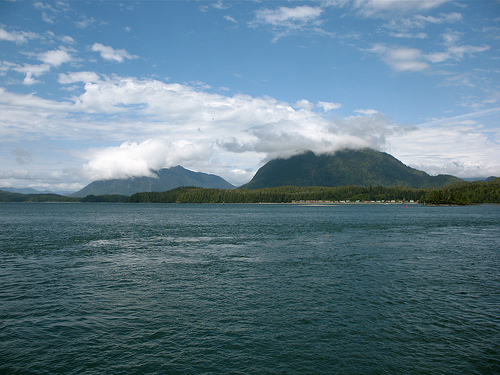
Catface (left) and Lone Cone, Clayoquot Sound. Village of Opitsaht in the foreground, Tofino to the right. Source: flickr.

MacLean’s is a magazine that is well past its “use by” date and true to that form they have put up a remarkably provocative and axe-grindy article on economic development in First Nations territories.  Mind you, I think it is entirely true that First Nations want meaningful economic opportunities and I hope they get them.  Some environmentalists seem to think that aboriginal people are noble savages who will play the role of wildlife in parkland.  Leaving aside the MacLeans implicit question of why the hell should they be au naturale when settlers have raped all the rest of the land, the fracture lines between the First Nations and Environmental groups have been clear to me since  I worked on the Meares Island case 20 years ago.  Anyone working on that project could see that the envirnmental movement and the First Nations were going to have a trainwreck at some point in the future.  A balance of park land and economic use is what we should expect on settlement lands.  What right do we have to hold the First Nations to a higher standard than to ourselves? Are the Squamish Nation’s billboards less lovely than Surrey, or North Vancouver, let alone the wasteland that is Squamish itself?  But MacLean’s magazine: way to completely ignore longstanding, demonstrated First Nations stewardship of the land.  That article is a complete waste of 10 minutes of my life, but I am linking to it anyway.

dSpace: The Indian History Film Project

Haida Town of Chaatl. Source: NMC

There is an interesting archive of interview transcripts housed in dSpace at the University of Regina.  Most of the interviews were by CBC Radio’s Imbert Orchard and so share the flaws of Journalism and Anthropology.   The preamble says,

The original intent of The Indian History Film Project was to conduct interviews with First Nations elders across Canada and to produce a television series portraying Canadian history from a First Nations’ perspective.

The Indian History Film Project was an initiative of Direction Films and was conceived and developed by Tony Snowsill. The project leaders were Tony Snowsill and Christine Welsh. The project evolved over time, and eventually it was decided to access libraries and archives across the country to incorporate existing interviews with First Nations elders. All interviews, whether original or archival, were cross indexed by word and theme and housed in the C.P.R.C [Canadian Plains Research Centre].

A number of these interviews are with Haida people, notably Solomon Wilson and Florence Edenshaw, who discussed her arranged marriage, the meaning of Tow Hill, and the artistic tradition of her family, the Edenshaws and Davidsons.  It appears tapes of these are also available through the BC Archives, but not online.

Note: anytime you see (Indian) it means that a Haida word was not transcribed — an eerie effect.  Searching for British Columbia brings up 91 documents.

The following excerpt from an interview with Solomon Wilson of Skidegate sees him relating a tale of smallpox blankets:

Continue reading

Somenos Creek CRM

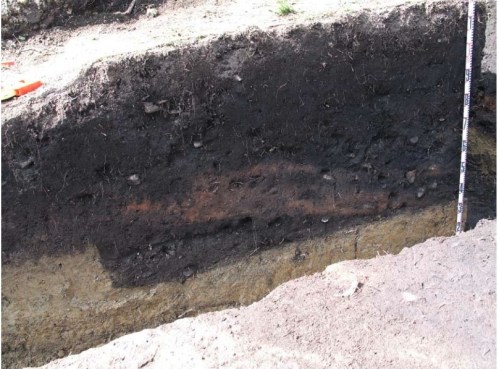
Diagonal exposure of apparent 2000 BP house at Somenos Creek.

I don’t know too much about the Somenos Creek development in the Cowichan Valley which is discussed in this column in the Times-Colonist:

The North Cowichan story goes back to 1972, when Schmidt was among the developers who bought 100 acres of farmland. About 300 homes eventually arose on what became Timbercrest Estates. Not developed was a six-acre piece where human remains were found in 1992, and where archeological investigations later turned up a feature — a hearth, perhaps, or a house foundation — dating back to the time of Christ.

The Cowichan Tribes think there’s more to be found, that it is important to preserve all six acres, perhaps use it for educational purposes, but Schmidt thinks a dozen houses can be built around the perimeter of the area of proven archeological significance. The natives’ hope now is that government will recognize the importance of the property and buy it, an idea they pitched to cabinet minister Kevin Krueger last week. His reaction? “It wasn’t negative, so I think that’s positive,” says Cowichan Tribes lands-research director Diane Hinkley.

Krueger says there isn’t money to buy such lands outright, but he wants to see what can be done to work things out.

For his part, Schmidt just wants to be done, one way or the other. Either the province or Ottawa buys the land, or he applies for a development permit. “I’m into it too deep to just let the land sit there.”

One of the researchers sent me a copy of the report, and there is a fairly compelling set of features unusual in (a) being inland (b) including an inland shell midden component and (c) including a large subsurface sub-rectangular, sharply defined feature which appears to be the remains of a house dating to ca. 2100 BP.  This makes the site of unusually high archaeological significance – not to mention there are numerous human burials (analysed in Doug Brown’s MA thesis) and extensive archaeological deposits of other kinds.  The house feature is remarkably similar to a contemporaneous feature I saw being excavated a few years back at Esquimalt Lagoon.  We know very little about houses from this period, particularly houses found in inland contexts.  What is striking about the newspaper column above is that it reports the developer has managed to put houses onto 94 of 100 acres, and is now champing at the bit to develop, or be compensated for, the last 6 acres.  I mean, seriously, George Schmidt of Timbercrest Estates, you have achieved 94% of the development you sought.  How about leaving the burial ground alone?  You bought the land in the 1970s.  Surely you have made your money back many many times over. A donation of this small parcel as a heritage park would be a classy move.
Somenos house? feature

Somenos feature - note sharpness of vertical section indicating probable use of plank retaining.