Category Archives: Cultural Resource Management

One more update on the Museum of Vancouver’s Petroglyph.

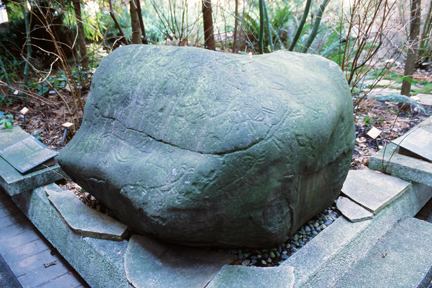
Interior Petroglyph now at Museum of Vancouver, while still in Stanley Park ca. 1980. Source: DanLeen.org

I have posted several times recently on a superb interior petroglyph boulder languishing in a shady courtyard at the Museum of Vancouver.  Together with Heather Pringle’s posts on this topic, we seem to have caught the attention of the Board of Directors of the Museum.

One of the Directors, Anthropology Professor Bruce Miller of UBC, called me the other day.  He consented to me posting notes from our conversation.   Continue reading

Shopping maul

Maul from the Dundas Collection.  Source: Sotheby's

Tsimshian Maul from the Dundas Collection. Source: Sotheby's

The Dundas collection of Tsimshian objects deserves a week of posts – not just for the stunning beauty and resonance of the art but for the profound issues in heritage management, cultural property ownership, and repatriation ethics which it raises or exemplifies.  I’ve been reading up on it a bit, and at one level the isssue is very simple: these Tsimshian treasures should have been repatriated – not to Canada per se, but to Tsimshian Territory.  At another level, there are complex, interwoven threads of (mutual) respect and ownership which make (and made) for no easy solution.   And no easy solution was reached: the collection was broken up, with the majority of the pieces sold to foreign hands (by foreign, here, I mean non-Tsimshian though I am prepared to argue this).

But for today, I was interested to see the Sotheby’s auction catalogue from the 2006 sale of this collection is still online.  The most interesting piece, of course, is the northern-style maul, seen above.  It sold for a surprising USD $1,320.00.  I wonder if it was in use at the time of collection or if it was already an archaeological specimen.  Collection of such materials from archaeological sites and their sale is, of course, now illegal although so far as I know there is a grandfather clause for older collections pre-dating the modern legislation.  I imagine any maul without such prominent provenance would be worth very little indeed.  Despite fetching far more than I would have imagined, it was a mere snip compared to the mask below which sold for a jaw-dropping USD$1,808,000.00.

Tsimshian Mask from the Dundas Collection. Source: Sotheby's.

More views of the Museum of Vancouver petroglyph problem

Petroglyph from Lone Creek Cabin, Stl’atl’imx Territory, now in an outdoor courtyard at the Museum of Vancouver. Source: Squamish-Lil'wat Centre.

I’ve posted before on the large petroglyph boulder from the central Fraser River that is being kept in a sub-standard context at the Museum of Vancouver.  I found some more pictures of it, from the website of the Squamish-Lil’wat Cultural Centre (which is excellent).  These additional pictures confirm there is a serious conservation issue at the Museum of Vancouver.  I don’t want to beat a dead horse but I am still mad about this situation. Continue reading

Reminder: RBCM Open House

If you are in Victoria, this is a reminder that the RBCM open house is today and tomorrow, at which they will explain about their “zoning application”, which I hope means they will also be ready to explain what they plan on doing with the rezoned land (I commented on this previously).  I see in today’s Times-Colonist they lost $491,000 last year, and are projecting no travelling shows until 2012, except the Terracotta Army.  That and the British Museum exhibit each cost about 3 million dollars to mount, as an off-the-shelf travelling exhibit here for a few months.  How much permanent exhibit could one buy for $3,00,000, which would pay for itself every day of the year?  I know they have been forced into a particular niche by funding constraints and all – but it seems to me they are in a financial and existential crisis.  Therefore I hope they are sincere about gathering meaningful public input because I suspect regular readers of this blog have a lot to say about it.

When:  March 6 & 7 2010
Where:  Royal BC Museum
675 Belleville Street
Newcombe Conference Hall

What to Expect: Open House hours between Noon – 3:00 pm.  Zoning project team members will be on-site to answer any questions, and/or have a conversation with you about zoning the Royal BC Museum site.

Squamish and Lil’wat Cultural Journey

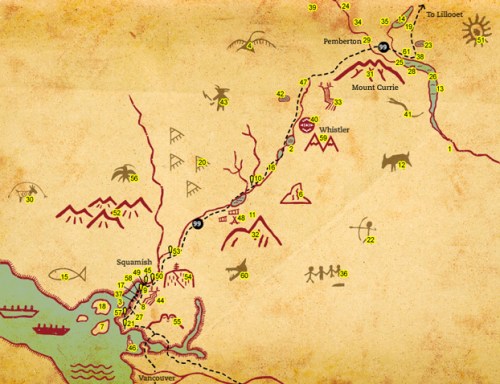
Squamish Lil’wat Cultural Journeys Map. Click to go to the site.

The Squamish and Lil’wat First Nations have jointly produced a really nice website which explores the cultural landscape of their traditional territories, which lie just north of Vancouver. Edit: it looks like their website now sells kitchen products – obviously they did not keep their registration up to date.

The interactive map has dozens of “clickable” elements, taking you to place name information, to the description of rock art motifs, and to landscape features imbued with stories from history and the supernatural.  Some of these include simple but effective animations, and the overall site design is clean and harmonious.

It seems that seven highway pullouts have also been designed with this information: aboriginal cultural tourism out on the land is something I have long thought has enormous potential in B.C.  Looking at a book or a website is one thing, but having the information available, provided by the First Nations, at the place where the story happened or the traditional use occurred, seems like it would be very effective, and popular, way of educating the public about the thousands of years of cultural history on either side of the Olympics.

Supernatural serpent emerging from Ts’zil (Mt. Currie). Screenshot from culturaljourney.ca

Handmade Garnet Musket Ball from New Archangel

Garnet musket ball from excavations at Sitka, Alaska. Source: Alaska OHA.

It is a common trick in archaeology classes to puzzle students with gunflints – part of the sparking mechanism of older muskets – which were made until recent times by the remnants of a European flaked stone industry until modern cartridges replaced them.  However, I had never heard of the use of stone musket balls before — but the picture above shows one made out of garnet, which is a heavy and dense mineral. This specimen is from a historic Tlingit-Russian site in Alaska.  As the caption notes:

“Large garnets can be found in schist… Because of the shortage of lead, the Kolosh [Tlingit]  use them instead of shot to kill sea animals.” [Khlebnikov’s 1817-1832 report, 1976:39]

It is typically ingenious for the Tlingit to have adapted traditional stone working technologies to the new, introduced technologies.

Over much of coastal Alaska the first contact aboriginal people had with Europeans was with Russians, rather than Americans, British, French or Spanish.  One of the most important Russian settlements was Novoarkhangelsk, or New Archangel, founded in 1799 at the present day town of Sitka (map).  The tumultous history of the founding of this outpost near a Tlingit village called Gajaa Héen, its subsequent capture by Tlingit warriors and ransom of Russian captives for 10,000 rubles, and its recapture 1804 by a Russian naval fleet during the “Battle of Sitka” is a subject for another day.

Suffice it to say that, as with all history, archaeology can fill in the stories of the everyday life of people and of events that go unrecorded by pen and paper.  In this respect, it is good to see the Alaska Office of History and Archaeology has a very full, very detailed report available online about archaeological work at “Castle Hill”, the ancient Tlingit fort known as Noow Tlein which subsequently became the cornerstone of the Russian defensive facilities at New Archangel.  You can browse the report chapters here, and the photos here and here.  No doubt I will post more in due course, as there are some extraordinary artifacts found at this site, not least among which is this hand-made toy musket.

The Russians may have won the battle of Sitka, but they eventually left, leaving behind the Sitka Tlingit tribes to continue their journey to the present, where their vibrant culture continues to thrive as this interactive place names map for the modern Town of Sitka makes clear.

Fort at New Arkhangel -- "View of the Establishment at Norfolk Sound," 1805-06 (from a watercolor by G.H. von Langsdorff). Source: Alaska OHA.

PS:  if you are skeptical about that Wikipedia link to the Battle of Sitka, then you can hear about the events in Tlingit here).

Plan of New Archangel, 1804. Fort site is to centre right. Source Alaska OHA.

Major expansion at the Royal B.C. Museum?

Proposed changes to the RBCM: the clear white structure to the back left is the new curatorial tower & archives; to the right is a new entrance and multi-functional area. Source: Times-Colonist.

The Victoria Times-Colonist had a story Saturday that the Royal B.C. Museum is proposing a major expansion, in which theirs quare footage would more than double, from 379,000 to 895,000 square feet.  The curatorial tower and the low-rise archives building on the NW side of the block would be demolished, replaced by a new multi-function complex which would also form the entrance to the museum.  The collections and curatorial facilities, and the archives, would move to a new 14 story building to the south of the current museum.  The RBCM C.E.O, Pauline Rafferty (an archaeologist by training) notes that ““We are now at a crossroads.  We have outgrown our on-site storage facilities and significant artifacts are stored below sea level.”  The article estimates the cost will be in the hundreds of millions of dollars which is easy to believe. The Times-Colonist weighs in with a strong editorial of support, citing the collapse of the Cologne archives last year with irreparable damage to the history of that City.  So: no-brainer, right?

Continue reading

Lasqueti Island Archaeology

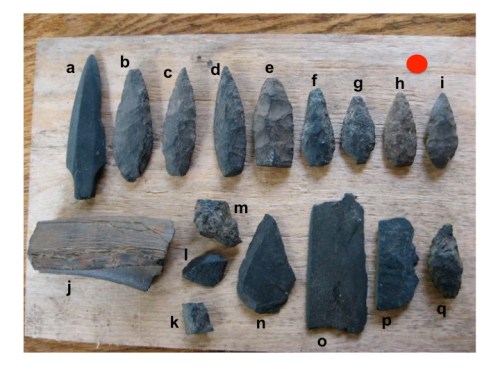
Projectile points and other artifacts from Lasqueti Island.

So many of the Gulf Island of the BC Coast are essentially unknown to archaeologists.  This goes for the larger ones as well as the small: I’d count Lasqueti, Hornby, Texada, Saturna, and Prevost Islands among those, while even major islands like Mayne Island and Quadra Island are often known only from one site, dug long ago.

This doesn’t mean there hasn’t been any work, or that there aren’t interesting and revealing collections of archaeological material already in existence.  So it is great to see that Dana Lepofsky of SFU has put together a small web site on the archaeology of Lasqueti Island.  She deftly combines some ethnographic and traditional practice information with a series of photographs of private collections of artifacts.  Among these are projectile points apparently assignable to the Charles Phase, which dates around 5400 to 3600 years ago.  Also note the beautiful ground stone adze or chisel in this picture: the luminous green nephrite (B.C. “jade”) would have been imported from the Central Fraser River, probably no closer than the Hope area.  This flaked and ground sandstone club is an unusual find, probably used in hunting or fishing, but perhaps also in warfare.

If you click the photographs, then a window will open; if you click the “image details” link on the pop-up window then you will be taken to more information about that photo, if available.  There are also two PDFs linked, one to the role of herring in traditional subsistence, and another on mapping a fishtrap.  These stem from Lepofsky’s ongoing work (and excellent website) in Tla’amin territory on the Sunshine Coast (previously), where she will be running an archaeological fieldschool again this summer.  While this only scratches the surface of Lasqueti Archaeology, it does point to the usefulness of looking at what citizens have picked up over the years as a guide to some of the time depth and activities of an area.

Sadly, of course, some of the artifacts picked up may have resulted from, or even caused, unnecessary disturbances to the archaeological record.  Lepofsky provides a helpful “call before you dig” article as well – specific to Lasqueti yet applicable elsewhere.  In typical Dana fashion, as a Lasquetian herself, the number to call is her own!

Lasqueti Island intertidal fishtrap. Photo: Dana Lepofsky.

1973 Aboriginal Perspective on UBC-MOA and SFU archaeology

Excerpt of 1973 Nesika newsletter criticizing MOA and SFU Archaeology. Click to view full page. Scroll down this page for link to plain text.

2018 edit: It looks like Nesika is now available to browse here, and to search here.

This is interesting, from the newsletter Nesika: Voice of B.C. Indians Vol. 2 No. 1 (February 1973), Page 6:

MONEY FOR BOAT: There is money to fund a boat to take archaeology students up and down our coastline to dig up the bones of our grandfathers and sift, sort, and label sacred objects from our burial grounds, but no money for us to treat our heritage with the dignity it. deserves?

This can only refer to the former pride and joy of the SFU department of Archaeology, the motor vessel Sisiutl.

That page from Nesika has two interesting articles.  One argues for the creation of a Cultural Centre at Hesquiat, while the other passionately objects to the millions spent on the UBC Museum of Anthropology and the above-mentioned Sisiutl.  Click on the image above for a legible image of the entire text, or click here for a transcript.  It is chastening to see the eloquence and power of these arguments from almost 40 years ago.  Hesquiat still has no Cultural Centre so far as I know while the Museum of Anthropology just wrapped up a 60+ million dollar renovation and SFU Archaeology has what amounts to their own, brand-new building as well, at what I hear was a cost of about 5 million dollars.

HESQUIAT BAND CULTURAL CENTRE

Lack of funds hit by Chief Rocky Amos

VANCOUVER (Staff) — After Indian Affairs had denied a request for funds for the Hesquiat Cultural Centre due to lack of funds, Band Chief Rocky Amos told the department that “we cannot accept the limitation of funds as valid.” Pointing to the $10 million available to a museum to house Indian artifacts at UBC and to other reports of funds granted for more white people to study Indians, Chief Amos wrote DIA: “It is difficult to follow the line of thinking that makes money available to exhibit our inheritance to city based people and when the rightful heirs to these very artifacts ask for assistance to house their history in an area where it will be meaningful to them, they are denied. “We of the Hesquiat Band are not unique and we have proven we can do it. Now we are made to crawl on our stomachs begging for funds to house our heritage. My pride is aching from begging but my pride also screams in agony when our people are forced into whitemen’s museums to see their inheritance.”

As the second article concludes in terms it is hard to argue with:

If there is money available for museums to store stolen work, then there is money available for museums to be built where that work belongs. With the children and grandchildren of the artists who represented a culture and society which has not, despite all efforts, conveniently died.

First custom built archaeology research vessel in North America: The Sisiutl. Recently scrapped by SFU.  Source: American Antiquity.

PS: kudos to the Union of BC Indian Chiefs for putting so much archival information online.  In related news, I previously linked to the archives of the Native Voice, which is another great resource for understanding First Nations politics and which also contains intriguing aboriginal perspectives on the practice of BC Archaeology.

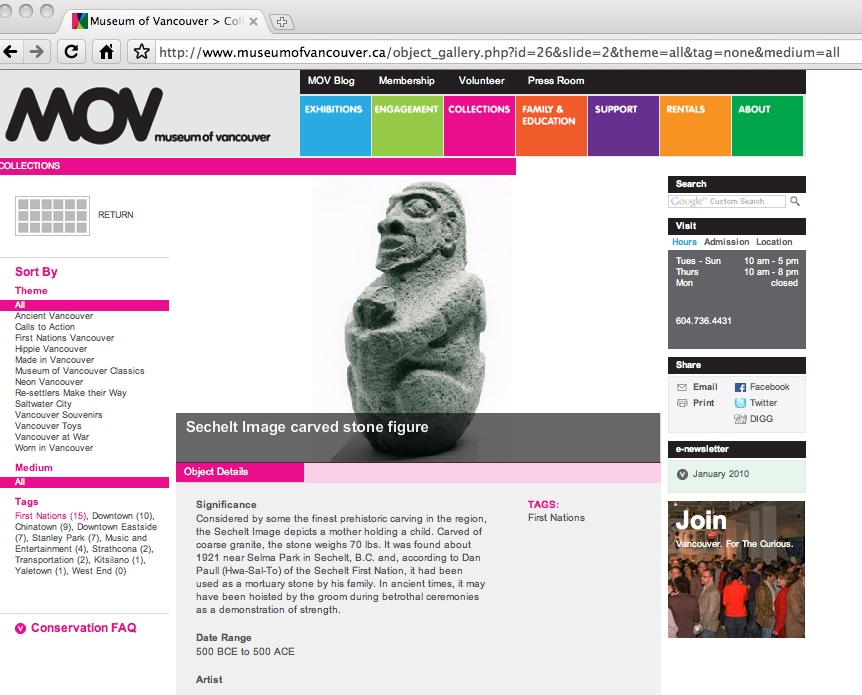
Museum of Vancouver Web Site (Fail)

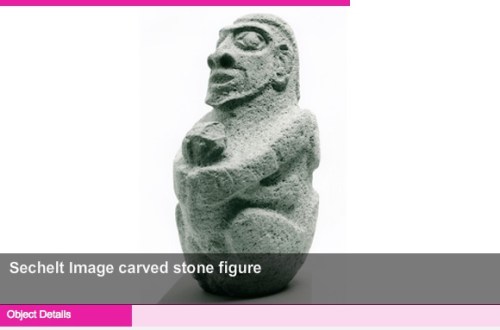
The Sechelt Image. Detail of Screenshot from the Museum of Vancouver. (click for full screen or scroll down)

The Museum of Vancouver has a pretty slick and punchy website from a design point of view, very “Web 2.0” with bright colours and links to twitter and facebook and the like.  But in some respects it fails, and fails badly.   Consider the image above: the “Sechelt Image”, a stone sculpture and one of the most famous objects in BC Archaeology.  A single low-resolution picture is offered, a link to which is not possible, and downloads of which are  deliberately made difficult.  And in this protective bubble,  the object can only be seen as a pale, grainy image, surrounded by the Museum’s loud and crass colour scheme. (Update: see full screenshot below: the Vancouver Museum overlays its neon social web over the Sculpture much like Vancouver itself overlays aboriginal culture).

Fine – I am used to that ridiculous phenomenon wherein Public Institutions think they own the images that they are entrusted with – if the image is allowed to be seen by the descendent communities (and in this case I wonder if it really is) then why can it not be seen in high resolution, free from the magenta borders and the exhortations to tweet!?

But the real problem is that the web designers, with their stupid and un-necessary banner reading “Sechelt Image carved stone figure”, obscure an important area of the sculpture, including the all-important vulva which reveals, as noted by Wilson Duff, that this sculpture is powerfully hermaphroditic.  It is not just bad and regressive museology to cover up an important part of an object, but I believe it is deeply disrespectful as well.  By obscuring part of the image and by imprisoning it within their branded frame and obfuscating web design, they, the (hopefully) temporary guardians of this powerful piece of art, are visually co-opting it for what amounts to advertising purposes.  There is no reason to put your label over top of that which you claim to be displaying for its own sake; no reason other than marketing zeal and lack of control over the web designers.

You might think it was just prurience over the frankly sexual image, but below we see another image from their website with no shocking! vulva! to conceal, which has been similarly branded and bounded by the MoV.  Maybe I am just mad at them still because they’re using a petroglyph boulder as a rock garden (note the obscuring “petroglyph” banner) but really: their website is an egregious example of stealth appropriation and blatant disrespect under the disguise of progressive design and social networking.  And I’m just a dumb archaeologist: I’d love to see a Visual Anthropologist dissect the public face they are so eager for the world to see, the face they insist must frame every image on their website.

The Skytte stone bowl. Screenshot from the Museum of Vancouver website. Click for full screen.

The Website sends the Message: "This is Not a Place of Honour. There is No Dignity Here."