Category Archives: Archaeology

Raven de La Perouse

Wooden and brass pipe representing Kan Lituya in the form of a Supernatural Frog, and his Bear Slave creating waves in Lituya Bay. Source: de Laguna, Volume. 3

My recent post on the 1786 visit by La Perouse to Tsunami-prone Lituya Bay, Alaska sent me scurrying to download the massive ethnography by Frederica de Laguna entitled Under Mount St. Elia Under Mount Saint Elias: The History and Culture of the Yakutat Tlingit.  As expected, there is a rich oral history of waves in this bay.  From Volume 1, page 94, she says

Emmons (1911, p. 295) recorded Indian beliefs about the dangers of Lituya Bay, caused by:
“… a monster of the deep who dwells in the ocean caverns near the entrance. He is known as Kan Lituya, ‘the Man of Lituya’ [qa htu ‘a?]. He resents any approach to his domain, and all of those whom he destroys become his slaves, and take the form of bears, and from their watch towers on the lofty mountains of the Mt Fairweather range they herald the approach of canoes, and with their master they grasp the surface water and shake it as if it were a sheet, causing tidal waves to rise and engulf the unwary.

De Laguna then continues to discuss an extraordinary wooden smoking pipe, illustrated above:

“This legend of Lituya is illustrated by a carved wooden pipe (fig. 50) [pi. 123], of splendid proportions, which was obtained in 1888 from the chief of the Tuck-tane-ton family of the Hoon-ah Kow [DAqdentan sib of Hoonah], who claimed this bay as his hereditary sea-otter hunting ground. It was used only upon occasions of particular ceremony—when the clan assembled to honor the dead, or to deliberate upon some important question of policy. At one end is shown a froglike figure with eyes of haliotis shell, which represents the Spirit of Lituya [possibly the Frog crest of the sib?], at the other end the bear slave sitting up on his haunches. Between them they hold the entrance of the bay, and the two brass-covered ridges are the tidal waves they have raised, underneath which, cut out of brass, is a canoe with two occupants, that has been engulfed. [Author’s note: This illustration was furnished through the courtesy of Mr George G. Heye, in whose collection the pipe now is.”]

One thng leading to another, I thought I would look into whether the Tlingit story of La Perouse’s visit had been passed on.  As it turns out, the early ethnographer G.T. Emmons records an account given by a Tlingit chief one hundred years after the visit of La Perouse to Lituya Bay.  This gives an indigenous perspective on what must have been an extraordinary series of events for both parties.  This account is well worth reading, so I am reproducing a portion of Emmons (1911) rendering below:

“In 1886, one hundred years after [the vist of la Perouse], Cowee, the principal chief of the Auk qwan of the Tlingit people, living at Sinta-ka- heenee, on Gastineaux Channel, told me the story of the first meeting of his ancestors with the white man, in Lituya Bay, where two boats of the strangers were upset and many of them were drowned. This narrative had been handed down by word of mouth for a century. These people possess no records nor had the chief, who spoke no word of our tongue, ever heard of La Perouse from outside sources; so we can here authenticate by an exact date a most interesting piece of native history in detail, the truth of which is substantiated by the fact that La Perouse was the only one of the early navigators to visit this locality in a large ship and by the attending loss of life in the destruction of his two boats.  Continue reading

Maori Canoe found in New Zealand Beach

Canoe being excavated at Muriwai Beach, 2010. Source: stuff.co.nz

From the Northwest Coast (of New Zealand) comes inspiring news for Northwest Coast (of North America) archaeologists.

I don’t know how many times I’ve told students that I would never really expect to find a canoe in an archaeological site and that the evidence for watercraft and marine fluency – still a contentious issue for the early Northwest Coast – will likely be resolved through interpretation of marine fauna from archaeological and from finding sites on remote islands.  While in my view Kilgii Gwaay settles this question for the early period on the Northwest Coast,  I suspect nothing short of a 10,000 year old dugout canoe will satisfy some people as to whether the first inhabitants around here could catch a fish.

So it came as a surprise to read that a nearly-complete, seven-metre long Maori wooden waka tikai, or river  canoe, has been recently found in Muriwai Beach (map) on the Northwest Coast of New Zealand (video clip).  The canoe may take several years to properly conserve, and is currently undated.  While the canoe presumably is less than a thousand years old (the accepted time frame for the  arrival of Maori in New Zealand), the fact that it survived at all, buried in the sands of what appears to be a fairly exposed beach, leads me to think we need to keep our eyes open more for this kind of find on the Northwest Coast.  This story claims that it was seen washing up in the 1920s, but still – once something like this survives the process of burial then it might survive for a very long time indeed protected deep in dark, wet beach or dune deposits.  Memo to self: don’t be so pessimistic!

Maori waka being raised. Source: nzherald.co.nz

Destruction of Kwalate Village

Major landslide scar near Kwalate Village. Source: panoramio user Obslord.

Yesterday’s post about Marianne Nicolson’s powerful pictograph in Kingcome Inlet and the post from a few days ago about the enormous Tsunami in Lituya Bay got me thinking again about recent work in Knight Inlet on the central B.C. Coast (map).

A recent project by a team of geomorphologists and an archaeologist, UVic’s own Duncan McLaren, investigated oral historical accounts about Kwalate Village of the A’wa’etlala and Da’naxda’xw peoples, of the Kwakwaka’wakw First Nations.  The accounts state that a landslide in Knight Inlet triggered a local Tsunami which swept this village away. This account is known anthropologically through a number of sources, including Franz Boas (1910, Kwakiutl Tales):

“About three generations ago, or possibly at an earlier date, a large portion of the mountain opposite Kwalate Point slid into the inlet causing a huge tidal wave which wiped out all of the inhabitants of the village opposite…and the vast slide is noticeable today”.

Of course, the story of the destruction of Kwalate is still told and the dead, unknown in number but perhaps up to one hundred, are still mourned and memorialized in the surrounding communities.  While it is not necessary, or even desirable or possible, for archaeology to confirm oral historical accounts, when that happens it can be of interest to archaeologists and First Nations people alike. Continue reading

Northwest Coast in New Zealand

Masset, ca. 1924. Source: University of Canterbury, NZ.

I found myself poking around in a New Zealand archive at the University of Canterbury the other day and found some nice historic pictures from the NW Coast.  These are assigned to the collection of John Macmillan Brown, an early New Zealand academic and, in retirement, an amateur anthropologist.  I am guessing these pictures were taken by him in retirement.  Most are undated; one carries a date of 1924.  The subjects are familiar yet the views are new – the more we can catalogue the world’s pictures of the NW Coast, the better we can understand the processes of transformation which continue to unfold.

Update: fixed links, sort of.  Note to web types: you should always provide stable URLs, none of this “your search has expired” junk.  If you want your collections used, and you do, because you put them on the web, you need to make it so the results can be bookmarked and shared.  Gosh.

Skidegate ca. 1924. Are those oarlocks on that canoe? Source: University of Canterbury.

Major expansion at the Royal B.C. Museum?

Proposed changes to the RBCM: the clear white structure to the back left is the new curatorial tower & archives; to the right is a new entrance and multi-functional area. Source: Times-Colonist.

The Victoria Times-Colonist had a story Saturday that the Royal B.C. Museum is proposing a major expansion, in which theirs quare footage would more than double, from 379,000 to 895,000 square feet.  The curatorial tower and the low-rise archives building on the NW side of the block would be demolished, replaced by a new multi-function complex which would also form the entrance to the museum.  The collections and curatorial facilities, and the archives, would move to a new 14 story building to the south of the current museum.  The RBCM C.E.O, Pauline Rafferty (an archaeologist by training) notes that ““We are now at a crossroads.  We have outgrown our on-site storage facilities and significant artifacts are stored below sea level.”  The article estimates the cost will be in the hundreds of millions of dollars which is easy to believe. The Times-Colonist weighs in with a strong editorial of support, citing the collapse of the Cologne archives last year with irreparable damage to the history of that City.  So: no-brainer, right?

Continue reading

Lasqueti Island Archaeology

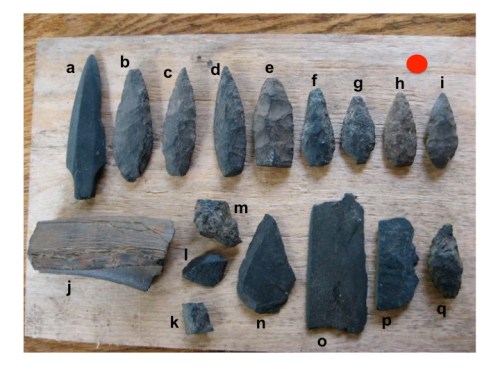
Projectile points and other artifacts from Lasqueti Island.

So many of the Gulf Island of the BC Coast are essentially unknown to archaeologists.  This goes for the larger ones as well as the small: I’d count Lasqueti, Hornby, Texada, Saturna, and Prevost Islands among those, while even major islands like Mayne Island and Quadra Island are often known only from one site, dug long ago.

This doesn’t mean there hasn’t been any work, or that there aren’t interesting and revealing collections of archaeological material already in existence.  So it is great to see that Dana Lepofsky of SFU has put together a small web site on the archaeology of Lasqueti Island.  She deftly combines some ethnographic and traditional practice information with a series of photographs of private collections of artifacts.  Among these are projectile points apparently assignable to the Charles Phase, which dates around 5400 to 3600 years ago.  Also note the beautiful ground stone adze or chisel in this picture: the luminous green nephrite (B.C. “jade”) would have been imported from the Central Fraser River, probably no closer than the Hope area.  This flaked and ground sandstone club is an unusual find, probably used in hunting or fishing, but perhaps also in warfare.

If you click the photographs, then a window will open; if you click the “image details” link on the pop-up window then you will be taken to more information about that photo, if available.  There are also two PDFs linked, one to the role of herring in traditional subsistence, and another on mapping a fishtrap.  These stem from Lepofsky’s ongoing work (and excellent website) in Tla’amin territory on the Sunshine Coast (previously), where she will be running an archaeological fieldschool again this summer.  While this only scratches the surface of Lasqueti Archaeology, it does point to the usefulness of looking at what citizens have picked up over the years as a guide to some of the time depth and activities of an area.

Sadly, of course, some of the artifacts picked up may have resulted from, or even caused, unnecessary disturbances to the archaeological record.  Lepofsky provides a helpful “call before you dig” article as well – specific to Lasqueti yet applicable elsewhere.  In typical Dana fashion, as a Lasquetian herself, the number to call is her own!

Lasqueti Island intertidal fishtrap. Photo: Dana Lepofsky.

Hoko River pictures are back

Hoko River project director Dale Croes, apparently wearing chaps, at the site in 1977.

(Edit 2018 October: look here for current location of these pictures)

Some time ago I pointed readers to the vast repository of Hoko River wet site excavation pictures put online by Dale Croes.  Unfortunately, those links broke but now, via  blog reader APM, I hear that the Hoko photo gallery is back online.  I will definitely be mining this repository for lots of posts.  Not only is this one of the most interesting sites ever excavated on the Northwest Coast, the pictures are a superb combination of excavation, artifact, and camp life – the latter a visual record of local archaeology as social practice in the 1970s. Also, as I mentioned previously, the lush, rich colour of the old Kodachrome slide film is stunning – you just don’t see that in modern digital cameras or even print film, despite the undeniable advantages of digital.

From the main page, many of the most interesting pictures are found under the “camp life” link.  There you will be confronted with an awkward frames-based link layout.  Not all links work still, but I’d say 90% do.  You can browse easily by clicking on the pictures that open on the right-hand frame to get the next picture.  This is easier than keeping the mouse centred on the picture number to the left.  Right click on the picture to bring it up in its own window or tab.  Some pages are organized as thumbnails, such as the wet site stratigraphy series. Because of the slightly awkward interface, I’ll aim to create a series of posts here which point to what I think are interesting aspects of this wonderful site.

Richard Daugherty and survey crew evaluate potential of Hoko Site in 1967 in WSU research vessel.

Boundary Maintenance

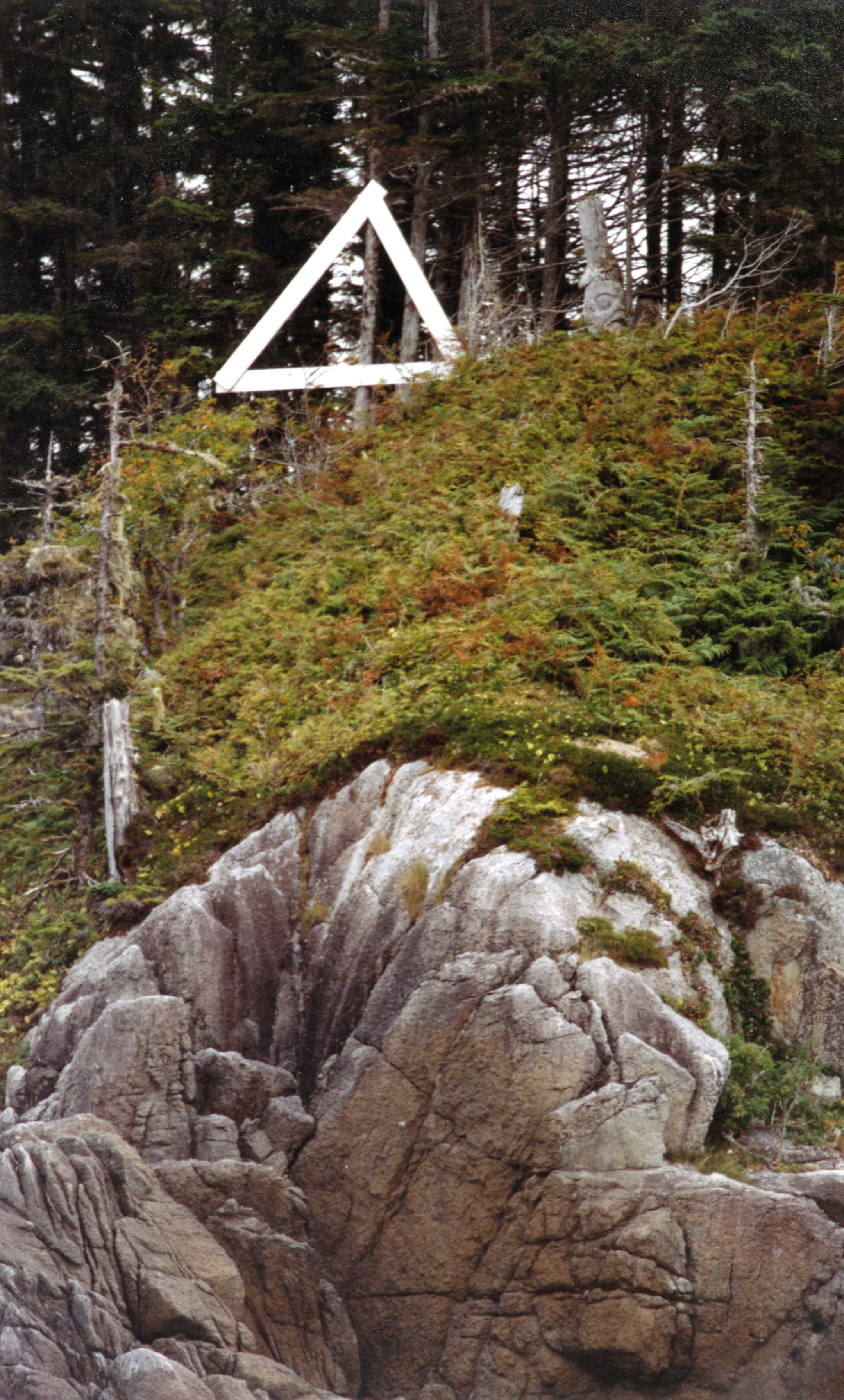
Headland with wooden markers. Click to zoom.

This is one of my favourite pictures of B.C. Archaeology, even though  it doesn’t look like much.  It’s a bit fuzzy: I took it with a zoom lens in about 1985 , rounding a headland in a small boat  on the Central Coast.  In fact, you might think it doesn’t look all that archaeological.  Look closer: sticking up to the right of the white triangle you can see the carved head of a pole.

The white triangle is a standard device used by Fisheries to demarcate the different fishing zones on the coast, for management purposes.  On one side of the triangle there might be different catch limits or closures or seasons of harvest enforced than on the other.

I don’t know much about the pole, but its location on such a prominent headland, facing the open Pacific, next stop Japan, is suggestive it marked a change of territory, a boundary shift, a movement from the control of one lineage or house to another. You don’t often see such a pole away from a village site.

Both wooden markers may ultimately serve the same purpose: boundary maintenance between zones of control; advertisements for power; watchful symbols of formal rights; the means of resource management.  It is intriguing and almost poetic to see them standing, side by side, on the same headland, guarding the same water.

Detail of wooden markers.

ASBC Talk: Tuesday, February 16th

Surveyors in the Uplands development, Victoria, using a burial cairn as a surveying aid. Source; BC Archives.

ARCHAEOLOGICAL SOCIETY OF BRITISH COLUMBIA, VICTORIA, February 2010 MEETING

Feb. 16, 2010, 7:30 pm

Pacific Forestry Centre, 506 West Burnside Road, Victoria, B.C.

Darcy Mathews

The Powerful Dead: The Rocky Point Cemetery and Straits Salish Identity.

Burial cairns and mounds are two types of pre-contact burial features in the Strait of Georgia region of south-western British Columbia. More than a millennium ago, the Straits Salish people, an ethno-linguistic group centered on present day Victoria, constructed a cairn cemetery at the Rocky Point site. Located 18 km southwest of present-day Victoria, this cemetery has over 300 cairns which occur in a variety of patterned shapes and sizes. Analysis of cairn construction and the use of space within this cemetery suggests that there was a strategic use of both material culture and landscape in Salish mortuary ritual, simultaneously expressing individual, household and perhaps even village-wide group identity. Underlying these statements of identity is the material expression of relationships between the living and the powerful dead, which were carefully navigated through the process of the funerary ritual, of which building cairns and mounds was but one part of a long-term process; a process that may have an antiquity of several thousand years. Biography Darcy Mathews is a PhD candidate at the University of Victoria. Working with the Scia’New First Nation, his ongoing dissertation research focuses on the identification, preservation, and study of pre-contact burial cairn and mound cemeteries in the Strait of Georgia.

For information, phone 384-6059 or e-mail asbcvictoria@gmail.com

Ancient Basketry from the Biderbost Site

2,000 year old basketry from the Biderbost Site, Seattle. Source: Burke Museum.

The Biderbost site is on the Snoqualmie River near Seattle.   Since 1960, a series of excavations have revealed a remarkable set of artifacts made from organic materials, preserved because of the water-saturated, anaerobic conditions of deposition.  The Biderbost site was the first site of its kind to be excavated in the Northwest, at least to a professional standard.  The Burke Museum has an excellent page on this site, including a page of basket photos (reasonable resolution, yay), weaving techniques, and conservation of these delicate artifacts.  There are also three informative (if not exciting) videos on YouTube about:

These artifacts, which include a large number of basketry pieces, date about 2,000 years ago.  Since most archaeological sites in the Northwest preserve stone, shell and bone fairly well but not wood, bark or root, these sites (which also includes Ozette, Hoko River (pics now broken fixed), Pitt Polder, Qwu?gwes, Kilgii Gwaay, and others) offer remarkable insight into the organic technology.  Ordinarily, we don’t see this stuff at all archaeologically and yet it may be the majority of the traditional technology; it may be stylistically distinctive and different compared to stone and bone tools; and it may be disproportionately representative of the lives of women.

Why there aren’t more archaeologists focusing research questions on these sites is unclear to me: yes, they are awkward sites and expensive and time consuming, but then so are shell middens.  I suspect it boils down to the unfortunate fact that the key NW wet-site researchers in the last thirty years (Dale Croes and Kathryn Bernick) were never in the kind of academic position where they routinely supervised graduate students and hence they were never able to harness the energy and intellect of that backbone of NW Coast Archaeology: the Master’s student and their diverse and often excellent theses.

I would be remiss in not mentioning that the Burke Museum has a Biderbost “Adopt a Basket” program to help with long term conservation of this remarkable suite of artifacts.

Basket rim and body fragment from Biderbost. Note the mud embedded in the weave. Source: Burke Museum.

Fishing weight wrapped in basketry with sticks attached. At a normal site this would appear to be an unmodified pebble. Source: Burke Museum.