Category Archives: Archaeology

Sally Binford

Sally Binford with her poodle, Jake. Photo credit: Honey Lee Cottrell, source: SFMOMA (click); cropped from original.

There is not much question that Lewis Binford was one of the most influential archaeologists of the 20th century – if not the founder, then the loudest exponent of “The New Archaeology“.  Like a lot of archaeologists not of a certain age, nor of a certain geography, I had never really focused on the co-editor of one of his more influential books, New Perspectives in Archaeology: Sally Binford.  Insofar as I had thought of her, I imagined some sort of academic liaison followed by her giving up her career, this being the 1960s and all – a not uncommon pattern.  Who was this other Binford, this flash in the pan?  I can’t be the only one who has wondered that, and not being plugged into the grandest social circles of the discipline, I’m turning to the internet.

Turns out she was superbly interesting in her own right.  I just came across a blog post recounting an interview excerpted from this book, which she gave not long before her death in 1994 (a death by her own hand on a date she had set 20 years ahead – one day before her 70th birthday.  She took her poodle, Jake, with her).  I  found the whole thing from A Very Remote Time Indeed.

I don’t endorse the interview in any particular way, clearly it is her perspective, but since Lewis Binford is a well known blowhard it can’t hurt to hear something from the other side of those days – especially as it also implicates the academic culture of Anthropology in the 1960s as including strong anti-semitic and racist undertones.  So, it is rather voyeuristically fascinating for me to read the lengthy interview,  but I warn it is a somewhat not-safe-for-work link.  There are some nude bodies and so forth, reflecting her post-archaeology career as a sex educator and sexual liberationist of some note.  Scroll down about halfway for the meetup with Lewis.  I’m pasting in some excerpts “below the fold”.

This whole thing is only tangentially related to the Northwest Coast and may be much too “inside baseball” for many readers, but the entire interview is quite compelling as a portrait of a cutting edge feminist and free thinker who intersected briefly, yet, brightly, with archaeology.

Continue reading

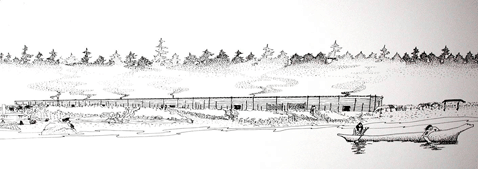
D’Suq’Wub: Old Man House – a Poster

Old Man House: computer reconstruction of one end. Source: Suquamish Tribe.

“Old Man House” is on the Kitsap Peninsula just north of Bainbridge island, across Puget Sound from modern downtown Seattle.  The “house” was the subject of one of the earlier excavations on the NW Coast by Warren Snyder and team from the University of Washington.  The house formed the locus of a major village of the Suquamish Tribe, and its most famous historic resident was Chief Sealth, also known as Chief Seattle.  The Suquamish Tribe has a very nice poster on the history and archaeology of Old Man House which can be downloaded from their website – clicking here will start a moderately sized JPG file. (Edit 2018: archived copy here)

Interpretive sketch of Old Man House. Source: Suquamish Tribe.

It is a bit of misnomer to call this structure a “house” though.

Continue reading

Caribou Metatarsal Hide Scraper

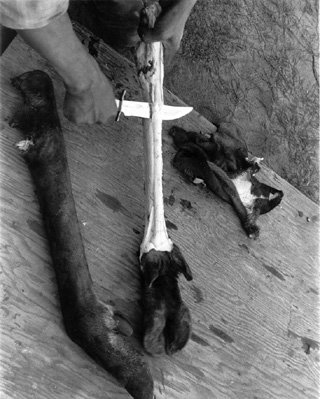
John Shea stripping ligaments from a caribou metatarsal in preparation for making a hide scraper. Source: SFU.ca

I haven’t really mined the SFU Archaeology museum website yet – they seem to have had a bit of a makeover recently, though many of their online resources are achieving “vintage” status.  One such is the photo-essay on making a hide scraper from a caribou metatarsal, or the long, straight bone between the caribou ankle and its hoof – the long bone of the foot (ungulates walk on their tip toes).

The essay is a series of over 20 pictures showing step-by-step the process of making the scraper:

Continue reading

Northwest Research Obsidian Studies Lab

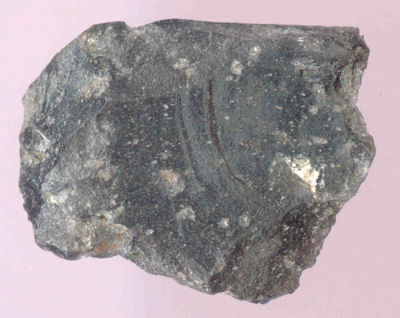
A flake of obsidian from DhRr-18, southern British Columbia. This visually-distinctive glass is from the Mount Garibaldi obsidian source.

Obsidian is a kind of volcanic glass and was highly prized for making certain kinds of stone tools.  Obsidian forms at places of relatively small outflows of magma, or liquid rock.  Small flows can cool quickly, which allows the formation of a glassy crystalline structure ideal for stone tool manufacture.  Small flows also represent a small sample of well-mixed magma, and thus each little patch of obsidian may share a very distinctive chemical signature.  This signature, usually identified by trace elements such as Strontium, Zirconium, Yttrium and Rubidium, then allows for the chemical fingerprinting of each source.  Any obsidian artifact found, whether at a source or not, can also be “fingerprinted” and then compared to a catalogue of known obsidian ources.  Since the artifacts don’t move around on their own but only through the agency of humans, the distribution of obsidian artifacts is a proxy measure for the movement and interaction of people.  When you have hundreds or thousands of such artifacts and a large database of known sources, then you can start to see large scale, long-term social interaction emerge from the silent archaeological record.  Most obsidian isn’t visually distinctive enough to sort out by eye alone, so these geochemical methods are essential.

So far, so Archaeology 101.  I was really happy to find that Oregon’s Northwest Research Obsidian Studies Laboratory has a web site not which not only solicits business, but is a highly educational and informative site about many aspects of obsidian analysis, with a focus on the Northwest. Continue reading

Salish Villages of Puget Sound

Overview map of Coast Salish Villages of Puget Sound. Click to go to the page of interactive maps at coastsalishmap.org

Tom Dailey has put together a large and very interesting site which documents the Coast Salish villages of Puget Sound.  The core of the site is a series of clickable maps (see the left hand side black/white map grid), each of which is marked with little village icons.  Clicking on these icons takes you to a master document with a synopsis of the settlement name and, usually, a couple of sentences about the village.  These are referenced to scholarly literature and other sources.  It is striking to see all these villages on one map, and notable how many are shown on rivers and lakes.

Continue reading

Arrow from Tsitsutl Peak Glacier, Western B.C.

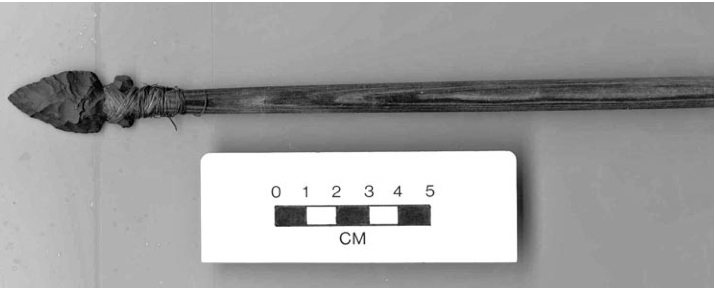
400 year old arrow or dart from Tsitsutl glacier, B.C. Source: Keddie and Nelson: 2005.

In 1924, a land surveyor found an arrow at an elevation of 2,100 metres near Tsitsutl Peak in west-central British Columbia (map).  The arrow made its way to the Royal BC Museum where it lay for over 80 years, until a timely inquiry and increased awareness of ice-patch archaeology stimulated a small research program.  This research, initiated by RBCM curator Grant Keddie and reported in the Canadian Journal of Archaeology (Keddie and Nelson 2005), establishes that the arrow is about 400 years old.

Continue reading

Webber’s Village in Nootka Sound: Original Watercolour

Painting of a village in Nootka Sound, 1778, by John Webber. Source: State Library of New South Wales. Click for larger original.

Yesterday I linked to the original watercolour of a 1778 Nootka Sound house interior by John Webber, which is the basis for the widely reproduced engraving.  Today we can take a look at Webber’s original painting of a Nootka Sound village, presumably Yuquot but not so labelled, as found at the State Library of New South Wales (though yesterday’s post brought forth questions as to whether these are watercolours or coloured engravings – see the comments).  The first and most important point is, see that lumpy, dissected landform in front of the houses?  That, my friends, is what an active shell midden looks like.  No wonder they can be such stratigraphic nightmares.

Continue reading

Webber’s House Interior: Original Watercolour

1778 Watercolour by John Webber of the interior of a house in Nootka Sound. Source: State Library of New South Wales. Click for original.

A few days ago I posted a beautiful watercolour of Nootka Sound by John Webber, artist on Cook’s third voyage.  In the ensuing discussion, it was brought up how nice it would be to see the original watercolours of more of his paintings, which often formed the basis for the  numerous engraved reproductions which are what one normally sees.  The loss of information in moving from the original to the engraving is something of an unknown quantity, and I for one had never seen the watercolours.  Until yesterday!

Continue reading

Puget Sound Clovis

In Red: Surface Finds of Clovis Projectile Points. After Croes et al. 2008.

I posted yesterday about the Manis Mastodon site and its possible status as a pre-Clovis site on the Olympic Peninsula.  Clovis projectile points are so distinctive that most archaeologists have no problem assigning even an isolated find of such a point, lacking in any kind of stratigraphic context or any associated dates, to the Clovis archaeological culture.  We know from sites elsewhere in North America that Clovis dates to a pretty narrow window, perhaps only 13,200 to 12,800 calendar years ago.  It has always been very closely associated with the ice-free corridor route for the First Peopling of the Americas and is predominantly known from classic sites in places like Colorado, New Mexico and Texas. So it may come as a surprise to some that Clovis is pretty well represented in Puget Sound and north to Bellingham Bay, although only from surface or other finds without provenience.

Continue reading

Yank that sucker out!

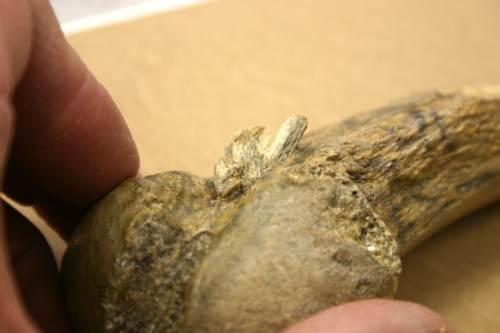
Mastodon rib from Manis site, showing protruding end of an intrusive object. Source: CSFA

The Manis Mastodon site near Sequim on the Olympic Peninsula (map) is one of the great enigmas of Northwest Coast archaeology.  The site has been known since the 1970s and is purportedly a Mastodon kill-butchery site.  With radiocarbon dates (on plant material associated with extinct mastodon) of 13,500 to 13,900 calendar years ago, the site is clearly pre-Clovis.  As a pre-Clovis site on the Northwest Coast, Manis  should be of comparable stature to, say, the Clovis-killer Monte Verde site in Chile, which dates to about 14,500 calendar years ago.

Doubts remain about this site, though, mainly because it is not yet completely reported.  A preliminary report by Gustafson et al. in the Canadian Journal of Archaeology (which I don’t have handy — hey CAA, I know you sell CDs of your back issues, so how hard can it be to put them online?) was equivocal about the association of some flake and cobble tools with the skeleton, and while interesting conclusions were drawn about the fragmentary nature of the skeleton, nothing conclusive was resolved.  This is despite one of the clearest possible “smoking guns” one could hope for in archaeology.

Continue reading