Category Archives: anthropology

Songhees claim to Cadboro Bay

Songhees claim to Cadboro Bay lands promised by Douglas. Source: TImes-Colonist.

The Douglas Treaties have stood up well in court but the fact remains that the rights to hunt and fish are severely compromised by urban developments.  Further, it is a widespread shameful pattern that the government went out of its way to reduce the sizes of the few, small reserves that were established and to eliminate some altogether.  It is very welcome to see the strong assertion of the Songhees Nation that they have the rights to 200 acres surrounding Cadboro Bay.

Lawyer Rory Morahan said the band is not trying to reclaim the land promised to it in one of the Douglas Treaties, but is asking for compensation and a declaration that it is Songhees land.

A statement of claim was filed in B.C. Supreme Court yesterday, but it is likely to be at least a year before the case is heard.

The key to launching the lawsuit was finding historical documents, Morahan said. “There’s oral tradition about the village site, but in the courts you need more than oral tradition. We have been working on this for about a year, getting the details down,” he said.

The treaty with the Chekonein people, ancestors of the Songhees Nation, specifies that they would have 200 acres (80 hectares) around their Cadboro Bay village site, adjacent to the beach, and about 40 acres (16 hectares) of camas and potato fields.

“Under the treaty, the Songhees ancestors were promised that their village sites and fields would be protected for their use and the use of future generations, and that their villages and fields would be properly surveyed,” Morahan said.

Clearly, the Songhees are not asking for the land to be returned, but for compensation for its unlawful and duplicitous preemption.  The were successful in obtaining compensation a couple of years ago for the land under the legislative assembly, ironically enough and I imagine they have a good chance of success with this case as well. There is certainly an inarguable case for the archaeological significance of Cadboro Bay.

The comments in the Times-Colonist article are some of the most pathetic, racist, ignorant drivel I have ever seen, though.

Stephen Hume kicking ass (but whose?)

Desecrated spiritual site: the Big Rock at Campbell River

Stephen Hume has written some great columns on BC archaeology and history over the years and he comes out swinging in this recent piece:

Beside Highway 3 near Keremeos, a large glacial boulder has myths attached that extend far into B.C.’s past. It’s our own Stonehenge but it’s defaced with graffiti. Not far away, somebody jackhammered out of a cliff face one of the most significant ancient rock paintings in North America. Near Campbell River, another cultural site of great significance to first nations — the Big Rock — is also covered with graffiti. On Saltspring Island, effluent filters through a grave site with government approval. Near Qualicum, the bones of persons of great importance were mixed into paving material for a parking lot.

We pay lip service to first nations culture; we trot it out when we’re on the world stage — at the Olympics, for example — but our actions betray our venal hypocrisy. When conflicts arise between private commercial gain and public protection of our now-shared ancient heritage, money seems to trump culture almost every time.

I use the term “our” to describe this heritage because we are all citizens of B.C. together, first nations and settler society, fused by our braided history. We have one shared narrative in this province. It is composed of many stories. They begin not with the recent arrival of European adventurers or Asian monks but in a far more ancient past.

When we permit the desecration of important first nations sites, it’s our shared history that we abuse and our children’s legacies that we steal.

I am not convinced that the private member’s bill to which he is refers is the answer, and in any case it died on the vine – more on that later.  And the BC Archaeology Branch is kept on a short leash through the expedient of under-funding.  But I certainly appreciate Hume’s  take-no-prisoners attitude – we need a few vocal bulldogs on the case.  Incidentally, in a parallel universe to this blog, Hume’s brother is in a UVIC archaeology class right now, so maybe another bulldog can be raised – it seems to run in the family.

Notably,  it looks like there is a move afoot to designate the Big Rock, spearheaded by Frank Assu of Cape Mudge.  Let’s hope this succeeds, and maybe we won’t see it get dressed up again as a pumpkin.

Vandalized Pictograph Boulder near Keremeos.

Arborglyph

calvert island face

Carved face on a Calvert Island tree. Photo: Dan Leen.

I’ve mentioned Dan Leen’s excellent web page before.  When I was on Teredo N. with him I heard many excellent stories including how he came across a spectacular carved tree on Calvert Island, near Namu.  Finally I get to see what he meant.  This strikes me as the work of a trippy bush hippy (and maybe Dan himself, heh) more than a NW Coast thing, but it is fun nonetheless.

Incidentally, “Arborglyph” is a Frankenstein word melding Greek and Latin roots and should probably be replaced with “dendroglyph”, which is also easier to say.

The Brooklyn Museum Collection

Tsimshian Skull "Helmet".  Click for higher resolution.

Tsimshian Skull "Helmet". Click for higher resolution.

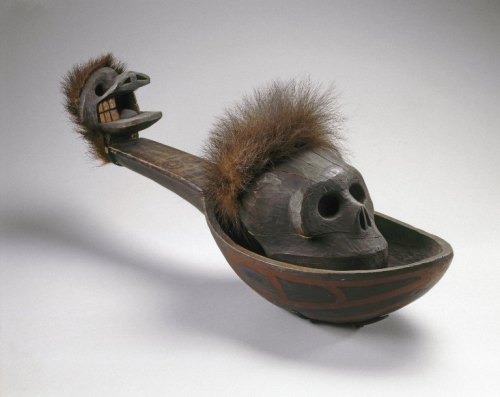
Of all places, the Brooklyn Museum has amassed an impressive suite of NW Coast artifacts and art.  Their online catalogue is mainly lodged under the  “research” and “collections” tabs.  One interesting thing about this collection is that any viewer can ‘tag‘ a picture, building up a folk taxonomy that cross-cuts more traditional museum categories.  This has its advantages of course (e.g., items which are tagged “beards“, or “scary“), but also raises questions about just how comprehensive is any set of results?  And how accurate – this rattle is tagged Tsimshian despite being collected in Bella Bella (Heiltsuk territory).  Still, with a grain of salt it is an idea definitely worth pursuing.  You can also click around on their “visible storage” map.  The images are decent resolution and combined with the tag-surfing possibilities this is a fun and informative site.

Heiltsuk Ladle with Skull. Click for larger resolution.

Heiltsuk Ladle with Skull. Click for larger resolution.

NW Coast Objects in Madrid

Tlingit adze with quillwork and copper insets in the Museo de América, Madrid.

Tlingit adze with quillwork and copper insets in the Museo de América, Madrid.

Even though the Spanish were among the first outsiders to eplore the NW Coast, you don’t hear much about collections they may have made while out here.  So it is welcome to see this (now, 10 year old) writeup on NW Coast items in Madrid’s Museo de América.  The article suggests that many such objects were collected but not retained in Royal Collections, perhaps because they were considered inferior to, say, Aztec and Inka pieces.  Either way, there are some spectacular objects illustrated in the article, though the photographs are not very sharp at all.

Going to the Museo de América’s website shows they have a search function and some online thumbnails.  This link should take you to their 52 pieces labelled as NW Coast, while this takes you to six pieces listed as from BC.   Most of the illustrations are extremely low resolution, though I found one or two which aren’t such as the outstanding Haida waterfowl, below.  Look how fluid the form-line rendering is in this 18th century piece.  Click the images on the Museo site for slightly higher resolution or go to the records page by clicking on “Ficha Completa” and then on “Ampliar Imagen”, where you can zoom in slightly using the magnifying glass.  Also worth checking out, this Tlingit clap-board style “rattle”, this foreshaft and point, and this rather spectacular hat.  Anyway, something to poke more: online catalogues in Spanish Museums.

EDIT:  I see their search function makes links to search results expire after a short time so I crossed them out, above.  Pretty lame, but there you go.  Get into the system via the generic system and then browse around, if you want.

18th Century Haida Waterfowl.

18th Century Haida waterfowl, listed as made from"Ivory".

dSpace: Elroy White (Xanius) on Fishtraps

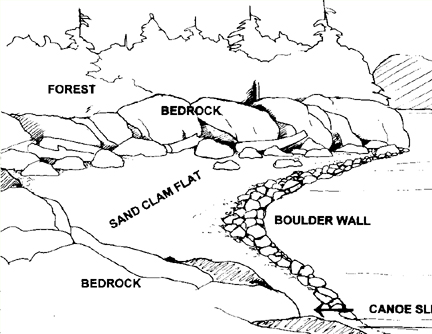
FbTa 59, a possible clam garden on the central coast.

FbTa 59, a possible clam garden on the central coast. Source: Elroy White / Xanius M.A. thesis.

I’ve only met Elroy once or twice but he seems like a sharp guy and I was looking forward to reading his 2006 thesis, which turns out to be an exceptional work – ambitiously trying to implement Eldon Yellowhorn’s “internalist archaeology” in his home territory (Heiltsuk) on the central coast.  This project, which focuses on fishtraps, is exemplary in a couple of ways.  First, as a cutting edge exercise in the practice of archaeology, indeed, practice as theory.  The combination of field archaeology, internalist work with a dozen elders, and extensive videography was a great exercise.  (PS Elroy, post some videos!).   Second, well, fishtraps are exceptionally interesting and need more study.  Essentially, we are just guessing about the specific functions and efficiencies of these features.  Elroy gathers a lot of information from elders, including interesting longitudinal data showing how quickly these features silt up — evidence in some ways for their silt retention qualities and also a suggestion there may be a lot of partially or totally obscured fishtraps out there.  And, as above, Elroy appears to find some “clam gardens” (diagram) in Heiltsuk territory.  Maybe it’s because my doctoral SSHRC project was going to be on fishtraps until I got talked out of that and into a GIStraightjacket, but I love’em.  Anyway, you can get yourself a copy of this high quality MA theses here, at SFU dSpace.

Incidentally, for an earlier, wider scope take on subsistence and settlement and fish traps on the central coast, you can also download John Pomeroy’s 1980 PhD thesis (which doesn’t show up under “archaeology” in their classification or keyword scheme for some reason.)

Elroy White (Xanius) with intertida fishtraps.  Credit: Ecostrust Canada.

Elroy White (Xanius) with intertidal fishtraps. Credit: Ecotrust Canada.

Tseycum Repatriation from AMNH

Inside the Tseycum Longhouse.  Click Image for etended video.

Inside the Tseycum Longhouse. Click Image for extended video.

This is old news now that in 2008 the Tseycum First Nation in North Saanich managed to repatriate the remains of 55 of their ancestors who had been removed and sold by Harlan I. Smith.  What I didn’t realize is in addition to the snippet on The National with Wendy Mesley (the file is incongruously called “brown-bones” – WTF CBC?), there is also an extended uncut video of the ceremony in the Tseycum longhouse.   Cora Jacks, who spearheaded the Tseycum repatriation effort and is interviewed here, sadly passed away soon after.

The detailed field notes kept between 1854 and 1910 assisted greatly in tracing the location of the ancestral remains. Museums in the states are required by law to provide information when a nation makes its request. This law called NAGPRA is the Native American Gravesite Protection Repatriation Act and has greatly facilitated the provision of a long list of human remains and sacred objects. (Similar legislation in Canada does not exist.) Historic references show that skulls had been sold for $5 each with similar price tags having been placed on skeletal remains.

Cora had visited New York in 2005 with Vern Jacks Jr. and experienced the deep emotionality of viewing the remains stored in boxes and placed on shelves. The museum had not followed any cultural protocol so that skulls were often separated and Jacks explains the “spiritual restlessness,” which results from this disrespectful treatment. In Chicago Jacks also discovered about 79 sets of remains many of which are probably from this region and most of them were small children who had likely died of smallpox after contact with European settlers. (source).

As the NY Times noted, the Field Museum in Chicago had not yet begun repatriation negotiations with the Tseycum.  While the NAGPRA law in the states is very strong when applicable, it clearly does not apply outside American borders so credit to the AMNH for working in good faith with the Tseycum.

But also: Grant – what the heck – is it really necessary to defend Harlan Smith?  Maybe as a curator of archaeology it is.  I dunno, seems like another relativising moment rather than a chance for an apology or a plain admission that it was wrong, then and now, to steal human remains for profit. But hey, stealing their land was also done in the spirit of the times, so what the heck?  Let’s not forget the RBCM itself is built on top of a village site.

dSpace: Dentalia Shells on the Northwest Coast

Dentalia Source "mu7is" in Hesquaht Harbour.  From Barton M.A. p. 116

Dentalia Source "mu7is" in Hesquiat Harbour. From Barton M.A. p. 116

Andrew Barton did an excellent job reviewing the biology of the Scaphopoda, the archaeological record of dentalia use and trade, and the technology available to harvest these small creatures with tusk-shaped shells.  Overall, he brought a lot of nuance to a topic that had been somewhat over-simplified.  For example, there is no real evidence that these shells were only available at depth from the NW corner of Vancouver Island.  Barton reports on attempts to replicate ethnographic dentalia “spears” (more like a rake, or a pasta fork).  You should be able to download a copy of Fishing for Ivory Worms : a review of ethnographic and historically recorded Dentalium source locations from SFU dSpace.

Dentalia necklace by Josephine Ingraham, Clatsop/Chinook Tribes

Dentalia necklace by Josephine Ingraham, Clatsop/Chinook Tribes

Skidegate Haida Model Village

Model of Skidegate (hlgaagilda 'llnagaay) as installed at Chicago Exhibition, 1893.

Model of Skidegate (hlgaagilda 'llnagaay) as installed at Chicago Exhibition, 1893.

The Burke Museum in Seattle is doing excellent work.  I just found the project which they are spearheading, together with the Haida Museum at Kaay’llnagaay and the Field Museum in Chicago, to reassemble the famous model village of Skidegate (hlgaagilda ‘llnagaay) created for the 1893  Chicago World Fair.  This exhibition was organized by Putnam, implemented by Boas, who hired James Deans (a well known Victoria antiquarian) to collect some NW Coast stuff.  Deans outdid himself by arranging for the carving of a complete model of Skidegate Village  – amounting to some 27 model houses (most with frontal poles), 2 model mortuary houses, and 17 free standing model poles.  (Deans also apparently collected three boxcars of other material including an entire house, canoe and other material, but that’s another story).

The Burke Museum now allows you to view an interactive panorama of the model village.

The website is designed both to showcase these model houses and also to help find the 13 houses and poles which have gone missing.   The intention is to return the model village to Kaay in 2011.  Replacement poles and houses will be commisioned for those that cannot be found.   A highlight are the videos of Skidegate residents such as Captain Gold, Niis Wes, Percy Williams, Kii7iljuus, and Kwiaahwah Jones talking about the model village, about family, and above all about being Haida yesterday, today and tomorrow.

House of Contentment, model carved by George Dickson

House of Contentment, model carved by George Dickson

Tla’amin Archaeology

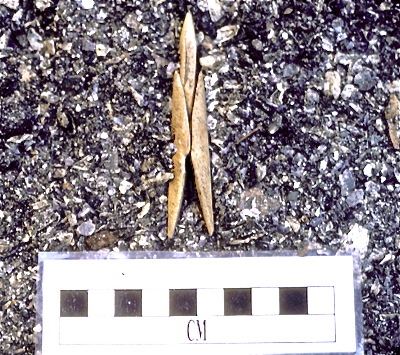
Toggling Composite Harpoon head, articulated in situ.

Toggling Composite Harpoon head, articulated in situ.

The Tla’amin (Sliammon)  First Nation on the Sunshine Coast (map) have been engaged in a wonderful community-based archaeology project with Dana Lepofsky at SFU and her team.  It’s not surprising when you think of what a great person Dana is – brilliant, yet nice, warm, generous. (Hi Dana!)

The website for this project is well worth browsing to see what meaningful partnerships with First Nations looks like.  I think it is a model for the future of BC Archaeology to work together – for then the project becomes not all about the past, but all about the present.  As they say – the past is over; it only exists in the present. Old things exist, but they exist now.   So how can we, as archaeologists, use our particular skills to help communities and the public appreciate the past as a meaningful part of the present, and hence of the future?  This impressive web site shows many great ways how.

Check out this page on Kleh Kwa Num – Scuttle Bay, for example, whih deftly points to the parallel stories of oral history, ethnohistory, and archaeology.  Or, this video of “what happens when an archaeological site is logged?”  As Elsie Paul, a Tl’amin elder says, their ancestral land was hammered for a century and what did aboriginal people get from it?  “Nothing”.  And as Dana says, it became very difficult to find intact archaeological sites around Powell River and the industrial areas, in particular.

These downloadable posters are also really well done, as is their prospectus/report (PDF) – very accessible stuff.   I do wish they didn’t use the silly flash interface for their pictures, though they do allow access to them otherwise – this project is really turning archaeology on its head!

Upside Down Archaeology in Tla'amin Territory.

Upside Down Archaeology in Tla'amin Territory.