Category Archives: anthropology

Tlingit, Dene and Eskimo Metallurgy (1969)

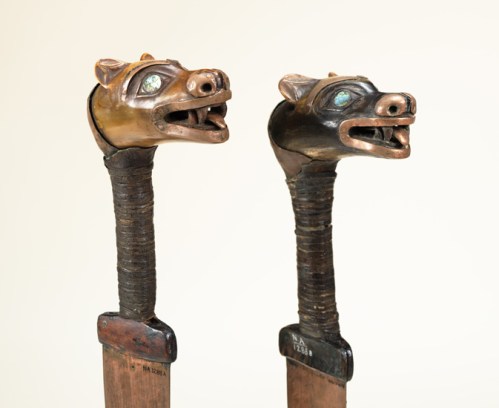
Tlingit dagger hafts, Kluckwan, Alaska. Purchased by George Gordon from Louis Shotridge at the Portland Fair, 1905. Penn Museum Objects NA1288a/b.

From the excellent University of Pennsylvannia Museum website, you can download back issues of their magazine “Expedition”, including this article on aboriginal metallurgy in Northwest North America (PDF).  The caption below is from that article: the two astonishing daggers being described are shown above.  Seriously, this is metalwork of the highest order, reminiscent of, say, Mycenaean pieces.

1969 caption describing the two daggers, above.

Death of Richard Antoun

Professor Richard Antoun. via ZeroAnthropology.

It was very disturbing to hear of the violent death of SUNY-Binghamton Anthropology Professor Emeritus Richard Antoun yesterday.  Professor Antoun was stabbed in his office by a graduate student, apparently one who had done poorly on their candidacy exams.  I’ve known some tightly wrapped graduate students, but the idea one of them could pull out a knife and stab me to death is, uh, “worrisome”.  Professor Antoun was a close friend of my current boss, and my heart goes out to her as well.  There is a pretty full roundup of this terrible news and an euology from a former student over at ZeroAnthropology.

New Westminster, 1903

Aboriginal women at New Westminster, 1903.

There is something about the above picture that is so evocative: Native women washing clothes or getting water while in the background the first construction of the Fraser River Bridge at New Westminster rises.  With a different caption this could be the Ganges River, or the Colorado: always women, always squatting, always the back turned to the viewer and the colonial future in the background.

From the idiosyncratic New Westminster online photo archives – this uses the LoC system so you have to search for, say, “Indians” rather than “First Nations”.

New Westminster, ca. 1865

Mechanical representation in a Haida Pipe

Haida Pipes, 1837. From U. Washington Collection.

I don’t know much about these early historic Haida argillite pipes.  These ones are illustrated in Edward Belcher’s Narrative of a voyage round the world, 1843, v.1, p. 309.  The lower one captured my attention, with its representation of a conveyor belt (?!) – or, more likely, a block-and-tackle/pulley setup.  The playful seriousness of these pipes is astounding – as can be seen in my earlier post on the SS Beaver pipe.  I would like to see a photograph of this one but I have no idea where it may have ended up.

The image is via the superb University of Washington Digital NW collections.

dSpace: The Indian History Film Project

Haida Town of Chaatl. Source: NMC

There is an interesting archive of interview transcripts housed in dSpace at the University of Regina.  Most of the interviews were by CBC Radio’s Imbert Orchard and so share the flaws of Journalism and Anthropology.   The preamble says,

The original intent of The Indian History Film Project was to conduct interviews with First Nations elders across Canada and to produce a television series portraying Canadian history from a First Nations’ perspective.

The Indian History Film Project was an initiative of Direction Films and was conceived and developed by Tony Snowsill. The project leaders were Tony Snowsill and Christine Welsh. The project evolved over time, and eventually it was decided to access libraries and archives across the country to incorporate existing interviews with First Nations elders. All interviews, whether original or archival, were cross indexed by word and theme and housed in the C.P.R.C [Canadian Plains Research Centre].

A number of these interviews are with Haida people, notably Solomon Wilson and Florence Edenshaw, who discussed her arranged marriage, the meaning of Tow Hill, and the artistic tradition of her family, the Edenshaws and Davidsons.  It appears tapes of these are also available through the BC Archives, but not online.

Note: anytime you see (Indian) it means that a Haida word was not transcribed — an eerie effect.  Searching for British Columbia brings up 91 documents.

The following excerpt from an interview with Solomon Wilson of Skidegate sees him relating a tale of smallpox blankets:

Continue reading

La Brea Woman: Image Controversy

La Brea Woman forensic reconstruction.

I came across this interesting article chronicling an emerging controversy in Los Angeles.  I never knew that human remains had been found in the La Brea tar pits, but a partial skeleton of a young female had been on display until recently in the George C. Page Museum there.  At some point, a museum  volunteer made forensic-style reconstructive drawings of this young woman.  Now the museum is trying to prevent their publication, a move which some claim is designed to help prevent their repatriation.

Are illustrations of human remains tantamount to display of the human remains themselves?  Is the display of a cast any different?  The forensic reconstructionist apparently used the cast, not the actual skull. But consider the process of making a cast: is not that a greater insult to the dead than merely handling their bones would be?  In any case, these forensic reconstructions contain a little too much interpretive latitude: consider the Kennewick man reconstruction whose resemblance to Patrick Stewart has done nothing to quell the notion Kennewick man was ‘Caucasian’. Further, the forensic reconstructions include disturbing “cutaways” revealing the reconstructive process and producing an otherworldly, inhuman appearance (see below).

Continue reading

Pitt Rivers Museum Haida Collection on flickr.com

Any idea what activity is being represented on this Haida argillite carving?

The Pitt Rivers Museum in Oxford is one of the world’s great ethnological museums.  Indeed, it is largely presented as a “museum of a museum”, with artifacts and curios displayed in glass cases in juxtapositions that made sense to anthropologists.  Now I see they are putting some of their collection online – one of many interesting innovations going on at that museum.  The Haida Collection which Cara Krmpotich has worked on consists of 200 really well composed and lit photos on the flickr.com website.  Cara notes that she hopes making this material available in this manner will facilitate its use by Haida people and I expect they will (indeed one person with a Haida name has been commenting on some of the photos).  Coincidentally, I see there has recently been a Haida delegation to the Pitt-Rivers museum.

In any case, the flickr set is a fantastic set of images of Haida art and technology. It would be nice to have the full catalogue information or other information associated with these, or at least a statement that such information is lacking.  While there are visually spectacular items throughout the set, also check these plain spoons from SGang’gwaay, Tanu’uu and Masset,  this bird bone whistle, and this tidy little loop of twine.

Haida wooden labret at Pitt Rivers museum.

Argillite Beaver

Haida argillite pipe representing the SS Beaver. Photo: University of Aberdeen.

The SS Beaver was a prominent early side-wheel trading ship on the NW Coast.  Nice to see it memorialized by Haida argillite pipe in the Marischal Museum collection of the University of Aberdeen, along with some other exceptional Haida pipes.  Apparently donated to the museum by the former Captain of the SS Beaver, William Mitchell, this pipe sports a rotating side wheel carved from whale bone, a beaver figurehead, and someone peeking out of the cabin windows, perhaps Capt. Mitchell himself who probably commissioned this carving.  Some other close ups (in an awkward zoomable interface) are  available on the Scots and Aboriginal People in the Fur Trade site.  More on the SS Beaver here.

A figure looking out the window of the SS Beaver pipe.

Songhees claim for Cadboro Bay land compensation: update

There is a fairly progressive editorial in the Times-Colonist on the Cadboro Bay land compensation issue.  The editorial cites John Lutz’s excellent book Makuk:A New History of Aboriginal-White Relations, to boot.

Lawyer Rory Morahan, acting on behalf of the Songhees, says the Chekonein village sites and fields were never surveyed, reserved or protected as required by the treaty. “The colony, or the province, appropriated the lands and issued title to the lands to other parties — that is, non-aboriginal colonists,” he says. The statement of claim says the Crown never paid compensation for taking the treaty land between 1851 and 1871.

The case will be complicated, given the variety of historical documents that will be presented to the court. Some basic facts are not in dispute, since even Roderick Finlayson, an early chief factor for the Bay, mentioned the Cadboro Bay village in his memoirs.

Beyond what is written in the treaties, the court might need to consider whether the Lekwungen actually understood what they were agreeing to. Lutz’s research has raised questions about the communication gap between the aboriginals and the whites.

Douglas signed nine treaties with aboriginals on southern Vancouver Island and, as Morahan says, this lawsuit could set a precedent if successful.

The decision could have ramifications elsewhere in the province. The Lekwungen were the first aboriginals in British Columbia to be dispossessed by settlers, but similar actions — land grants given, then taken without compensation — occurred for decades.

If it is proven in court that an injustice has occurred, the governments should act quickly to make things right. After a century and a half, it’s time.

This isn’t the first time I’ve noticed a fairly progressive editorial slant down at the TC – good for them, as the comments on their pieces show, there is a lot of resistance to the notion of fair compensation.

Sgaawsid K’uuljaad, the Boss Lady Potato.

Sgaawsid K'uuljaad gets funky.

Silly season in Haida Gwaii must have started, as Carey’s potato of unusual size is stolen (and returned), but not before a star appearance or two on youtube.