Monthly Archives: February 2010

Annotation: Collison Bay

Annotation of the Collison Bay night-time, low tide excavations.

The Collison Bay site in Haida Gwaii  posed some unusual challenges, some natural and others of our own making.  The site is found in the intertidal zone and dates, like the Kilgii Gwaay site about 10 km away, to a brief window about 10,700 calendar years ago.  I posted the above picture before, but without annotation.  That previous post describes something of the site formation processes, which mean a site which was terrestrial when occupied is now in the intertidal zone, and excavation must take place between the tides.

Looking at the above, you can see we didn’t plan for the tides very well!  other projects required us to be elsewhere and when it was Collison Bay’s turn, the low tides were in the middle of the night.  This meant we had to get up at midnight to work until about 6.00 in the morning the first night to catch the falling tide, then we got up about 12.45, then about 1.30, and so on: tracking the procession of the low tides.  So, to the inherent complications of working in the intertidal zone we did it in the dark, running electric lights from a generator.  This actually worked really well and data recovery was excellent – we dug there on another occasion in the daytime (see below) and there was no real difference in quality of work.  Also part way through this project we were working until mid-morning and could see pretty well!

The site includes numerous water-worn stone tools on the surface and in the upper beach deposits, but in the lower beach deposits the tools are pristine and show no signs of water-rolling.  In many cases they lie flat, also suggesting a lack of disturbance, and they are encased in a thin, brown layer of jelly-like material which is the organic remains of a degraded soil.  Unlike at Kilgii Gwaay, there is no survival of bone or wood.  Nonetheless, the stone tools are very similar to that site, and speak to a terminal Pleistocene technological approach using discoidal and uni-directional cores to create large blade-like flakes.  Too much information for some readers I bet – but the take home message is this way of making stone tools might be peculiar to the  Pacific Rim and not the continental interior and therefore might, perhaps, maybe, one day, turn out to have significance for the coastal route of the First Peopling of the Americas.
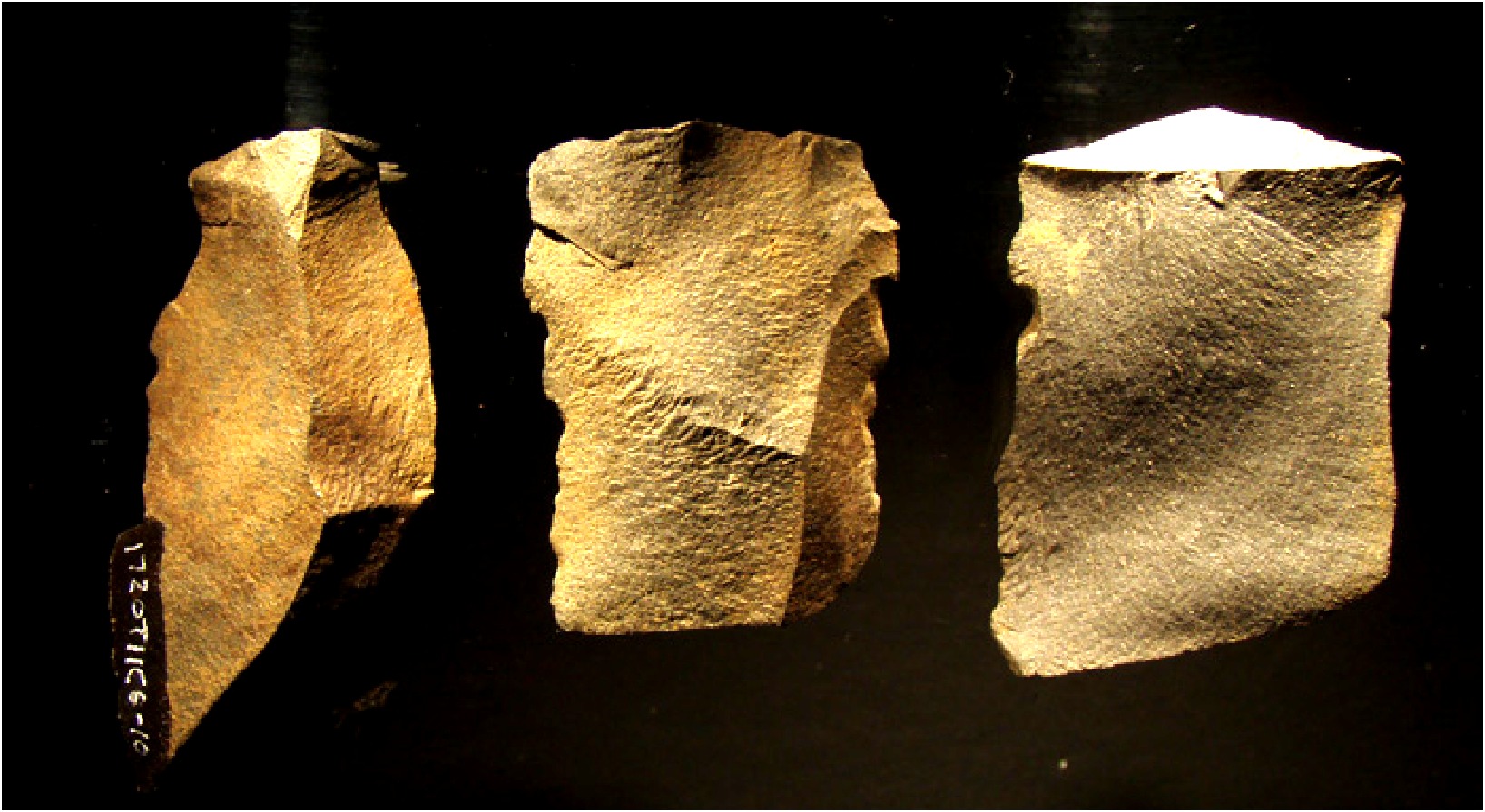
Pristine, sharp blade-like flakes used as stone tools from 10,700 year old deposits in the beach at Collison Bay. Flake on right is about 6 cm long. Photo: D. Fedje

Establishing an excavation unit as soon as feasible on a falling tide to maximize digging window.

Lu Zil Män Fish Lake: SW Yukon Archaeology and Oral History

Artifacts from the Lu Zil Män Fish Lake site. Source: Yukon government.

The Yukon government has a good web site up about archaeological and oral historical projects in the  Lu Zil Män Fish Lake area of the Kwanlin Dün First Nation’s territory.  The SW Yukon is a fascinating area where inland Tlingit people ranged from the coast, producing entangled relations with the interior speakers of na-Dene languages.

It’s good to see that the site puts the oral testimony of elders first and the archaeology second – what we’d call the “direct historical” approach if we were in a classroom.  This approach puts living people first in archaeology, using their insights to find locales and to interpret the uppermost layers.  Then, as one digs deeper, memory and history become less detailed and environments were different, and increasingly more generalized explanations from archaeology and ethnology come to bear.  The direct historical approach is usually ascribed to early researchers in the American SW, but a leading exponent and innovator was actually Frederica de Laguna, who began work on the Northwest Coast in the late 1920s, and had a 70 year active career.  The direct historical approach fell out of favour in a period where archaeologists tried to be highly scientific and to seek generalizations about people, but recently there has been renewed interest in it, especially in a community-based archaeological idiom.

Anyway, the Lu Zil Män Fish Lake project looks like it was a lot of fun, culturally informed, and well integrated into the community, while the web site is well written for the non-specialist.  My only complaint is the photos are rather washed out seeming and not very crisp or low resolution.

Find sites and excavation units. Source: Yukon government.

Ha’ina: supernatural Nuu-chah-nulth crystal?

Crystal artifact said to be used to summon guests to feasts. Source: British Museum

Hmmm, coincidences.  Two or three days ago I was having a beer with a recently graduated student of mine, who was telling me about a number of quartz crystal artifacts he had found in an excavation in the Fraser Valley.  Now, artifacts made of quartz crystal are well known in the Gulf of Georgia — the nature of the rock makes it highly suitable for flaked stone tool production, especially microblades.  Ethnographic accounts suggest they could also be used for sawing very tough rock types such as nephrite.  However, the artifacts being described to me the other night included complete crystals with grooves around the bases — pendant-like, perhaps, or specialized abraders, or, well, or what?

Well,  in a stunning display of “coincidence”, or a happy intervention from a raven, today I ran across just such a shiny little thing at the British Museum website.  From their text, (which I cannot vouch for, having never heard of such a thing before):

The Nuu-chah-nulth believed that these crystals, or ha’ina, grew on the top of mountains and were endowed with magical qualities for bringing wealth and good fortune, for example, when hunting sea otter.

This ha’ina was collected by Captain George Dixon, who had accompanied Captain Cook on his Third Voyage (1776-80) to Vancouver Island. In 1785-88 Dixon made a trading voyage on the King George and Queen Charlotte which was promoted by the King George’s Sound Company (King George’s Sound was Captain Cook’s short-lived name for Nootka Sound on Vancouver Island, where this crystal was collected, probably from the Mowachaht people.)

The Nuu-chah-nulth used the ha’ina to invite people to potlatches, the great feasts given to celebrate life-cycle events at which hereditary rights were displayed. The invitation to a potlatch would take place at a gathering a year or two before the potlatch, when the crystal would be, metaphorically speaking, sent out to the prospective guests. They may have ‘sent’ this example to Dixon. Dixon was supported by Sir Joseph Banks in his work, and through Banks gave this ‘piece of rock crystal’ to the British Museum on 22 May 1789.

It would be sad and ironic (though not surprising) if this artifact was indeed an invitation never acknowledged, an unfulfilled RSVP, and if the gormless British had managed to interpret an invitation as a commodity and not as a request for honour, attendance and respect.  It would be wrong on a number of levels to draw conclusions about the Fraser Valley examples, but it does show the potentially fuzzy boundaries between symbolic and functional material culture.

Tse-whit-zen interactive pages and slide show

Whale vertebrae modified into a spindle whorl, from the Tse-whit-zen site. Source: Seattle Times

I mentioned the Tse-whit-zen site a few days ago, in reference to the recent discovery of a small whale sculpture found there in 2009.  The Seattle Times had a superb web site on this ancient Klallam village, but unfortunately, many of the links are broken (how does that even happen, anyway?).  But the four part illustrated slide show with extensive audio commentary by Klallam, archaeologists and other people is still available and is well worth watching – in fact its one of the best such slideshows I’ve seen.  The Interactive Village component of the site is still active as well, and also definitely worth checking out.

As with so many of these sad stories of site disturbance through development, there is a silver lining as the dig itself, and the objects found, have contributed to a vitalization of Klallam traditional practices and increased interest in Klallam traditional culture within their younger generation.  At a severe price, though: over three hundred burials were excavated and removed from the site before the project, a massive graving dock, was brought to a halt – a halt which, according to some, cost over 100 million dollars.  I’m posting some of the pictures in case the Times site loses even more functionality.

Comb recovered from Tse-whit-zen site. Source: Seattle Times.

One of the more than 800 remarkable etched stones found at Tse-whit-zen, some in association with human remains. Source: Seattle Times

More than 300 human burials were disturbed by the graving dock project. Here, some await reburial in a warehouse on site. Source: Seattle Times.

Speaking of Ozette: dSpace resources.

The "White Series" Ozette reports are freely available for download! Image shows house-plank decoration from the Ozette Site, used as cover art for these reports.

This space has recently carried a lot of items about the Ozette water-saturated site on the Olympic Peninsula,  about Makah whaling, and Queets canoes, and other wet sites in Washington State.  All archaeologists and many of the public in the Northwest are familiar with the Ozette site which, with its fabulous preservation has stimulated a lot of work on the archaeology of the big houses which so characterise the culture area from the Columbia to the Gulf of Alaska. A principal way most archaeologists are familiar with Ozette is through the three large  site reports published by Washington State University, bound as large white paperbacks, and found on the bookshelf of archaeologists across the region.

So, imagine how happy I was to find that all three volumes are available as free PDF downloads from Washington State University.  The PDFs are very large, perhaps un-necessarily so, but who can complain about over a thousand pages of detailed archaeological information on one of the most significant archaeological sites in North America, or even the world?  The three volumes are:

  • Samuels et al.  Ozette archaeological project research reports Volume I House structure and floor midden. 1991.  Link to download page.  (193 megs)
  • Samuels et al. Ozette archaeological project research reports volume II Fauna. 1994.  Link to download page(154 megs)
  • Whelchel et al.  Ozette archaeological project research reports volume III ethnobotany and wood technology.  2004.  Link to download page.  (288 megs).
  • While you’re at it, pick up Dale Croes’ pioneering 1974 computer applications in archaeology paper: The use of computer graphics in archaeology : a case study from the Ozette site, WashingtonLink to download page.  (149 megs).

UPDATE March 3/2010:  the handle.net URLs have been broken for a couple of days.  Try this link to get straight to WSU dSpace for Ozette. If that breaks ( a lot of places prevent stable URLs from search results because obviously people never want to share things) then go here and enter “ozette” in the search box.

(Note: all the above documents may download as files named “ARI” with no file extension.  You will need to add the extension .PDF to the file before you open it.)

These PDFs are fully searchable which makes finding things within the copious material of the Ozette site much easier.  The huge number of artifacts, features and fauna from Ozette have been a blessing and a curse, as interpretation struggles under the dead weight of data.  I would therefore be remiss if I didn’t bring to your attention the excellent M.A. thesis on Northwest Coast household archaeology by UVIC’s own Brendan Gray, who uses Ozette as a test-bed to investigate how we might be able to dig less but dig smarter and therefore learn more from Northwest houses.  Every NW Coast archaeologist should read this thesis.

  • Gray, Brendan 2009.  Sampling methods in Northwest Coast household archaeology: a simulation approach using faunal data from the Ozette siteLink (a bargain at 4.8 megs)

Anyway, I know many readers might find this to be too much inf.ormation, but I don’t believe it is common knowledge that these full text Ozette reports are freely available:  the WASU servers are fast, hard drives are cheap, and the reports are first class.  Enjoy.

Simulated and actual sampling designs projected onto Ozette house floors. From Brendan Gray M.A. thesis.

Memories of Ozette

Makah whaler Wilson Parker posing as a MAKAH WHALER for Edward Curtis, ca.1915

The magazine of Washington State University has a nice article on the archaeological project at Ozette, the UNESCO World Heritage Site on the west side of the Olympic Peninsula.  This Makah village site was covered by a landslide about three hundred years ago (animation), which created preservation conditions highly favourable to preservation of wooden artifacts.  The story begins

THERE’S A WELL-KNOWN PHOTOGRAPH taken by Native American chronicler Edward Curtis in 1915 of a Makah whaler. Dressed in an animal skin, the man is longhaired and wild. He had indeed been a whaler, as had generations of his people. But still, the photograph is a memory of a time already past. Curtis provided Wilson Parker with a hide and a wig to replace the European clothes the Makahs had adopted long before. In spite of Curtis’s fiction, however, there is much to be learned from Wilson Parker, the man in the photograph. As is always the case with a good myth, there is a deeper truth that lies beneath the surface story.

Parker is Sharon Kanichy’s great-great-grandfather, she tells me as we talk in the Makah cultural center in Neah Bay. Kanichy ’01 was born in February 1970. That same month, a powerful storm blew in off the Pacific, eroding the bank above the beach at Cape Alava, on the Olympic Coast, revealing something remarkable.

“All we knew was there was a burial site,” says Ed Claplanhoo of the buried longhouses revealed by that February storm. Claplanhoo ’56 was Makah tribal chairman in 1970, so it was he who got a phone call the first Saturday in February, from a hippie schoolteacher, as Claplanhoo describes him. A dubious character, says Claplanhoo, which is why he didn’t take the fellow seriously when he tried to warn Claplanhoo that “people” were getting in the “house” and taking “artifacts.” Claplanhoo knew everyone in Neah Bay and knew everyone who owned artifacts. He’d heard of no problems.

But the fellow persisted. The next Sunday, the same phone call. “Mr. Claplanhoo, they’re still taking artifacts out of the house.”

“So I said okay,” says Claplanhoo, “I’ll tell you what, you come to my house at seven o’clock tonight and we’ll talk about it.”

From there, the article recounts the story of the Ozette excavations from the point of view of both Makah and the archaeologist Richard Daugherty, who led the decade long excavation of “North America’s Pompeii.”  It nicely captures the importance of the site as well as the nature of the dig and the social relations formed which endure to this day.

Don’t miss the slideshow from the excavations — it’s an awkward interface but some very atmospheric pictures of life on a remote archaeological dig in the 1960s – as well as a few shots of the US Marines who helped airlift supplies in and treasures out.

Digging at the Ozette Site - the hoses were used to gently free the wooden artifacts, such as the house planks shown, from the mudflow which buried them. Source: WASU Magazine.

Oregon: Where Past is Present

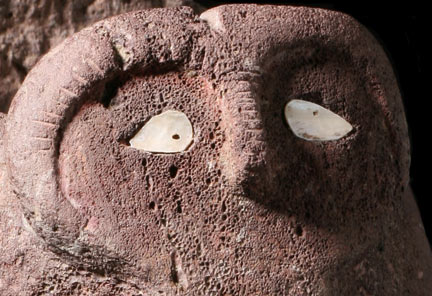
Stone lamp from interior Oregon with inset eyes of abalone shell. Source: OMNCH.

The Oregon Museum of Natural and Cultural History has some very nice exhibits and it looks like their underlying collections are superb.  Their online photo-gallery “Oregon: Where Past is Present” is some pretty nice eye-candy, though I would love to see them give a little more information about each piece.  The sculptural lamp above is simply superb.

So-called "wealth blade" made of flaked obsidian, length 25 cm. Source: OMNCH

Lousy conservation at the Vancouver Museum?

Shoddy conservation of magnificent petroglyph boulder at the Vancouver Museum. Screenshot from VM website.

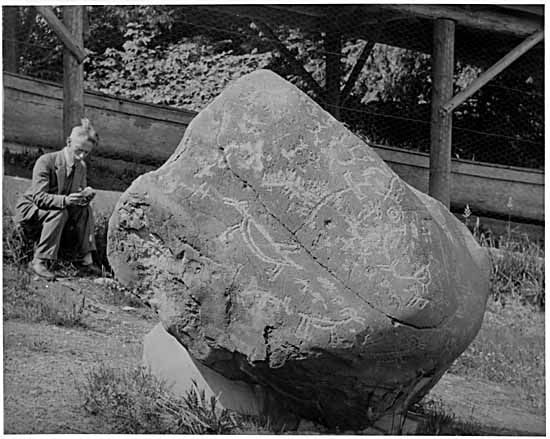
For some reason mistreatment of rock art just makes me spitting mad.  I posted the other day about a magnificent petroglyph boulder that was removed from its home on the central Fraser River near Lillooet in 1926.  Bad enough that this work of art was ripped from its setting to be a curio in an urban park.  Petroglyphs are not ornaments for your outdoor rock garden any more than they are lifestyle amenities deployed as advertising copy, even if you are a museum.

Now my spies tell me that this petroglyph boulder was moved to the Vancouver Museum in 1992.  Pictures of the boulder on the VM website show it to be in absolutely appalling shape.  It is covered with moss, the designs are visibly eroded and faint, there are signs of exfoliation, and the large crack seen in 1926 seems to be getting larger.   The Vancouver Museum appears to be keeping this treasure in a damp, shady, spot in the outdoors (as they say, it is in a “lower level garden courtyard”) and there is no sign of any attention to basic, fundamental conservation responsibilities. They even have the gall to note in their website description “Today archaeologists are reluctant to reveal the locations of petrogylphs, lest they be disturbed.”  Well I am revealing the location of this petroglyph, which is being disturbed by careless curation!

Seriously: this boulder is one of only a few petroglyphs from that part of the province, where pictographs are much more common.  It was in pristine condition in 1926.  Now it is a moss-ridden crumbling mess.  This boulder is a cultural masterpiece.  It is a provincial treasure.  It is a national treasure.  It is of international significance.  And yet it is being absolutely neglected by a leading cultural institution.  Imagine an Emily Carr painting being treated so poorly.  Imagine a Bill Reid sculpture  treated so shabbily.  It would never happen.  Yet this boulder is as important, is MORE important, and is consigned to rot away metres from state of the art curatorial facilities which are being devoted to white leather pant suits (!!).  It is astonishing to me that they put this boulder on the web at all, suggesting that they don’t see a problem and are therefore unworthy to be in possession of it.  They should make arrangements immediately to have it transferred to a suitable institution or have it returned to its original setting, in what I take to be St’at’imc territory

Vancouver Museum, you have a responsibility of professional stewardship.  Are you living up to it?

Note the eroded engravings and extensive moss/algae cover. Source: VM website screenshot.

The boulder in the early 1930s, soon after it was brought to Stanley Park. Note the crispness of the designs and the lack of moss.

e-fauna and e-flora of British Columbia

Raven, Corvus corax. Photo: Doug Skilton, via e-fauna BC

Not a strictly archaeological topic, but I was interested to find these online projects: the Electronic Atlas of the Fauna of British  Columbia, and a sister site for the flora.   These are subsites of a larger project called The Biodiversity of British Columbia.  Together, these sites aims to document, with photos, all the marine and terrestrial plants and animals of BC.  They have made a lot of progress – almost any critter or shrub you’ve heard about has  a photo at least, while many have descriptive pages of information and range.  Some sample pages for culturally-significant species: blue camasbalsam root, harbour sealsturgeon, Roosevelt elk, and Pacific banana-slug.  Species with photos only include raven and the hairy spiny doris.

Looking at the “animal photos wanted” page is a reality check though: while the current databse includes almost 9,000 photos, some 11,002 species still need photos to be submitted.  This speaks to the size of the task as well as the stunning breadth of biodiversity in BC.   If you have pictures of unusual animals then consider joining and making a submission – this would be a fantastic distributed project where the hive-mind of amateur naturalists across BC could make a solid contribution to these encyclopedic ventures.  They have some very handy checklists if you are inclined towards completionism.

One complaint: the site navigation is extensive, with multiple kinds of search possible, but the frame structure makes linking to specific pages very awkward or impossible.  Cleaning this up would be a big job but would increase the utility of the site greatly.

Chum salmon in a Burnaby estuary. Photo by Les Deighton via e-fauna.