Tag Archives: Northwest Coast

Last glaciation of Puget Sound (Quicktime Movie)

This is a nice little animated demonstration of the massive glacial changes in Puget Sound, found via the Burke Museum’s nice Waterlines online exhibit, which is a history of the geo-engineering of Seattle.

Chilliwack Museum and Archives

Chilliwack Museum Accession number 1957.019.084

Chilliwack Museum Accession number 1957.019.084

The Chilliwack Museum (map) has a large, searchable collection of photos online, which they ruin with a huge watermark in the middle.  Seriously, guys, these are ancient artifacts that you are lucky to be curating.  And, your pictures aren’t very good in the first place – many out of focus, or with extensive shadowing.  In any case, for archaeologists, you can click for artifacts made of, or records containing the word,   “stone” (they have a huge number of celts, mauls and abrader stones, as you might imagine since the Fraser Valley is known for these, perhaps because of extensive plowing of former woodlands).  Oddly they don’t seem to have any aboriginal artifacts made of bone, shell, or antler.  Search term “Sto:lo” returns one empty field.  Further they make it almost impossible to link to a specific record or picture. I am putting in a picture I downloaded from their site of an unusual artifact – a ground stone point with a very unusual morphology and material.  They list it made out of serpentine, but from what I can tell, it shows signs of being readily worked, and so may be a softer verson of serpentine, perhaps soapstone.  The shape is like a bronze age arrowhead or something — highly unusual.   Too bad there isn’t a better picture available.  So, all in all, Chilliwack Museum people: you put a lot of time and energy into a resource that is not particularly useful nor does it readily promote the heritage of the Fraser Valley.  I suggest you rework your URL system, remove the watermarks, and update your keywords by adding Sto:lo to appropriate records.  Double-check your raw material “horn” as well.  You have a fantastic collection, share it!

Fieldwork Picture of the Day 5

Submersible at Section Cove

Submersible at Section Cove

A few years back I fulfilled a lifetime ambition by going down in a submersible.  This shows the Nuytten craft “Aquarius” on the surface in front of the warden’s cabin on SW Huxley Island in Gwaii Haanas (map).  We tried diving onto the ancient lake that now lies drowned at 33 metres below sea level,  more or less in front of the cabin.  This lake would have been last exposed to air about 10,000 14C years ago.  We started at about 110 metres down and then worked our way up a palaeo-river channel towards the lake, but unfortunately got off course and ended up a lot closer to the beach than we had anticipated.  These things are flown by a pilot, but the basic navigation is by transponders on the bow and stern of the mother ship which allow triangulation from a known point.  Apparently, not foolproof!  The lake we were diving onto shows huge potential for an archaeological site.  We are thinking there may have been a base camp for bear hunting at Gaadu Din 1 or 2, which are less than a kilometre away.   Possibly, too, there was a sockeye salmon fishing camp here, since the nearby caves contain numerous salmon bones from the late Pleistocene.  Anyway, it was pretty cool to go down in the submersible!

West Vancouver Archives

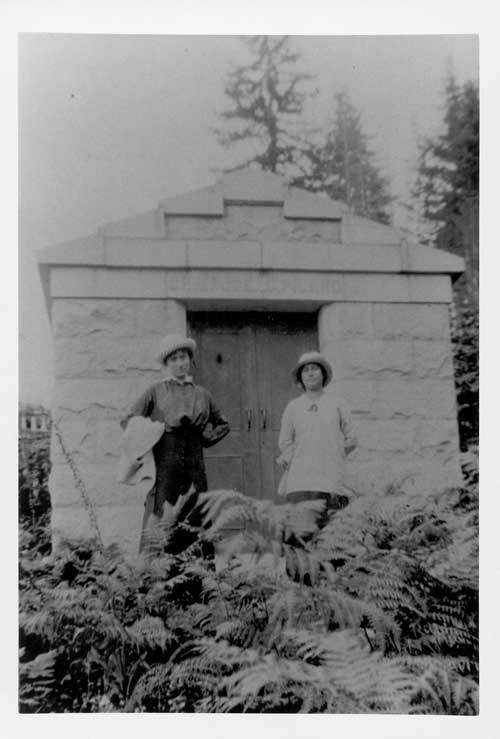
Tomb of Chief Joe Capilano ca. 1917

Visitors to the Tomb of Chief Joe Capilano ca. 1917

Stumbling on the Vancouver Public Library’s photo site the other day got me poking around smaller museums and archives for archaeology and First Nations related stuff.  It turns out there’s a lot out there.  First up is this picture I found at the West Vancouver Museum and Archives.  They have a searchable collection, within which a fair number of digitized historic photos.  A fair amount of stuff is under “First Nations” and “Indian”.  To the left is a remarkable picture of Chief Joe Capilano’s tomb (map).  It’s quite a slab, house-shaped (though not a shed roof house!), but surely it is as close to a mortuary house as it is to traditional Christian mausoleum.     Joe Capilano was a leader of the Sḵwxwú7mesh (Squamish) nation, to whom he was known as Sa7plek.

Sa7plek: Chief Joe Capilano

Sa7plek: Chief Joe Capilano

Apparently, he recieved the title of ‘Chief”  (via recieving the name Kiyapalanexw (Capilano), in order to facilitate his trip to Ottawa and to London, to meet King Edward VII.   The name bestowal was in the belief that he would need a title in order to speak “Chief-to-Chief” with the Prime Minister and the King, or so says wikipedia.  These smaller archives have fairly idisoyncratic interfaces and often the context given is poor.  Nonetheless, I will occasionally, or even frequently, post pictures or other material from them.

Vancouver Public Library Archives

beach-grove-dig

"Archaeologists at Beach Grove, 1962"

The Vancouver Public Library has a nice collection of historical photos online, though the resolution is not great.  Interestingly, there are a number of historical archaeology pictures I had never seen before.   I’m sure someone knows these faces, presumably they include Duff and Borden?  Another picture from Beach Grove (map) shows someone sitting at an ASAB desk (Archaeological Sites Advisory Board).  When surveying at the Milliken Site in about 1986 I remember finding an old desk that was presumably Borden’s – reputedly he had a desk at his digs.  Also, there was a bookshelf out there, in the middle of the woods above the tracks.  The VPL site also has a few pictures of the Eburne (Marpole) midden, including this disturbing closeup one of the human remains visible in the link above.

You can go here and enter the search term “archaeol*”

Getting Started!

I am preparing the website on Haida Archaeology, for which my Anthropology 449 students have been making the content.   I started doing it all on WordPress, but I found I was struggling with the use of so many pages on a system that was primarily designed for blog posts, with items scrolling away off the page.  So I switched to using iWeb, which has something of a learning curve but I think it will work better in the end.   Nonetheless it is taking a lot of time and I would definitely do some things differently next time.  But then, next time I will know what I know now!