Tag Archives: Northwest Coast

Akerman Collection – Salt Spring Island

Stone Bowl from Akerman Museum

Stone Bowl from Akerman Museum

Salt Spring Island has a pretty active museum and archival society, by the looks of it – at least, they are putting a lot of pictures and documents online.  One thing which caught my eye was their photos of the Akerman Museum – which I take to be the private collection at the home of Bob Akerman.  This is a striking carved object (of which I wish there were more photographs) described as: Black stone that they claim had healing power. Shamans used it when they were visiting the sick. Though elsewhere, they show another object with a similar description which appears not to be worked much, if at all.  There’s no real documentation which is too bad — the stone tools in this picture, for example, strike me as more of a neolithic thing than a northwest coast one.  I hope they have the information somewhere.  This is an impressive metal celt, and it looks like he has a good collection of nephrite ones as well, though the picture is exceptionally poor.  (NB – bandwidth is not nearly so much of a concern these days, so don’t shrink your pictures so much!) There are lots of slightly unusual artifacts, like this collection of handstones. All around, it looks like Akerman has a great collection — I don’t want to think too much about where the archaeological material came from, or how he came to have it, and I’d like to think there is a shoebox full of notes somewhere — but all the same it is interesting to peruse and I’m glad the Salt Spring Archives have at least some documentation of it.

Another highlight of the site is Chris Arnett’s short, but lively and informative history of First Nations of Saltspring Island.

Skidegate Haida Model Village

Model of Skidegate (hlgaagilda 'llnagaay) as installed at Chicago Exhibition, 1893.

Model of Skidegate (hlgaagilda 'llnagaay) as installed at Chicago Exhibition, 1893.

The Burke Museum in Seattle is doing excellent work.  I just found the project which they are spearheading, together with the Haida Museum at Kaay’llnagaay and the Field Museum in Chicago, to reassemble the famous model village of Skidegate (hlgaagilda ‘llnagaay) created for the 1893  Chicago World Fair.  This exhibition was organized by Putnam, implemented by Boas, who hired James Deans (a well known Victoria antiquarian) to collect some NW Coast stuff.  Deans outdid himself by arranging for the carving of a complete model of Skidegate Village  – amounting to some 27 model houses (most with frontal poles), 2 model mortuary houses, and 17 free standing model poles.  (Deans also apparently collected three boxcars of other material including an entire house, canoe and other material, but that’s another story).

The Burke Museum now allows you to view an interactive panorama of the model village.

The website is designed both to showcase these model houses and also to help find the 13 houses and poles which have gone missing.   The intention is to return the model village to Kaay in 2011.  Replacement poles and houses will be commisioned for those that cannot be found.   A highlight are the videos of Skidegate residents such as Captain Gold, Niis Wes, Percy Williams, Kii7iljuus, and Kwiaahwah Jones talking about the model village, about family, and above all about being Haida yesterday, today and tomorrow.

House of Contentment, model carved by George Dickson

House of Contentment, model carved by George Dickson

Fieldwork Picture of the Day 9

Danny at the helm,  aaaargh Billy.

Danny at the helm, aaaargh Billy.

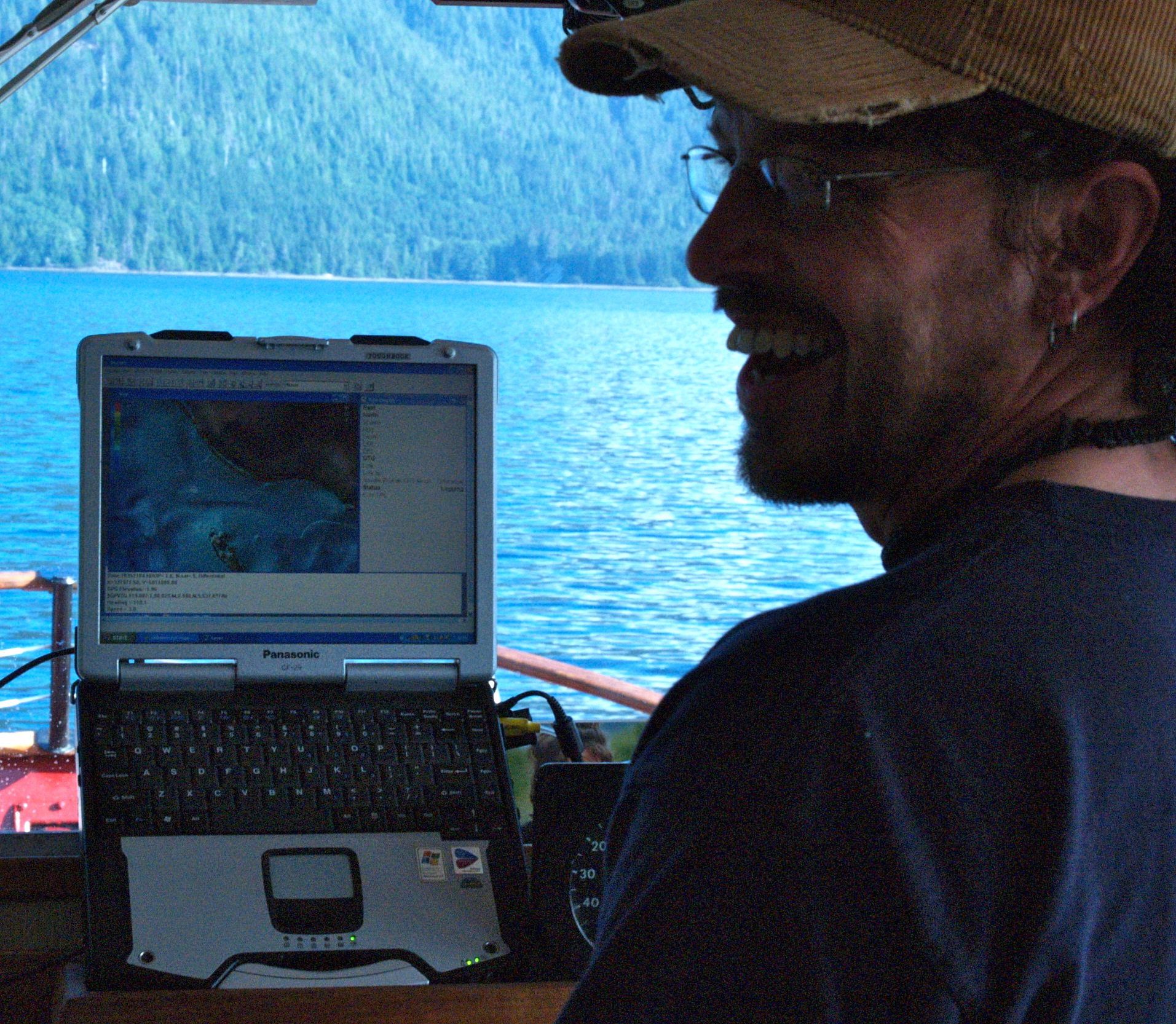
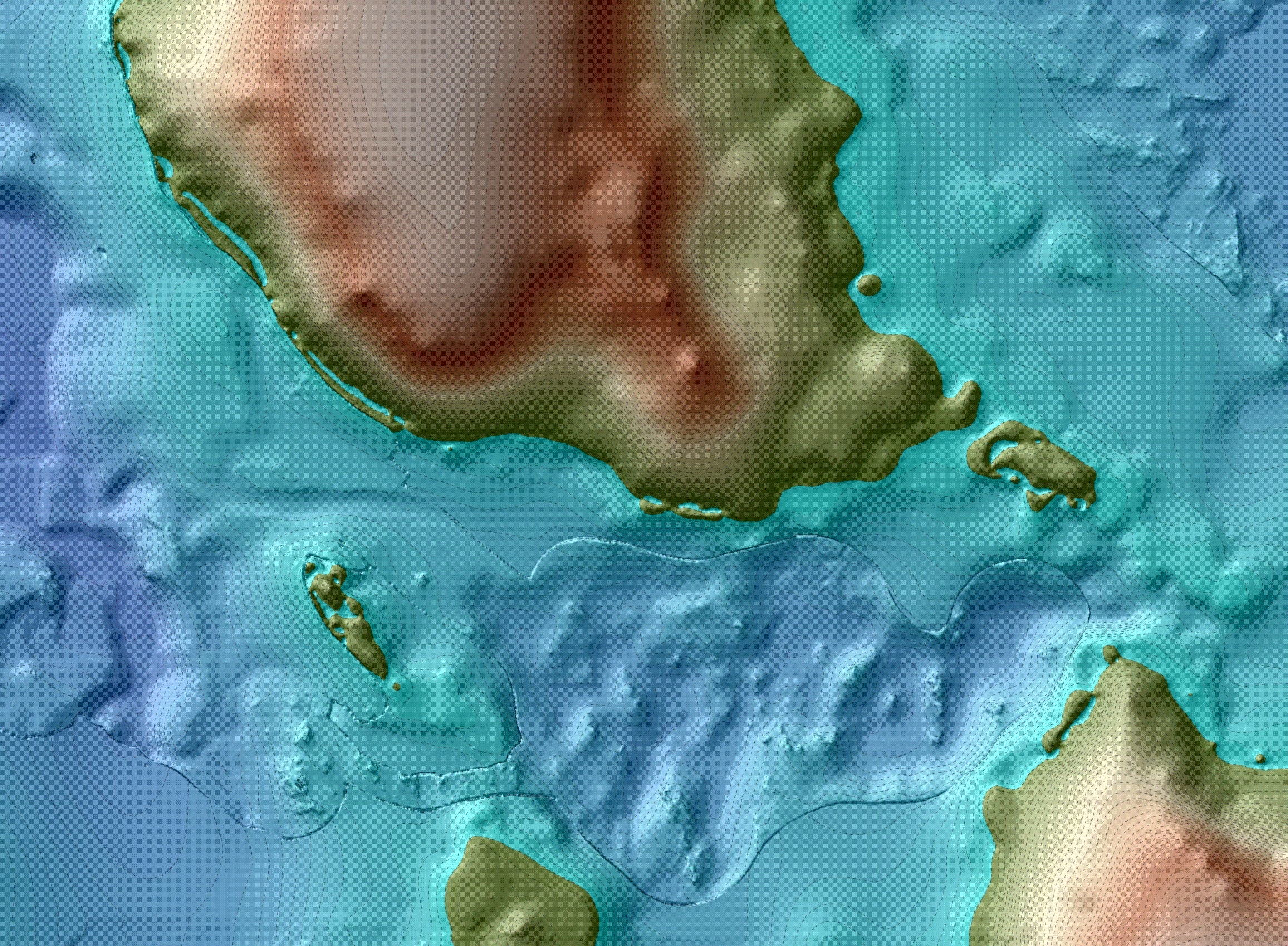
Underwater research at Section Cove, near Gaadu Din. I posted a picture earlier of a diver on the bottom.  Here is a view from topside — Danny, boat skipper, wise-ass and all round rock solid good guy — has a GPS-linked laptop in front of him which is displaying the bathymetry of Section Cove.  (see the image on Danny’s screen here, courtesy of Daryl).  This enables him to tow the sonar fish exactly where required, or, on this occasion, help position a small dredging bucket for bottom sampling purposes.  With differential GPS, you can position the ship to within less than a metre of where you want it, relative to the bottom.  This means measuring the distance between the GPS antenna and the crane and building in an offset, which is trickier than it sounds. The bathymetry is also sub-metre in resolution.  Thus, we can target the bucket exactly where we want it — of course strong currents and bucket flutter can still move it around some.  It has been slow progress on this work but all the pieces are in place for what could be an exciting breakthrough –  a base camp on a small lake, now drowned, dating to sometime older than 11,500 solar years ago would be most welcome considering most of our other sites of this age are rather one-dimensional.

The purpose of the camp could be base camp for bear hunting in the nearby Gaadu Din caves, or more likely sockeye fishing in the lake-stream system that used to flow along the terrain here, under Danny’s  keel.

The lake, the salmon, the cave, the creek.  Green tones are now underwater.

The lake, the salmon, the cave, the creek. Green tones are now underwater. Image prepared by Daryl.

Tla’amin Archaeology

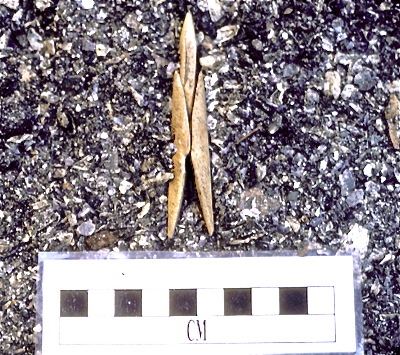
Toggling Composite Harpoon head, articulated in situ.

Toggling Composite Harpoon head, articulated in situ.

The Tla’amin (Sliammon)  First Nation on the Sunshine Coast (map) have been engaged in a wonderful community-based archaeology project with Dana Lepofsky at SFU and her team.  It’s not surprising when you think of what a great person Dana is – brilliant, yet nice, warm, generous. (Hi Dana!)

The website for this project is well worth browsing to see what meaningful partnerships with First Nations looks like.  I think it is a model for the future of BC Archaeology to work together – for then the project becomes not all about the past, but all about the present.  As they say – the past is over; it only exists in the present. Old things exist, but they exist now.   So how can we, as archaeologists, use our particular skills to help communities and the public appreciate the past as a meaningful part of the present, and hence of the future?  This impressive web site shows many great ways how.

Check out this page on Kleh Kwa Num – Scuttle Bay, for example, whih deftly points to the parallel stories of oral history, ethnohistory, and archaeology.  Or, this video of “what happens when an archaeological site is logged?”  As Elsie Paul, a Tl’amin elder says, their ancestral land was hammered for a century and what did aboriginal people get from it?  “Nothing”.  And as Dana says, it became very difficult to find intact archaeological sites around Powell River and the industrial areas, in particular.

These downloadable posters are also really well done, as is their prospectus/report (PDF) – very accessible stuff.   I do wish they didn’t use the silly flash interface for their pictures, though they do allow access to them otherwise – this project is really turning archaeology on its head!

Upside Down Archaeology in Tla'amin Territory.

Upside Down Archaeology in Tla'amin Territory.

Harpoon Head from the Hunterian

I have to say, I disagree with your description.  Based on size alone, at 14 cm this is much too large to have been for salmon fishing.  Stylistically, fish harpoons tend not to have a blade bed, but rather some kind of cylinder formed by the two valves.  Flat beds such as this one are more consistent with large arming points made of ground slate or ground mussel shell.  If intended for a fish, this would be more suitable for Fraser River sturgeon, say.
But I doubt it.  I’d suggest in size and manufacture this is much more consistent with a sea mammal harpoon head.  I don’t recall seeing any of this size in Coast Salish archaeological sites.  If your provenance traces to Laskey and thus to Cook, I’d suggest it is much more likely to be from the Nuu-chah-nulth (Nootka) area of western Vancouver Island, where Cook occupied himself much of the time he spent on the NW Coast proper, and with which it is stylistically consistent.  Indeed, even without provenance that is where I would assign it.  And I would suggest in size and manufacture it is more likely to be a large sea mammal – probably whale – harpoon head of a kind we describe out here as “Composite Toggling Harpoons”, composed of two valves forming the barbs with an allowance (usually) for an inset arming point.  Something like a sea lion harpoon I would expect to be about 2/3 of this size.   Further, Cook never really had much interaction with Coast Salish groups.
Normally too I would expect the valves on one of this size to be made of antler or of wood (yew, or Douglas fir) and not bone so that is an interesting difference.
Anyway, all this is by way of saying, it appears the lanyard extends up one side, then crosses through the notch (blade bed) to the other side where it fastens.  I’d be interested in knowing if this is the case since it would be an interesting functional design aspect encouraging the harpoon head to toggle when pressure is put on the lanyard.  If you had higher resolution pictures I would love to see them.
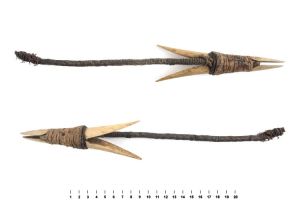
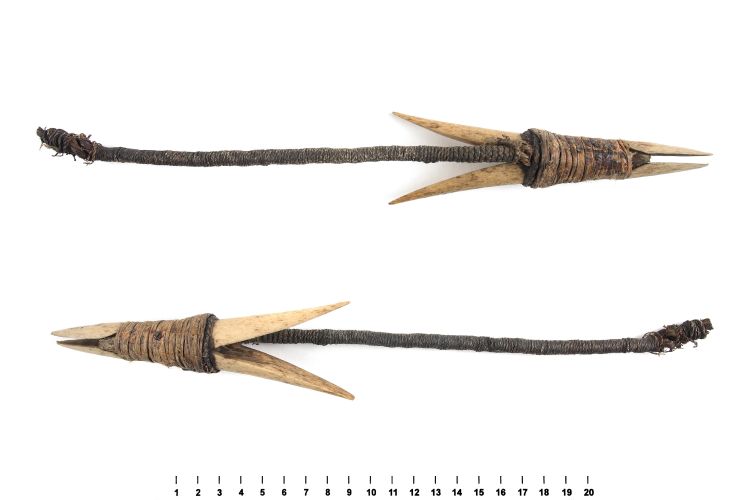
Composite Toggling Harpoon with lanyard.

Composite Toggling Harpoon with lanyard.

This item from the Hunterian Museum in Glasgow traces its provenance provisionally to Captain Cook:

This harpoon head has one large split point, with a curved split socket with pointed tips. It has twisted sinew lashing around the middle and a line of vegetable fibre attached. This type of harpoon would have been used to catch salmon and is stylistically attributable to the Salish people of the North West Coast of America. The harpoon was originally accessioned as donated by Dr. G. Turner, however there are no items from the North West Coast on the 1860 donation list. It may be one of the hooks mentioned by Captain John Laskey in his 1813 account of the museum, in which case it may have been collected on one of the three Pacific voyages of Captain James Cook.

I have to say, I disagree with the description. Based on size alone, at 14 cm for the head, this is much too large to have been for salmon fishing. Stylistically, fish harpoons tend not to have a blade bed, but rather some kind of groove formed by the two valves which supports a cylindrical bone point.  Flat beds such as this one are more consistent with large arming points made of ground slate or ground mussel shell. If intended for a fish, this would be more suitable for Fraser River sturgeon, say.

But I doubt it. I’d suggest in size and manufacture this is much more consistent with a sea mammal harpoon head. I don’t recall seeing any of this size in Coast Salish archaeological sites. If the provenance traces to Laskey and thus to Cook, I’d suggest it is much more likely to be from the Nuu-chah-nulth (Nootka) area of western Vancouver Island, where Cook occupied himself much of the time he spent on the NW Coast proper, and with which it is stylistically consistent. Indeed, even without provenance that is where I would assign it.

And I would suggest in size and manufacture it is more likely to be a large sea mammal – probably whale – harpoon head of a kind we describe out here as “Composite Toggling Harpoons”, composed of two valves forming the barbs with an allowance (usually) for an inset arming point. Something like a sea lion harpoon I would expect to be about 2/3 of this size. Further, Cook never really had much interaction with Coast Salish groups.  These harpoons work by an analogous process to the toggles on a duffel coat: insert the toogle narrow-ways, then it turns side-ways and won’t pull through the loop.  For toggle, read “vicious harpoon” and for loop, read “flesh”.  Because most maritime hunting and fishing technologies require immobilization of the prey and retrieval, the technology tends to quite a bit more complex and intricate and well-engineered than terrestrial hunting technology which is more single purpose (kill!).  The composite harpoons are a great example of this.

Normally too I would expect the valves on one of this size to be made of antler or of wood (yew, or Douglas fir) and not land mammal bone so if these valves are land mammal that is an interesting difference.

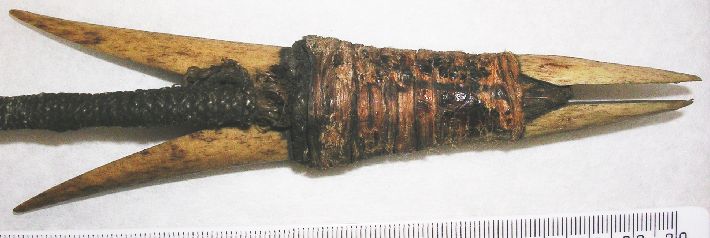
Anyway, all this is by way of saying, it appears the lanyard extends up one side, then crosses through the notch (blade bed) to the other side where it fastens. This would be an interesting functional design aspect encouraging the harpoon head to toggle when tension  is put on the lanyard.  (I emailed the Hunterian to see what they think)
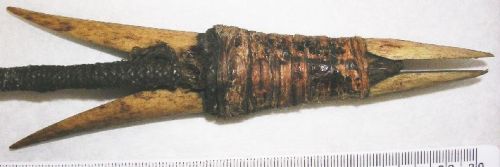
What is that organic matter between the valves? The lanyard?

What is that organic matter between the valves? The lanyard?

Vancouver [Native] Art in the Sixties

GOOGA!

GOOGA!

This 1962 picture of Haida artist Robert Davidson at age 13 caught my eye, not least because he looks a lot like his nephew, Haida archaeologist and great guy Allan “Googa Boy Lefty ClamBone Monica Sunshine” Davidson. Here’s Allan tending to his espresso pot at Richardson Island.  Very shareable.  I am pretty sure this was before I accidentally tossed a grub into his cup.

Maps and Charts at the RBCM

1849 Indian Fort at Cadboro Bay

Indian Fort at Cadboro Bay, 1849

The Royal BC Museum was ahead of the curve in putting significant parts of its collection.  One thing I like is their small but relevant collection of maps and charts.  The 1849 chart inset to the left shows an “Indian Fort” in Cadboro Bay, for example.  There is a good selection of Admiralty Charts from the mid 19th Century, Pemberton’s 1861 map of Victoria (the “Bay” in this section is the real “James Bay”, now landfill under the Empress Hotel , where the bridge shows is now the causeway), and a 1911 map showing the Economic geography of Haida Gwaii (which interestingly includes Sea Otter as part of the fauna “on the west coast” since that species is thought to have been extirpated much earlier).  It is always surprising and sobering to see just how quickly remote areas were divided up and labelled according to their perceived economic value in a way that borders on propaganda, but there is realism too check out the instructions to family men.  Now the bad news: the price of being first is often not being very good.  I suspect when these went online bandwidth was a realy problem.  Each chart is split up into 100kb segments and it is not possible to download the entire thing at once.  The full size images must exist, so how about a quick project at the RBCM to make them downloadable in their entirety?  Same goes for the picture archives.

dSpace: Labrets by Marina La Salle

Tlingit Woman with Labret, Yakutat 1837

Tlingit Woman with Labret, Yakutat 1837

Labrets, decorative inserts worn in the lip, are an extraordinary artifact type.  It is hard to think of a more intimate or personal artifact, or at least, one that is routinely found.  Further, archaeologists have seized on labrets as status markers and routinely use them for interpretive ends.  Indeed, they are seen as a sign of “achieved status”, since one could (in theory) start wearing a labret at any age, and this has been contrasted with cranial head deformation, which must be initiated in infancy.  This distinction has been claimed to characterize the Locarno Beach to Marpole transition about 2000 years ago in the Salish Sea, for example.   And yet, for all the talk about them, they have languished through the years with only small reports and descriptive accounts of small collections given (an exception after a fashion is Grant Keddie’s catalogue of them downloadable here).  So it is very welcome to see a 2008 UBC MA thesis on labrets by Marina La Salle (4 meg PDF; click on “view/open” near the bottom of the page).  Moreover, this is a thesis which treats them with a suitable dose of social theory and strives for subtlety and nuance vs. the  over-determination of status so often seen in NW Coast Archaeology..

From La Salle 2008 MA Thesis

From La Salle 2008 MA Thesis

Apart from some solid work on their metric dimensions, typology, and a documentation of the astonishing variety of raw materials used to make labrets, there is also welcome and innovative discussion of identity formation and the negotiation of status as active, cultural processes.  This contrasts with earlier studies or casual reference to labrets as simplistic and unambiguous markers of status, worn non-problematically and being basically a badge of identification vs. a negotiable brand.  I wish La Salle had done a few small things, such as always give the artifact numbers in figures and table, and give repositories where possible (follow up work is made so much easier), and her colourful tables are entirely inscrutable, but I credit her very much with taking a fresh approach to an important, perhaps crucial artifact type.  She has a lot to say and I sense a certain frustration (or maybe this is just projection) with UBC’s restrictive 50 page limit on MA theses.  This thesis checks in at over 200 pages anyway, but a limited space for discussion of a lot of data.  Does this mean that MA students now produce more data than they can use and is this a kind of serfdom?  Discuss.

Stone Fish

From the Hunterian, labelled as 19th Century.

From the Hunterian, labelled as 19th Century.

I can’t get enough of this Haida argillite fish which the Glasgow Hunterian Museum has in their collection. Well, they say it’s a fish but it looks like it has flukes and large fins and if anything it looks like a harbour porpoise.   On the other hand, there is a lateral line as well and the proportions are more like a herring. In any case, it is utterly charming and I have never seen a comparable carving.  It looks to be about 30 cm long, which is quite large.  More from the Hunterian in due course.

Pickford on Excavation of “Indian Middens”

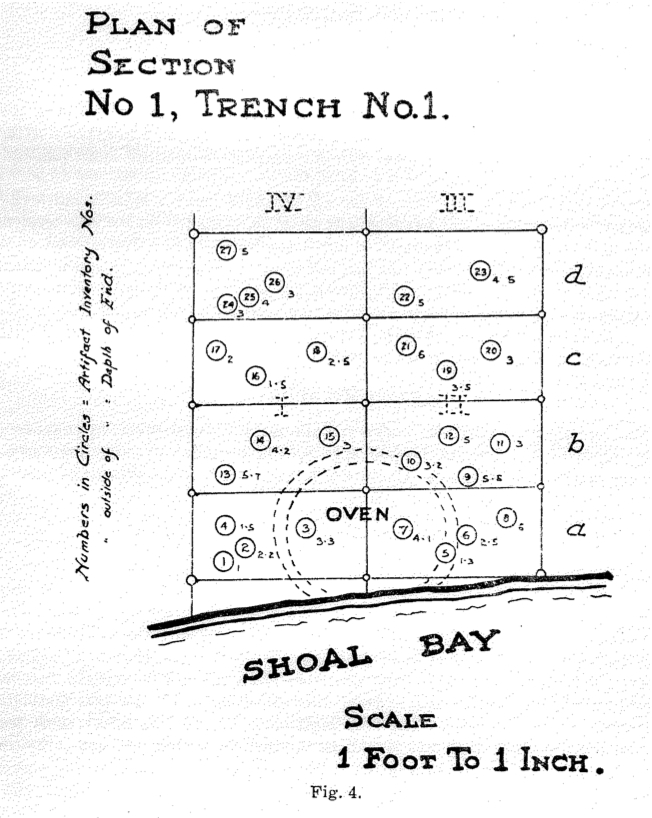
A.E. Pickford's ideal plan of an earth oven.

A.E. Pickford's ideal plan of an earth oven.

A.E. Pickford was the Assistant in Anthropology at the Royal BC Museum, when it was still known by its proper name of the Provincial Museum of Natural History and Anthropology.  Here I link to his indispensible 1947 article, “Archaeological Excavation of Indian Middens” – the examination of such middens by means of sampling.

The rationale for the publication is interesting:  “In case of private ownership, if a person is unable to restrain the impulse to dig on his own land, we urge that he shall adhere to some such principles as those which follow, then he will have the satisfaction of knowing that his work is well done and, when brought into focus with similar undertakings, will help to build up that sound formation of knowledge, without which the correct story of the early population of this country cannot be written.”

After encouraging the study of lofty topics such as racial and cultural origins, foods, housing …. etc., Pickford busts out his inner schoolmarm: “He who digs for relics alone may be likened to the child who tears a book apart in order to secure the coloured plates which it contains, being the while all unaware that in scattering the printed pages to the wind he is losing forever a valuable source of information about those same plates and the life which they represent”.

Reference: Report for the Year 1947.  Victoria: Provincial Museum of Natural History and Anthropology, Province of British Columbia, Department of Education.  [yes, education].