Tag Archives: Northwest Coast

dSpace: Adams on Gabriola Petroglyphs

Gabriola Petroglyph Design Elements. Source: Adams 2003.

One recent M.A. thesis I was really looking forward to reading is by Amanda Adams entitled Visions cast on stone : a stylistic analysis of the petroglyphs of Gabriola Island, B.C., from UBC Anthropology 2003, and available for free download here.

I was particularly interested to read the instructions she received on proper deportment when visiting the rock art:

Sites were visited in a manner and with a personal code of conduct adhering to Snuneymuxw wishes. Petroglyph sites were not visited at either dawn or dusk. A respectful demeanor was expected as was an “open heart and mind” (Bill Seward, Snuneymuxw elder, personal communication 2002). I was asked to give my full attention to the petroglyphs and their sacredness, not allowing daily distractions to interfere with my concentration on the ancient imagery. These expectations were met to the best of my ability. (18-19)

While many archaeologists are under the impression that there is little to no ethnographic information about petroglyphs, I have long felt that more likely such knowledge is private or highly privileged and not readily shareable.  In this self-serving sense, it was gratifying to see that Adams was able to record some such information:

Snuneymuxw Elder, Bill Seward, asserts that many petroglyphs were made by shamans, hunters and vision seekers (personal communication 2002) while Elder Ellen White maintains that the carvings were places where people both sought and gained power. She explained that “men would be stripped – even in cold weather and laid on top of each petroglyph – learning the spirit world, connecting to the area.” She also noted that the pitted ‘dots’ surrounding several of the carvings were “points of access”, places where one could dip their fingers into pools of “energy” and reservoirs of strength (Archaeology Forum group tour 2002).  (p 13)

Another welcome aspect of Adams’ thesis is her direct comparison to portable art.  Continue reading

Maori Canoe found in New Zealand Beach

Canoe being excavated at Muriwai Beach, 2010. Source: stuff.co.nz

From the Northwest Coast (of New Zealand) comes inspiring news for Northwest Coast (of North America) archaeologists.

I don’t know how many times I’ve told students that I would never really expect to find a canoe in an archaeological site and that the evidence for watercraft and marine fluency – still a contentious issue for the early Northwest Coast – will likely be resolved through interpretation of marine fauna from archaeological and from finding sites on remote islands.  While in my view Kilgii Gwaay settles this question for the early period on the Northwest Coast,  I suspect nothing short of a 10,000 year old dugout canoe will satisfy some people as to whether the first inhabitants around here could catch a fish.

So it came as a surprise to read that a nearly-complete, seven-metre long Maori wooden waka tikai, or river  canoe, has been recently found in Muriwai Beach (map) on the Northwest Coast of New Zealand (video clip).  The canoe may take several years to properly conserve, and is currently undated.  While the canoe presumably is less than a thousand years old (the accepted time frame for the  arrival of Maori in New Zealand), the fact that it survived at all, buried in the sands of what appears to be a fairly exposed beach, leads me to think we need to keep our eyes open more for this kind of find on the Northwest Coast.  This story claims that it was seen washing up in the 1920s, but still – once something like this survives the process of burial then it might survive for a very long time indeed protected deep in dark, wet beach or dune deposits.  Memo to self: don’t be so pessimistic!

Maori waka being raised. Source: nzherald.co.nz

Cliff Painting by Marianne Nicolson

Marianne Nicolson is a member of the Dzawada’enuxw Tribe of the Kwakwaka’wakw First Nations.  She is an internationally-known contemporary artist, and a Ph.D. candidate in the Departments of Linguistics and Anthropology at the University of Victoria.  Her work is outstanding and profound and if you get a chance to see her studio pieces, then by all means do so.

One work you will not be seeing in a gallery anytime soon is her massive pictograph, Cliff Painting, near the head of Kingcome Inlet in her traditional territory (map).  The work is over 15 metres high by 10 metres wide, emblazoned on a prominent cliff as you round the final corner heading into Kingcome (video, scroll down).  It formed the focal point of the book by Judith Williams Two Wolves at the Dawn of Time, which is highly recommended.  Painted using scaffolds lowered from above the cliff, the work is a profound statement of power and energy.  The image is of a “copper“, a large shield-shaped symbol of chiefly power, family prestige and spiritual inheritance, among many more nuanced meanings.  Many pictographs on the coast are fading away, rinsed by sun and rain, vandalized even.  This massive pictograph takes a stance for all the past, present, and future powers of the Kwakwaka’wakw First Nation.

Cliff Painting in Progress. Source: The Medicine Project.

Northwest Coast in New Zealand

Masset, ca. 1924. Source: University of Canterbury, NZ.

I found myself poking around in a New Zealand archive at the University of Canterbury the other day and found some nice historic pictures from the NW Coast.  These are assigned to the collection of John Macmillan Brown, an early New Zealand academic and, in retirement, an amateur anthropologist.  I am guessing these pictures were taken by him in retirement.  Most are undated; one carries a date of 1924.  The subjects are familiar yet the views are new – the more we can catalogue the world’s pictures of the NW Coast, the better we can understand the processes of transformation which continue to unfold.

Update: fixed links, sort of.  Note to web types: you should always provide stable URLs, none of this “your search has expired” junk.  If you want your collections used, and you do, because you put them on the web, you need to make it so the results can be bookmarked and shared.  Gosh.

Skidegate ca. 1924. Are those oarlocks on that canoe? Source: University of Canterbury.

Ha’ina: supernatural Nuu-chah-nulth crystal?

Crystal artifact said to be used to summon guests to feasts. Source: British Museum

Hmmm, coincidences.  Two or three days ago I was having a beer with a recently graduated student of mine, who was telling me about a number of quartz crystal artifacts he had found in an excavation in the Fraser Valley.  Now, artifacts made of quartz crystal are well known in the Gulf of Georgia — the nature of the rock makes it highly suitable for flaked stone tool production, especially microblades.  Ethnographic accounts suggest they could also be used for sawing very tough rock types such as nephrite.  However, the artifacts being described to me the other night included complete crystals with grooves around the bases — pendant-like, perhaps, or specialized abraders, or, well, or what?

Well,  in a stunning display of “coincidence”, or a happy intervention from a raven, today I ran across just such a shiny little thing at the British Museum website.  From their text, (which I cannot vouch for, having never heard of such a thing before):

The Nuu-chah-nulth believed that these crystals, or ha’ina, grew on the top of mountains and were endowed with magical qualities for bringing wealth and good fortune, for example, when hunting sea otter.

This ha’ina was collected by Captain George Dixon, who had accompanied Captain Cook on his Third Voyage (1776-80) to Vancouver Island. In 1785-88 Dixon made a trading voyage on the King George and Queen Charlotte which was promoted by the King George’s Sound Company (King George’s Sound was Captain Cook’s short-lived name for Nootka Sound on Vancouver Island, where this crystal was collected, probably from the Mowachaht people.)

The Nuu-chah-nulth used the ha’ina to invite people to potlatches, the great feasts given to celebrate life-cycle events at which hereditary rights were displayed. The invitation to a potlatch would take place at a gathering a year or two before the potlatch, when the crystal would be, metaphorically speaking, sent out to the prospective guests. They may have ‘sent’ this example to Dixon. Dixon was supported by Sir Joseph Banks in his work, and through Banks gave this ‘piece of rock crystal’ to the British Museum on 22 May 1789.

It would be sad and ironic (though not surprising) if this artifact was indeed an invitation never acknowledged, an unfulfilled RSVP, and if the gormless British had managed to interpret an invitation as a commodity and not as a request for honour, attendance and respect.  It would be wrong on a number of levels to draw conclusions about the Fraser Valley examples, but it does show the potentially fuzzy boundaries between symbolic and functional material culture.

Tse-whit-zen interactive pages and slide show

Whale vertebrae modified into a spindle whorl, from the Tse-whit-zen site. Source: Seattle Times

I mentioned the Tse-whit-zen site a few days ago, in reference to the recent discovery of a small whale sculpture found there in 2009.  The Seattle Times had a superb web site on this ancient Klallam village, but unfortunately, many of the links are broken (how does that even happen, anyway?).  But the four part illustrated slide show with extensive audio commentary by Klallam, archaeologists and other people is still available and is well worth watching – in fact its one of the best such slideshows I’ve seen.  The Interactive Village component of the site is still active as well, and also definitely worth checking out.

As with so many of these sad stories of site disturbance through development, there is a silver lining as the dig itself, and the objects found, have contributed to a vitalization of Klallam traditional practices and increased interest in Klallam traditional culture within their younger generation.  At a severe price, though: over three hundred burials were excavated and removed from the site before the project, a massive graving dock, was brought to a halt – a halt which, according to some, cost over 100 million dollars.  I’m posting some of the pictures in case the Times site loses even more functionality.

Comb recovered from Tse-whit-zen site. Source: Seattle Times.

One of the more than 800 remarkable etched stones found at Tse-whit-zen, some in association with human remains. Source: Seattle Times

More than 300 human burials were disturbed by the graving dock project. Here, some await reburial in a warehouse on site. Source: Seattle Times.

Speaking of Ozette: dSpace resources.

The "White Series" Ozette reports are freely available for download! Image shows house-plank decoration from the Ozette Site, used as cover art for these reports.

This space has recently carried a lot of items about the Ozette water-saturated site on the Olympic Peninsula,  about Makah whaling, and Queets canoes, and other wet sites in Washington State.  All archaeologists and many of the public in the Northwest are familiar with the Ozette site which, with its fabulous preservation has stimulated a lot of work on the archaeology of the big houses which so characterise the culture area from the Columbia to the Gulf of Alaska. A principal way most archaeologists are familiar with Ozette is through the three large  site reports published by Washington State University, bound as large white paperbacks, and found on the bookshelf of archaeologists across the region.

So, imagine how happy I was to find that all three volumes are available as free PDF downloads from Washington State University.  The PDFs are very large, perhaps un-necessarily so, but who can complain about over a thousand pages of detailed archaeological information on one of the most significant archaeological sites in North America, or even the world?  The three volumes are:

  • Samuels et al.  Ozette archaeological project research reports Volume I House structure and floor midden. 1991.  Link to download page.  (193 megs)
  • Samuels et al. Ozette archaeological project research reports volume II Fauna. 1994.  Link to download page(154 megs)
  • Whelchel et al.  Ozette archaeological project research reports volume III ethnobotany and wood technology.  2004.  Link to download page.  (288 megs).
  • While you’re at it, pick up Dale Croes’ pioneering 1974 computer applications in archaeology paper: The use of computer graphics in archaeology : a case study from the Ozette site, WashingtonLink to download page.  (149 megs).

UPDATE March 3/2010:  the handle.net URLs have been broken for a couple of days.  Try this link to get straight to WSU dSpace for Ozette. If that breaks ( a lot of places prevent stable URLs from search results because obviously people never want to share things) then go here and enter “ozette” in the search box.

(Note: all the above documents may download as files named “ARI” with no file extension.  You will need to add the extension .PDF to the file before you open it.)

These PDFs are fully searchable which makes finding things within the copious material of the Ozette site much easier.  The huge number of artifacts, features and fauna from Ozette have been a blessing and a curse, as interpretation struggles under the dead weight of data.  I would therefore be remiss if I didn’t bring to your attention the excellent M.A. thesis on Northwest Coast household archaeology by UVIC’s own Brendan Gray, who uses Ozette as a test-bed to investigate how we might be able to dig less but dig smarter and therefore learn more from Northwest houses.  Every NW Coast archaeologist should read this thesis.

  • Gray, Brendan 2009.  Sampling methods in Northwest Coast household archaeology: a simulation approach using faunal data from the Ozette siteLink (a bargain at 4.8 megs)

Anyway, I know many readers might find this to be too much inf.ormation, but I don’t believe it is common knowledge that these full text Ozette reports are freely available:  the WASU servers are fast, hard drives are cheap, and the reports are first class.  Enjoy.

Simulated and actual sampling designs projected onto Ozette house floors. From Brendan Gray M.A. thesis.

Oregon: Where Past is Present

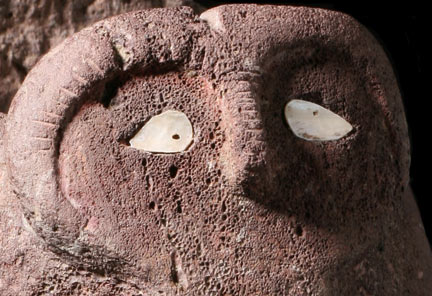
Stone lamp from interior Oregon with inset eyes of abalone shell. Source: OMNCH.

The Oregon Museum of Natural and Cultural History has some very nice exhibits and it looks like their underlying collections are superb.  Their online photo-gallery “Oregon: Where Past is Present” is some pretty nice eye-candy, though I would love to see them give a little more information about each piece.  The sculptural lamp above is simply superb.

So-called "wealth blade" made of flaked obsidian, length 25 cm. Source: OMNCH

Tse-whit-zen whale

Tse-whit-zen whale sculpture.  Source: Peninsula News, Port Angeles.

Whale sculpture from the Tse-whit-zen archaeological site, Port Angeles. Source: Peninsula News.

The Tse-whit-zen site is a former Klallam Tribe village that was discovered by the construction of a graving dock at Port Angeles, Washington State.  The subsequent disturbance and archaeological project led to an astonishing series of events with over 300 human burials recovered, many more disturbed, 65,000 artifacts recovered and after a huge investment the abandonment of the graving dock project at a cost some estimate in excess of 100 million dollars.  This is a story I want to know more about and will probably post on from time to time.

But for today, set aside the sad history and feast your eyes on the above small sculpture of a whale discovered during the summer of 2009 at Tse-whit-zen during mopping up remediation.  The artist has captured the essence of whale!  The article doesn’t say, but there may be a socket on the lower back of the whale just in front of the tail – perhaps this was the handle for a small chisel, or a knife.  I also wonder if it doesn’t go the other way up — the mouth is asymmetric and the arching back of a diving whale would be a more natural posture.  Either way, this is a happy little sculpture, probably dating from about 2,000 years ago.

Geist: Memory and the Valley Photo Essay

Sxwòyeqs (The Place that Everyone Died) | Stave Lake. Source: Geist Magazine.

A while ago I linked to a beautiful photo-essay from Geist Magazine on decaying towns on the BC coast.  I see they have another excellent photo essay, this one on the subject of the superposition of Euro-Canadian towns and spaces onto Aboriginal archaeological sites and significant places.  The text by Sandra Shields and David Campion is sensitive and evocative and the photographs are well taken — in some ways they are banal – an overpass, and access road – yet knowing what lies underneath triggers emotional reactions. UVIC’s own Duncan McLaren is featured as well so it must be a good article – Stave Lake (above) has two of the oldest archaeological sites in Canada (each more than 12,000 years old), parts of which miraculously survived the reservoir inundation.

The Geist authors are interviewed here, which is also well worth reading:

Interviewer: it’s not only peo­ple that are miss­ing in “Memory and the Valley”; you touch on the dis­ap­pear­ing salmon, the white pine, the waters drained away. There’s def­i­nitely that tone of loss through­out the whole work.

Campion: That is why we’re hav­ing the exhibit here in the old city hall in Chilliwack, with a wall of the orig­i­nal pio­neers look­ing down on the work. It’s because you strug­gle with these two nar­ra­tives. One says: When Canada started, we came to a land that had no peo­ple in it and we strug­gled really hard and made a won­der­ful life for our­selves and a future for our chil­dren. Whereas, for abo­rig­i­nal peo­ple, it’s a story of huge pain and suf­fer­ing, and a huge loss of peo­ple to dis­ease, even before con­tact. Then res­i­den­tial schools, cul­tural mod­i­fi­ca­tion, and so on.

So you’ve got this prob­lem at the base of Canadian soci­ety. For soci­ety as a whole to move for­ward, we need to find a way to acknowl­edge that loss, not just to have it mean some­thing in that on/off, negative/positive sense. As non-Natives, we need to find a way to absorb the real­i­ties of our com­ing here into our national narrative.

The notion of a “palimpsest” in archaeology is common, borrowed from manuscript studies: parchments would be scraped clean and re-used, yet, the older writing can still be seen and read, a ghostly precursor image.  Writing over writing, material culture over material culture, names over names and the living over the dead.  Every time you walk across the concrete apron in front of the MacPherson Library at UVIC you walk across an archaeological site.  Every time you leave the Elliot Lecture hall you walk across a site.  The Legislature is on a site, the Fraser Arms Hotel, the Willows Beach Tea House, all superimposed, a collective blotting.  Our feet tread the scraped parchment of the dead.

Leq’á:mél | Nicomen Island