Tag Archives: fishing

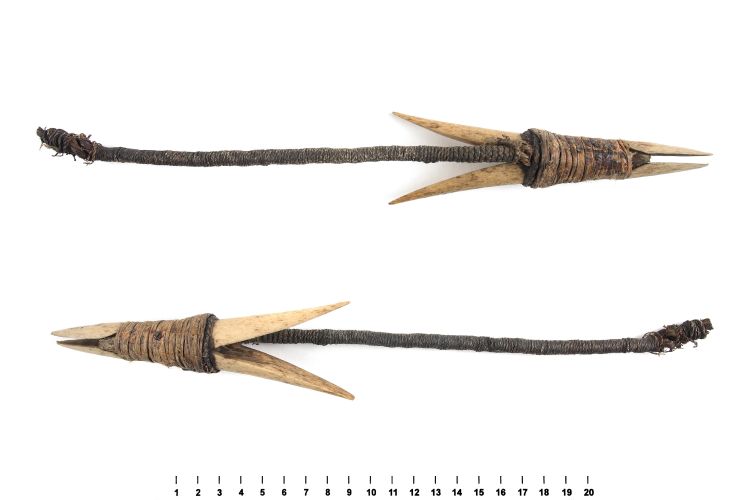
Harpoon Head from the Hunterian

I have to say, I disagree with your description.  Based on size alone, at 14 cm this is much too large to have been for salmon fishing.  Stylistically, fish harpoons tend not to have a blade bed, but rather some kind of cylinder formed by the two valves.  Flat beds such as this one are more consistent with large arming points made of ground slate or ground mussel shell.  If intended for a fish, this would be more suitable for Fraser River sturgeon, say.
But I doubt it.  I’d suggest in size and manufacture this is much more consistent with a sea mammal harpoon head.  I don’t recall seeing any of this size in Coast Salish archaeological sites.  If your provenance traces to Laskey and thus to Cook, I’d suggest it is much more likely to be from the Nuu-chah-nulth (Nootka) area of western Vancouver Island, where Cook occupied himself much of the time he spent on the NW Coast proper, and with which it is stylistically consistent.  Indeed, even without provenance that is where I would assign it.  And I would suggest in size and manufacture it is more likely to be a large sea mammal – probably whale – harpoon head of a kind we describe out here as “Composite Toggling Harpoons”, composed of two valves forming the barbs with an allowance (usually) for an inset arming point.  Something like a sea lion harpoon I would expect to be about 2/3 of this size.   Further, Cook never really had much interaction with Coast Salish groups.
Normally too I would expect the valves on one of this size to be made of antler or of wood (yew, or Douglas fir) and not bone so that is an interesting difference.
Anyway, all this is by way of saying, it appears the lanyard extends up one side, then crosses through the notch (blade bed) to the other side where it fastens.  I’d be interested in knowing if this is the case since it would be an interesting functional design aspect encouraging the harpoon head to toggle when pressure is put on the lanyard.  If you had higher resolution pictures I would love to see them.
Composite Toggling Harpoon with lanyard.

Composite Toggling Harpoon with lanyard.

This item from the Hunterian Museum in Glasgow traces its provenance provisionally to Captain Cook:

This harpoon head has one large split point, with a curved split socket with pointed tips. It has twisted sinew lashing around the middle and a line of vegetable fibre attached. This type of harpoon would have been used to catch salmon and is stylistically attributable to the Salish people of the North West Coast of America. The harpoon was originally accessioned as donated by Dr. G. Turner, however there are no items from the North West Coast on the 1860 donation list. It may be one of the hooks mentioned by Captain John Laskey in his 1813 account of the museum, in which case it may have been collected on one of the three Pacific voyages of Captain James Cook.

I have to say, I disagree with the description. Based on size alone, at 14 cm for the head, this is much too large to have been for salmon fishing. Stylistically, fish harpoons tend not to have a blade bed, but rather some kind of groove formed by the two valves which supports a cylindrical bone point.  Flat beds such as this one are more consistent with large arming points made of ground slate or ground mussel shell. If intended for a fish, this would be more suitable for Fraser River sturgeon, say.

But I doubt it. I’d suggest in size and manufacture this is much more consistent with a sea mammal harpoon head. I don’t recall seeing any of this size in Coast Salish archaeological sites. If the provenance traces to Laskey and thus to Cook, I’d suggest it is much more likely to be from the Nuu-chah-nulth (Nootka) area of western Vancouver Island, where Cook occupied himself much of the time he spent on the NW Coast proper, and with which it is stylistically consistent. Indeed, even without provenance that is where I would assign it.

And I would suggest in size and manufacture it is more likely to be a large sea mammal – probably whale – harpoon head of a kind we describe out here as “Composite Toggling Harpoons”, composed of two valves forming the barbs with an allowance (usually) for an inset arming point. Something like a sea lion harpoon I would expect to be about 2/3 of this size. Further, Cook never really had much interaction with Coast Salish groups.  These harpoons work by an analogous process to the toggles on a duffel coat: insert the toogle narrow-ways, then it turns side-ways and won’t pull through the loop.  For toggle, read “vicious harpoon” and for loop, read “flesh”.  Because most maritime hunting and fishing technologies require immobilization of the prey and retrieval, the technology tends to quite a bit more complex and intricate and well-engineered than terrestrial hunting technology which is more single purpose (kill!).  The composite harpoons are a great example of this.

Normally too I would expect the valves on one of this size to be made of antler or of wood (yew, or Douglas fir) and not land mammal bone so if these valves are land mammal that is an interesting difference.

Anyway, all this is by way of saying, it appears the lanyard extends up one side, then crosses through the notch (blade bed) to the other side where it fastens. This would be an interesting functional design aspect encouraging the harpoon head to toggle when tension  is put on the lanyard.  (I emailed the Hunterian to see what they think)
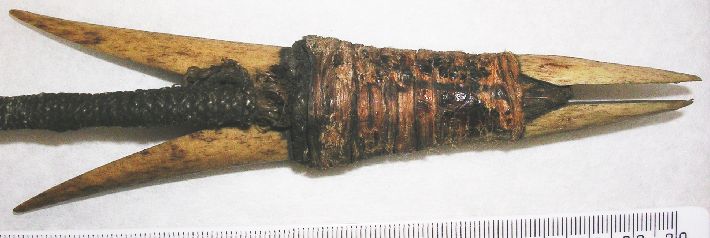
What is that organic matter between the valves? The lanyard?

What is that organic matter between the valves? The lanyard?

University of Washington Digital Collections

Makah codfish spear (or, more accurately, harpoon)

Makah codfish spear (or, more accurately, harpoon)

The University of Washington has a superb digital collection online, transcending all kinds of different historical, archaeological and popular culture niches.  Searching on “artifact” brings up some 583 images (some of which are links to text etc).  These are downloadable and have stable URLs to which one can link. The resolution could be higher, but the pictures are sharp and clean, at least for those ones they have apparently taken themselves, and they don’t plaster watermarks all over them.  Good work.  The amount of metadata is impressive, and the fact that is is clickable renders this site a fantabulous timewaster of the highest order.  To the left, I was just having a discussion with a student about harpooning fish.  I am under the impression that harpoons were used on large lingcod – after the lingcod were lured to the surface using a cunning little shuttlecock-shaped rising float.  This picture is labelled “Makah codfish spear” though it is self-evidently a harpoon and lanyard.  More (vindication) coming from this excellent site as time goes by.

dSpace: Lundy on Rock Art

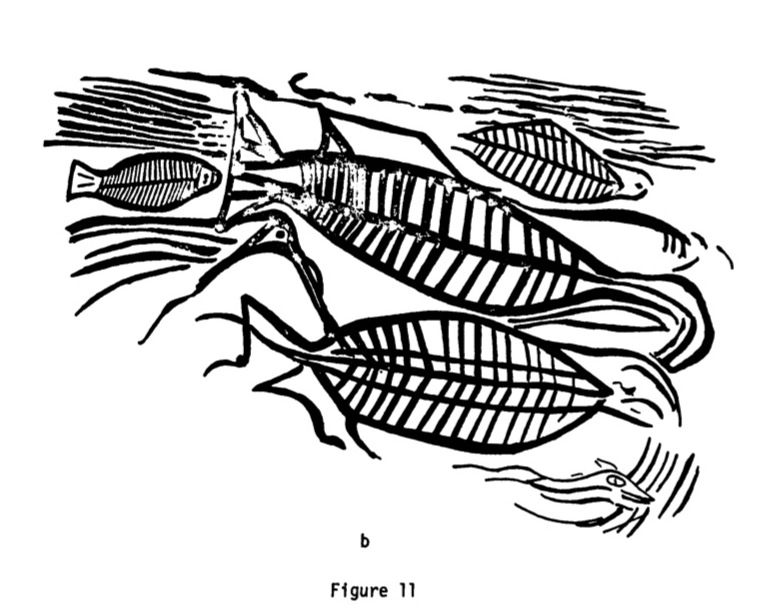
Salmon Petroglyph at Jack Point. From Lundy (1974: 111)

There is a wonderful trend of institutions putting old, grey literature online.  One widely used platform  for doing this is called “dSpace”, though the approach exists under other names.  Some of the best of this material are graduate theses and dissertations.  These are freely available if you walk into the University library, but may be essentially unavailable in any other form.  Unlike a lot of digital initiatives, the majority of these are not limited to students and faculty, but can be accessed by anyone – provided you know they are there.  Consider Doris Lundy’s monumental MA thesis on NW Coast Rock Art, obtained in 1974 from SFU.  Most of this 350+ page thesis was never published in any form.  Now you can download the whole thing from SFU (4 meg PDF). Despite being a rocky scan, the entire text is searchable.  There is some digital protection applied but I found it simple to save a copy to my hard drive.  The image to the left is the famous salmon petroglyph at Jack Point near Nanaimo in Snuneymuxw territory.  This is the petroglyph that would be painted with ochre and adorned with eagle down by ritualists if the salmon runs were late or meagre – one of the only such works which has specific beliefs recorded for it.

Let me know if you have problems downloading this: it works for me on and off campus, so I presume anyone can do it.

Archives of “The Native Voice”

Native Voice banner

2018 edit: it appears the PDFs are now only available through the Internet Archive here.

The Native Voice is the official organ of the Native Brotherhood of British Columbia, an organization which has been active since 1931 and continues to do good work, especially in relation to aboriginal fishing rights, and aboriginal fishers themselves.  The NBBC has put PDF copies of  many editions of the Native Voice online from the years 1947-1955.  These archived issues offer a fascinating glimpse into the the mid-20th century state of First Nations politics, and everyday life besides.

To the right, for example, click on the text image to go to an issue wherein the NBBC riffs (positively, in this case) on  a Ruth Benedict article.

The Dionysians Strike Back

The Dionysians Strike Back

It is rare to see such responses (positive or negative) to the Anthropological Literature. Scroll lower in that article for 1947 ‘News from Ahousat”, a statement on segregation in PRince Rupert cinemas, and an odd “humour” column which seems rather offensive and patronizing in retrospect.    I am looking forward to trawling, or trolling, through these archives as the days go by.  Kudos to the NBBC for not only putting these documents online, but for the excellent, clear digitization — clearly someone took care making these files.

Scary article on overfishing

Every time I focus on this topic it has gotten incrementally worse.