Tag Archives: artifacts

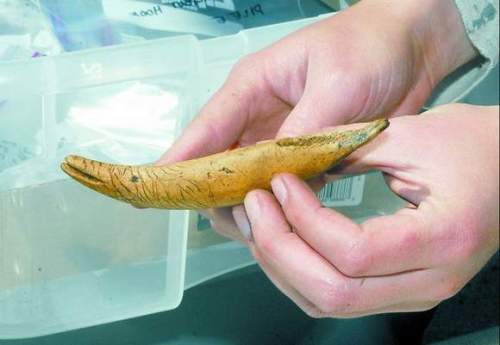
Tse-whit-zen whale

Tse-whit-zen whale sculpture.  Source: Peninsula News, Port Angeles.

Whale sculpture from the Tse-whit-zen archaeological site, Port Angeles. Source: Peninsula News.

The Tse-whit-zen site is a former Klallam Tribe village that was discovered by the construction of a graving dock at Port Angeles, Washington State.  The subsequent disturbance and archaeological project led to an astonishing series of events with over 300 human burials recovered, many more disturbed, 65,000 artifacts recovered and after a huge investment the abandonment of the graving dock project at a cost some estimate in excess of 100 million dollars.  This is a story I want to know more about and will probably post on from time to time.

But for today, set aside the sad history and feast your eyes on the above small sculpture of a whale discovered during the summer of 2009 at Tse-whit-zen during mopping up remediation.  The artist has captured the essence of whale!  The article doesn’t say, but there may be a socket on the lower back of the whale just in front of the tail – perhaps this was the handle for a small chisel, or a knife.  I also wonder if it doesn’t go the other way up — the mouth is asymmetric and the arching back of a diving whale would be a more natural posture.  Either way, this is a happy little sculpture, probably dating from about 2,000 years ago.

Canoe Steaming

Carl and Joe Martin steam a canoe near Tofino. Click to play video.

The Northwest Coast is rightly famous for the superb dugout canoes made by First Nations, a craft which continues to the present day.  It takes weeks or months to carve  a canoe from a single log of red cedar – imagine then the tension inherent in having a big part of the success or failure “boil down” to a single event the steaming process.  The video above shows master carvers Joe and Carl Martin of the Nuu-chah-nulth nation steaming a canoe at a beach near Tofino, on western Vancouver Island.

Steaming softens the cedar and makes it more flexible, allowing the insertion of carefully-measured, carefully-planned wooden spacers which spread the middle of the canoe into a graceful curve, increasing its buoyancy, resistance to capsizing, and introducing subtle yet beautiful lines, as seen in this enormous example mis-labelled (I think) as Salish.  After the canoe cools and dries, the wood returns to its natural properties. The process means the canoe can in principle be wider than the single piece of cedar from which it is carved.

You can click here to see a slide show of the steaming of a Haida canoe carved by the team of Jaalen Edenshaw and his father Guujaw. In the old times, a canoe might be roughed out in the bush then hauled to the beach for finishing.  Sometimes flaws in the wood or other interruptions mean a canoe was never finished.  Such half-finished vessels are a known, but uncommon archaeological site in the woods of coastal British Columbia.

The carving of such canoes is increasingly common.  Nowadays, the canoe log is likely to be hauled to a carving shed.  Sadly, a major constraint  on canoe construction is the difficulty in obtaining prime, straight, clear, old-growth cedar logs.

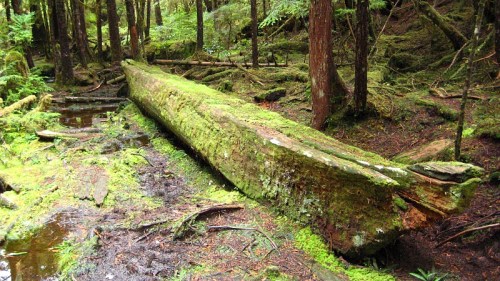
Partially finished Haida canoe in forest. Photo by Martin Lalune.

Another Haida Argillite Pipe for Sale

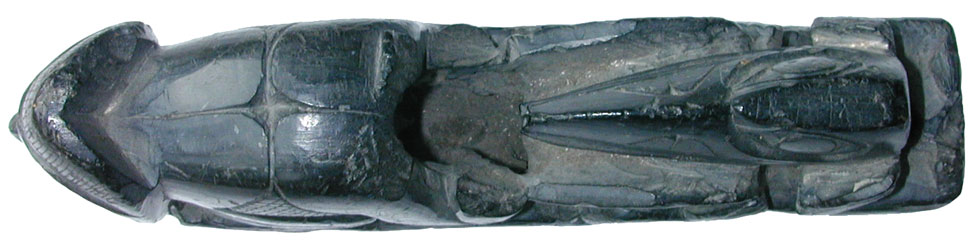
Haida panel pipe, nineteenth century.

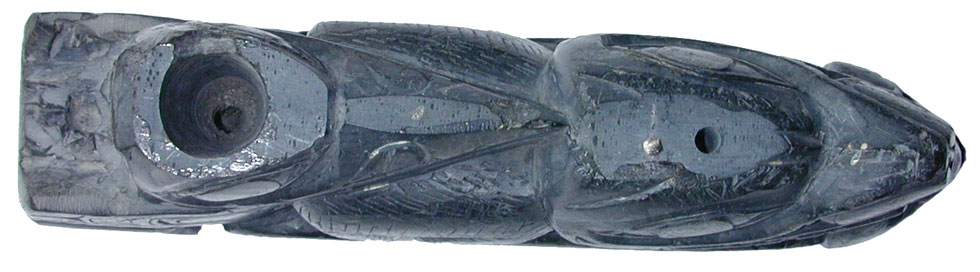
A few days ago I featured photographs of a stunning 19th century Haida argillite pipe for sale at a UK web site.  They have a second pipe for sale, a more complex design but in poorer condition.  The photos are similarly revealing of carving strokes and rock grain; even more so in some ways as this piece appears to be unfinished.  The design is complex focusing on Raven and Bear (not the Frog as the description below says, I don’t think), but it is not for me to try to decode the story being told.

The description is given as follows:

19thC. HAIDA ARGILLITE PIPE PANEL. #asc004 #asc004

Probably from the Raven Tribe, the panel carved with various mythological figures including a raven, a man, a frog and the thunder bird, this is possibly part of a larger panel and the top has been slightly filed flat for mounting on a stand, (not photographed). Overall 13.5cm.

From the Haida tribes of the Northwest Pacific Coast of British Columbia and Queen Charlotte Island

£2,500.00

Again, for posterity, here are nine views of this pipe: 1, 2, 3, 4, 5, 6, 7, 8, 9.  As I noted before, while not as sharp as the other set, these photographs surpass most of what one finds on many, many museum sites, where the rule seems to be: offer a single view of an object, offer it at low resolution, do not allow direct hyperlinks to the file, and break the URL as soon as possible.

Front view of panel pipe.

Top view of pipe.

Haida Argillite Pipe: High Resolution Pictures

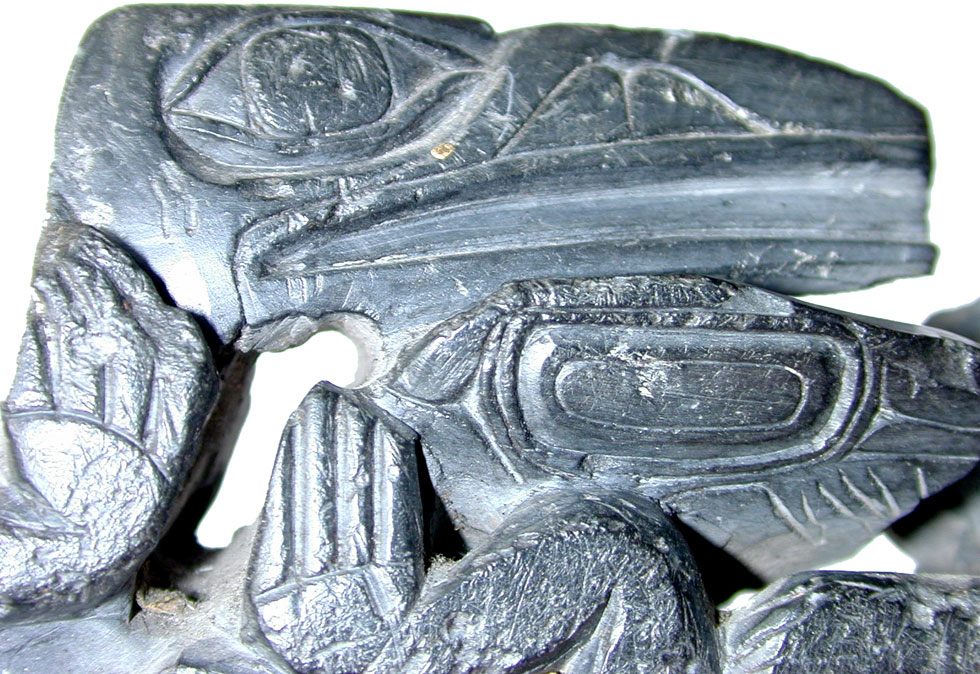
Detail: Haida Argillite Pipe ca. 1880. http://www.antiquearms.co.uk

I occasionally complain about the lousy pictures that professional organizations put on the web.  I guess I should know that when you have something to sell, you put it’s best face forward; when you don’t, you might not care as much.  Check out the high resolution pictures of this Haida argillite pipe for sale (4,800 GBP).  Multiple angles of the pipe, each one sharp and crisp: you can see each stroke of the knife and the grain of the slate.  Yes there is some glare but the images are much better than most museums make available on the web.  Amazing stuff.

Described as:

19thC. HAIDA ARGILLITE EFFIGY PIPE. #4213 #4213

a bowl carved in the form of a European sailor’s head with large rounded eyes and long straight nose, a figure seated astride the stem also with large rounded eyes and long straight nose and with arms extended wearing European costume with a stripe incised along the sides of the tunic arms and the trousers. Overall 20cm. From the tribes of the Pacific Northwest Coast of North America, principily Northern Columbia and Queen Charlotte Island. 20cm

This pipe was brought back and formed part of the collection of John Madden (1837-1902) of Hilton Park Clones Co, Monaghan Ireland, he left the Irish family estate at the age of 24 to travel by horse across the eastern states of America as far as the Great Lakes just before the start of the Civil War. During his later travels between 1870-1890 he is known to have reached British Columbia where he bought this pipe, it stayed in the family home until the collection was sold at an auction of part of the contents of Hilton Park on the 8th July 1985 where this item was aquired.

For the record, here are the seven views offered by the dealer: 1, 2, 3, 4, 5, 6, 7.

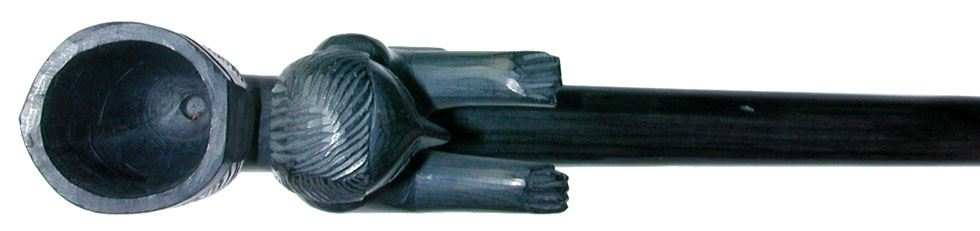
Haida Pipe: detail as if looking down the stem to the bowl.

Replica Tlingit Armour

Replicated Tlingit body armour.

The Tlingit artist Tommy Joseph has replicated a traditional set of armour:

… body armor made of alder slats and rods and woven together with hemp. Wooden panels are stitched together with leather lacing. Moosehide straps. Two alder toggles fasten the armor around the body.

It’s for sale: $3,500.

I was looking into this because of a recent post on Linen Armour (!) at Heather Pringle’s blog — I tried to leave a comment there in response to a question about NW Coast armour but wordpress ate it — probably because I had a bunch of links.  Dan form there, if you read this, most likely the armour Simon Fraser saw was made of two or more layers of stiffened elk hide.

Nettle winding around wooden slats and rods plus toggle fastening.


Punchaw Lake Geochemistry

Elongate side-notched points from Punchaw Lake. Source: Montgomery 1978.

Archaeologists are often pretty lousy geologists.  Nowhere is this more apparent in the use of visual cues to classify rock types.  Accurate classification of rock types is an enormous clue to the mobility of past people, to ancient territories, as well as trade and exchange networks.  Even so, very few archaeological studies on the Northwest Coast have looked at geochemical characterization of raw materials, other than for obsidian at least.  The best work done to date is probably Nicole Smith’s M.A. thesis on the Richardson Island site.

It is therefore nice to see some other comparable work being done.  I don’t know much about the Punchaw Lake (near Prince George) project beyond this poster which has been put online  in  the form of a PDF conference poster by Lorenz Bruechert (abstract).  I understand Bruechert did his MA at UNBC on this geochemical study and also there is a much earlier 1978 MA thesis by Patricia Montgomery available online.  It seems Bruechert used the 1970s excavations as a study sample, and the ICP-MS and other work was contracted out to ACME (not that one), a geochemistry consulting company (note: Nicole did the geochem work herself at UVIC so bonus points there).

In any case, Bruechert finds that a sample of the debitage is geochemically sortable into six groups, all of which are closely-related trachydacite or dacite.  There is as much internal differentiation at Punchaw Lake in the geochemistry of this rock type as there is between any two typical sites on the Plateau.  Hence, he suggests three distinct sources with “tens” of kilometres between them.  As the Punchaw Lake site finds itself on the Alexander Mackenzie trail, this is not that surprising to see diversity of raw material (though one could argue there should be even more diversity).  Nonetheless, the point remains that, as the picture below shows, all the material tested by Bruechert would have been classified visually as basalt (lower left on the graph); whereas in fact, none of it is basalt.  It was such findings at Richardson Island which helped allowed Nicole to postulate an “experimental” phase of technological innovation – in her case, a variety of materials including rhyolites, argillites and varvites had all been variously mixed and matched in ways that did not reflect their geochemical origins.

Bruechert Figure 2: rocks called "basalt" (lower left) are actually dacity/trachydacite.

Haida, Argillite, and the Pig War

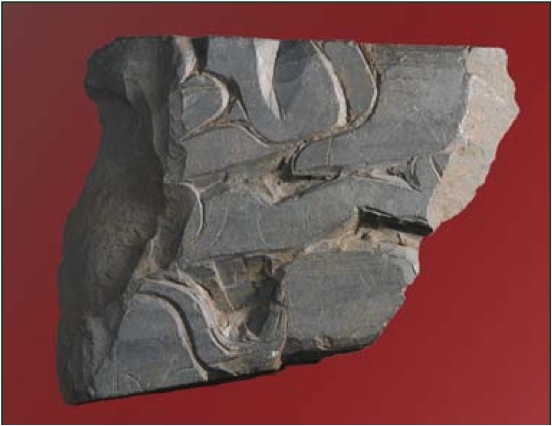
Carved argillite from Belle Vue Sheep Farm, San Juan Island. Source: NPS.

I don’t know as much about the 1859 Pig War as you might think, having spent an awful lot of time on San Juan Island. This “war”, which was more of an armed standoff between British and American troops, was a key event in the various mid-19th century boundary disputes.  One key location was Belle Vue Sheep Farm, near the southern tip of San Juan Island, where there has recently been some interesting historical archaeological work by the U.S. National Parks Service.

One interesting find at this dig is a piece of carved argillite, shown above, which most likely stems from Haida Gwaii (see page 7 of this PDF report, browse other NW NPS reports here).  Around this time there were plenty of Haida and other North Coast Nations around the Victoria area, and so it is not surprising, really, to see this piece.  And yet, it is also a stroke of massive good fortune to have such a distinctive piece of the turbulent 19th century history of First Nations.

Intriguingly, a key figure on the American side of the Pig War was George Pickett, who later achieved substantial fame for leading Pickett’s Charge at the Battle of Gettysburg in the American Civil War,

Ironically for someone who later fought for the racist Confederacy, Pickett was once married to a Haida woman by the name of Sâkis Tiigang.   (More often known as “Morning Mist”, this site gives her Haida name as beSakkis Tiigang while the Pickett Society in a detailed article gives her the slightly more authoritative-seeming name Sâkis Tiigang, meaning “Mist Lying Down”).  They had a son together, the artist James Tilton Pickett who, without wanting to generalize overly, certainly looks like a Haida man.  Shortly after the birth of young James in 1857, Sâkis Tiigang passed away.

Probably there is no tangible connection between Morning Mist/Sâkis Tiigang and this carved piece of her homeland, but surely there is a poetic one.

James Tilton Pickett, son of Sâkis Tiigang and George Pickett/ 1857-1889. Source: Pickett Society.

Speaking of Wilson Duff and Bill Reid

Roy Jones of Skidegate climbs a pole at SGang Gwaay. Source: CBC.

Yesterday I noted the upcoming musical about the Bill Reid-Wilson Duff expedition to “rescue” carved poles at the Haida Village of SGang Gwaay (Ninstints).  I’ve just found that the CBC has posted online a short documentary, (2013:edit, use this link)  first broadcast in 1959 and narrated by Bill Reid, showing the removal of these poles to the Museum of Anthropology at UVIC.  The expedition also included Wayne Suttles and Michael Kew, as well as Wilson Duff of course.  The Haida crew consisted of Roy Jones, Clarence Jones and Frank Jones of Skidegate. Some aspects of the trip are recounted in the BC Provincial Museum Annual Report of 1957, which I will scan and post some other day.

The spoken component of the documentary is a fascinating account by Reid, at that time just beginning his carving career, but the real jaw-dropping element is the depiction of the use of axes and saws and climbing spikes to log this forest of poles.  Necessary, of course, but jarring nonetheless.

Broadcast Date: May 21, 1959

A small boat ferrying Bill Reid and a team of anthropologists approaches the southern tip of the Queen Charlotte Islands. Reid documents the rescue mission to salvage and relocate the last of the crumbling Haida totems as revealed in this CBC documentary. With a sense of excited urgency, Reid describes and catalogues the enormous poles on the approaching shore. As they are gently felled, the majestic cultural landmarks will creak and groan before they are prepared for transport.

It’s low resolution and grainy, but the general impression is a very powerful one.

Felling a tree, surely, not a pole at SGang Gwaay. Source: CBC.

Tlingit, Dene and Eskimo Metallurgy (1969)

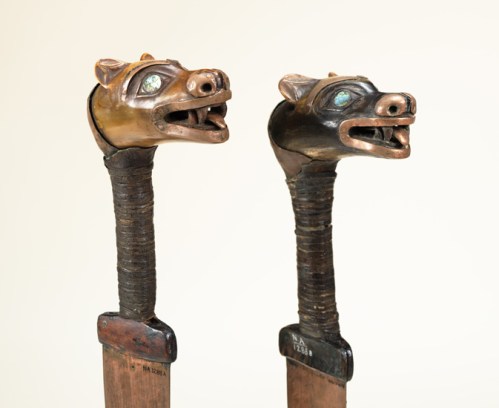
Tlingit dagger hafts, Kluckwan, Alaska. Purchased by George Gordon from Louis Shotridge at the Portland Fair, 1905. Penn Museum Objects NA1288a/b.

From the excellent University of Pennsylvannia Museum website, you can download back issues of their magazine “Expedition”, including this article on aboriginal metallurgy in Northwest North America (PDF).  The caption below is from that article: the two astonishing daggers being described are shown above.  Seriously, this is metalwork of the highest order, reminiscent of, say, Mycenaean pieces.

1969 caption describing the two daggers, above.

Peavies, pickaroons, hookaroons and skid tongs

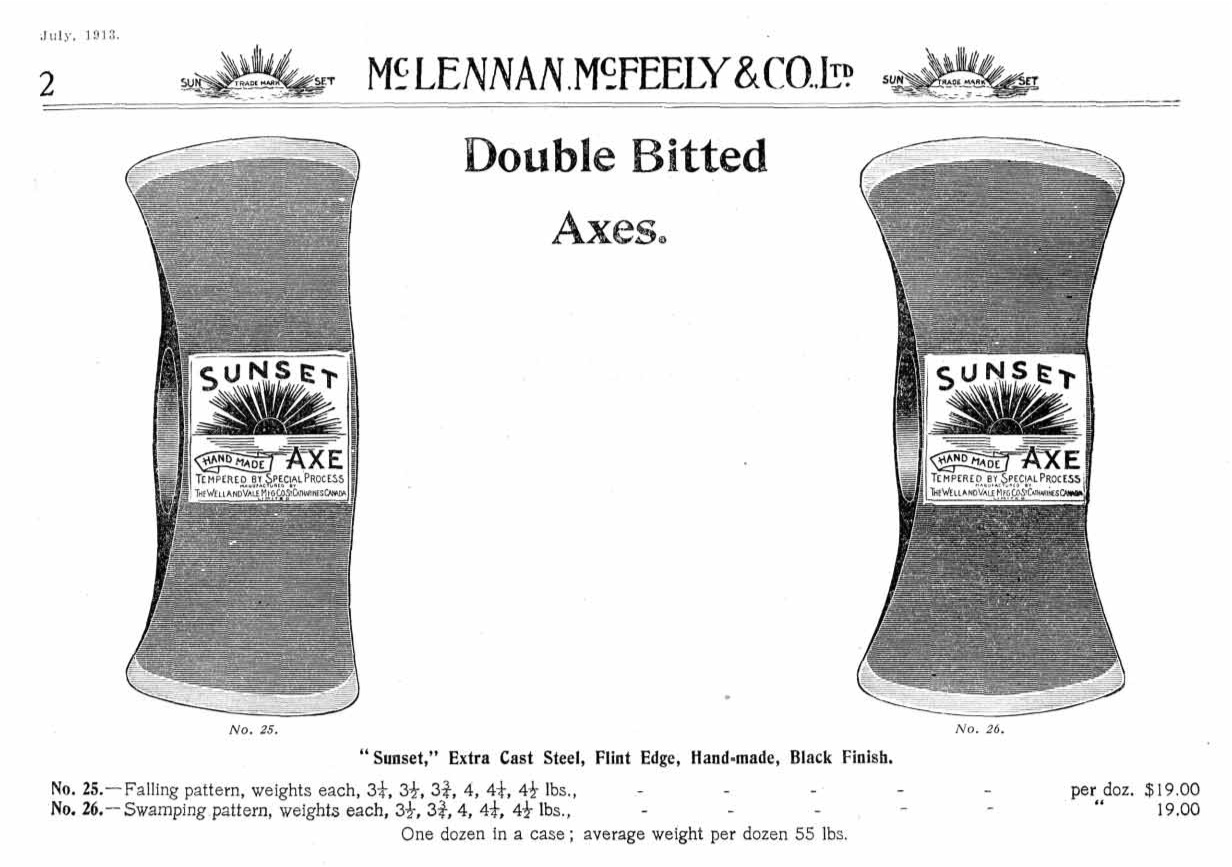
Double-bitted axes, available by the case.

It’s pretty common to run into historic industrial equipment when doing archaeological work in BC, especially logging equipment.  The Vancouver City archives has put the entire McLennan, McFeely & Co. Ltd Catalogue 1908-14 online, albeit in a somewhat awkward format (hey guys, why not just post a single PDF as well?) (edit: see comments below).  This catalogue would have been the ordering bible for many remote logging, mining and cannery outfits up and down the coast, the remains of which are often lying atop shell middens or strewn in the intertidal zone.  Altogether, the Vancouver City Archives and the Burnaby Village Museum have put  more than 1,500 pages of historic merchandise, as well as ordering and shipping information and price lists. Click on an image and it brings up a legible PDF of that single page.

Continue reading