Songhees claim to Cadboro Bay

Songhees claim to Cadboro Bay lands promised by Douglas. Source: TImes-Colonist.

The Douglas Treaties have stood up well in court but the fact remains that the rights to hunt and fish are severely compromised by urban developments.  Further, it is a widespread shameful pattern that the government went out of its way to reduce the sizes of the few, small reserves that were established and to eliminate some altogether.  It is very welcome to see the strong assertion of the Songhees Nation that they have the rights to 200 acres surrounding Cadboro Bay.

Lawyer Rory Morahan said the band is not trying to reclaim the land promised to it in one of the Douglas Treaties, but is asking for compensation and a declaration that it is Songhees land.

A statement of claim was filed in B.C. Supreme Court yesterday, but it is likely to be at least a year before the case is heard.

The key to launching the lawsuit was finding historical documents, Morahan said. “There’s oral tradition about the village site, but in the courts you need more than oral tradition. We have been working on this for about a year, getting the details down,” he said.

The treaty with the Chekonein people, ancestors of the Songhees Nation, specifies that they would have 200 acres (80 hectares) around their Cadboro Bay village site, adjacent to the beach, and about 40 acres (16 hectares) of camas and potato fields.

“Under the treaty, the Songhees ancestors were promised that their village sites and fields would be protected for their use and the use of future generations, and that their villages and fields would be properly surveyed,” Morahan said.

Clearly, the Songhees are not asking for the land to be returned, but for compensation for its unlawful and duplicitous preemption.  The were successful in obtaining compensation a couple of years ago for the land under the legislative assembly, ironically enough and I imagine they have a good chance of success with this case as well. There is certainly an inarguable case for the archaeological significance of Cadboro Bay.

The comments in the Times-Colonist article are some of the most pathetic, racist, ignorant drivel I have ever seen, though.

Stephen Hume kicking ass (but whose?)

Desecrated spiritual site: the Big Rock at Campbell River

Stephen Hume has written some great columns on BC archaeology and history over the years and he comes out swinging in this recent piece:

Beside Highway 3 near Keremeos, a large glacial boulder has myths attached that extend far into B.C.’s past. It’s our own Stonehenge but it’s defaced with graffiti. Not far away, somebody jackhammered out of a cliff face one of the most significant ancient rock paintings in North America. Near Campbell River, another cultural site of great significance to first nations — the Big Rock — is also covered with graffiti. On Saltspring Island, effluent filters through a grave site with government approval. Near Qualicum, the bones of persons of great importance were mixed into paving material for a parking lot.

We pay lip service to first nations culture; we trot it out when we’re on the world stage — at the Olympics, for example — but our actions betray our venal hypocrisy. When conflicts arise between private commercial gain and public protection of our now-shared ancient heritage, money seems to trump culture almost every time.

I use the term “our” to describe this heritage because we are all citizens of B.C. together, first nations and settler society, fused by our braided history. We have one shared narrative in this province. It is composed of many stories. They begin not with the recent arrival of European adventurers or Asian monks but in a far more ancient past.

When we permit the desecration of important first nations sites, it’s our shared history that we abuse and our children’s legacies that we steal.

I am not convinced that the private member’s bill to which he is refers is the answer, and in any case it died on the vine – more on that later.  And the BC Archaeology Branch is kept on a short leash through the expedient of under-funding.  But I certainly appreciate Hume’s  take-no-prisoners attitude – we need a few vocal bulldogs on the case.  Incidentally, in a parallel universe to this blog, Hume’s brother is in a UVIC archaeology class right now, so maybe another bulldog can be raised – it seems to run in the family.

Notably,  it looks like there is a move afoot to designate the Big Rock, spearheaded by Frank Assu of Cape Mudge.  Let’s hope this succeeds, and maybe we won’t see it get dressed up again as a pumpkin.

Vandalized Pictograph Boulder near Keremeos.

Arborglyph

calvert island face

Carved face on a Calvert Island tree. Photo: Dan Leen.

I’ve mentioned Dan Leen’s excellent web page before.  When I was on Teredo N. with him I heard many excellent stories including how he came across a spectacular carved tree on Calvert Island, near Namu.  Finally I get to see what he meant.  This strikes me as the work of a trippy bush hippy (and maybe Dan himself, heh) more than a NW Coast thing, but it is fun nonetheless.

Incidentally, “Arborglyph” is a Frankenstein word melding Greek and Latin roots and should probably be replaced with “dendroglyph”, which is also easier to say.

CRM Problem in Cadboro Bay

cadboro bay mess

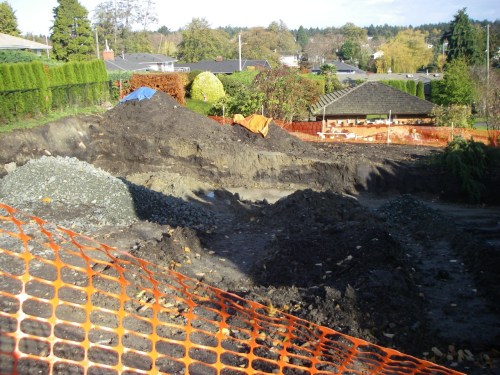
Uncontrolled destruction of Archaeological Site in Cadboro Bay, Victoria.

This week saw an all-too-familiar case of human remains disturbed by residential construction, this time in Cadboro Bay close to the University of Victoria. There are two major known sites in Cadboro Bay and many others must be there as well (I haven’t checked to see what has and has not been recorded). In addition to these known very large sites, it has been known since the 19th century (e.g.,  Cadboro Bay: Ancient City of the Dead — 6 meg PDF) that the slopes leading down from the top of Gordon Head were favoured places for human burials. So, no one could be surprised to find human remains in this area and indeed this is what happened.

A twist on the usual story comes with the reporting that the landowner, identified as Henry Ravenscourt, had had an archaeological impact assessment done and yet then excavated out almost the entire soil and subsoil of the lot in question. According to the Times-Colonist:

The property had been designated an archaeological site in Oct. 2008 when an Archaeological Impact Assessment was conducted there. Under the Heritage Conservation Act, the landowner was required to obtain a permit before digging, however, it appears no permit was granted for the new-home construction.

The Globe and Mail reports that,

Provincial [sic – probably consulting] archeologists who had been monitoring the property alerted police last Wednesday after discovering that workers digging the foundation for a new home had unearthed a human skull, knee and leg bone.

VicNews.com has added information: the Police say the landowner was in possession of the Archaeologist’s report:

Sgt. Julie Fast with Saanich police said the homeowner could possibly face charges through the Heritage Conservation Act because an Archaeological Impact Assessment was done on Hibbins Close in October 2008. That assessment designated it an archaeological site, which means, before any digging or building takes place, a permit issued through the Provincial Archaeological Branch is required.

“From what I understand, the homeworker is supposed to be in possession of the (permit). We are determining if they were aware (of the Archeological Impact Assessment), and if they had the letter,” Fast said.

The permit would designate how deep digging can be done and where a structure can be built without disturbing any remains on the property.

It is hard to say what is really going on here. If an AIA was conducted in October 2008, then surely the landowner had a copy of the report. Were there archaeologists monitoring the site? That would be consistent with a development process whereby archaeologists routinely watch backhoes and then jump in when the skulls start rolling. But surely the archaeologists would not have allowed such complete removal of material in such an uncontrolled way? I visited the site last week and saw how several, perhaps 10, dump trucks worth of material from almost the entire lot had been removed and there were only token piles of backfill. Where did this soil go? It undoubtedly contains human remains and archaeological material.  I trust the Archaeology Branch is tracing its whereabouts.

It is very welcome that the Police are considering charges in this case and I certainly hope that if a landowner or developer ignores an AIA recommendations that they get the book thrown at them as firmly as possible. Contrary to what the newspapers are reporting that the owner is subject to a 2,000 dollar fine, there appears to be a contravention under Section 13(2) of the Heritage Conservation Act, for which the maximum penalty under Section 36(3)a is $50,000 and six months for an individual, and 1,000,000 for a corporation. It is essential that the justice system starts to deal with these people in a serious manner. By completely removing the archaeological material from the property a landowner could in effect raise the property value by more than 50,000.

I share Songhees archaeologist Ron Sam’s cynicism though:

“They know full well there’s bones under there and they just go ahead and do it anyway because they know there’s no penalty,” Mr. Sam said, adding that the band is seeking legal advice. “We can say what we want, but at the end of the day it’s private property and we can’t stop it.”

Perhaps not. But those charged with managing and enforcing the Heritage Conservation Act and those responsible for gathering evidence and laying charges must start to make examples of those who flagrantly destroy the collective heritage.

Also check out this busybody’s letter to the Times-Colonist complaining about the costs incurred and implying the archaeologists are just making work.  Chris Harker of North Saanich, you officially have no idea what you are talking about.

cadboro bay mess 2

Note how close the excavation is to the property line.

Single Hook

Pomeroy polynesian hook 1

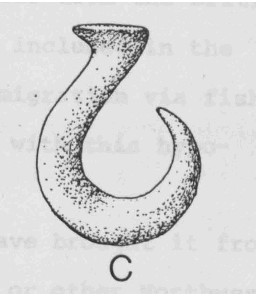
Polynesian-style fish hook found at McNaughton Island

John Pomeroy found this unusual shell (“scallop”) artifact at McNaughton Island (ElTb-10) on the central coast in 1972 (Pomeroy 1980: 321b).  It strongly resembles some Polynesian fish hooks, and is also similar to some Californian ones.  While no scale is given, by comparison to the text it appears about 5 cm long by 4 cm wide. Pomeroy offers three suggestions:

Pomeroy polynesian hook 2

Polynesian fishook from Beasley (1928) via Pomeroy (1980)

1. That it was traded from California

2.  That it was brought from Polynesia by early European explorers.

3. That it arrived inside a tuna.

He notes that there are no tuna remains at this site, which makes (3) less likely though not impossible.  While trade from California is possible, Pomeroy  notes that this specific artifact most closely resembles some from Polynesia and not from California – namely the one to the right from Beasley (1928).  The fact that it was found at a depth of 1.7 metres suggests that (2) is unlikely.  There is a date for about one metre below the surface at this site of 900 BP.  While the exact relationship of the date sample to this artifact is uncertain on my brief reading, it is most likely the date is above the artifact and thus more recent.  Certainly this general time frame of less than 1500 years is the time when eastern Polynesia is being settled and there may have been greater opportunity for drift items or other accidental contact to occur.  On the other hand, this is also said to be the time that the Californian examples arise.

Pomeroy leaves the matter unresolved.  I’m going to keep my eyes open for other examples including fragments that might be misclassified.

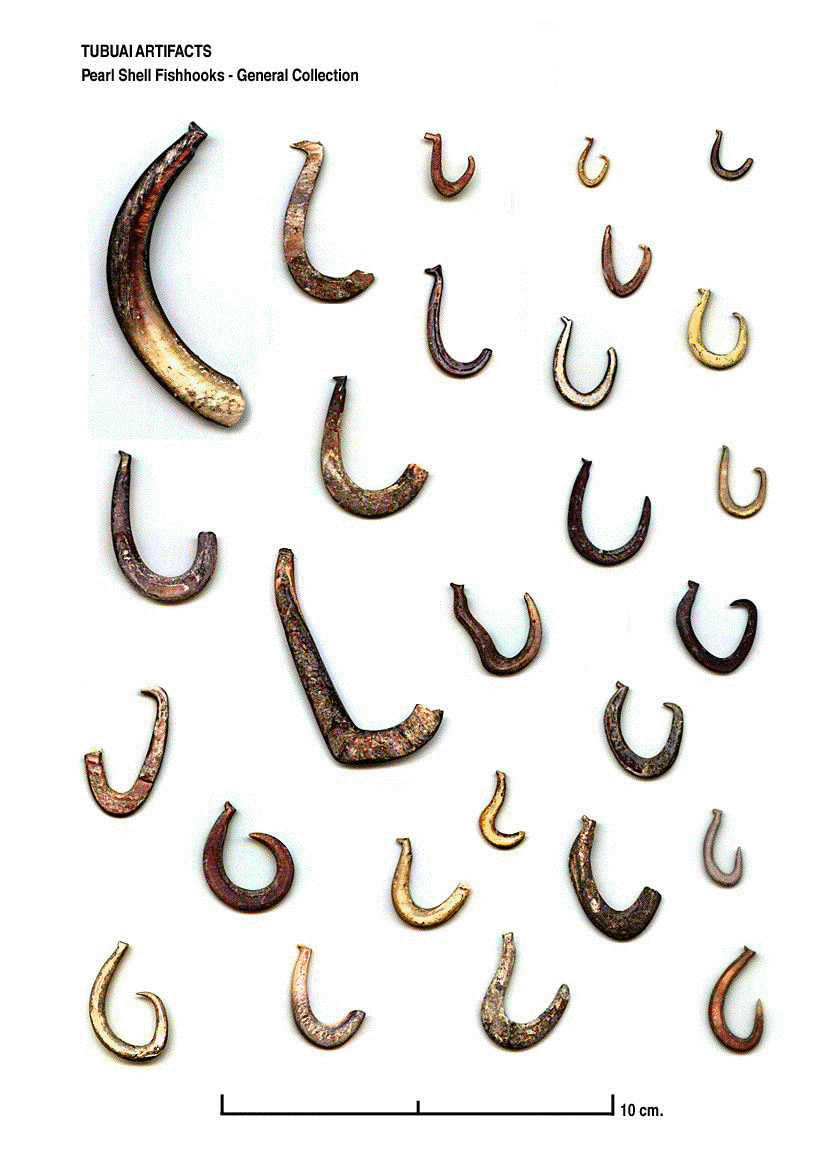
polynesian fishhooks

Polynesian Fish Hooks.

The Brooklyn Museum Collection

Tsimshian Skull "Helmet".  Click for higher resolution.

Tsimshian Skull "Helmet". Click for higher resolution.

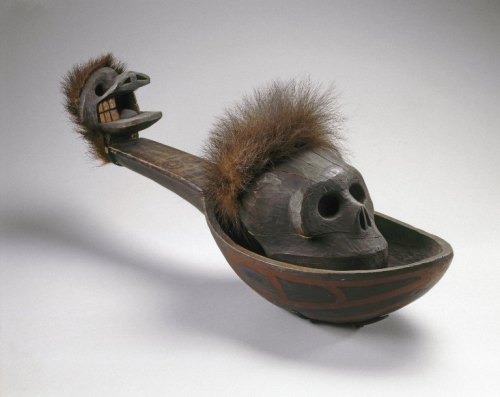
Of all places, the Brooklyn Museum has amassed an impressive suite of NW Coast artifacts and art.  Their online catalogue is mainly lodged under the  “research” and “collections” tabs.  One interesting thing about this collection is that any viewer can ‘tag‘ a picture, building up a folk taxonomy that cross-cuts more traditional museum categories.  This has its advantages of course (e.g., items which are tagged “beards“, or “scary“), but also raises questions about just how comprehensive is any set of results?  And how accurate – this rattle is tagged Tsimshian despite being collected in Bella Bella (Heiltsuk territory).  Still, with a grain of salt it is an idea definitely worth pursuing.  You can also click around on their “visible storage” map.  The images are decent resolution and combined with the tag-surfing possibilities this is a fun and informative site.

Heiltsuk Ladle with Skull. Click for larger resolution.

Heiltsuk Ladle with Skull. Click for larger resolution.

NW Coast Objects in Madrid

Tlingit adze with quillwork and copper insets in the Museo de América, Madrid.

Tlingit adze with quillwork and copper insets in the Museo de América, Madrid.

Even though the Spanish were among the first outsiders to eplore the NW Coast, you don’t hear much about collections they may have made while out here.  So it is welcome to see this (now, 10 year old) writeup on NW Coast items in Madrid’s Museo de América.  The article suggests that many such objects were collected but not retained in Royal Collections, perhaps because they were considered inferior to, say, Aztec and Inka pieces.  Either way, there are some spectacular objects illustrated in the article, though the photographs are not very sharp at all.

Going to the Museo de América’s website shows they have a search function and some online thumbnails.  This link should take you to their 52 pieces labelled as NW Coast, while this takes you to six pieces listed as from BC.   Most of the illustrations are extremely low resolution, though I found one or two which aren’t such as the outstanding Haida waterfowl, below.  Look how fluid the form-line rendering is in this 18th century piece.  Click the images on the Museo site for slightly higher resolution or go to the records page by clicking on “Ficha Completa” and then on “Ampliar Imagen”, where you can zoom in slightly using the magnifying glass.  Also worth checking out, this Tlingit clap-board style “rattle”, this foreshaft and point, and this rather spectacular hat.  Anyway, something to poke more: online catalogues in Spanish Museums.

EDIT:  I see their search function makes links to search results expire after a short time so I crossed them out, above.  Pretty lame, but there you go.  Get into the system via the generic system and then browse around, if you want.

18th Century Haida Waterfowl.

18th Century Haida waterfowl, listed as made from"Ivory".

Dog Burial Field Guide

From PacificID's Dog Burial Field Guide.

From PacificID's Dog Burial Field Guide.

Dogs are such an important source of evidence for past human life.  Not just as “man’s best friend” and all that but because of the insight they give into domestication, into evolutionary processes, as proxies for stable isotope studies of human diet, and so forth.  So, pretty great to see PacificID is putting out a field guide to dog burials and in situ dog remains in archaeology, complete with snazzy laminated ID card. The book itself is also printed on waterproof paper.  There are also downloadable diagrams (PDF) for recording dog burials.  The author, Dr. Susan Crockford, is an authority on the evolution of dogs and other domestication and evolution issues, and on dog osteology.  This looks like excellent value for money.

Speaking of dSpace

The Globe and Mail has a story on the (in progress) digitization and internet posting of UBC’s complete run of over 35,500 theses and dissertations – with an arch response by SFU’s Dean of Libraries (or whatever).  As I’ve been noting, numerous other universities have these schemes as well, usually some flavour of the dSpace software package. Typically, University of Toronto calls it T-Space.  Dissertations there do not seem to be online unless you are a library card holder, though strictly speaking they are not in T-Space either I don’t think.  Nonetheless, they obviously have a digital copy mounted on a server.

Continue reading

dSpace: Elroy White (Xanius) on Fishtraps

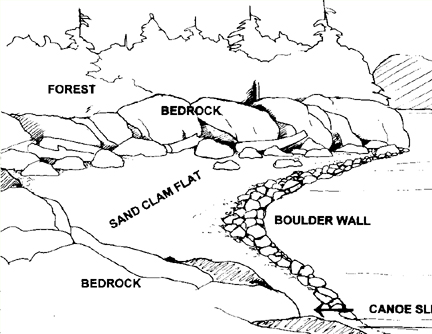
FbTa 59, a possible clam garden on the central coast.

FbTa 59, a possible clam garden on the central coast. Source: Elroy White / Xanius M.A. thesis.

I’ve only met Elroy once or twice but he seems like a sharp guy and I was looking forward to reading his 2006 thesis, which turns out to be an exceptional work – ambitiously trying to implement Eldon Yellowhorn’s “internalist archaeology” in his home territory (Heiltsuk) on the central coast.  This project, which focuses on fishtraps, is exemplary in a couple of ways.  First, as a cutting edge exercise in the practice of archaeology, indeed, practice as theory.  The combination of field archaeology, internalist work with a dozen elders, and extensive videography was a great exercise.  (PS Elroy, post some videos!).   Second, well, fishtraps are exceptionally interesting and need more study.  Essentially, we are just guessing about the specific functions and efficiencies of these features.  Elroy gathers a lot of information from elders, including interesting longitudinal data showing how quickly these features silt up — evidence in some ways for their silt retention qualities and also a suggestion there may be a lot of partially or totally obscured fishtraps out there.  And, as above, Elroy appears to find some “clam gardens” (diagram) in Heiltsuk territory.  Maybe it’s because my doctoral SSHRC project was going to be on fishtraps until I got talked out of that and into a GIStraightjacket, but I love’em.  Anyway, you can get yourself a copy of this high quality MA theses here, at SFU dSpace.

Incidentally, for an earlier, wider scope take on subsistence and settlement and fish traps on the central coast, you can also download John Pomeroy’s 1980 PhD thesis (which doesn’t show up under “archaeology” in their classification or keyword scheme for some reason.)

Elroy White (Xanius) with intertida fishtraps.  Credit: Ecostrust Canada.

Elroy White (Xanius) with intertidal fishtraps. Credit: Ecotrust Canada.