

Inkulkation.
I hereby challenge rockwash to go out and get one of these trowel tattoos. Or be like Brad and get the coveted Ötzi tattoo. Or check here for more science tattoo inspiration. (Ötzi really did have tattoos, BTW).

Icey Dead People.
Inkulkation.
I hereby challenge rockwash to go out and get one of these trowel tattoos. Or be like Brad and get the coveted Ötzi tattoo. Or check here for more science tattoo inspiration. (Ötzi really did have tattoos, BTW).
Icey Dead People.

Paisley Cave human coprolite dating older than 14,000 cal BP. Source: PBS.
There is a tantalizing news item in a recent edition of Nature indicating that the team led by Dennis Jenkins has found a bone tool in the old layers at Paisley Cave in southern Oregon. This cave already returned a number of pre-Clovis dates on human coprolites. Although there was some vociferous opposition to this finding, a vigorous defence of these feces was mounted and to my mind was effective. (Note that one of those claiming the human poop is actually camel poop posts a slightly hysterical online comment on this Nature news item. This charge of excess fibre is dealt with in Gilbert et al’s 2009 rebuttal in Science, which is not mentioned in the Nature comment. Clearly there is a new generation of data-selective Clovis Police being groomed out east.)
Anyway, this bone tool, which I assume will be published soon, is said in the Nature article to date to 14,230 cal. BP, from which I infer a 14C estimation of about 12,250 – exactly contempraneous with the poop. According to the article,
The dating of the bone tool, and the finding that the sediments encasing it range from 11,930 to 14,480 years old, might put these questions to rest. “You couldn’t ask for better dated stratigraphy,” Jenkins told the Oregon meeting.
Seeing the tool itself will of course be very interesting and hopefully definitive, as there is a long history of bone pseudo-tools in North American archaeology. So far this date has only been announced at an unspecified “meeting” and peer reviewed publication will be essential to form a final judgment.
You can watch a PBS news clip on the poop discovery from a link here which gives a good idea of the setting of the cave, and also includes nice footage of Luther Cressman!

Camel astragalus from Paisley Cave. Source: U of Oregon.
Reference:
Dalton, Rex. 2009. Oldest American artefact unearthed: Oregon caves yield evidence of continent’s first inhabitants. Nature: doi:10.1038/news.2009.1058.
Posted in Archaeology, Northwest Interior, Oregon, palaeontology
Tagged clovis, Oregon, Paisley Cave, palaeoenvironment, paleoindian, pre-clovis
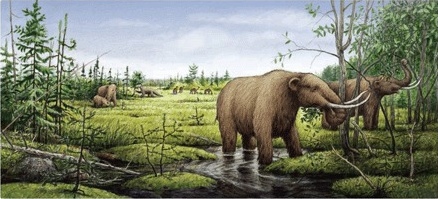
Mastodon! From: Science 20 November 2009
Abundant megafauna are important to the Clovis-First model of the peopling of the Americas because the mechanism for what was considered to be an exceptional event or series of events was overkill of these large, naive, critters . Overkill led first to localized extirpations (moving the Clovis folks along on a bow-wave of blood) and ultimately to megafaunal extinctions across the hemisphere.
Sad, then, for that particular story and its storytellers, to see recently reported results in Science which track (through samples of dung fungus) a millenium-long decline in mastodon and other megafauna before the arrival of Clovis. This decline might relate to climate change or to the influence of pre-Clovis humans – it’s too early to say. But as the graph below shows, the decline set in pre-Clovis at about 14,800 cal B.P., and by the time of Clovis (ca. 13,500 cal B.P.), far from being hyperabundant, herbiferous megafauna seem to have been at a historically low level of population. Vegetation change (often used to track climate) was a result of this die-back, not the cause of it. Perhaps this remnant megafauna population was then finished off by Clovis, but that is hardly a bow-wave of blood scenario, but rather a “mopping up” of increasingly scarce game. Has there ever been as misunderstood an archaeological concoction as the Clovis Culture?
Update: The Guardian has coverage, incongruously illustrated by the RBCM’s life-sized mammoth model.
Reference:
Jacquelyn L. Gill, John W. Williams, Stephen T. Jackson, Katherine B. Lininger, Guy S. Robinson.
Pleistocene Megafaunal Collapse, Novel Plant Communities, and Enhanced Fire Regimes in North America.
Science 20 November 2009: Vol. 326. no. 5956, pp. 1100 – 1103
DOI: 10.1126/science.1179504

Pre-Clovis decline of large herbivores. Source: Science 20 November 2009
Posted in Archaeology, Miscellaneous, palaeontology
Tagged Archaeology, clovis, mastodons, megafauna, palaeoenvironment, palaeontology, pre-clovis

Any idea what activity is being represented on this Haida argillite carving?
The Pitt Rivers Museum in Oxford is one of the world’s great ethnological museums. Indeed, it is largely presented as a “museum of a museum”, with artifacts and curios displayed in glass cases in juxtapositions that made sense to anthropologists. Now I see they are putting some of their collection online – one of many interesting innovations going on at that museum. The Haida Collection which Cara Krmpotich has worked on consists of 200 really well composed and lit photos on the flickr.com website. Cara notes that she hopes making this material available in this manner will facilitate its use by Haida people and I expect they will (indeed one person with a Haida name has been commenting on some of the photos). Coincidentally, I see there has recently been a Haida delegation to the Pitt-Rivers museum.
In any case, the flickr set is a fantastic set of images of Haida art and technology. It would be nice to have the full catalogue information or other information associated with these, or at least a statement that such information is lacking. While there are visually spectacular items throughout the set, also check these plain spoons from SGang’gwaay, Tanu’uu and Masset, this bird bone whistle, and this tidy little loop of twine.

Haida wooden labret at Pitt Rivers museum.
Posted in anthropology, Archaeology, First Nations, Haida Gwaii, history, Northwest Coast, pics
Tagged argillite, artifacts, conservation, Haida, Haida Gwaii, museums, Northwest Coast, Pitt Rivers Museum, PRM
Looks like someone at SFU is about to launch a new archaeology journal focusing on archaeology of the Northwest. (Presumably NW North America, but you never know when it comes to SFU). The pages are formatted, but blank, except for the instructions to authors. I hope this journal template turns into something real.
Posted in Archaeology, Northwest Interior, Northwest Coast
Tagged Archaeology, Foggy Top, Northwest Coast, Public Archaeology, SFU, Simon Fraser University

Haida argillite pipe representing the SS Beaver. Photo: University of Aberdeen.
The SS Beaver was a prominent early side-wheel trading ship on the NW Coast. Nice to see it memorialized by Haida argillite pipe in the Marischal Museum collection of the University of Aberdeen, along with some other exceptional Haida pipes. Apparently donated to the museum by the former Captain of the SS Beaver, William Mitchell, this pipe sports a rotating side wheel carved from whale bone, a beaver figurehead, and someone peeking out of the cabin windows, perhaps Capt. Mitchell himself who probably commissioned this carving. Some other close ups (in an awkward zoomable interface) are available on the Scots and Aboriginal People in the Fur Trade site. More on the SS Beaver here.

A figure looking out the window of the SS Beaver pipe.
Posted in anthropology, First Nations, Haida Gwaii, history, Miscellaneous, Northwest Coast
Tagged Aberdeen, argillite, artifacts, Haida, Haida Gwaii, museums, Northwest Coast, pipes, SS Beaver
There is a fairly progressive editorial in the Times-Colonist on the Cadboro Bay land compensation issue. The editorial cites John Lutz’s excellent book Makuk:A New History of Aboriginal-White Relations, to boot.
Lawyer Rory Morahan, acting on behalf of the Songhees, says the Chekonein village sites and fields were never surveyed, reserved or protected as required by the treaty. “The colony, or the province, appropriated the lands and issued title to the lands to other parties — that is, non-aboriginal colonists,” he says. The statement of claim says the Crown never paid compensation for taking the treaty land between 1851 and 1871.
The case will be complicated, given the variety of historical documents that will be presented to the court. Some basic facts are not in dispute, since even Roderick Finlayson, an early chief factor for the Bay, mentioned the Cadboro Bay village in his memoirs.
Beyond what is written in the treaties, the court might need to consider whether the Lekwungen actually understood what they were agreeing to. Lutz’s research has raised questions about the communication gap between the aboriginals and the whites.
Douglas signed nine treaties with aboriginals on southern Vancouver Island and, as Morahan says, this lawsuit could set a precedent if successful.
The decision could have ramifications elsewhere in the province. The Lekwungen were the first aboriginals in British Columbia to be dispossessed by settlers, but similar actions — land grants given, then taken without compensation — occurred for decades.
If it is proven in court that an injustice has occurred, the governments should act quickly to make things right. After a century and a half, it’s time.
This isn’t the first time I’ve noticed a fairly progressive editorial slant down at the TC – good for them, as the comments on their pieces show, there is a lot of resistance to the notion of fair compensation.
Posted in anthropology, First Nations, history, Northwest Coast, Uncategorized, Vancouver Island
Tagged BC Treaties, Cadboro Bay, Esquimalt, Northwest Coast, Salish Sea, Songhees

Sgaawsid K'uuljaad gets funky.
Silly season in Haida Gwaii must have started, as Carey’s potato of unusual size is stolen (and returned), but not before a star appearance or two on youtube.
Posted in anthropology, Haida Gwaii, odd
Tagged ethnobotany, Haida, Haida Gwaii, potato

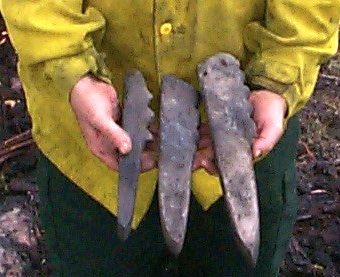
Cache of stone woodworking tools found in Tongass National Forest
So maybe I am obsessed with ground stone celts, who isn’t, but nonetheless I liked this story of the lucky discovery of a cache of large pecked and ground stone woodworking tools in Tongass National Forest in the Alaska Panhandle. The article claims the hafting grooves are finger grips, which I think is unlikely. More likely these are from elbow adzes, such as this one.
Posted in alaska, Archaeology, Cultural Resource Management, Technology
Tagged alaska, Archaeology, artifacts, Northwest Coast, tlingit
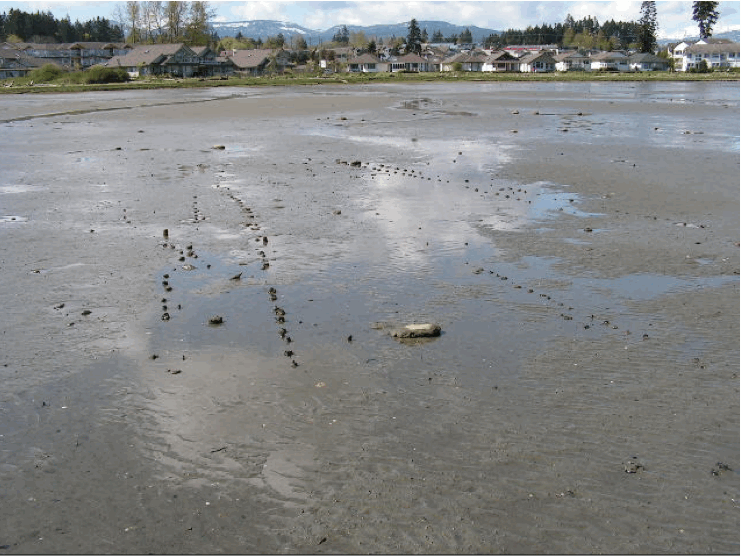
Chevron-shaped fishtraps in Comox Harbour. From Caldwell 2008.
The University of Manitoba is in on the dSpace trend. The most notable thesis I found there was Megan Caldwell’s excellent analysis of some Comox Harbour fishtraps in relation to the Q’umu?xs Village site (DkSf-19). Sixteen carbon dates are now available on these traps, thanks mainly to the work of Nancy Greene. Caldwell takes a theoretical stance of Optimal Foraging Theory, arguing that fishtraps amount to “artificial patches” which can alter choices made under Patch Selection principles. Essentially, a similar and more holistic argument could be made using principles of the “built environment” in an Ingoldian sense, but OFT is more structured and maybe more suitable for an MA thesis. Interestingly, Caldwell’s work on auger sampling of the Q’umu?xs Village site shows a preponderance of herring, which is also interpreted as the target prey of the fishtraps. This runs against the grain of the ethnographic work she conducted, where she was told that salmon were more important — mind you, salmon have difficult taphonomy and site formation processes, which she acknowledges. In any case, this is a well organized, focused thesis which reflects a lot of high quality original work and while I haven’t read the whole thing I intend to do so! Caldwell mentions Nancy Greene is still working on her fish trap study and I hope to see the results of that soon as well — these Comox Harbour trap complexes are very likely the finest of their type anywhere on the Northwest Coast and may well offer key insight into cultural construction of the landscape and its resources. Download her thesis here!

Map of Fishtrap Stakes in Comox Harbour. From Caldwell 2008.

Schematic of two basic fishtrap designs. From Caldwell 2008.

| Has There Ever Been… on Destruction of Kwalate Vi… | |
 | George La Plante on Arborglyph |
 | Kira Sokolovskaia on dSpace: Lundy on Rock Art |
| George La Plante on Arborglyph |
| At the Boundary Betw… on Samuel Hancock witnesses small… | |
| At the Boundary Betw… on Samuel Hancock witnesses small… | |
| Cooler Aloft –… on Oregon Earthquakes and Ts… | |
 | Tom Dailey on Salish Villages of Puget … |
 | Stuart Jenner on Samuel Hancock witnesses small… |
 | Melissa Taliana on Alaskan Fish Weir Photos |
 | Alex on Tree Burials at Tsaxis |
| The Forgotten Fluffy… on Coast Salish “Woolly Dog… | |
 | Sue Thomas on La Brea Woman: Image Cont… |
 Northwest Coast Archaeology
