Edenshaw Compote

Argillite and ivory compote attributed to Haida master carver Charles Edenshaw. Height: 30 cm. Source: Liverpool Museum.

I only have a short post today since I am up to my neck in alligators, courtesy of my day job.  So, take a moment and check out the spectacular argillite compote (a pedestaled serving dish), attributed to Haida master carver Da.axiigang, Charles Edenshaw.  This particular dish is in the collection of the Liverpool Museum – an institution that  holds a collection donated by well-known coastal collector, casual ethnographer, and (apparently) former Liverpudlian, Dr. Charles Newcombe – many of the items in their Northwest Coast section must come from this source.  It is one of the more striking pieces of Argillite I have seen in that the form is so clearly derived from silverware: it is sublimely ridiculous, and I can’t help but feel that Edenshaw was in on the joke.  Yes, he would make what would sell, but a piece like this makes me wonder if he wasn’t slyly pulling the touristic leg, somewhat.

Continue reading

Salish Villages of Puget Sound

Overview map of Coast Salish Villages of Puget Sound. Click to go to the page of interactive maps at coastsalishmap.org

Tom Dailey has put together a large and very interesting site which documents the Coast Salish villages of Puget Sound.  The core of the site is a series of clickable maps (see the left hand side black/white map grid), each of which is marked with little village icons.  Clicking on these icons takes you to a master document with a synopsis of the settlement name and, usually, a couple of sentences about the village.  These are referenced to scholarly literature and other sources.  It is striking to see all these villages on one map, and notable how many are shown on rivers and lakes.

Continue reading

Arrow from Tsitsutl Peak Glacier, Western B.C.

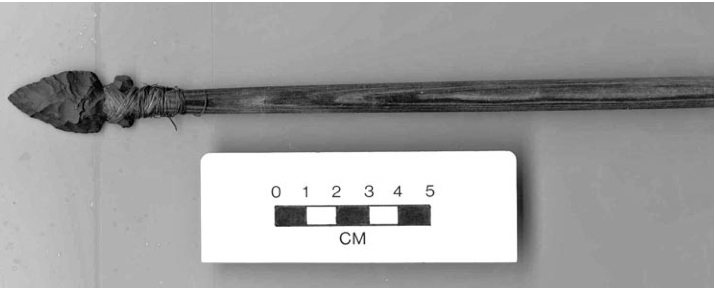
400 year old arrow or dart from Tsitsutl glacier, B.C. Source: Keddie and Nelson: 2005.

In 1924, a land surveyor found an arrow at an elevation of 2,100 metres near Tsitsutl Peak in west-central British Columbia (map).  The arrow made its way to the Royal BC Museum where it lay for over 80 years, until a timely inquiry and increased awareness of ice-patch archaeology stimulated a small research program.  This research, initiated by RBCM curator Grant Keddie and reported in the Canadian Journal of Archaeology (Keddie and Nelson 2005), establishes that the arrow is about 400 years old.

Continue reading

Webber’s Village in Nootka Sound: Original Watercolour

Painting of a village in Nootka Sound, 1778, by John Webber. Source: State Library of New South Wales. Click for larger original.

Yesterday I linked to the original watercolour of a 1778 Nootka Sound house interior by John Webber, which is the basis for the widely reproduced engraving.  Today we can take a look at Webber’s original painting of a Nootka Sound village, presumably Yuquot but not so labelled, as found at the State Library of New South Wales (though yesterday’s post brought forth questions as to whether these are watercolours or coloured engravings – see the comments).  The first and most important point is, see that lumpy, dissected landform in front of the houses?  That, my friends, is what an active shell midden looks like.  No wonder they can be such stratigraphic nightmares.

Continue reading

Webber’s House Interior: Original Watercolour

1778 Watercolour by John Webber of the interior of a house in Nootka Sound. Source: State Library of New South Wales. Click for original.

A few days ago I posted a beautiful watercolour of Nootka Sound by John Webber, artist on Cook’s third voyage.  In the ensuing discussion, it was brought up how nice it would be to see the original watercolours of more of his paintings, which often formed the basis for the  numerous engraved reproductions which are what one normally sees.  The loss of information in moving from the original to the engraving is something of an unknown quantity, and I for one had never seen the watercolours.  Until yesterday!

Continue reading

Puget Sound Clovis

In Red: Surface Finds of Clovis Projectile Points. After Croes et al. 2008.

I posted yesterday about the Manis Mastodon site and its possible status as a pre-Clovis site on the Olympic Peninsula.  Clovis projectile points are so distinctive that most archaeologists have no problem assigning even an isolated find of such a point, lacking in any kind of stratigraphic context or any associated dates, to the Clovis archaeological culture.  We know from sites elsewhere in North America that Clovis dates to a pretty narrow window, perhaps only 13,200 to 12,800 calendar years ago.  It has always been very closely associated with the ice-free corridor route for the First Peopling of the Americas and is predominantly known from classic sites in places like Colorado, New Mexico and Texas. So it may come as a surprise to some that Clovis is pretty well represented in Puget Sound and north to Bellingham Bay, although only from surface or other finds without provenience.

Continue reading

Yank that sucker out!

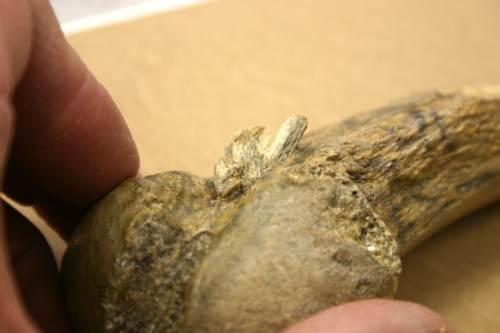
Mastodon rib from Manis site, showing protruding end of an intrusive object. Source: CSFA

The Manis Mastodon site near Sequim on the Olympic Peninsula (map) is one of the great enigmas of Northwest Coast archaeology.  The site has been known since the 1970s and is purportedly a Mastodon kill-butchery site.  With radiocarbon dates (on plant material associated with extinct mastodon) of 13,500 to 13,900 calendar years ago, the site is clearly pre-Clovis.  As a pre-Clovis site on the Northwest Coast, Manis  should be of comparable stature to, say, the Clovis-killer Monte Verde site in Chile, which dates to about 14,500 calendar years ago.

Doubts remain about this site, though, mainly because it is not yet completely reported.  A preliminary report by Gustafson et al. in the Canadian Journal of Archaeology (which I don’t have handy — hey CAA, I know you sell CDs of your back issues, so how hard can it be to put them online?) was equivocal about the association of some flake and cobble tools with the skeleton, and while interesting conclusions were drawn about the fragmentary nature of the skeleton, nothing conclusive was resolved.  This is despite one of the clearest possible “smoking guns” one could hope for in archaeology.

Continue reading

Association for Washington Archaeology

9,000 year old stone tools from Colville National Forest, Washington. Source: The Spokesman-Review.

I was a little surprised (and probably shouldn’t be) to find out there was an organization called the Association for Washington Archaeology – equivalent to the Archaeological Society of B.C.  They have a journal (equivalent to The Midden), and are clearly a respected avocational archaeology organization.  They have a pretty low profile, obviously: but partly this must be another symptom of the poor cross-border communication between BC, Alaska, Washington, and Oregon  – the core jurisdictions bounding the Northwest Coast.  They even have a blog called Washington Archaeology, which is only a few weeks old.  Their own link to it is both hidden under a “feedback button” and is broken: I hope that linking it here helps people find it.  There’s not much there yet, but it did lead me to a nice news roundup on the Tse-whit-zen site, and also to an interesting story on a 9,000 year old site in the Colville National Forest, near a town called Republic – just south of the Canadian border close to Grand Forks BC. (map).  Continue reading

Historic Pamphlets and Booklets on First Nations Topics

Skeena River pole ca. 1920s: On back: ""Named Waum Gana'o 14' high / erected 1845 / 4 Bottom figure, is of the big hog, upside down." Source: USASK."

The University of Saskatchewan has a comprehensive Indigenous Studies portal, with links to a massive corpus of published and unpublished documents – some of which are available online, free of institutional restriction.  One section which I found interesting was the large collection of pamphlets and booklets.  I know this web site isn’t always 100% archaeological – but you can’t separate the practice of archaeology from the social context in which it occurs. Among these pamphlets are:

  • CBC Radio and Department of Indian Affairs 1939: The Indians Speak to Canada (transcript of a remarkable series of 1939 CBC radio broadcasts in which aboriginal people address the nation; Haida representative Rev. Peter Kelly starts on page 28; White Man’s Burden is found in the closing remarks by the Minister of Mines and Resources)

Continue reading

Webber in Nootka Sound, 1778

Detail of a Nootka Sound watercolour by John Webber, 1778. Click to enlarge. Source: British Museum.

From the British Museum, a superb watercolour:

Nootka Sound, on the Pacific coast of Vancouver Island in Canada, was discovered by Captain Cook in his two ships, Resolution and Discovery in 1778. This drawing records this bay and some of its inhabitants. It is drawn in ink, pencil and wash and watercolours. The artist, John Webber (1751-93), accompanied Captain Cook on his third voyage of exploration in the South Seas and Pacific Ocean, which lasted for four years from 1776 to 1780. Webber was one of several artists employed to record the peoples, animals birds, fishes, plants and landscapes of the newly discovered Pacific Islands.

The written descriptions of the location are confirmed by the drawing. It is severe and inhospitable. High cliffs, rocks that reach right down into the sea, and the jagged shore line gave it a ‘melancholy appearance’. The terrible weather, which left the trees ‘mutilated by rough gales’ contrasted greatly with the tropical scenes ans palm trees enjoyed by the explorers in Tahiti.

Webber also drew the native people. Their clothing, basically the same for men as for women, consisted of a woven cloth, fastened at the shoulder or neck. According to Captain Cook, the cloth was the bark of the pine tree, beaten flat like a sort of rough felt. The head was covered with a conical hat made of matting. It is probable that Webber modified the drawing for the sake of decency and for public viewing. Cook described the men’s dress as generally bare in the ‘… Middles, nor are they ashamed to appear naked’.

It’s not clear what the kneeling man on the right is doing: is he using a mussel shell to dig?  Several harpoons complete with foreshafts seem to be visible.  It is a skillful and atmospheric rendering of Nuu-chah-nulth life shortly after first contact with Europeans.