Category Archives: Vancouver Island

Shipwrecks of Vancouver Island

The three-masted ship Carelmapu with decks awash, dragging her anchors into Schooner Cove, near Tofino, in 1915

The ‘Virtual Museum of Canada”  has been responsible for some nice online exhibits, although a lot of these are now fairly dated.  One with what we could call a “retro web design”, but some good content, is the Shipwrecks of Vancouver Island site, apparently put together mainly on the watch of the Maritime Museum of BC with help from the Underwater Archaeological Society of BC.  There are some nice videos of underwater archaeology, and other informative materials.

Site navigation, though, is much easier if you just go to the site map here — the absurdly finicky navigation does weird things like, say, means using the back button always takes you to a splash introduction screen — is a crime against the web.  Especially since museum people are involved: why such disdain for solid future-proof web design values?  This page, for example, has a nifty slider to scroll through an interactive map: but if you don’t pay attention (e.g., if you use your back button) you will always end up on a “loading XML – introduction to the database” overlay screen page which gets tired after about the third time.  The VMC should consider a legacy fund to make sure that the sites which they poured money into for a while can all be kept up to date for both content and also compliance or at least ease of use.  It would not surprise me in the slightest if the VMC had spent over $100,000 on this site — the one site of their I know something about they spent $140,000 and it is no flashier than this thing.  Almost all that money went into design and mounting of content, very little went to the content creators themselves.  If that  applied here, I think we have a right to expect more – is this site design worth $100,000?  It seems to me that, even in 2004, a competent web designer working alone, with content given by others, could have put this together in about a month.

Canadian Navy diver goes overboard in 1959 to examine the 1853 wreck of the Lord Western, near Flores Island.

Somenos Creek: Update 2

CHEK-TV video clip on the Somenos Creek archaeological situation. Click to play.

Someone passed along this CHEK-TV news item showing George Schmidt of TimberCrest Estates, Ltd., the development company wishing to put houses on top of a major archaeological site in the Cowichan Valley at Somenos Creek, which I’ve written about before: 1, 2.

Listen to the favourable treatment he gets from the newscaster. Loaded language like “In limbo”. “Pony Up”.

Hey, CHEK-TV, since you’re the voice of the people now and all that and also “journalists”, how about you dig around in the zoning history of the land before you just repeat the mantra “government must pay”.  Did the developer buy this land already zoned for residential development?  How much did he pay in 1972?  Does he deserve compensation for having a risk turn out the wrong way for him?  Does he have the right to destroy a cemetery?  Is he, in fact, losing anything that he already had, or is he losing a perceived entitlement?  He took a risk, he has gained mightily, and now he wants a slice of the First Nation’s pie as well.

I’d seriously suggest CHEK-TV also looks into the $500,000 amount he claims to have spent on archaeology at Somenos Creek.  From what little I know of the site, I am very skeptical about that figure.

Truly, there needs to be a mechanism by which true hardship cases of conflict between development and archaeology, or where the impact assessment process has failed, can be resolved.  That, indeed, may mean some government financial input.  But these should be reserved for instances where other options have run out and where there is demonstrable financial hardship.  This case does not pass the smell test – vast profits have assuredly been made and now legal and moral constrains are drawing a line under this development.

I say this company should stop going cap in hand to the government and just give the land up as a heritage park in return for a tax receipt.  Unless I am mistaken, most entrepreneurs are not socialists, and I  am sure the last thing the typical developer would want is to be perceived as a corporate welfare bum.

Somenos Creek: Update

Somenos Creek site. Picture this with 20 houses on it. Photo credit: anonymous.

Further to my post below, here is another news item on the Somenos Creek (Cowichan Valley) situation.  It mostly rehashes the Times-Colonist piece but does have new comments from Eric and from the developer, notably:

Schmidt, who has tried but failed to have the six-acre site, known as Lot B, rezoned for development, said it would be worth up to $3 million if it weren’t for the presence of the artifacts and burial site.

Timbercrest has built about 300 homes on the land so far and would like to put up another 20 on Lot B.

So, lets see 20/300 = 6.7% of the 100 acres.  The 100 acres was bought in the 1970s.  I am going to go out on a limb and suggest that much less than 1 million was paid for the 100 acres back then.  The current valuation of these six acres would value the entire parcel at 45 million.  Let’s halve that:m 22 million.

So this developer has turned a one million dollar piece of land into a 20 million dollar piece of land.  A 2000% return.  And he wants financial consideration and compensation from the public because he happens to have a legally-protected (and morally protected, I might add) site of the highest archaeological significance on the residual piece?

This is the 21st century: Greed is no longer good, Timbercrest Estates Ltd.  Give the land up, get a tax writeoff, and count your blessings you live in a country that is so extremely friendly to rampant development of land, enabling fortunes to to be made.

Somenos Creek CRM

Diagonal exposure of apparent 2000 BP house at Somenos Creek.

I don’t know too much about the Somenos Creek development in the Cowichan Valley which is discussed in this column in the Times-Colonist:

The North Cowichan story goes back to 1972, when Schmidt was among the developers who bought 100 acres of farmland. About 300 homes eventually arose on what became Timbercrest Estates. Not developed was a six-acre piece where human remains were found in 1992, and where archeological investigations later turned up a feature — a hearth, perhaps, or a house foundation — dating back to the time of Christ.

The Cowichan Tribes think there’s more to be found, that it is important to preserve all six acres, perhaps use it for educational purposes, but Schmidt thinks a dozen houses can be built around the perimeter of the area of proven archeological significance. The natives’ hope now is that government will recognize the importance of the property and buy it, an idea they pitched to cabinet minister Kevin Krueger last week. His reaction? “It wasn’t negative, so I think that’s positive,” says Cowichan Tribes lands-research director Diane Hinkley.

Krueger says there isn’t money to buy such lands outright, but he wants to see what can be done to work things out.

For his part, Schmidt just wants to be done, one way or the other. Either the province or Ottawa buys the land, or he applies for a development permit. “I’m into it too deep to just let the land sit there.”

One of the researchers sent me a copy of the report, and there is a fairly compelling set of features unusual in (a) being inland (b) including an inland shell midden component and (c) including a large subsurface sub-rectangular, sharply defined feature which appears to be the remains of a house dating to ca. 2100 BP.  This makes the site of unusually high archaeological significance – not to mention there are numerous human burials (analysed in Doug Brown’s MA thesis) and extensive archaeological deposits of other kinds.  The house feature is remarkably similar to a contemporaneous feature I saw being excavated a few years back at Esquimalt Lagoon.  We know very little about houses from this period, particularly houses found in inland contexts.  What is striking about the newspaper column above is that it reports the developer has managed to put houses onto 94 of 100 acres, and is now champing at the bit to develop, or be compensated for, the last 6 acres.  I mean, seriously, George Schmidt of Timbercrest Estates, you have achieved 94% of the development you sought.  How about leaving the burial ground alone?  You bought the land in the 1970s.  Surely you have made your money back many many times over. A donation of this small parcel as a heritage park would be a classy move.

Somenos house? feature

Somenos feature - note sharpness of vertical section indicating probable use of plank retaining.

Songhees claim for Cadboro Bay land compensation: update

There is a fairly progressive editorial in the Times-Colonist on the Cadboro Bay land compensation issue.  The editorial cites John Lutz’s excellent book Makuk:A New History of Aboriginal-White Relations, to boot.

Lawyer Rory Morahan, acting on behalf of the Songhees, says the Chekonein village sites and fields were never surveyed, reserved or protected as required by the treaty. “The colony, or the province, appropriated the lands and issued title to the lands to other parties — that is, non-aboriginal colonists,” he says. The statement of claim says the Crown never paid compensation for taking the treaty land between 1851 and 1871.

The case will be complicated, given the variety of historical documents that will be presented to the court. Some basic facts are not in dispute, since even Roderick Finlayson, an early chief factor for the Bay, mentioned the Cadboro Bay village in his memoirs.

Beyond what is written in the treaties, the court might need to consider whether the Lekwungen actually understood what they were agreeing to. Lutz’s research has raised questions about the communication gap between the aboriginals and the whites.

Douglas signed nine treaties with aboriginals on southern Vancouver Island and, as Morahan says, this lawsuit could set a precedent if successful.

The decision could have ramifications elsewhere in the province. The Lekwungen were the first aboriginals in British Columbia to be dispossessed by settlers, but similar actions — land grants given, then taken without compensation — occurred for decades.

If it is proven in court that an injustice has occurred, the governments should act quickly to make things right. After a century and a half, it’s time.

This isn’t the first time I’ve noticed a fairly progressive editorial slant down at the TC – good for them, as the comments on their pieces show, there is a lot of resistance to the notion of fair compensation.

dSpace: Caldwell on Comox Harbour Fishtraps

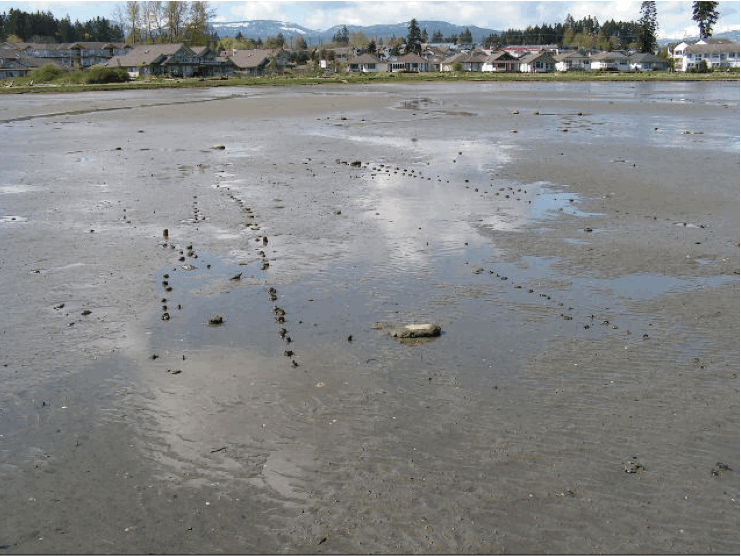
Chevron-shaped fishtraps in Comox Harbour. From Caldwell 2008.

The University of Manitoba is in on the dSpace trend.  The most notable thesis I found there was Megan Caldwell’s excellent analysis of some Comox Harbour fishtraps in relation to the Q’umu?xs Village site (DkSf-19).  Sixteen carbon dates are now available on these traps, thanks mainly to the work of Nancy Greene.  Caldwell takes a theoretical stance of Optimal Foraging Theory, arguing that fishtraps amount to “artificial patches” which can alter choices made under Patch Selection principles.  Essentially, a similar and more holistic argument could be made using principles of the “built environment” in an Ingoldian sense, but OFT is more structured and maybe more suitable for an MA thesis.  Interestingly, Caldwell’s work on auger sampling of the Q’umu?xs Village site shows a preponderance of herring, which is also interpreted as the target prey of the fishtraps.  This runs against the grain of the ethnographic work she conducted, where she was told that salmon were more important — mind you, salmon have difficult taphonomy and site formation processes, which she acknowledges.  In any case, this is a well organized, focused thesis which reflects a lot of high quality original work and while I haven’t read the whole thing I intend to do so!  Caldwell mentions Nancy Greene is still working on her fish trap study and I hope to see the results of that soon as well — these Comox Harbour trap complexes are very likely the finest of their type anywhere on the Northwest Coast and may well offer key insight into cultural construction of the landscape and its resources.  Download her thesis here!

Map of Fishtrap Stakes in Comox Harbour. From Caldwell 2008.

Schematic of two basic fishtrap designs. From Caldwell 2008.

Songhees claim to Cadboro Bay

Songhees claim to Cadboro Bay lands promised by Douglas. Source: TImes-Colonist.

The Douglas Treaties have stood up well in court but the fact remains that the rights to hunt and fish are severely compromised by urban developments.  Further, it is a widespread shameful pattern that the government went out of its way to reduce the sizes of the few, small reserves that were established and to eliminate some altogether.  It is very welcome to see the strong assertion of the Songhees Nation that they have the rights to 200 acres surrounding Cadboro Bay.

Lawyer Rory Morahan said the band is not trying to reclaim the land promised to it in one of the Douglas Treaties, but is asking for compensation and a declaration that it is Songhees land.

A statement of claim was filed in B.C. Supreme Court yesterday, but it is likely to be at least a year before the case is heard.

The key to launching the lawsuit was finding historical documents, Morahan said. “There’s oral tradition about the village site, but in the courts you need more than oral tradition. We have been working on this for about a year, getting the details down,” he said.

The treaty with the Chekonein people, ancestors of the Songhees Nation, specifies that they would have 200 acres (80 hectares) around their Cadboro Bay village site, adjacent to the beach, and about 40 acres (16 hectares) of camas and potato fields.

“Under the treaty, the Songhees ancestors were promised that their village sites and fields would be protected for their use and the use of future generations, and that their villages and fields would be properly surveyed,” Morahan said.

Clearly, the Songhees are not asking for the land to be returned, but for compensation for its unlawful and duplicitous preemption.  The were successful in obtaining compensation a couple of years ago for the land under the legislative assembly, ironically enough and I imagine they have a good chance of success with this case as well. There is certainly an inarguable case for the archaeological significance of Cadboro Bay.

The comments in the Times-Colonist article are some of the most pathetic, racist, ignorant drivel I have ever seen, though.

Stephen Hume kicking ass (but whose?)

Desecrated spiritual site: the Big Rock at Campbell River

Stephen Hume has written some great columns on BC archaeology and history over the years and he comes out swinging in this recent piece:

Beside Highway 3 near Keremeos, a large glacial boulder has myths attached that extend far into B.C.’s past. It’s our own Stonehenge but it’s defaced with graffiti. Not far away, somebody jackhammered out of a cliff face one of the most significant ancient rock paintings in North America. Near Campbell River, another cultural site of great significance to first nations — the Big Rock — is also covered with graffiti. On Saltspring Island, effluent filters through a grave site with government approval. Near Qualicum, the bones of persons of great importance were mixed into paving material for a parking lot.

We pay lip service to first nations culture; we trot it out when we’re on the world stage — at the Olympics, for example — but our actions betray our venal hypocrisy. When conflicts arise between private commercial gain and public protection of our now-shared ancient heritage, money seems to trump culture almost every time.

I use the term “our” to describe this heritage because we are all citizens of B.C. together, first nations and settler society, fused by our braided history. We have one shared narrative in this province. It is composed of many stories. They begin not with the recent arrival of European adventurers or Asian monks but in a far more ancient past.

When we permit the desecration of important first nations sites, it’s our shared history that we abuse and our children’s legacies that we steal.

I am not convinced that the private member’s bill to which he is refers is the answer, and in any case it died on the vine – more on that later.  And the BC Archaeology Branch is kept on a short leash through the expedient of under-funding.  But I certainly appreciate Hume’s  take-no-prisoners attitude – we need a few vocal bulldogs on the case.  Incidentally, in a parallel universe to this blog, Hume’s brother is in a UVIC archaeology class right now, so maybe another bulldog can be raised – it seems to run in the family.

Notably,  it looks like there is a move afoot to designate the Big Rock, spearheaded by Frank Assu of Cape Mudge.  Let’s hope this succeeds, and maybe we won’t see it get dressed up again as a pumpkin.

Vandalized Pictograph Boulder near Keremeos.

CRM Problem in Cadboro Bay

cadboro bay mess

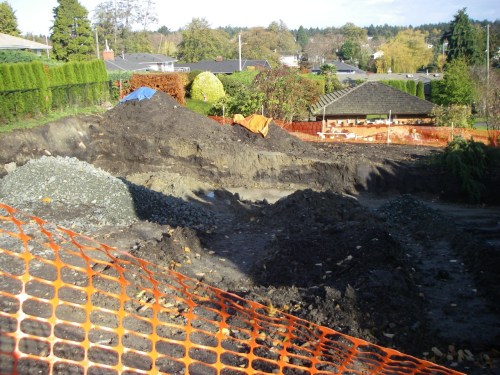
Uncontrolled destruction of Archaeological Site in Cadboro Bay, Victoria.

This week saw an all-too-familiar case of human remains disturbed by residential construction, this time in Cadboro Bay close to the University of Victoria. There are two major known sites in Cadboro Bay and many others must be there as well (I haven’t checked to see what has and has not been recorded). In addition to these known very large sites, it has been known since the 19th century (e.g.,  Cadboro Bay: Ancient City of the Dead — 6 meg PDF) that the slopes leading down from the top of Gordon Head were favoured places for human burials. So, no one could be surprised to find human remains in this area and indeed this is what happened.

A twist on the usual story comes with the reporting that the landowner, identified as Henry Ravenscourt, had had an archaeological impact assessment done and yet then excavated out almost the entire soil and subsoil of the lot in question. According to the Times-Colonist:

The property had been designated an archaeological site in Oct. 2008 when an Archaeological Impact Assessment was conducted there. Under the Heritage Conservation Act, the landowner was required to obtain a permit before digging, however, it appears no permit was granted for the new-home construction.

The Globe and Mail reports that,

Provincial [sic – probably consulting] archeologists who had been monitoring the property alerted police last Wednesday after discovering that workers digging the foundation for a new home had unearthed a human skull, knee and leg bone.

VicNews.com has added information: the Police say the landowner was in possession of the Archaeologist’s report:

Sgt. Julie Fast with Saanich police said the homeowner could possibly face charges through the Heritage Conservation Act because an Archaeological Impact Assessment was done on Hibbins Close in October 2008. That assessment designated it an archaeological site, which means, before any digging or building takes place, a permit issued through the Provincial Archaeological Branch is required.

“From what I understand, the homeworker is supposed to be in possession of the (permit). We are determining if they were aware (of the Archeological Impact Assessment), and if they had the letter,” Fast said.

The permit would designate how deep digging can be done and where a structure can be built without disturbing any remains on the property.

It is hard to say what is really going on here. If an AIA was conducted in October 2008, then surely the landowner had a copy of the report. Were there archaeologists monitoring the site? That would be consistent with a development process whereby archaeologists routinely watch backhoes and then jump in when the skulls start rolling. But surely the archaeologists would not have allowed such complete removal of material in such an uncontrolled way? I visited the site last week and saw how several, perhaps 10, dump trucks worth of material from almost the entire lot had been removed and there were only token piles of backfill. Where did this soil go? It undoubtedly contains human remains and archaeological material.  I trust the Archaeology Branch is tracing its whereabouts.

It is very welcome that the Police are considering charges in this case and I certainly hope that if a landowner or developer ignores an AIA recommendations that they get the book thrown at them as firmly as possible. Contrary to what the newspapers are reporting that the owner is subject to a 2,000 dollar fine, there appears to be a contravention under Section 13(2) of the Heritage Conservation Act, for which the maximum penalty under Section 36(3)a is $50,000 and six months for an individual, and 1,000,000 for a corporation. It is essential that the justice system starts to deal with these people in a serious manner. By completely removing the archaeological material from the property a landowner could in effect raise the property value by more than 50,000.

I share Songhees archaeologist Ron Sam’s cynicism though:

“They know full well there’s bones under there and they just go ahead and do it anyway because they know there’s no penalty,” Mr. Sam said, adding that the band is seeking legal advice. “We can say what we want, but at the end of the day it’s private property and we can’t stop it.”

Perhaps not. But those charged with managing and enforcing the Heritage Conservation Act and those responsible for gathering evidence and laying charges must start to make examples of those who flagrantly destroy the collective heritage.

Also check out this busybody’s letter to the Times-Colonist complaining about the costs incurred and implying the archaeologists are just making work.  Chris Harker of North Saanich, you officially have no idea what you are talking about.

cadboro bay mess 2

Note how close the excavation is to the property line.

Tseycum Repatriation from AMNH

Inside the Tseycum Longhouse.  Click Image for etended video.

Inside the Tseycum Longhouse. Click Image for extended video.

This is old news now that in 2008 the Tseycum First Nation in North Saanich managed to repatriate the remains of 55 of their ancestors who had been removed and sold by Harlan I. Smith.  What I didn’t realize is in addition to the snippet on The National with Wendy Mesley (the file is incongruously called “brown-bones” – WTF CBC?), there is also an extended uncut video of the ceremony in the Tseycum longhouse.   Cora Jacks, who spearheaded the Tseycum repatriation effort and is interviewed here, sadly passed away soon after.

The detailed field notes kept between 1854 and 1910 assisted greatly in tracing the location of the ancestral remains. Museums in the states are required by law to provide information when a nation makes its request. This law called NAGPRA is the Native American Gravesite Protection Repatriation Act and has greatly facilitated the provision of a long list of human remains and sacred objects. (Similar legislation in Canada does not exist.) Historic references show that skulls had been sold for $5 each with similar price tags having been placed on skeletal remains.

Cora had visited New York in 2005 with Vern Jacks Jr. and experienced the deep emotionality of viewing the remains stored in boxes and placed on shelves. The museum had not followed any cultural protocol so that skulls were often separated and Jacks explains the “spiritual restlessness,” which results from this disrespectful treatment. In Chicago Jacks also discovered about 79 sets of remains many of which are probably from this region and most of them were small children who had likely died of smallpox after contact with European settlers. (source).

As the NY Times noted, the Field Museum in Chicago had not yet begun repatriation negotiations with the Tseycum.  While the NAGPRA law in the states is very strong when applicable, it clearly does not apply outside American borders so credit to the AMNH for working in good faith with the Tseycum.

But also: Grant – what the heck – is it really necessary to defend Harlan Smith?  Maybe as a curator of archaeology it is.  I dunno, seems like another relativising moment rather than a chance for an apology or a plain admission that it was wrong, then and now, to steal human remains for profit. But hey, stealing their land was also done in the spirit of the times, so what the heck?  Let’s not forget the RBCM itself is built on top of a village site.