Category Archives: Vancouver Island

“Prehistoric Cairns of Vancouver Island”: notes for a lecture given in 1901

Frank Sylvester Burial Cairns Manuscript, Page One. Source: UVic Special Collections: http://goo.gl/mSxBGe

Frank Sylvester Burial Cairns Manuscript, Page One. Source: UVic Special Collections: http://goo.gl/mSxBGe

There’s an interesting manuscript digitized in the University of Victoria’s special collections library, entitled “Prehistoric Cairns of Vancouver Island.”  The accession notes read:

“Handwritten manuscript, on ruled paper with red-lined margin. Pages hand-numbered 1-20. Signed and dated: Frank Sylvester, Victoria, B.C., June 10, 1901. Appears to be notes for a talk that Frank Sylvester gave, concerning burial cairns on Vancouver Island, his method of excavation of the cairns, and his theories as to the meaning of the cairns and the ancestry of the people buried there.”

It’s a curious document, a mixture of interesting observation, shameless plunder and racial theorizing.  It’s also one of the more complete descriptions I’ve seen of the burial cairn excavation activities of the Victoria Natural History Society.  I don’t recall seeing it cited in the literature, so it’s possible others haven’t come across it either.  In the interests of broad circulation and easy reading,  I’ve transcribed it (PDF), and I also put a version on google docs if anyone cares to improve that transcription.

Continue reading

Clam Garden Event in Sidney, Monday Nov 3rd at 6.30

Clam garden event in Sidney. Source: Parks Canada, click for full poster.

Clam garden event in Sidney. Source: Parks Canada, click for full poster.

This looks like it will be a really cool and interesting event out in Sidney and if you, like blog world headquarters, are on the south island you might want to check it out in person. Snacks included! The great news though is you can register for an online webinar if you can’t make it in person. Kudos to Parks (and their new Clam Garden facilitator and friend of this blog, Sarah R.) for setting that up.  The full details are in this poster, but the short version is: the time is 6.30 and the location is the Shaw Centre on the Sidney waterfront. If you want a quick primer/links on clam gardens, then keep reading.

Continue reading

Stone Foundations and Tent Platforms in NW Coast Archaeology

Tlingit house with stone wall foundation near Juneau, Alaska.  Source: SHI Archives, Richard Wood collection. http://goo.gl/hH9Pfl

Tlingit house with stone wall foundation. “Photograph of a Taku village homes, photo likely by Partridge, circa 1887. Village site was located on the mainland across from Douglas Island, south of present-day Juneau”: SHI Archives, Richard Wood collection. http://goo.gl/hH9Pfl

We’re a little obsessed with wooden architecture in the NW Coast archaeology world – with good reason, I guess, since monumental wooden houses are such a prominent feature of the recent past. I suppose we sometimes stereotype these houses a little – a point some commenters made in the Houses on Stilts post here a while back – we think: “large rectangular house squatting in midden supported by giant house posts.” Not always the case, certainly not through time.

In general, we may underestimate large scale constructions in stone.  Burial cairns and mounds (one of Darcy’s consists of 18 dump-trucks worth of soil), rock wall defensive sites, trench embankments, canoe runs, fish traps, and of course, clam gardens, all involved massive deployments of stone, with associated labour investments and creation of a durable built environment. Anyway, we’ve recently been running into enigmatic rock structures on the central coast and Quadra Island, and in particular, the possibility of dwelling structures partially based on stone walls.  So it’s quite cool to run across the picture above from the SHI photo collections, showing a Taku Tlingit house from the historic period, sitting on a platform which has a stone wall as a foundation.

Continue reading

ASBC Victoria Public Talk: Tue. Oct. 21 – Darcy Mathews on Funerary Petroforms at Rocky Point

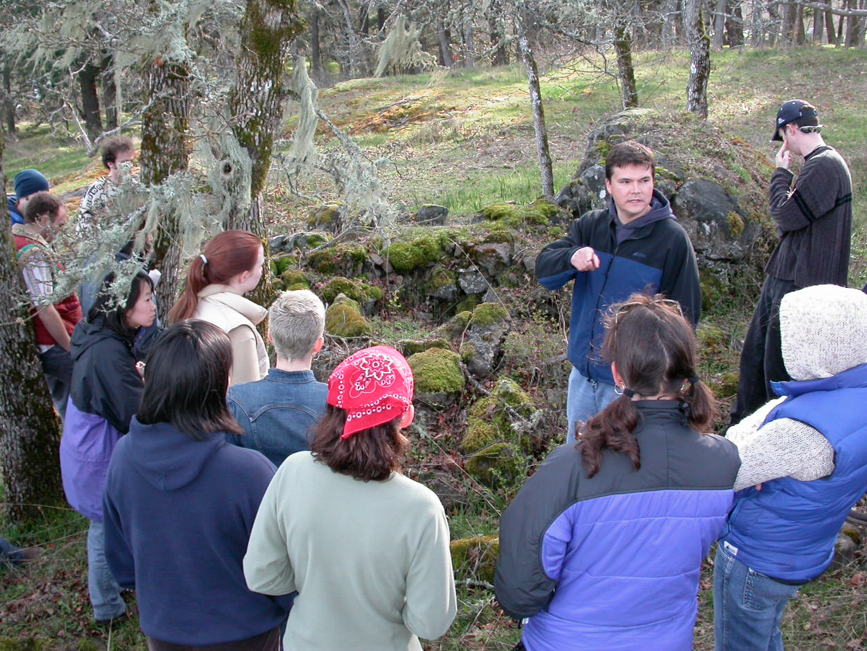
Darcy Matthews leading a UVic field trip to burial features in Metchosin.  Photo:qmackie

Darcy Matthews leading a UVic field trip to burial features in Metchosin. Photo:qmackie

ARCHAEOLOGICAL SOCIETY OF BRITISH COLUMBIA, VICTORIA,  OCTOBER MEETING:

Dr. Darcy Mathews

Funerary Ritual and Ancestral Presence at Rocky Point, British Columbia

Tuesday, October 21, 2014, 7:30 pm

UVIC Cornett Building B129 (map)

Free and open to the public

While you might think you’ll have had your fill of cool archaeology at Saturday’s BC Archaeology Forum in Nanaimo, you won’t have seen the latest from Dr.(!!) Darcy Mathews, who will be presenting his recent UVic Ph.D. research to the ASBC next week. Perhaps benefitting from the finest supervision which single-malt can buy, Darcy’s dissertation is Piled Higher and Deeper with carefully chosen nuggets of the finest methods and theories, much like the cairns funerary petroforms it is based on. Seriously, it is a tour de force which absolutely nails its topic in a way seldom seen. No doubt it’ll be coming soon to a prestigious academic press near you.

Anyway, the ASBC provides the abstract: Continue reading

A Lummi Reef Net Model

Lummi Reef Netting Model. Source: WhatcomWatch.org

Lummi Reef Netting Model. Source: http://whatcomwatch.org/wpww/?p=348

A while back I found the cool picture above in an online exhibit of the Whatcom Museum showing photographs of Point Roberts and Lummi Island, on Puget Sound just south of the Canadian border.  Reef netting is a peculiarly Straits Salish technology which involved the setting of complex nets, suspended between two canoes, at strategic locations where the natural flow of salmon was constrained. A sort of on-ramp led the fish up to the net by creating a gentle optical illusion of a rising bottom.  When the salmon were milling around in the horizontal net, still free, the canoes would be suddenly swung together, closing the net and trapping the salmon.

Continue reading

The Giant of Happy Valley

The giant of Happy Valley Esquivalt(?) [sic].  Sent to Professor Flower at Nat Hist Mus and returned to the owner Left McCallum. Source: British Museum.

“The giant of Happy Valley Esquivalt(?) [sic]. Sent to Professor Flower at Nat Hist Mus and returned to the owner Left McCallum.” Source: British Museum.

When I was looking for more information about the Coast Salish grave houses I pictured a few days ago, I ran into these images from the British Museum.  They show the torso and head of a large human figure, carved out of wood.  The height of the sculpture is 4 foot 9 inches, meaning the whole sculpture, assuming it once had legs, would have stood well over seven feet tall.  So, a giant indeed.  There is very little information about the sculpture, other than it comes from happy Valley, “Esquivalt” – clearly meaning Esquimalt – a neighbouring municipality to the west of Victoria.  The next municipality to the west is Colwood, and indeed it has a prominent “Happy Valley Road” running through it into Metchosin.  While at the first glance the sculpture doesn’t appear to be a typical NW Coast sculpture, I think there’s reason to at least consider that possibility.

[edit: be sure to see the comment from Pete at the bottom]

Continue reading

Coast Salish Mausolea, Victoria, 1859

 Grave near Victoria on the harbour, 1859, by William Tyrwhitt-Drake.  Source: British Museum. Click for their record and verso.

Grave near Victoria on the harbour, 1859, by William Tyrwhitt-Drake. Source: British Museum. Click for their record and verso.

So, not long ago we had an excellent discussion here centered around Edward Richardson’s 1864 painting of a Coast Salish grave house or mausoleum.  I’ve recently come across another set of images of these places which are so important to First Nations. These images were painted by well-known early Victoria resident (and former mayor and Supreme Court of BC Justice)  Montague Tyrwhitt-Drake.  They’re pretty interesting paintings  from the early colonial period on southern Vancouver Island which I don’t recall seeing before.

The painting above clearly shows a small mausoleum, weighted with rocks on top, in front of which are two carved figures. The one on the right includes fishers or river otters, both of which have important spiritual significance in this area.  Each of these images has notes on the back, which are also reproduced at the British Museum site (click the image to go to the accession record). For this image, the notes aren’t transcribed, though maybe someone with better olde handwritinge fkills would care to have a go  As near as I can make out, the back reads:

This is another eccentric specimen of Indian taste for sculpture, it is equal to the finest specimens of _________  — see the elegant attitude of that man scratching his ?cheek bone, but a _____ ________ _______ would have mastered __________ a flight of ___________ imagination. The other is holding two dogs [sic] of a breed which I am afraid is lost to the present generation. This ______ are carved in wood and _____ ________ near a large grave of the family vault above ground ___________ .

It”s true, both sculptures are lively and naturalistic. In both cases, and the one below, there is apparently a rendering of face paint.  I’m sure those readers more knowledgeable than I will see a lot of interesting detail in these pictures.  Note the open prairie environment – anthropogenic Garry Oak meadow, no doubt.

Continue reading

Yelm Jim’s Fish Weir at Puyallup

Yelm Jim's fish weir on the Puyallup River ca. 1885. Click for high resolution.  Source:  http://www.digitalarchives.wa.gov/Record/View/DAA73FC7A57E989D65B6DBEA419FC89E

Yelm Jim’s fish weir on the Puyallup River ca. 1885. Click for high resolution. Source: http://www.digitalarchives.wa.gov/Record/View/DAA73FC7A57E989D65B6DBEA419FC89E

So for one reason or another I’ve been thinking about fish weirs lately.  A picture can be worth a thousand thoughts though, so I was happy to see these two shots of a massive weir photographed ca. 1885 on the Puyallup Indian Reservation (map) near Tacoma, southern Puget Sound, Washington.  I’m sure these are common knowledge images but for some reason I hadn’t come across them before.  If you’re new to weirs I posted something on them before, referencing the monumental reconstruction of one on the Koeye River.  Essentially they are a method for controlling the upstream migration of salmon, allowing for stock assessment and selective harvesting.

Continue reading

BC Archaeology Forum is in Nanaimo, Saturday October 18th

Petroglyph from Petroglyph Park, Nanaimo. Source: danielleen.org

Panel from Petroglyph Park, Nanaimo. Source: danielleen.org

I’m about to disappear off the grid for a couple of weeks (fieldwork in Gwaii Haanas) but before I do, I want to give some publicity for the Annual BC Archaeology Forum.  It’s great to have some advance notice of this and as you can see below it is co-hosted by VIU and the Snuneymuxw First Nation.

edit: they now have a website including the program.

British Columbia Archaeology Forum

Saturday, October 18th, 2014

Nanaimo, BC

We are pleased to announce that the 2014 British Columbia Archaeology Forum will be hosted by Vancouver Island University in the territory of the Snuneymuxw First Nation in Nanaimo, BC this coming October.

A reception will be held on the evening of Friday, October 17th, with Saturday the 18th reserved for a full day of speakers and presentations followed by an evening event, and optional Sunday excursions in the local area.

We are currently consulting with downtown hotels about the event and securing discounted rooms for forum participants; more information on this will be provided asap.

In the meantime, save the date — Saturday, October 18th, 2014 — and we’ll be in touch soon!

For more information, email: archforum2014 (at) gmail.com

Visit to the UVic Fieldschool on Prevost Island in the Salish Sea

UVic field school students at work on Prevost Island inland midden site.

UVic field school students at work on Prevost Island inland midden site. Trust me, there really are dense midden deposits at this site.

I had a good visit the other day to the UVic archaeological field school, which is on Prevost Island in the Salish Sea.  Prevost is a large island of about 1700 acres, mostly privately owned by an active farming family, but part of lies within Gulf Islands National Park Reserve.  In some ways, it is the hub of the southern Gulf Islands, lying squarely between Salt Spring, Galiano, Pender and Mayne Islands. There’s no ferry to this island, so it’s surprisingly off the beaten track considering how centrally located it is.  I suspect that’s a car-centric view, and taking the perspective of a maritime cultural landscape, this is one of the best-connected islands in the Salish Sea.

Anyway, the UVic fieldschool is being taught by doctoral student Eric McLay, whose research focuses on inland shell middens in the Salish Sea.  These are middens well away from the high tide line — in the case of Prevost, about 800 metres inland.  Several dozen comparable sites are known, such as the ones near the rockshelter burials on Gabriola Island.  Why people brought substantial quantities of shell to these inland locations is something of a mystery, one which Eric, with the help of the fieldschool students and First Nations participants, and the support of the Wenner-Gren Foundation, aims to shed light on.

Continue reading