Category Archives: Vancouver Island

Akerman Collection – Salt Spring Island

Stone Bowl from Akerman Museum

Stone Bowl from Akerman Museum

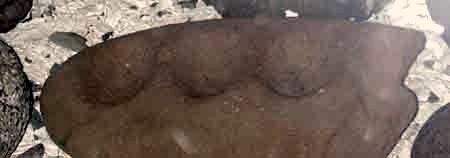
Salt Spring Island has a pretty active museum and archival society, by the looks of it – at least, they are putting a lot of pictures and documents online.  One thing which caught my eye was their photos of the Akerman Museum – which I take to be the private collection at the home of Bob Akerman.  This is a striking carved object (of which I wish there were more photographs) described as: Black stone that they claim had healing power. Shamans used it when they were visiting the sick. Though elsewhere, they show another object with a similar description which appears not to be worked much, if at all.  There’s no real documentation which is too bad — the stone tools in this picture, for example, strike me as more of a neolithic thing than a northwest coast one.  I hope they have the information somewhere.  This is an impressive metal celt, and it looks like he has a good collection of nephrite ones as well, though the picture is exceptionally poor.  (NB – bandwidth is not nearly so much of a concern these days, so don’t shrink your pictures so much!) There are lots of slightly unusual artifacts, like this collection of handstones. All around, it looks like Akerman has a great collection — I don’t want to think too much about where the archaeological material came from, or how he came to have it, and I’d like to think there is a shoebox full of notes somewhere — but all the same it is interesting to peruse and I’m glad the Salt Spring Archives have at least some documentation of it.

Another highlight of the site is Chris Arnett’s short, but lively and informative history of First Nations of Saltspring Island.

dSpace: Dentalia Shells on the Northwest Coast

Dentalia Source "mu7is" in Hesquaht Harbour.  From Barton M.A. p. 116

Dentalia Source "mu7is" in Hesquiat Harbour. From Barton M.A. p. 116

Andrew Barton did an excellent job reviewing the biology of the Scaphopoda, the archaeological record of dentalia use and trade, and the technology available to harvest these small creatures with tusk-shaped shells.  Overall, he brought a lot of nuance to a topic that had been somewhat over-simplified.  For example, there is no real evidence that these shells were only available at depth from the NW corner of Vancouver Island.  Barton reports on attempts to replicate ethnographic dentalia “spears” (more like a rake, or a pasta fork).  You should be able to download a copy of Fishing for Ivory Worms : a review of ethnographic and historically recorded Dentalium source locations from SFU dSpace.

Dentalia necklace by Josephine Ingraham, Clatsop/Chinook Tribes

Dentalia necklace by Josephine Ingraham, Clatsop/Chinook Tribes

Erik the Lost

Erik the Lost

More berzerkness up-island

This site contains an inspired argument that Viking Vinland, Markland and Helluland were on the NW Coast. It’s thought-through to a scary degree, in the way that magnificent obsessions often are.  Though as I always say, if something isn’t worth doing, it isn’t worth doing well. And based on my acquaintance with NW Coast Archaeology, I have to say that the theory falls down at a few key junctures.  Worse, it is part of a long-running narrative in which aboriginal people of the Americas have their finest cultural achievements taken and assigned as the work of Europeans.  See, for example, the Vikings in Minnesota theories, which argue that the great mounds of Mississippian Culture were the construction of White Men from the North.   Do the Minnesota proponents have academic arguments with the Vancouver Island proponents?  Were Vikings everywhere?  Is this a racist narrative?   Too bad all this energy is not put into something worthwhile, there is so much serious work to do.

Harpoon Head from the Hunterian

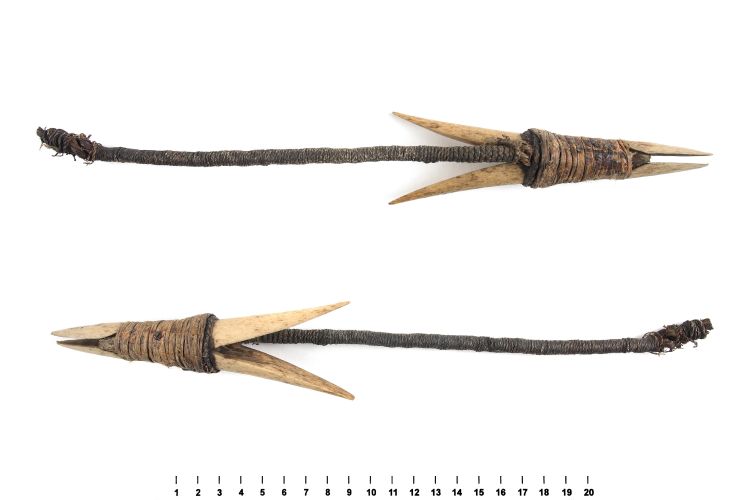
I have to say, I disagree with your description.  Based on size alone, at 14 cm this is much too large to have been for salmon fishing.  Stylistically, fish harpoons tend not to have a blade bed, but rather some kind of cylinder formed by the two valves.  Flat beds such as this one are more consistent with large arming points made of ground slate or ground mussel shell.  If intended for a fish, this would be more suitable for Fraser River sturgeon, say.
But I doubt it.  I’d suggest in size and manufacture this is much more consistent with a sea mammal harpoon head.  I don’t recall seeing any of this size in Coast Salish archaeological sites.  If your provenance traces to Laskey and thus to Cook, I’d suggest it is much more likely to be from the Nuu-chah-nulth (Nootka) area of western Vancouver Island, where Cook occupied himself much of the time he spent on the NW Coast proper, and with which it is stylistically consistent.  Indeed, even without provenance that is where I would assign it.  And I would suggest in size and manufacture it is more likely to be a large sea mammal – probably whale – harpoon head of a kind we describe out here as “Composite Toggling Harpoons”, composed of two valves forming the barbs with an allowance (usually) for an inset arming point.  Something like a sea lion harpoon I would expect to be about 2/3 of this size.   Further, Cook never really had much interaction with Coast Salish groups.
Normally too I would expect the valves on one of this size to be made of antler or of wood (yew, or Douglas fir) and not bone so that is an interesting difference.
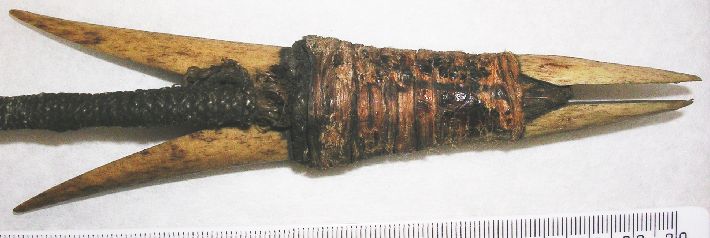
Anyway, all this is by way of saying, it appears the lanyard extends up one side, then crosses through the notch (blade bed) to the other side where it fastens.  I’d be interested in knowing if this is the case since it would be an interesting functional design aspect encouraging the harpoon head to toggle when pressure is put on the lanyard.  If you had higher resolution pictures I would love to see them.
Composite Toggling Harpoon with lanyard.

Composite Toggling Harpoon with lanyard.

This item from the Hunterian Museum in Glasgow traces its provenance provisionally to Captain Cook:

This harpoon head has one large split point, with a curved split socket with pointed tips. It has twisted sinew lashing around the middle and a line of vegetable fibre attached. This type of harpoon would have been used to catch salmon and is stylistically attributable to the Salish people of the North West Coast of America. The harpoon was originally accessioned as donated by Dr. G. Turner, however there are no items from the North West Coast on the 1860 donation list. It may be one of the hooks mentioned by Captain John Laskey in his 1813 account of the museum, in which case it may have been collected on one of the three Pacific voyages of Captain James Cook.

I have to say, I disagree with the description. Based on size alone, at 14 cm for the head, this is much too large to have been for salmon fishing. Stylistically, fish harpoons tend not to have a blade bed, but rather some kind of groove formed by the two valves which supports a cylindrical bone point.  Flat beds such as this one are more consistent with large arming points made of ground slate or ground mussel shell. If intended for a fish, this would be more suitable for Fraser River sturgeon, say.

But I doubt it. I’d suggest in size and manufacture this is much more consistent with a sea mammal harpoon head. I don’t recall seeing any of this size in Coast Salish archaeological sites. If the provenance traces to Laskey and thus to Cook, I’d suggest it is much more likely to be from the Nuu-chah-nulth (Nootka) area of western Vancouver Island, where Cook occupied himself much of the time he spent on the NW Coast proper, and with which it is stylistically consistent. Indeed, even without provenance that is where I would assign it.

And I would suggest in size and manufacture it is more likely to be a large sea mammal – probably whale – harpoon head of a kind we describe out here as “Composite Toggling Harpoons”, composed of two valves forming the barbs with an allowance (usually) for an inset arming point. Something like a sea lion harpoon I would expect to be about 2/3 of this size. Further, Cook never really had much interaction with Coast Salish groups.  These harpoons work by an analogous process to the toggles on a duffel coat: insert the toogle narrow-ways, then it turns side-ways and won’t pull through the loop.  For toggle, read “vicious harpoon” and for loop, read “flesh”.  Because most maritime hunting and fishing technologies require immobilization of the prey and retrieval, the technology tends to quite a bit more complex and intricate and well-engineered than terrestrial hunting technology which is more single purpose (kill!).  The composite harpoons are a great example of this.

Normally too I would expect the valves on one of this size to be made of antler or of wood (yew, or Douglas fir) and not land mammal bone so if these valves are land mammal that is an interesting difference.

Anyway, all this is by way of saying, it appears the lanyard extends up one side, then crosses through the notch (blade bed) to the other side where it fastens. This would be an interesting functional design aspect encouraging the harpoon head to toggle when tension  is put on the lanyard.  (I emailed the Hunterian to see what they think)
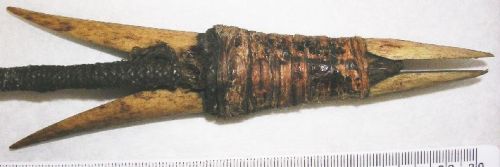
What is that organic matter between the valves? The lanyard?

What is that organic matter between the valves? The lanyard?

Maps and Charts at the RBCM

1849 Indian Fort at Cadboro Bay

Indian Fort at Cadboro Bay, 1849

The Royal BC Museum was ahead of the curve in putting significant parts of its collection.  One thing I like is their small but relevant collection of maps and charts.  The 1849 chart inset to the left shows an “Indian Fort” in Cadboro Bay, for example.  There is a good selection of Admiralty Charts from the mid 19th Century, Pemberton’s 1861 map of Victoria (the “Bay” in this section is the real “James Bay”, now landfill under the Empress Hotel , where the bridge shows is now the causeway), and a 1911 map showing the Economic geography of Haida Gwaii (which interestingly includes Sea Otter as part of the fauna “on the west coast” since that species is thought to have been extirpated much earlier).  It is always surprising and sobering to see just how quickly remote areas were divided up and labelled according to their perceived economic value in a way that borders on propaganda, but there is realism too check out the instructions to family men.  Now the bad news: the price of being first is often not being very good.  I suspect when these went online bandwidth was a realy problem.  Each chart is split up into 100kb segments and it is not possible to download the entire thing at once.  The full size images must exist, so how about a quick project at the RBCM to make them downloadable in their entirety?  Same goes for the picture archives.

dSpace: Lundy on Rock Art

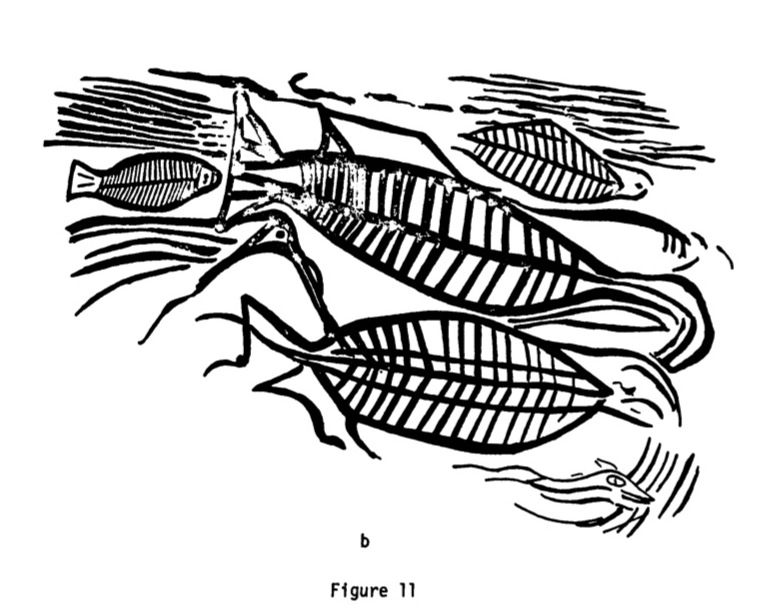
Salmon Petroglyph at Jack Point. From Lundy (1974: 111)

There is a wonderful trend of institutions putting old, grey literature online.  One widely used platform  for doing this is called “dSpace”, though the approach exists under other names.  Some of the best of this material are graduate theses and dissertations.  These are freely available if you walk into the University library, but may be essentially unavailable in any other form.  Unlike a lot of digital initiatives, the majority of these are not limited to students and faculty, but can be accessed by anyone – provided you know they are there.  Consider Doris Lundy’s monumental MA thesis on NW Coast Rock Art, obtained in 1974 from SFU.  Most of this 350+ page thesis was never published in any form.  Now you can download the whole thing from SFU (4 meg PDF). Despite being a rocky scan, the entire text is searchable.  There is some digital protection applied but I found it simple to save a copy to my hard drive.  The image to the left is the famous salmon petroglyph at Jack Point near Nanaimo in Snuneymuxw territory.  This is the petroglyph that would be painted with ochre and adorned with eagle down by ritualists if the salmon runs were late or meagre – one of the only such works which has specific beliefs recorded for it.

Let me know if you have problems downloading this: it works for me on and off campus, so I presume anyone can do it.

Camas and Cairns

Lekwungen women harvesting camas bulbs on Beacon Hill. Illustration by Victoria graphic artist Gordon Friesen.

Lekwungen women harvesting camas bulbs on Beacon Hill. Illustration by Victoria graphic artist Gordon Friesen. (Edit: a bunch of their pictures are down, even on their site. Click to go to story)

Two small articles look at the archaeology of Beacon Hill Park in central Victoria.   Camas country includes charming illustrations and a knowledgeable write-up by Janis Ringuette, who also summarizes the remarkable story of how Beacon Hill Park workers consolidated a series of burial cairns (in the 1980s, no less), in order to facilitate mowing.  As she aptly notes:

Parks and Recreation Committee Chairman Geoff Young promised an interpretative sign. He said the Committee had been planning a marker well before the stones were “accidently disturbed.” He agreed a sign was needed because “They just look like ordinary rocks on the surface. It’s not a spectacular site. You have to know them.” Parks Director Al Smith said, “It’s going to be one of the more interesting features of the park, especially when we get the marker in place. We should have something showing the Indians were the original owners of the land.”

Continue reading