Category Archives: Teaching

ASBC Talk: Tuesday, February 16th

Surveyors in the Uplands development, Victoria, using a burial cairn as a surveying aid. Source; BC Archives.

ARCHAEOLOGICAL SOCIETY OF BRITISH COLUMBIA, VICTORIA, February 2010 MEETING

Feb. 16, 2010, 7:30 pm

Pacific Forestry Centre, 506 West Burnside Road, Victoria, B.C.

Darcy Mathews

The Powerful Dead: The Rocky Point Cemetery and Straits Salish Identity.

Burial cairns and mounds are two types of pre-contact burial features in the Strait of Georgia region of south-western British Columbia. More than a millennium ago, the Straits Salish people, an ethno-linguistic group centered on present day Victoria, constructed a cairn cemetery at the Rocky Point site. Located 18 km southwest of present-day Victoria, this cemetery has over 300 cairns which occur in a variety of patterned shapes and sizes. Analysis of cairn construction and the use of space within this cemetery suggests that there was a strategic use of both material culture and landscape in Salish mortuary ritual, simultaneously expressing individual, household and perhaps even village-wide group identity. Underlying these statements of identity is the material expression of relationships between the living and the powerful dead, which were carefully navigated through the process of the funerary ritual, of which building cairns and mounds was but one part of a long-term process; a process that may have an antiquity of several thousand years. Biography Darcy Mathews is a PhD candidate at the University of Victoria. Working with the Scia’New First Nation, his ongoing dissertation research focuses on the identification, preservation, and study of pre-contact burial cairn and mound cemeteries in the Strait of Georgia.

For information, phone 384-6059 or e-mail asbcvictoria@gmail.com

ASBC Victoria January Meeting

Haida Gwaii watershed above Sunday Inlet.

The Archaeological Society of British Columbia is a long-established society which promotes knowledge and conservation of BC Archaeology.  The Victoria Chapter is particularly active (though they need to update their website and blog).  They aim for a public lecture every month. There are also chapters in Nanaimo and Vancouver.

This month’s Victoria talk, which is free and open to the public, is:

Watersheds and Coastal Archaeology: A Northwest Coast Perspective.

Jan. 19, 2010, 7:30 pm Pacific Forestry Centre, 506 West Burnside Road.

Rich Hutchings

The watershed or basin has been considered a primary unit of analysis for hydrologists, geologists, ecologists, human geographers, and historians. On the Northwest Coast, the economic significance of riverine settlement has long been a central focus, yet it is only in the last decade that anthropologists have begun to contemplate the social, political and ideological implications of rivers, river edges, and, to a lesser degree, basins. In this lecture, I will explore the concept of watersheds as a unit of analysis for archaeologists working on the Coast. Specifically, I consider the notion of what I call ‘watershed identity’, the issue of territorial boundaries, and the social implications of changing basin landscapes. Finally, these issues are highlighted in relation to the increasing threat of coastal erosion and its impact on maritime heritage, a concern for archaeologists and communities alike in this region.

Biography: Rich Hutchings was born and raised in Seattle, Washington. Having trained and worked as a diver in the marine industry, Rich completed his undergraduate degree at the University of Idaho, Moscow. He then undertook research in the area of alluvial and coastal geoarchaeology on the Nooksack River, earning his Masters degree from Western Washington University, Bellingham in 2004. Rich is currently pursuing Doctoral research at the University of British Columbia, looking at maritime cultural landscapes, coastal erosion, and marine heritage management in the Sechelt area. For information, phone 384-6059 or e-mail asbcvictoria@gmail.com

Haida Archaeology at the Virtual Museum of Canada

Rodney Brown at the Cohoe Creek Site, 1998. Source: CHIN.

The Canadian Heritage Information Network (the venerable CHIN) has, via the Virtual Museum of Canada,  a small online exhibit of Haida Gwaii archaeology posted.

I hate to be all grumpy since such initiatives should be supported, but seriously – the problems with this exhibit are manifold.  First, a number of the facts are wrong, despite the content being copyrighted 2009.  They use a figure of 9,000 years for first occupation, not the figure of 12,500 which is more reasonable.  That’s more than a 30% difference.  They state it was a grassland 10,000 years ago, when the better number would be 14,000 or more. It’s written in the first person, so apparently a Haida person wrote it – but really should that be an excuse? Maybe the details don’t really matter.

So, factual errors are unfortunate.  But they also have completely crap illustrations – low resolution, poorly lit images from ethnological collections are used to represent the archaeological record.  This is misleading on a number of levels.  Archaeologists do not usually find beautifully decorated clubs, for example, and it diminishes understanding of the archaeological record and process to imply they do. Indeed, the text of the exhibit lists the following “learning outcomes:

Learning Objectives

The learner will:

  • Describe the history of Haida people revealed by archeology
  • Describe some Haida objects found in archeological excavations

As far as I can tell, not a single object “found in archaeological excavation” is shown and essentially no archaeological facts are given.

Also, all the pages, including “Haida Society since European Contact” are under the header of “Haida Ecology” which is a bit unfortunate.  Put the whole thing under “Haida history”.

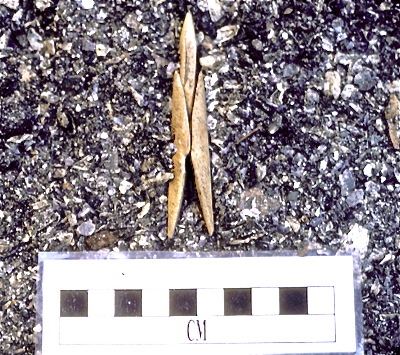
It’s also regrettable that the pictures are of such poor quality, like this one of fish hooks.  I mean, this is a national institution, and the year of the web is 2009, not 1995.  People expect more and will tune out if you don’t offer them some substantial eye candy.  I think they have a right to receive it from the Ottawa heritage establishment – after all the NMC is sitting on a superb collection that most of us never get to see.

Finally, the information content is miniscule.  The whole thing can’t add up to more than 500 words and is cluttered with jargon like “Print this Learning Object” and “View the complete asset”.  What kind of robotic geek came up with that sort of bullshit management-speak? And every bit of this information has a copyright notice on it, even pictures from other institutions.  This page has SEVEN separate, identical copyright notices “© 2009, CHIN-Canadian Heritage Information Network. All Rights Reserved.”

Memo to CHIN and the VMC:  no one wants to copy your minimalist, factually incorrect and low-resolution information anyway.  If you can’t do decent eye candy then do decent information.  If you can’t do either, then don’t try to bully me with copyright notices.

C’mon guys, you can do so much better than this, especially if your goal is to educate.  Email me, I’ll send you some pictures and fact-check your page.  No fancy consultancy charge will apply!

I just noticed this was NW Coast Archaeology blog post #100. To counteract this being so grumpy, here's a nice picture of camp life on Tanu Island.

UCLA-Stó:lō Field School at Welqámex

s’iltexwáwtxw

I see UCLA is running a fieldschool again this coming summer in Stó:lō territory at Welqámex, a village site on the  small island in the Fraser River near Hope.  Instruction is by Anthony Graesch (UCLA) and Dave Schaepe  (Stó:lō Research and Resource Management Centre).  The UCLA web site has been down as much as up recently (because it has so  many bells and freakin’ whistles it doesn’t know if it is coming or going — idiot web designers make such fragile shit these days), so you can also check the AIA web site.  Here is a direct link to their pamphlet (PDF).

Note the students wearing protective ochre daubing.

Society of Ethnobiology Conference: Coming to Victoria

Top notches in a standing western red cedar tree, the result of extracting one or more planks.

Dana sent me a note that the 33rd annual meeting of the Society of Ethnobiology “The Meeting Place: Integrating Ethnobiological Knowledge”, will be held 5–8 May, 2010, in Victoria.I believe some “rockwashy” types are helping out with the organization.  It sounds like a great conference and a chance to build networks between plant people and rock people and bone people – and we sure do need a lot more archaeology of plants out here on the NW Coast, where bones and stones still rule the day.

This year’s conference theme celebrates the potential of ethnobiology to bridge disciplines, ideas, and communities, and to foster an understanding of the connections between the biological and cultural worlds.

In addition to our usual dazzling line up of papers and sessions, here’s a preview of some of the other special events:

  • Wednesday night welcome reception in the First Nations gallery at the Royal British Columbia Museum
  • Special discussion sessions on: Teaching science through ethnobiology, Ethnobiology and ethics, Communicating environmental knowledge through media, Indigenous people’s food systems, and more!
  • Thursday night poster reception at the just opened First People’s House at the University of Victoria
  • Six! fabulous field trip options
  • A banquet of traditional B.C. First Nation’s food followed by a presentation of the Atla’kima “Spirits of the Forest” dance by Kwakwaka’wakw Longhouse dancers

This year’s meetings will be back-to-back with the International Society of Ethnobiology congress in nearby Tofino, B.C., May 9–14.

Annotation: Kilgii Gwaay excavations.

Excavation at Kilgii Gwaay, southern Haida Gwaii.

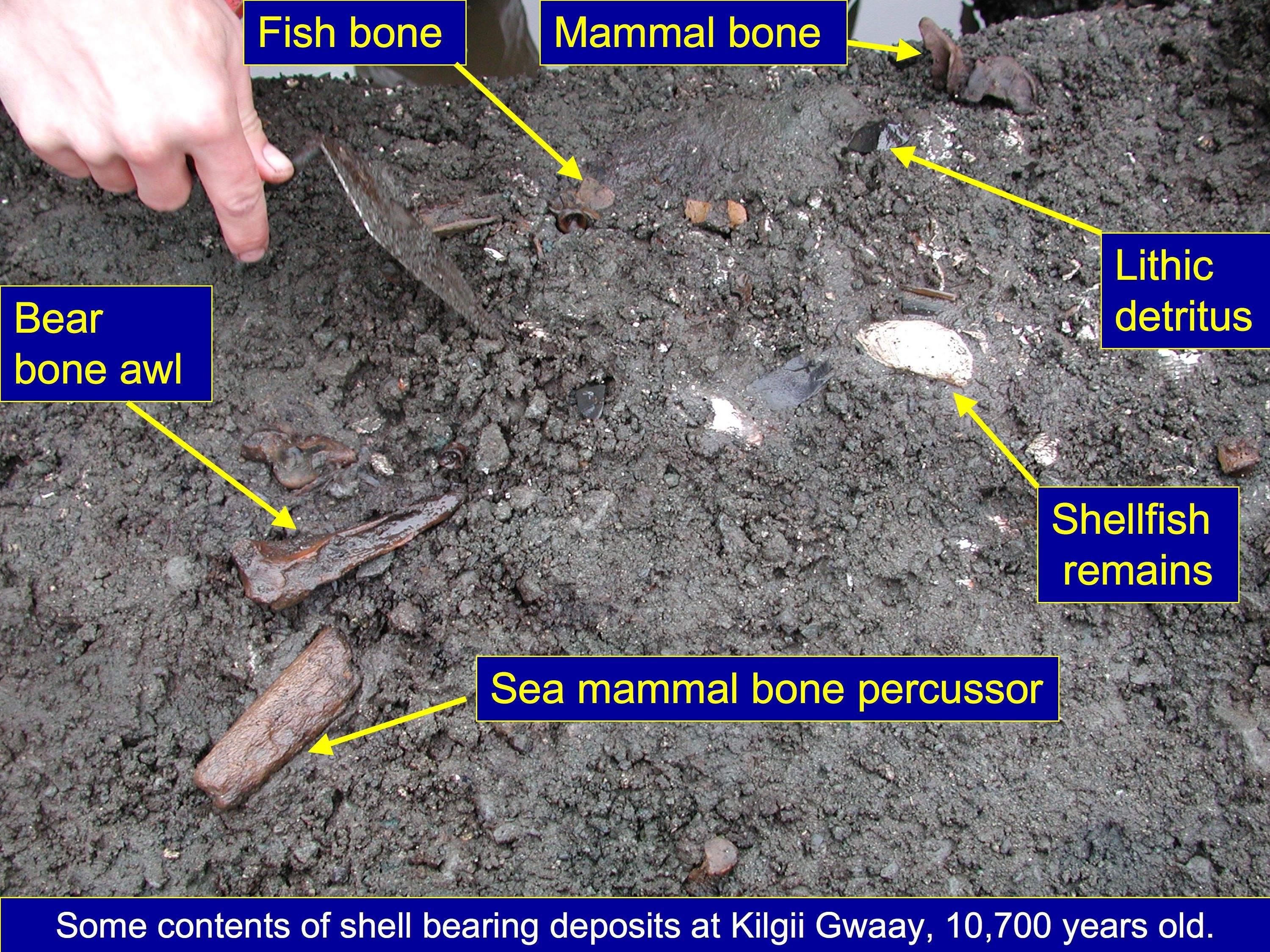
I’ve found that individual powerpoint slides can be saved as JPG images, complete with their annotations.  Since I have a lot of these I may share some.  The above shows excavation in the shell-rich component of the intertidal site at Kilgii Gwaay.  The combination of shellfish remains and saturation in slightly alkaline sea water has produced remarkable preservation for a site which is firmly dated via about 20 carbon samples to 9450 14C BP, or around 10,700 calendar years ago.  In this picture you can see some of the evidence: bone tools, stone tools, and the remains of shellfish, fish and mammals which, together with birds, formed the basis of the diet at this summertime camp.

Continue reading

Northwest Anthropology Conference: NWAC 2010

The web site for NWAC 2010, to be hosted at Central Washington University March 24 – 27, 2010 in Ellensburg, Washington,  is up and running.  NWAC is a great conference which we were lucky to host in Victoria a couple of years ago.  In case you are wondering where Ellensburg is (no offence), it’s just to the east of the Cascades from Seattle, north of Yakima, about a 350 km drive from Victoria: map.

The theme of this year’s conference is the very welcome “At a Crossroads”:

Anthropology at the Crossroads” is the theme for the Northwest Anthropology Conference (NWAC), Ellensburg, Washington, March 24 – 27, 2010. While all submissions will be considered, this conference will offer opportunities for multiple perspectives on where we are as a discipline, society, and species, with a special emphasis on people and the environment. The “Anthropology at the Crossroads” conference will include symposia and presentations on subjects from archaeology, cultural and linguistic anthropology, paleoanthropology, primatology, medical anthropology, visual anthropology, and others. We invite submitters to use their own preposition in describing their presentation/symposia as “Anthropology at/of/on/etc the Crossroads.” Studying the past, understanding the present, and preparing for the future, makes Anthropology even more relevant today as the discipline continues to assert the importance of an appreciation for culturally diverse modes of interacting with our environment. Thus, this conference is a crossroads where the exchange of ideas better prepares us, our students, and our work to serve the communities we live in as we maintain our commitment to exchanging and transmitting our under-standings of all people, in all places, and at all times. “Anthropology at the Crossroads” also implies interaction among sub-disciplines and communities in an integrated fashion and in this manner encourages self reflection on the relevance of Anthropology today at a moment when we appear to be at several global crossroads.

Tla’amin Archaeology

Toggling Composite Harpoon head, articulated in situ.

Toggling Composite Harpoon head, articulated in situ.

The Tla’amin (Sliammon)  First Nation on the Sunshine Coast (map) have been engaged in a wonderful community-based archaeology project with Dana Lepofsky at SFU and her team.  It’s not surprising when you think of what a great person Dana is – brilliant, yet nice, warm, generous. (Hi Dana!)

The website for this project is well worth browsing to see what meaningful partnerships with First Nations looks like.  I think it is a model for the future of BC Archaeology to work together – for then the project becomes not all about the past, but all about the present.  As they say – the past is over; it only exists in the present. Old things exist, but they exist now.   So how can we, as archaeologists, use our particular skills to help communities and the public appreciate the past as a meaningful part of the present, and hence of the future?  This impressive web site shows many great ways how.

Check out this page on Kleh Kwa Num – Scuttle Bay, for example, whih deftly points to the parallel stories of oral history, ethnohistory, and archaeology.  Or, this video of “what happens when an archaeological site is logged?”  As Elsie Paul, a Tl’amin elder says, their ancestral land was hammered for a century and what did aboriginal people get from it?  “Nothing”.  And as Dana says, it became very difficult to find intact archaeological sites around Powell River and the industrial areas, in particular.

These downloadable posters are also really well done, as is their prospectus/report (PDF) – very accessible stuff.   I do wish they didn’t use the silly flash interface for their pictures, though they do allow access to them otherwise – this project is really turning archaeology on its head!

Upside Down Archaeology in Tla'amin Territory.

Upside Down Archaeology in Tla'amin Territory.

Aboriginal history a la mode.

Being a mere archaeologist and not a sophisticated type, I like to reduce complex topics to simplistic graphs.  I showed this one to the first class of my new course on the Archaeology of BC.     The numbers for this are based on the emerging 13,000+ (calibrated) year old archaeological finds in Haida Gwaii,  so I expect the red slice to keep on growing.

If I were a paranoid type, I’d liken it to Pac-Man just getting his teeth into a ghost.

Reverse the colours to get the relative number of BC historians vs BC archaeologists in Universities – though I am all for historical archaeology as well, not to mention history, and BC history in particular.   All really good things.  But it is striking nonetheless to consider how weighted we are institutionally towards  the green slice.  As I said to the students, hearing the BC government natter on obsessively on the radio and in newspaper ads last year about the “150th Anniversary of British Columbia” just made my blood boil every time.  Seriously, Premier, do you want a new relationship with First Nations?  How about acknowledging the red slice of pie?  How about a celebration of 130 centuries of BC history?  Call off the government lawyers and other PR flacks who seem to think the world began 150 years ago.

While we are on the topic of letting the facts speak in the tongue of numbers,  where I work, the ratio of BC archaeology faculty members to all regular faculty members = 1:800.  As the kids say, Hello?

PS: Archaeologists are quintessentially “shovel ready” so maybe some stimulus money goes well with pie.  Try it.