Category Archives: Northwest Interior

Puget Sound Clovis

In Red: Surface Finds of Clovis Projectile Points. After Croes et al. 2008.

I posted yesterday about the Manis Mastodon site and its possible status as a pre-Clovis site on the Olympic Peninsula.  Clovis projectile points are so distinctive that most archaeologists have no problem assigning even an isolated find of such a point, lacking in any kind of stratigraphic context or any associated dates, to the Clovis archaeological culture.  We know from sites elsewhere in North America that Clovis dates to a pretty narrow window, perhaps only 13,200 to 12,800 calendar years ago.  It has always been very closely associated with the ice-free corridor route for the First Peopling of the Americas and is predominantly known from classic sites in places like Colorado, New Mexico and Texas. So it may come as a surprise to some that Clovis is pretty well represented in Puget Sound and north to Bellingham Bay, although only from surface or other finds without provenience.

Continue reading

Association for Washington Archaeology

9,000 year old stone tools from Colville National Forest, Washington. Source: The Spokesman-Review.

I was a little surprised (and probably shouldn’t be) to find out there was an organization called the Association for Washington Archaeology – equivalent to the Archaeological Society of B.C.  They have a journal (equivalent to The Midden), and are clearly a respected avocational archaeology organization.  They have a pretty low profile, obviously: but partly this must be another symptom of the poor cross-border communication between BC, Alaska, Washington, and Oregon  – the core jurisdictions bounding the Northwest Coast.  They even have a blog called Washington Archaeology, which is only a few weeks old.  Their own link to it is both hidden under a “feedback button” and is broken: I hope that linking it here helps people find it.  There’s not much there yet, but it did lead me to a nice news roundup on the Tse-whit-zen site, and also to an interesting story on a 9,000 year old site in the Colville National Forest, near a town called Republic – just south of the Canadian border close to Grand Forks BC. (map).  Continue reading

Historic Pamphlets and Booklets on First Nations Topics

Skeena River pole ca. 1920s: On back: ""Named Waum Gana'o 14' high / erected 1845 / 4 Bottom figure, is of the big hog, upside down." Source: USASK."

The University of Saskatchewan has a comprehensive Indigenous Studies portal, with links to a massive corpus of published and unpublished documents – some of which are available online, free of institutional restriction.  One section which I found interesting was the large collection of pamphlets and booklets.  I know this web site isn’t always 100% archaeological – but you can’t separate the practice of archaeology from the social context in which it occurs. Among these pamphlets are:

  • CBC Radio and Department of Indian Affairs 1939: The Indians Speak to Canada (transcript of a remarkable series of 1939 CBC radio broadcasts in which aboriginal people address the nation; Haida representative Rev. Peter Kelly starts on page 28; White Man’s Burden is found in the closing remarks by the Minister of Mines and Resources)

Continue reading

A Portal to Online Graduate Theses and Dissertations

If you look up you should see two more links have been added along the header of this page, just above the banner picture.

ARCHAEOLOGY THESES is a page of links to freely-available, online PDF copies of graduate dissertations and theses on Northwest Archaeology subjects (with a few palaeo-environment theses thrown in for fun).

OTHER THESES is a similar page, but where the focus is on Northwest Anthropology, First Nations Studies, History and related disciplines.

I am planning another page which will be for online archaeological, ethnographic and historic documents of note, in particular “classic” ethnographic works and major site reports which have been intentionally posted in online contexts.  Probably this will be a few weeks yet.

The impetus for these pages is that I have often said the M.A. thesis in particular is a significant backbone of B.C. Archaeology, and the dissertation even more so.  For years these substantial works languished on library shelves.  Now, libraries are increasingly making them available online, free to the public and the academy alike – that is, not behind password protection.

However, you have to know how to look, and where to look, and often you need to know in advance what you are looking for, in order to find this stuff.  I thought it would be useful to have a very simple portal for these graduate works.  Not only does this make them browsable by the more hardcore of my blog readers, but it will get them some google-love!

Not all theses ever written are available online (mine isn’t!):  as it notes on the pages, there are programs in place at UVIC and UBC to digitize their back-catalogue of theses and dissertations.  It would be great if institutions like Calgary, Toronto and McMaster could get their dSpaces full, and open. Unless, of course, they are ashamed of the quality of their graduate student work 😉

So, these pages will be updated periodically. I am not vouching for the quality of any of the ones I linked — indeed a few of them are exceptionally poorly reasoned,  naive, unsupported, badly written, or long-winded efforts -and  in at least one case, all of the above!  Most are very solid though, in my estimation, and a few are truly excellent.  If you know of useful and relevant graduate work that is freely available and not yet linked, let me know in a comment below, or send me an email qmackie [at] gmail.com.  In the meantime, happy browsing.

Thoughts on a WSU Archaeological Perspective

Pioneering WSU archaeologist Richard Daugherty instructs students on the beach at Ozette, late 1960s. Source: WSU.

Washington State University (WSU) has one of the oldest and most notable programs in Northwestern North American archaeology, with pioneers such as Richard Daugherty and William Ackerman leading the way.  The WSU magazine has a nice interview with a number of their distinguished alumni and faculty, including William Andrefsky, Dale Croes, Colin Grier, and Gary Wessen.  There are some interesting quotes in it, notably, to my mind – and perhaps yours, if you are a university nerd like me: Continue reading

Alaskan Ice Patches

Barbed bone or antler point with copper tip from Alaskan Ice Patch. Source: Dixon, NPS

All over  Northwestern North America, from Colorado to the NWT, global climate change is rapidly melting glaciers, and their less mobile cousins, permanent patches of ice which accumulate and never completely melt.  Some finds from these ice patches have revealed exceptionally-preserved organic technology dating from recent times to more than 8,000 calendar years ago.  Additionally, of course, there is the remarkable story of Kwädąy Dän Ts’ìnchį, Long-Ago Person Found, a man who died on a glacier in the Tatsenshini area hundreds of years ago.  All of these would make good posts for the future!

For today, though, I found an article online (PDF) about the lesser known Alaskan ice patches, which have been researched primarily by E. James Dixon.  Continue reading

More views of the Museum of Vancouver petroglyph problem

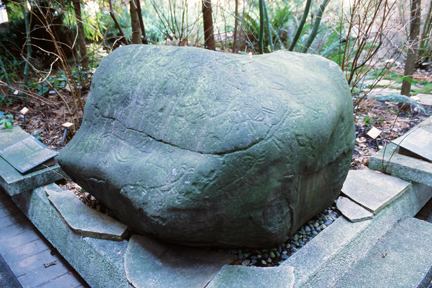
Petroglyph from Lone Creek Cabin, Stl’atl’imx Territory, now in an outdoor courtyard at the Museum of Vancouver. Source: Squamish-Lil'wat Centre.

I’ve posted before on the large petroglyph boulder from the central Fraser River that is being kept in a sub-standard context at the Museum of Vancouver.  I found some more pictures of it, from the website of the Squamish-Lil’wat Cultural Centre (which is excellent).  These additional pictures confirm there is a serious conservation issue at the Museum of Vancouver.  I don’t want to beat a dead horse but I am still mad about this situation. Continue reading

Five Frogs’ Quiver

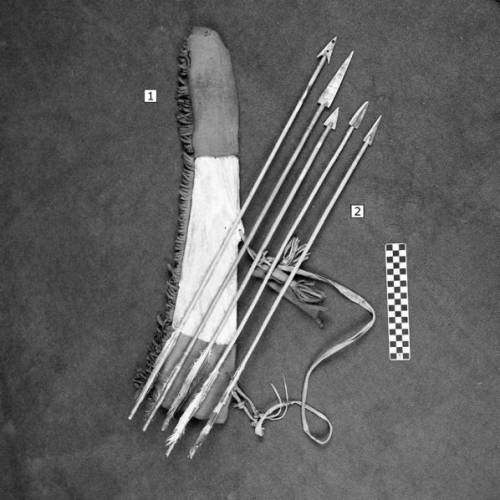
Five Frogs' quiver with five metal-tipped arrows. Source: WSU

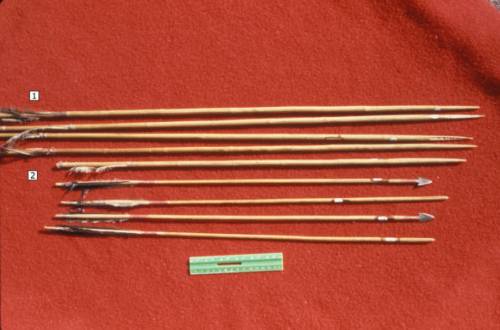
The quiver and set of arrows above is from the McWhorter Collection at Washington State University.  It belonged to the Nez Perce warrior Pahka Pahtahank (Five Frogs), who fell in battle in 1877.  Ten arrows in total were in the quiver: five with metal tips, and five with plain wooden tips – or, more likely, unhafted (probably prepared for a side-hafting method).  The wooden five are illustrated below. What I find interesting about this quiver is that no two of the five metal-tipped arrows are the same.  Archaeologists are very prone to a simple “projectile point sociology” whereby the styles of (usually, stone) projectile points are used as proxies for archaeological cultures, or ethnic groups, or as temporal markers:  ‘The side-notch people”;  “The corner notch phase”.

It is therefore a little sobering when we see ethnographic instances of an apparently cavalier attitude towards stylistic consistency.  Sometimes, (at least rarely) being a little sober is a useful mindset.   Did the different arrowheads make no difference to accuracy, or to penetration, or even to their definition as “suitable arrows”?  What are the archaeological implications of Five Frogs’ diverse arrows?  In a classic paper, Polly Wiessner (1983) noted several mechanisms for a similar Kalahari case, including hunters exchanging arrows with each other as a sign of respect and affection.  Closer to home, Glen MacKay, in his excellent UVIC M.A. thesis, suggested diverse projectile points in a short occupation site in The Yukon was a technological mediation of kinship unease:

Was the ‘arbitrary’ technical choice of hafting techniques a subtle way for young men living matrilocally to express their discontent with this institution, a means of communicating a desire to return to the people with whom they learned to make spear points and hunt? Several contextual details fiom the KdVo-5 hunting stand support this proposition…..

Emotion in archaeological interpretation!  Stamp it out.

Tips of Five Frogs' wooden arrows. Source: WSU

The top five arrows are from Five Frogs' quiver. The bottom four are from another Nez Perce warrior, Yellow Wolf (Hemene MoxMox), made as deliberate replicas. Source: WSU/

References:

Wiessner, Polly   1983.  Style and Social Information in Kalahari San Projectile Points.  American Antiquity, Vol. 48, No. 2 (Apr., 1983), pp. 253-276

MacKay, Glen R.   2004.  The Nii’ii hunting stand site : understanding technological practice as social practice in subarctic prehistory.  Unpublished M.A. thesis, Department of Anthropology, University of Victoria.  Download.

Fluted Points from the Bering Land Bridge

Fluted points from the Serpentine Hot Springs Site, Seward Peninsula, Alaska. Source: Bering Land Bridge NPS

For many years, archaeologists considered the so-called “Clovis” Culture to be the remains of the first humans to enter the Americas.  These people were said to come via the Bering Land Bridge, a subcontinental land mass which joins North America to Northeast Asia.  Clovis culture was distinguished by a very characteristic type of stone spear point which had a long flake removed from the base on each side, forming a “flute” which considerably thinned the base of the point. Such fluting was a hallmark of Clovis and another, slightly more recent, culture: Folsom.

Clovis was thought to have arrived into the Americas from the present-day Yukon area through an “ice free corridor”.  However, for many years,  Clovis points and the rest of Clovis culture, were unknown from north of the ice sheets and there was a sustained research agenda to find Clovis, or to find Clovis antecedents, in Yukon, NWT or Alaska.  While the occasional fluted point became known from surface finds, those from solid archaeological context did not.

It is therefore interesting to see a site, Serpentine Hot Springs, has come to light on Alaska’s Seward Peninsula (the bit that sticks out closest to Asia – map) which has revealed numerous fluted points.  Continue reading

Historic Sketchbook of Heywood W. Seton-Karr

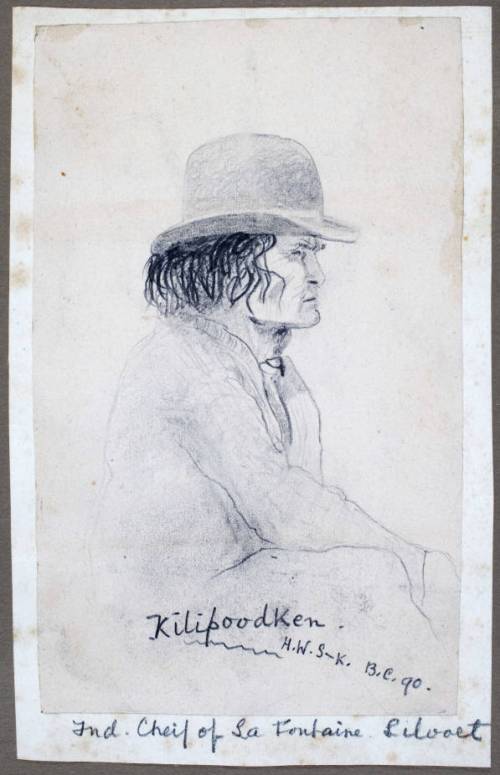
Portrait of Kilipoodken by Heywood Seton-Karr, ca. 1890. Source: Alaska Digital Archives.

I’ve just come across a remarkable sketchbook in the Alaskan digital archives.  It covers the wide-ranging travels of one Heywood W. Seton-Karr, a British Army officer, big game hunter, amateur archaeologist, and talented artist (about whom, more below).  While I could probably fill 10 blog posts from this sketchbook, (and may do so!) a very interesting find is the portrait sketch above.  The caption reads,

Kilipoodken. Ind. [Cheif]  of La Fontaine Libooet. H.W.S-K. B.C.90.

This certainly refers to the Xaxli’p First Nation, also known as the Fountain First Nation, one of the Lillooet (not Libooet!) Tribal Council from the central Fraser River region of British Columbia.  Since googling for “Kilipoodken” only returns the Alaska Digital archives source, it seems to me possible that this mislabelled portrait is unknown to the Xaxli’p Nation, where it is more than likely some of this Chief’s descendants still live.   I hope they find this portrait.

Otherwise, there is much of interest in these sketchbooks. Continue reading