Category Archives: Miscellaneous

Archaeomath’s advice for archaeology graduate school

Fish skeleton tattoo by Russell Fortier. Source: http://lucky7tattoo.net

I linked once before to the excellent quantitative zooarchaeology blog written by a mysterious anonymous figure.  Turns out the anonymous fish guy also has some great advice for graduate students – two pages worth, tailored to different stages.  I found myself agreeing with quite a bit of it.  Here are a few excerpts, but there is much more in the two excellent posts here and here.

Continue reading

March ASBC Talk: GvonP on UP Art

UVIC's own, Langford's own, Genevieve von Petzinger. Source: Goldstream News-Gazette

I had the pleasure of serving on this month’s ASBC speaker’s graduate committee and I know if you are in the Victoria area you will be entertained and educated at this talk – which unfortunately I can’t make due to pre-existing public speaking commitments of my own.  Genevieve has recently been featured on the cover of New Scientist magazine and there has been something of a global storm of publicity stemming from her Master’s research.

ARCHAEOLOGICAL SOCIETY OF BRITISH COLUMBIA, VICTORIA CHAPTER

March 2010 Monthly Meeting: Tuesday, March 16, 2010, 7:30 pm

Pacific Forestry Centre, 506 West Burnside Road.

The talk is free and open to the public.

Genevieve von Petzinger

Making the Abstract Concrete: The Place of Geometric Signs in French Upper Paleolithic Cave Art.

In Paleolithic cave art, geometric signs tend to outnumber figurative images and yet, they remain relatively understudied. To address this gap in our knowledge, I compiled a digital catalogue of all known geometric signs found in parietal art in France, and then trended the results looking for patterns of continuity and change over time and space. I focused on parietal art, as I could be certain of its provenance, and picked France as my region due to its abundance of decorated sites and its natural boundaries of water and mountain ranges. The database is searchable by a variety of criteria such as sign category, method of production, date range, site type, geographical coordinates and region. It is now being converted into an online resource. To provide a visual dimension, it includes a selection of linked photographs and reproductions of the different signs. In this thesis, I detail the chronological and regional patterning in sign type and frequency and the implications of these patterns for understanding where, when and why the making of these signs was meaningful to the Pleistocene peoples who created them.

(editor’s note: you can download her thesis free of charge here)

Biography Having been interested in the cognitive evolution of modern humans since her undergraduate days at the University of Victoria, Genevieve von Petzinger was finally able to explore this in more depth at the Master’s level. Working with Dr April Nowell, again at the University of Victoria, she was able to pursue this interest, and received her MA in June 2009. Using the geometric signs of Upper Paleolithic rock art, Genevieve discovered some very interesting information about these early examples of symbolic behaviour, and presented her findings at the Paleoanthropology Society meeting in Chicago, Illinois in April 2009. This presentation was the catalyst for her research being featured as the Feb. 20th, 2010 cover story in New Scientist magazine. This exposure then led to a strong media follow-up, which included an interview on the Discovery Channel, a feature in the Tuttoscienze supplemental of La Stampa in Italy, an article in the Globe and Mail, and a full page feature in the Vancouver Sun, as well many other popular press articles and radio interviews in French and English, both nationally and internationally. While being slightly overwhelmed by all the attention, Genevieve has been very excited about the positive response, and is just thrilled that other people want to hear her talk about her favourite subject!

For information, phone 384-6059 or e-mail asbcvictoria@gmail.com

Media Links

http://www.newscientist.com/article/mg20527481.200-the-writing-on-the-cave-wall.html?full=true

http://www.timescolonist.com/news/UVic+researcher+taps+into+cave+language/2599510/story.html

Maori Canoe found in New Zealand Beach

Canoe being excavated at Muriwai Beach, 2010. Source: stuff.co.nz

From the Northwest Coast (of New Zealand) comes inspiring news for Northwest Coast (of North America) archaeologists.

I don’t know how many times I’ve told students that I would never really expect to find a canoe in an archaeological site and that the evidence for watercraft and marine fluency – still a contentious issue for the early Northwest Coast – will likely be resolved through interpretation of marine fauna from archaeological and from finding sites on remote islands.  While in my view Kilgii Gwaay settles this question for the early period on the Northwest Coast,  I suspect nothing short of a 10,000 year old dugout canoe will satisfy some people as to whether the first inhabitants around here could catch a fish.

So it came as a surprise to read that a nearly-complete, seven-metre long Maori wooden waka tikai, or river  canoe, has been recently found in Muriwai Beach (map) on the Northwest Coast of New Zealand (video clip).  The canoe may take several years to properly conserve, and is currently undated.  While the canoe presumably is less than a thousand years old (the accepted time frame for the  arrival of Maori in New Zealand), the fact that it survived at all, buried in the sands of what appears to be a fairly exposed beach, leads me to think we need to keep our eyes open more for this kind of find on the Northwest Coast.  This story claims that it was seen washing up in the 1920s, but still – once something like this survives the process of burial then it might survive for a very long time indeed protected deep in dark, wet beach or dune deposits.  Memo to self: don’t be so pessimistic!

Maori waka being raised. Source: nzherald.co.nz

ASBC Talk: Tuesday, February 16th

Surveyors in the Uplands development, Victoria, using a burial cairn as a surveying aid. Source; BC Archives.

ARCHAEOLOGICAL SOCIETY OF BRITISH COLUMBIA, VICTORIA, February 2010 MEETING

Feb. 16, 2010, 7:30 pm

Pacific Forestry Centre, 506 West Burnside Road, Victoria, B.C.

Darcy Mathews

The Powerful Dead: The Rocky Point Cemetery and Straits Salish Identity.

Burial cairns and mounds are two types of pre-contact burial features in the Strait of Georgia region of south-western British Columbia. More than a millennium ago, the Straits Salish people, an ethno-linguistic group centered on present day Victoria, constructed a cairn cemetery at the Rocky Point site. Located 18 km southwest of present-day Victoria, this cemetery has over 300 cairns which occur in a variety of patterned shapes and sizes. Analysis of cairn construction and the use of space within this cemetery suggests that there was a strategic use of both material culture and landscape in Salish mortuary ritual, simultaneously expressing individual, household and perhaps even village-wide group identity. Underlying these statements of identity is the material expression of relationships between the living and the powerful dead, which were carefully navigated through the process of the funerary ritual, of which building cairns and mounds was but one part of a long-term process; a process that may have an antiquity of several thousand years. Biography Darcy Mathews is a PhD candidate at the University of Victoria. Working with the Scia’New First Nation, his ongoing dissertation research focuses on the identification, preservation, and study of pre-contact burial cairn and mound cemeteries in the Strait of Georgia.

For information, phone 384-6059 or e-mail asbcvictoria@gmail.com

Elfshot: experimental and replicative archaeology

Saqqaq Palaeo-Eskimo flaked stone scrapers and knives, hafted with the aid of baleen. Source: Elfshot.

Elfshot is a cool blog chronicling archaeologist Tim Rast’s replicative and experimental work.  Interestingly to us out here on the NW Coast, a lot of  what he studies and replicates is from the comparable areas of the NE Coast, Newfoundland and the eastern Arctic.  That means he is using some marine sources such as baleen as well as materials such as moose sinew.  There is a lot to read at his blog, which is very well illustrated with photographs, videos, and scans from manuscripts.  If you find yourself in his neighbourhood, you can take courses and workshops on ancient technology from him, and I note that some of his beautiful replications are for sale.

Experimental archaeology is a really valuable approach in archaeology. It helps the archaeologist, who more often than not isn’t part of a traditional materials tool-use culture, understand the constraints of certain materials and likely technological sequences that would have been followed to make and use things.  While perhaps no substitute for observation and interviews, the fact is that by the time ethnographers got to most places in the world many traditional technologies had fallen by the wayside, and so there are very few descriptions of such basic technological domains as flaked stone tools.  Much of what we know about these tools and technologies comes from the work of replicators and experimentalists who set the facts of life out to help analyse the material which comes from the ground in archaeological digs.

Anyway, I strongly recommend Elfshot as a knowledgeable blog offering a lot of archaeological insight, especially for coastal contexts.

Use of the "mystery tool type" - piece esquillee - as a wood-splitting wedge. Source: Elfshot.

The Gabriolan

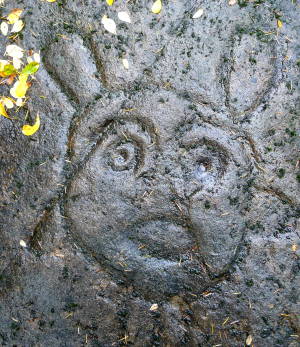
Gabriola Petroglyph. Source: The Gabriolan.ca

Another blog linked to me the other day: The Gabriolan. This is a lovely blog, whose mysterious author has a great eye for the quirky and beautiful things about that Island. I especially like the various pictures of unusual things found in the woods, like antlers on trees. On my quick browse through the site I noted the excellent photograph of a Gabriola Island petroglyph which I am posting above. This is not a petroglyph I am familiar with though I don’t have my books in front of me.  I’ll look it up.  With its double-rendered eyes and protruding ears, it may be Mouse-Woman.  But anyway, anonymous Gabriolan, thanks for the link, and look after those petroglyphs.

Toys for Christmas

Miniature ulu, or woman's knife, from west Greenland. Source: field notes blog/ Genevieve LeMoine

OK, so it is not from the NW Coast, but this thousand year old miniature (toy?) ulu from Cape Grinnell, Western Greenland is close enough.  Close to the North Pole, Reindeer, and all that, that is.  It even has a miniature blade made from meteoric iron.  Via field notes.

Google and the Indigenous Mapping Network

Nisga'a Place Names. Click for interactive version.

Google is putting together a workshop together with the Indigenous Mapping Network:

On February 25th and 26th, 2010, Google and IMN will host a workshop on the Google campus for members and staff of indigenous groups who want to learn about Google geospatial and mobile technologies. This hands-on workshop will approach Google technologies with the special concerns of indigenous communities in mind, and will focus on the technical aspects of using Google Earth, Google Maps, Sketchup, Android mobile phones and Open Data Kit, among other technologies.

I’m pretty sure both parties are on it, but despite Google’s corporate motto of “Do No Evil” uploading sensitive, spatially-referenced cultural information to their servers seems like something that would need some thought.  Nonetheless, it is interesting to see this as a pro-active direction Google is taking.  Canadian First Nations are some of the most GIS-savvy anywhere in the world.  One of their main networks seems to be the Aboriginal Mapping Network, who have an excellent-looking book coming out soon called Living Proof: The Essential Data-Collection Guide for Indigenous Use-and-Occupancy Map Surveys by Terry N. Tobias.  Also see their handy link to data sources especially for BC.

Society of Ethnobiology Conference: Coming to Victoria

Top notches in a standing western red cedar tree, the result of extracting one or more planks.

Dana sent me a note that the 33rd annual meeting of the Society of Ethnobiology “The Meeting Place: Integrating Ethnobiological Knowledge”, will be held 5–8 May, 2010, in Victoria.I believe some “rockwashy” types are helping out with the organization.  It sounds like a great conference and a chance to build networks between plant people and rock people and bone people – and we sure do need a lot more archaeology of plants out here on the NW Coast, where bones and stones still rule the day.

This year’s conference theme celebrates the potential of ethnobiology to bridge disciplines, ideas, and communities, and to foster an understanding of the connections between the biological and cultural worlds.

In addition to our usual dazzling line up of papers and sessions, here’s a preview of some of the other special events:

  • Wednesday night welcome reception in the First Nations gallery at the Royal British Columbia Museum
  • Special discussion sessions on: Teaching science through ethnobiology, Ethnobiology and ethics, Communicating environmental knowledge through media, Indigenous people’s food systems, and more!
  • Thursday night poster reception at the just opened First People’s House at the University of Victoria
  • Six! fabulous field trip options
  • A banquet of traditional B.C. First Nation’s food followed by a presentation of the Atla’kima “Spirits of the Forest” dance by Kwakwaka’wakw Longhouse dancers

This year’s meetings will be back-to-back with the International Society of Ethnobiology congress in nearby Tofino, B.C., May 9–14.

MacLeans: Natives and Suits vs. Environmentalists

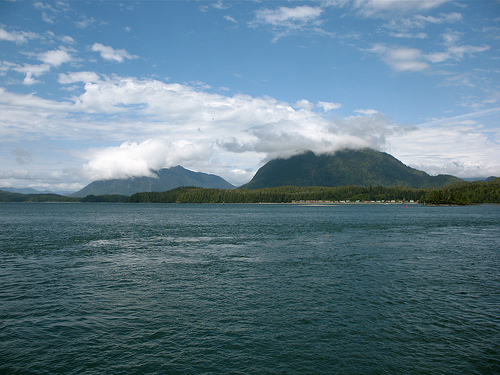
Catface (left) and Lone Cone, Clayoquot Sound. Village of Opitsaht in the foreground, Tofino to the right. Source: flickr.

MacLean’s is a magazine that is well past its “use by” date and true to that form they have put up a remarkably provocative and axe-grindy article on economic development in First Nations territories.  Mind you, I think it is entirely true that First Nations want meaningful economic opportunities and I hope they get them.  Some environmentalists seem to think that aboriginal people are noble savages who will play the role of wildlife in parkland.  Leaving aside the MacLeans implicit question of why the hell should they be au naturale when settlers have raped all the rest of the land, the fracture lines between the First Nations and Environmental groups have been clear to me since  I worked on the Meares Island case 20 years ago.  Anyone working on that project could see that the envirnmental movement and the First Nations were going to have a trainwreck at some point in the future.  A balance of park land and economic use is what we should expect on settlement lands.  What right do we have to hold the First Nations to a higher standard than to ourselves? Are the Squamish Nation’s billboards less lovely than Surrey, or North Vancouver, let alone the wasteland that is Squamish itself?  But MacLean’s magazine: way to completely ignore longstanding, demonstrated First Nations stewardship of the land.  That article is a complete waste of 10 minutes of my life, but I am linking to it anyway.