Category Archives: Cultural Resource Management

Tseycum Repatriation from AMNH

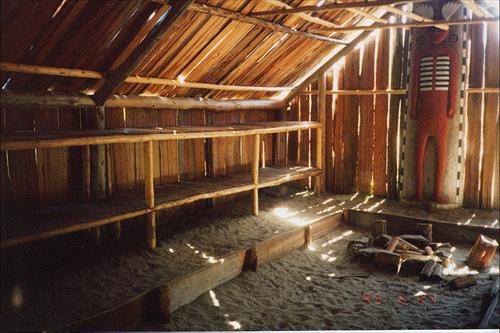
Inside the Tseycum Longhouse.  Click Image for etended video.

Inside the Tseycum Longhouse. Click Image for extended video.

This is old news now that in 2008 the Tseycum First Nation in North Saanich managed to repatriate the remains of 55 of their ancestors who had been removed and sold by Harlan I. Smith.  What I didn’t realize is in addition to the snippet on The National with Wendy Mesley (the file is incongruously called “brown-bones” – WTF CBC?), there is also an extended uncut video of the ceremony in the Tseycum longhouse.   Cora Jacks, who spearheaded the Tseycum repatriation effort and is interviewed here, sadly passed away soon after.

The detailed field notes kept between 1854 and 1910 assisted greatly in tracing the location of the ancestral remains. Museums in the states are required by law to provide information when a nation makes its request. This law called NAGPRA is the Native American Gravesite Protection Repatriation Act and has greatly facilitated the provision of a long list of human remains and sacred objects. (Similar legislation in Canada does not exist.) Historic references show that skulls had been sold for $5 each with similar price tags having been placed on skeletal remains.

Cora had visited New York in 2005 with Vern Jacks Jr. and experienced the deep emotionality of viewing the remains stored in boxes and placed on shelves. The museum had not followed any cultural protocol so that skulls were often separated and Jacks explains the “spiritual restlessness,” which results from this disrespectful treatment. In Chicago Jacks also discovered about 79 sets of remains many of which are probably from this region and most of them were small children who had likely died of smallpox after contact with European settlers. (source).

As the NY Times noted, the Field Museum in Chicago had not yet begun repatriation negotiations with the Tseycum.  While the NAGPRA law in the states is very strong when applicable, it clearly does not apply outside American borders so credit to the AMNH for working in good faith with the Tseycum.

But also: Grant – what the heck – is it really necessary to defend Harlan Smith?  Maybe as a curator of archaeology it is.  I dunno, seems like another relativising moment rather than a chance for an apology or a plain admission that it was wrong, then and now, to steal human remains for profit. But hey, stealing their land was also done in the spirit of the times, so what the heck?  Let’s not forget the RBCM itself is built on top of a village site.

NorthWord Archaeology

Layer 1: snow.  Layer 2: littermat.

Layer 1: snow. Layer 2: littermat.

I just found a pretty good article from NorthWord, a community newspaper that covers northern BC’s coast and interior.  Nice quotes and insights from Rick Budwha, Farid Rahemtulla and David Archer – but what caught my eye was the surreal photo used to illustrate the piece.  Is that a light dusting of snow on the clipboard?  Is that wind down the plumber-butt?  Is that a marginally insane unit location right in the root mat of a huge tree?  Is this winter impact assessment under Oil and Gas Commission guidelines? How did they establish the glorious sidelight?   Is there snow on the soles of their boots?  Could this be a painting?  I want to know more about this picture, dammit!

Tla’amin Archaeology

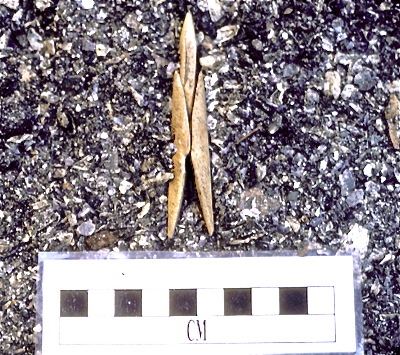
Toggling Composite Harpoon head, articulated in situ.

Toggling Composite Harpoon head, articulated in situ.

The Tla’amin (Sliammon)  First Nation on the Sunshine Coast (map) have been engaged in a wonderful community-based archaeology project with Dana Lepofsky at SFU and her team.  It’s not surprising when you think of what a great person Dana is – brilliant, yet nice, warm, generous. (Hi Dana!)

The website for this project is well worth browsing to see what meaningful partnerships with First Nations looks like.  I think it is a model for the future of BC Archaeology to work together – for then the project becomes not all about the past, but all about the present.  As they say – the past is over; it only exists in the present. Old things exist, but they exist now.   So how can we, as archaeologists, use our particular skills to help communities and the public appreciate the past as a meaningful part of the present, and hence of the future?  This impressive web site shows many great ways how.

Check out this page on Kleh Kwa Num – Scuttle Bay, for example, whih deftly points to the parallel stories of oral history, ethnohistory, and archaeology.  Or, this video of “what happens when an archaeological site is logged?”  As Elsie Paul, a Tl’amin elder says, their ancestral land was hammered for a century and what did aboriginal people get from it?  “Nothing”.  And as Dana says, it became very difficult to find intact archaeological sites around Powell River and the industrial areas, in particular.

These downloadable posters are also really well done, as is their prospectus/report (PDF) – very accessible stuff.   I do wish they didn’t use the silly flash interface for their pictures, though they do allow access to them otherwise – this project is really turning archaeology on its head!

Upside Down Archaeology in Tla'amin Territory.

Upside Down Archaeology in Tla'amin Territory.

Pickford on Excavation of “Indian Middens”

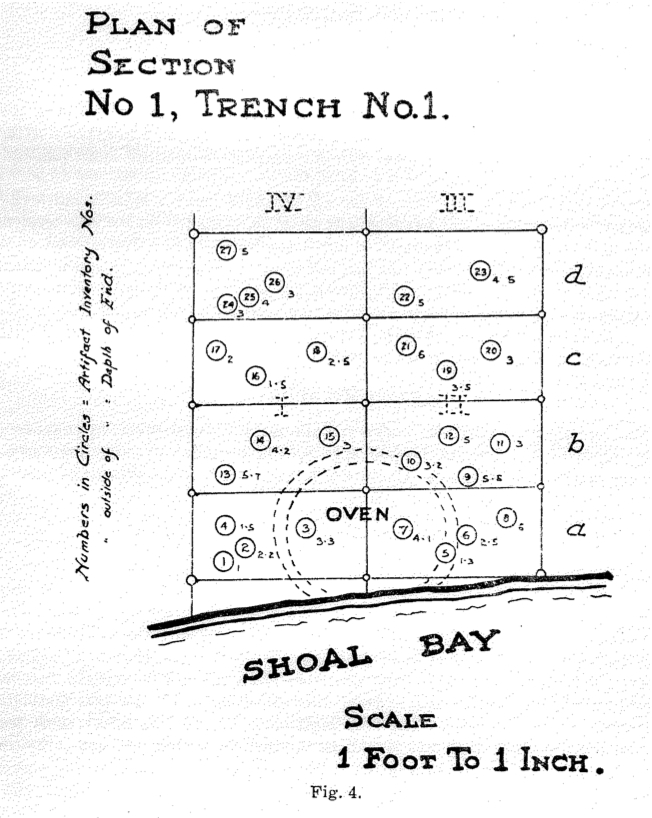
A.E. Pickford's ideal plan of an earth oven.

A.E. Pickford's ideal plan of an earth oven.

A.E. Pickford was the Assistant in Anthropology at the Royal BC Museum, when it was still known by its proper name of the Provincial Museum of Natural History and Anthropology.  Here I link to his indispensible 1947 article, “Archaeological Excavation of Indian Middens” – the examination of such middens by means of sampling.

The rationale for the publication is interesting:  “In case of private ownership, if a person is unable to restrain the impulse to dig on his own land, we urge that he shall adhere to some such principles as those which follow, then he will have the satisfaction of knowing that his work is well done and, when brought into focus with similar undertakings, will help to build up that sound formation of knowledge, without which the correct story of the early population of this country cannot be written.”

After encouraging the study of lofty topics such as racial and cultural origins, foods, housing …. etc., Pickford busts out his inner schoolmarm: “He who digs for relics alone may be likened to the child who tears a book apart in order to secure the coloured plates which it contains, being the while all unaware that in scattering the printed pages to the wind he is losing forever a valuable source of information about those same plates and the life which they represent”.

Reference: Report for the Year 1947.  Victoria: Provincial Museum of Natural History and Anthropology, Province of British Columbia, Department of Education.  [yes, education].

Leland Gilsen’s Archaeology of Oregon

Replica of a Clatsop House.

Replica of a Clatsop House.

Leland Gilsen, former State Archaeologist of Oregon has a pretty impressive website.   His extensive notes on aboriginal house styles are particularly worth a read — well referenced, well illustrated, and thoughtful, and he reproduces a lot of plan diagrams from the grey literature.  He also has good pages on “pyroculture” (deliberate landscape burning), and extensive notes and commentary on culture history, through a culture-ecological lens.  His image-rich virtual museum is a fun and educational slideshow.  Hmmm, someone should do a site like this for BC, or Vancouver Island at least.  Dr. Gilsen seems like a proud processualist of the Arizona school (not that there’s anything wrong with that) and a serious scholar.  At first glance, this web site could easily be used as an undergraduate textbook for a course on the Archaeology of Oregon.  Hats off, if I see you at NWAC, first beer is on me.

The Marmes Rockshelter Site

View out of the Marmes Rockshelter site.

View out of the Marmes Rockshelter site.

The Marmes rockshelter in eastern Washington State (map) is one of the oldest and most significant archaeological sites in NW North America. In its inundation by reservoir waters, it is also one of the sadder stories.  Washington State University has put a large amount of Marmes material online, including several photo galleries of work in progress.

The site was found in the early 1950s on land owned by Roland “Squirt” Marmes (pronounced “Mar-muss”)  a local rancher, but it wasn’t until 1962 that a large scale excavation commenced.

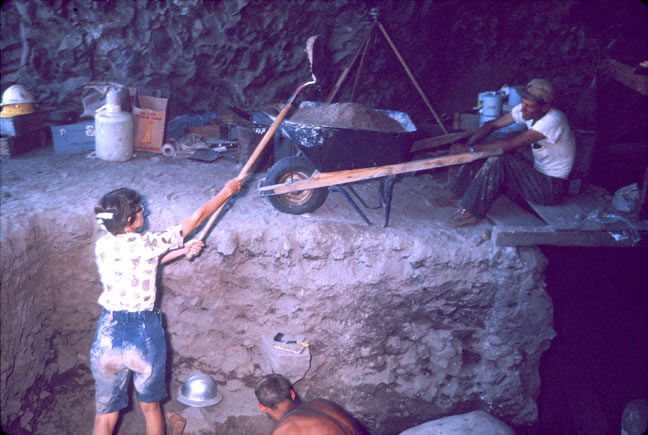
Shovel Bums of the Old School

Shovel Bums of the Old School

In soon order, there was a series of sensational finds of artifacts, fauna and human remains.  The oldest of these dated to 10,750 radiocarbon years ago, or, about 12,700 solar years ago.  At the time, these were the oldest human remains known from the Americas, and the artifacts represented one of the oldest known sites and one that was, interestingly, markedly different from the Clovis Culture type especially in the number and style of large, stemmed projectile points.  Among the other artifacts were distinctive crescentic stone blades, this exquisite bone needle, beads made of Olivella shell, which must have come from the Pacific Ocean.    HistoryLink.org, Washington State’s online encyclopedia, has a good summary article, and the WSU links above also give much more detail.  Indeed, WSU has been doing some wonderful digitization of old projects, which I will highlight in posts to come.  Things I have learned include the ubiquity of pipe smoking in the earlier days of Washington Archaeology.  My only criticism of this wonderful resource is the lack of captions on the photo galleries.  Who are these people, for example; who is under these splendid war bonnets?  Take a moment to tell us in a caption, or the file name.

The story of the inundation of the site by rising river impoundment is also of interest. Continue reading

Karst Mismanagement in British Columbia

Karst destroyed with approval of karst consultant.

Karst destroyed with approval of karst consultant.

The protection of BC karst landscapes falls into a sort of legal limbo.  There is only weak protection afforded through regulation, and only in some contexts.  If a cave can be shown to have archaeological deposits, it can be afforded very strong protection under the Heritage Conservation Act.  In theory, the HCA can also protect the cave if it has spiritual values to First Nations.  Nonetheless, the practice of karst assessment is controlled by a small cabal of self-appointed experts.  These folks make a living by doing impact assessments, mainly for forestry companies.  The picture at the left shows the results, a magnificent karst bluff destroyed after the karst consultant wrote the area off – from an office 500 miles distant, based on notes provided by a forest company employee.  In the report, archaeological values are dismissed from afar, doubly ridiculous since the karst consultant is notably ignorant about archaeology.  Continue reading

Camas and Cairns

Lekwungen women harvesting camas bulbs on Beacon Hill. Illustration by Victoria graphic artist Gordon Friesen.

Lekwungen women harvesting camas bulbs on Beacon Hill. Illustration by Victoria graphic artist Gordon Friesen. (Edit: a bunch of their pictures are down, even on their site. Click to go to story)

Two small articles look at the archaeology of Beacon Hill Park in central Victoria.   Camas country includes charming illustrations and a knowledgeable write-up by Janis Ringuette, who also summarizes the remarkable story of how Beacon Hill Park workers consolidated a series of burial cairns (in the 1980s, no less), in order to facilitate mowing.  As she aptly notes:

Parks and Recreation Committee Chairman Geoff Young promised an interpretative sign. He said the Committee had been planning a marker well before the stones were “accidently disturbed.” He agreed a sign was needed because “They just look like ordinary rocks on the surface. It’s not a spectacular site. You have to know them.” Parks Director Al Smith said, “It’s going to be one of the more interesting features of the park, especially when we get the marker in place. We should have something showing the Indians were the original owners of the land.”

Continue reading

Chilliwack Museum and Archives

Chilliwack Museum Accession number 1957.019.084

Chilliwack Museum Accession number 1957.019.084

The Chilliwack Museum (map) has a large, searchable collection of photos online, which they ruin with a huge watermark in the middle.  Seriously, guys, these are ancient artifacts that you are lucky to be curating.  And, your pictures aren’t very good in the first place – many out of focus, or with extensive shadowing.  In any case, for archaeologists, you can click for artifacts made of, or records containing the word,   “stone” (they have a huge number of celts, mauls and abrader stones, as you might imagine since the Fraser Valley is known for these, perhaps because of extensive plowing of former woodlands).  Oddly they don’t seem to have any aboriginal artifacts made of bone, shell, or antler.  Search term “Sto:lo” returns one empty field.  Further they make it almost impossible to link to a specific record or picture. I am putting in a picture I downloaded from their site of an unusual artifact – a ground stone point with a very unusual morphology and material.  They list it made out of serpentine, but from what I can tell, it shows signs of being readily worked, and so may be a softer verson of serpentine, perhaps soapstone.  The shape is like a bronze age arrowhead or something — highly unusual.   Too bad there isn’t a better picture available.  So, all in all, Chilliwack Museum people: you put a lot of time and energy into a resource that is not particularly useful nor does it readily promote the heritage of the Fraser Valley.  I suggest you rework your URL system, remove the watermarks, and update your keywords by adding Sto:lo to appropriate records.  Double-check your raw material “horn” as well.  You have a fantastic collection, share it!