Category Archives: anthropology

Namu Reburials

SFU Archaeology instructor Rudy Reimer holds a small replica of the handmade bentwood boxes that will be used to store ancestral Aboriginal remains. Source: SFU flickr stream.

There have been several newspaper stories recently noting the impending repatriation and reburial of human remains excavated from the famous Namu village site of the Heiltsuk Nation, on the central coast of B.C.   For example, here is one from the Vancouver Sun (PDF), another from the Globe and Mail (PDF) and a media release from Simon Fraser University itself, whose archaeology department conducted most of the excavations at this large site in the 1970s and 1980s, mainly under the direction of Roy Carlson. As ever, each newspaper source contains slightly different information.

Continue reading

Rock Art Talk in Vancouver BC, Wed. April 27

Source: ASBC

With hockey sidelined for a few days, there’s no excuse for Vancouverites not to take in an interesting-looking talk on rock art of the Stein River Valley tonight, sponsored by the Archaeological Society of British Columbia, “Vancouver Chapter”.

The talk, entitled “Rock Art Science in the Stein River Valley, British Columbia”, will be given by Chris Arnett, a UBC graduate student and experienced rock art researcher.  It is open to the public and free of charge, starting at 7.00 p.m. at the Museum of Vancouver, 1100 Chestnut Street in Kitsilano (map).  The link at the ASBC website is borked, so the abstract is here for posterity:

Rock art is found on every continent and is part of the cultural heritage of many peoples but there are few places in the world where direct historical and cultural continuity exists between those who made the art and the contemporary people. In places where this continuity does exist knowledge regarding rock art is controlled and not always accessible to non-indigenous people. When access is made available and information shared there can be prejudice towards indigenous ways of knowledge in favour of fashionable (historically contingent) theories of researchers. Early 21 century research shifts from a hermeneutic rock art research to a rock art science that combines forensic archaeology with Indigenous theory. My presentation will trace the dynamics of rock art research over a 125 year period in a place renowned for its rock art, the Stein River Valley of British Columbia, and suggest that the combined interests of researchers and indigenous people has potential to produce mutually constructed histories.

Oregon Earthquakes and Tsunamis

Source: Byram 2007.

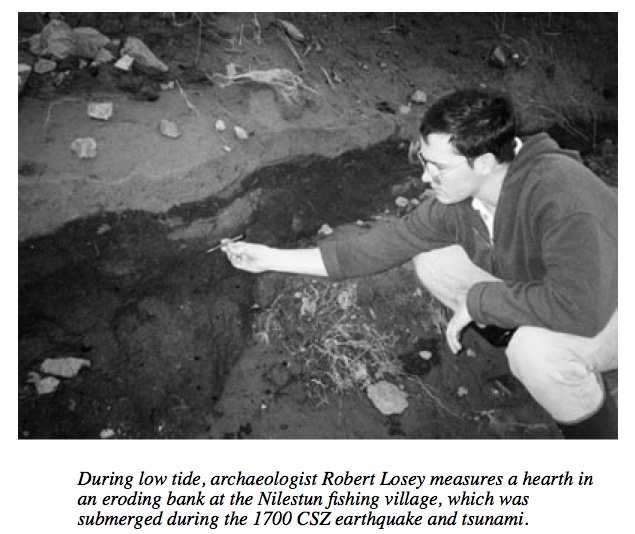
Every few centuries, on average, the Northwest Coast gets shocked by a massive mega-thrust earthquake, on the order of 8 to 9 on the Richter scale.  On occasion, these produce a devastating tsunami wave.  It wouldn’t be surprising then if such disruptive events featured in aboriginal oral histories and also in the archaeological record itself.  There is a growing body of research on this topic which I am not planning on reviewing at this time, but a nicely focused starting point is a series of papers in the Oregon Historical Quarterly, available online.

Continue reading

Revisiting the Salt Spring Island Archives

Part of the Charles Sampson collection from Salt Spring Island. Source: saltspringarchives.com

Salt Spring Island is a large island in the Salish Sea, close to Vancouver Island’s southeast corner (map).  Quite a while ago I highlighted the photographs of the “Bob Akerman” museum, which comes via the comprehensive Salt Spring Island archives.  There are a few other photo records of archaeological collections there which I thought were worth a quick look.  For example, the picture above from the Charles Sampson Collection shows some fairly spectacular ground slate points to the left, and what may be a Charles phase (ca. 4,000 year old)  contracting stem point to the bottom right.  It’s not just archaeological collections that the archives has going for it, though. Continue reading

The Bill Reid Centre For Northwest Coast Art Studies

Gwayasdums house under construction 1899. Source: SFU.

The Bill Reid Centre for Northwest Coast Art Studies is part of the Department of Archaeology and First Nation Studies at Simon Fraser University, although it is physically located in downtown Vancouver. It  currently shares space with the Bill Reid Gallery on Hornby St., near SFU’s Harbour Centre Campus. They have a website that looks to be growing fast with some good content – and despite the name of the centre, it is not only about Haida Art, or even just about Art:

A major activity of the Centre is to visually document through photographs, drawings and other works, the depth and richness of Northwest Coast Art in the hundreds of communities in which monumental architecture and sculpture were recorded.

I’ll point out a few highlights and make some comments “after the jump”

Continue reading

“BC Studies” is now mostly free

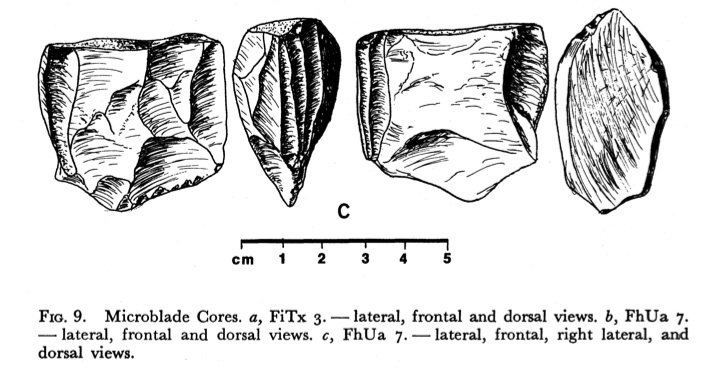
Haida Gwaii microblade cores. Source: Fladmark 1970. BC Studies.

The journal BC Studies is a respected, peer-reviewed publication that focuses on, well, studies of BC, but particularly on historical topics it seems.  It has long been an awkwardly circulated journal, in that it appears in few indexing databases and no PDFs were available, even via subscription or through paywalls such as university databases. These days, going to the library to photocopy is considered a hardship.   It is therefore extremely welcome to see that BC Studies has put almost its entire series of back issues online, open access, free. Wow.  You can download any article from inception in 1969 through the  Summer of 2008.  Interestingly, a number of the articles are also available as mp3 sound files, so you could listen to these on your daily commute.  Naturally you can browse it yourself but you won’t, so let me point out some of the highlights, with an eye on archaeology, ethnohistory and historical geography.

Continue reading

Newsflash: Facebook is Good for Something

Lolota, the son of Zickchuse, - Snoqualmie - 1890

I’m a bit of a reluctant user of “facebook”, mostly because of their user-hostile and byzantine privacy policies.  However, increasingly people are using its easy interface to create really useful web pages, many of which you don’t need to be a member of facebook or logged in to enjoy.  There are some quite specific archaeology ones relevant to the Northwest Coast which I will review some other time.  Today, I want to focus on a remarkable compendium of historic photos of North American indigenous people.  There are almost 200 separate galleries, many with more than fifty pictures in them (do the math), under the auspices of the group administrator Jonathan Holmes, who takes an active role in the discussions and comments.  This is an enormous investment of time and effort, especially as many of the pictures have notes (hover your mouse over the picture) and in a remarkable number the identity of the subject is named and contextualized.  This is not a mere link dump for pictures – the over 20,000 comments reflect many positive reviews from Tribal and First Nations members (e.g., Tahltan) and members of the general public, (as well as some cranky comments from six year olds and racists). Continue reading

Long term salmon resilience

Salmon lice infestation. Source: Georgia Strait Alliance.

I’ve just dipped into an interesting paper (PDF) by Sarah Campbell and Virginia Butler, which explores 7,500 years of relationship between First Nations and Pacific Salmon.  While, as ever, the archaeological evidence is discontinuous and somewhat patchy, the authors reach profound conclusions that go far beyond the usual archaeological focus on the past, as if the past still exists other than in the present.

The Northwest Coast was estimated to have the second highest indigenous population density in North America (after California) at European contact, with population estimates ranging from 102,100 to 210,100 (Ubelaker 2006). Haggan et al. (2006) propose an annual average per person consumption rate of 230 kg/yr based on two 19th- century estimates. At this rate, 200,000 people would annually consume 46,000 metric tons (50,706 tons) of salmon, comparable in magnitude to the average yearly commercial catch between 1901 and 2000 (Jones 2002). (emphasis added)

Continue reading

Yukon River Canoe Project 2009 Blog

Work on the log begins. Source: Yukon Canoe Project.

I just found an interesting blog that traces a community project to carve a Tlingit style dugout canoe on the banks of the Yukon River near Whitehorse:

Nineteen young Yukon carvers made history by creating a 30-foot red cedar dugout canoe. Under the leadership of Tlingit Master Carver Wayne Price, the carvers went on a journey of discovery.

An island on the east side of the Yukon River became their home for the next two months as went go back on the land to learn the traditional techniques for carving a dugout canoe.

Continue reading

In-SHUCK-ch Cedar Bark Stripping Gallery

Pulling a cedar bark strip. The scarred face will heal in a highly characteristic way. Source: In-SHUCK-ch live.com (click)

I came across a nice set of 18 pictures of members of the In-SHUCK-ch First Nation stripping cedar bark for use in traditional manufactures, especially basketry, cordage, matting, and clothing.  This nation is on the lower Fraser in the general Lillooet-Harrison Lake area.  It’s true you have to turn your head sideways on a lot of the pictures, but at the same time you would have to crane your head way back if you were stripping bark, so that’s ok.  Continue reading