Monthly Archives: October 2009

dSpace: Dentalia Shells on the Northwest Coast

Dentalia Source "mu7is" in Hesquaht Harbour.  From Barton M.A. p. 116

Dentalia Source "mu7is" in Hesquiat Harbour. From Barton M.A. p. 116

Andrew Barton did an excellent job reviewing the biology of the Scaphopoda, the archaeological record of dentalia use and trade, and the technology available to harvest these small creatures with tusk-shaped shells.  Overall, he brought a lot of nuance to a topic that had been somewhat over-simplified.  For example, there is no real evidence that these shells were only available at depth from the NW corner of Vancouver Island.  Barton reports on attempts to replicate ethnographic dentalia “spears” (more like a rake, or a pasta fork).  You should be able to download a copy of Fishing for Ivory Worms : a review of ethnographic and historically recorded Dentalium source locations from SFU dSpace.

Dentalia necklace by Josephine Ingraham, Clatsop/Chinook Tribes

Dentalia necklace by Josephine Ingraham, Clatsop/Chinook Tribes

Keatley Creak

An unusually strong review of Brian Hayden‘s Keatley Creek excavations on the middle Fraser River, near Lillooet can be found at this site:

” […]Hayden was able to show that the aristocratic owners lived on one side of the house, where the larger hearths, the larger storage pits, and the better tools and ornaments were all found, and their servants or poor relations on the other side.  The bones from the good side of the house were mostly ribs and vertebrae from the best parts of the fish, while the tail bones came mostly from the poor side.  The deer bones were also mostly from the rich side.  So we can imagine the rich folks keeping warm with big fires and eating the best parts of the fish, while their inferiors watched them from the other side of the same room, huddling by tiny fires and gnawing on fish tails.  To this visual image we must add the smell.  Air-drying salmon protects it from harmful rot, but European observers all thought the process left the fish “half tainted.”  The smell in a closed house full of the stuff “was such as nobody who has not grown up with the stench can endure it for even a few minutes.” The more I think about this strange place, the more disoriented and disgusted I become. […] ”

I look forward to more such insight into how the public perceives the fruits of archaeological labours.

Skidegate Haida Model Village

Model of Skidegate (hlgaagilda 'llnagaay) as installed at Chicago Exhibition, 1893.

Model of Skidegate (hlgaagilda 'llnagaay) as installed at Chicago Exhibition, 1893.

The Burke Museum in Seattle is doing excellent work.  I just found the project which they are spearheading, together with the Haida Museum at Kaay’llnagaay and the Field Museum in Chicago, to reassemble the famous model village of Skidegate (hlgaagilda ‘llnagaay) created for the 1893  Chicago World Fair.  This exhibition was organized by Putnam, implemented by Boas, who hired James Deans (a well known Victoria antiquarian) to collect some NW Coast stuff.  Deans outdid himself by arranging for the carving of a complete model of Skidegate Village  – amounting to some 27 model houses (most with frontal poles), 2 model mortuary houses, and 17 free standing model poles.  (Deans also apparently collected three boxcars of other material including an entire house, canoe and other material, but that’s another story).

The Burke Museum now allows you to view an interactive panorama of the model village.

The website is designed both to showcase these model houses and also to help find the 13 houses and poles which have gone missing.   The intention is to return the model village to Kaay in 2011.  Replacement poles and houses will be commisioned for those that cannot be found.   A highlight are the videos of Skidegate residents such as Captain Gold, Niis Wes, Percy Williams, Kii7iljuus, and Kwiaahwah Jones talking about the model village, about family, and above all about being Haida yesterday, today and tomorrow.

House of Contentment, model carved by George Dickson

House of Contentment, model carved by George Dickson

Cook Journal Illustrations from Oz

inside house nootka soundThe Australian National Library has a nice set of the engraved illustrations for the journals of Captain Cook online.   Above is the famous 1778 image of life inside a large house at Yuquot (Friendly Cove) in Nootka Sound.  The image above encapsulates so much about life on the west coast: one group of people on the ground, tending to the fire, looking a little miserable, while another family unit sits on benches in nicer clothes and with their feet dry; the little partition dividing up the large house into dwelling foci; the boxes of stored good and paraphernalia; the fish hanging up in the smoke (and look how they are all different sizes and shapes of fish).  And note the “whaling trophy” at the base of the left housepost, a wooden whale fin apparently studded with sea otter teeth.  A closely comparable example was found at the Ozette site.  That’s the inside of the house — one remarkable thing about the outside of the house is the massive piles of shell midden almost obscuring the dwellings.  We think of middens as flat, but active middens may have been highly mobile, rutted, mounded affairs, which should give us pause, or at least, humility.

Their interface is clumsy (or maybe just slow) and I know you only want the Northwest Coast ones anyhow, so other treats are these masks and frontlets, the well-known man and woman from Nootka, and, below, a sea otter proving that cute overload is no modern invention – thought the listless aspect of the otter suggests that it may have been dead at the moment of portraiture.

cook sea otter

Fieldwork Picture of the Day 9

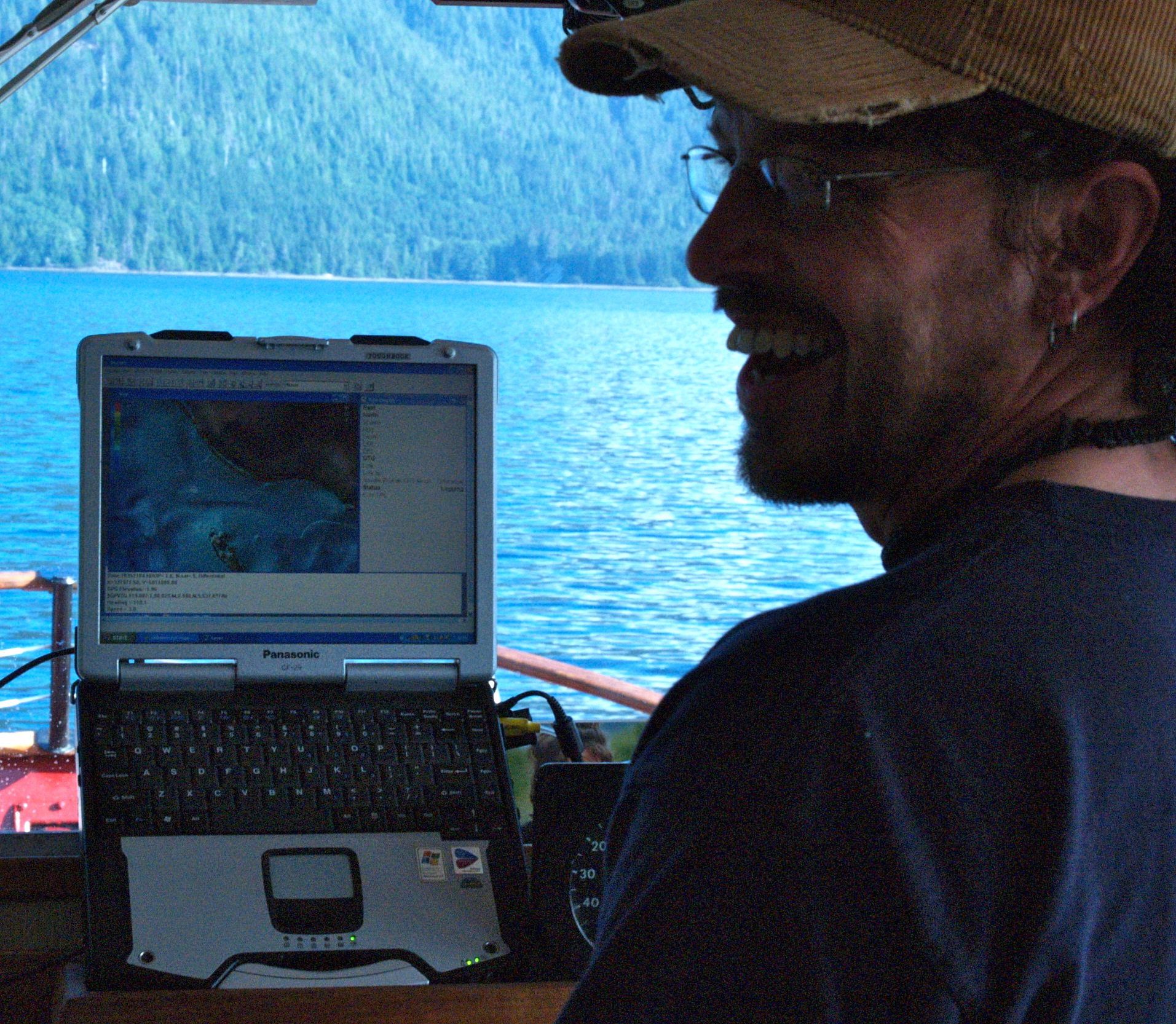
Danny at the helm,  aaaargh Billy.

Danny at the helm, aaaargh Billy.

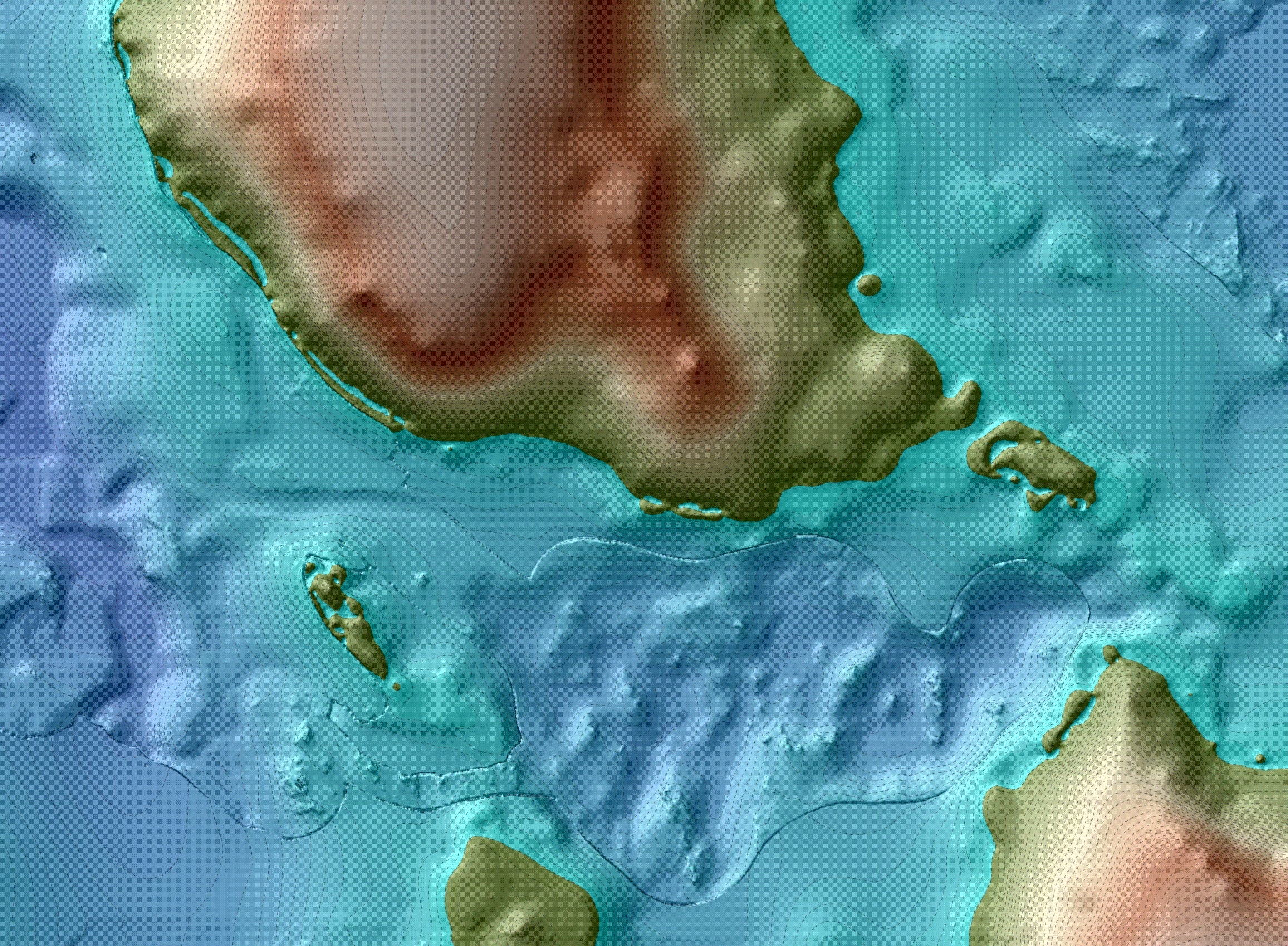
Underwater research at Section Cove, near Gaadu Din. I posted a picture earlier of a diver on the bottom.  Here is a view from topside — Danny, boat skipper, wise-ass and all round rock solid good guy — has a GPS-linked laptop in front of him which is displaying the bathymetry of Section Cove.  (see the image on Danny’s screen here, courtesy of Daryl).  This enables him to tow the sonar fish exactly where required, or, on this occasion, help position a small dredging bucket for bottom sampling purposes.  With differential GPS, you can position the ship to within less than a metre of where you want it, relative to the bottom.  This means measuring the distance between the GPS antenna and the crane and building in an offset, which is trickier than it sounds. The bathymetry is also sub-metre in resolution.  Thus, we can target the bucket exactly where we want it — of course strong currents and bucket flutter can still move it around some.  It has been slow progress on this work but all the pieces are in place for what could be an exciting breakthrough –  a base camp on a small lake, now drowned, dating to sometime older than 11,500 solar years ago would be most welcome considering most of our other sites of this age are rather one-dimensional.

The purpose of the camp could be base camp for bear hunting in the nearby Gaadu Din caves, or more likely sockeye fishing in the lake-stream system that used to flow along the terrain here, under Danny’s  keel.

The lake, the salmon, the cave, the creek.  Green tones are now underwater.

The lake, the salmon, the cave, the creek. Green tones are now underwater. Image prepared by Daryl.

Tla’amin Archaeology

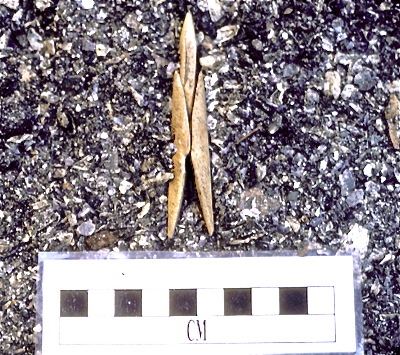
Toggling Composite Harpoon head, articulated in situ.

Toggling Composite Harpoon head, articulated in situ.

The Tla’amin (Sliammon)  First Nation on the Sunshine Coast (map) have been engaged in a wonderful community-based archaeology project with Dana Lepofsky at SFU and her team.  It’s not surprising when you think of what a great person Dana is – brilliant, yet nice, warm, generous. (Hi Dana!)

The website for this project is well worth browsing to see what meaningful partnerships with First Nations looks like.  I think it is a model for the future of BC Archaeology to work together – for then the project becomes not all about the past, but all about the present.  As they say – the past is over; it only exists in the present. Old things exist, but they exist now.   So how can we, as archaeologists, use our particular skills to help communities and the public appreciate the past as a meaningful part of the present, and hence of the future?  This impressive web site shows many great ways how.

Check out this page on Kleh Kwa Num – Scuttle Bay, for example, whih deftly points to the parallel stories of oral history, ethnohistory, and archaeology.  Or, this video of “what happens when an archaeological site is logged?”  As Elsie Paul, a Tl’amin elder says, their ancestral land was hammered for a century and what did aboriginal people get from it?  “Nothing”.  And as Dana says, it became very difficult to find intact archaeological sites around Powell River and the industrial areas, in particular.

These downloadable posters are also really well done, as is their prospectus/report (PDF) – very accessible stuff.   I do wish they didn’t use the silly flash interface for their pictures, though they do allow access to them otherwise – this project is really turning archaeology on its head!

Upside Down Archaeology in Tla'amin Territory.

Upside Down Archaeology in Tla'amin Territory.

Erik the Lost

Erik the Lost

More berzerkness up-island

This site contains an inspired argument that Viking Vinland, Markland and Helluland were on the NW Coast. It’s thought-through to a scary degree, in the way that magnificent obsessions often are.  Though as I always say, if something isn’t worth doing, it isn’t worth doing well. And based on my acquaintance with NW Coast Archaeology, I have to say that the theory falls down at a few key junctures.  Worse, it is part of a long-running narrative in which aboriginal people of the Americas have their finest cultural achievements taken and assigned as the work of Europeans.  See, for example, the Vikings in Minnesota theories, which argue that the great mounds of Mississippian Culture were the construction of White Men from the North.   Do the Minnesota proponents have academic arguments with the Vancouver Island proponents?  Were Vikings everywhere?  Is this a racist narrative?   Too bad all this energy is not put into something worthwhile, there is so much serious work to do.

Harpoon Head from the Hunterian

I have to say, I disagree with your description.  Based on size alone, at 14 cm this is much too large to have been for salmon fishing.  Stylistically, fish harpoons tend not to have a blade bed, but rather some kind of cylinder formed by the two valves.  Flat beds such as this one are more consistent with large arming points made of ground slate or ground mussel shell.  If intended for a fish, this would be more suitable for Fraser River sturgeon, say.
But I doubt it.  I’d suggest in size and manufacture this is much more consistent with a sea mammal harpoon head.  I don’t recall seeing any of this size in Coast Salish archaeological sites.  If your provenance traces to Laskey and thus to Cook, I’d suggest it is much more likely to be from the Nuu-chah-nulth (Nootka) area of western Vancouver Island, where Cook occupied himself much of the time he spent on the NW Coast proper, and with which it is stylistically consistent.  Indeed, even without provenance that is where I would assign it.  And I would suggest in size and manufacture it is more likely to be a large sea mammal – probably whale – harpoon head of a kind we describe out here as “Composite Toggling Harpoons”, composed of two valves forming the barbs with an allowance (usually) for an inset arming point.  Something like a sea lion harpoon I would expect to be about 2/3 of this size.   Further, Cook never really had much interaction with Coast Salish groups.
Normally too I would expect the valves on one of this size to be made of antler or of wood (yew, or Douglas fir) and not bone so that is an interesting difference.
Anyway, all this is by way of saying, it appears the lanyard extends up one side, then crosses through the notch (blade bed) to the other side where it fastens.  I’d be interested in knowing if this is the case since it would be an interesting functional design aspect encouraging the harpoon head to toggle when pressure is put on the lanyard.  If you had higher resolution pictures I would love to see them.
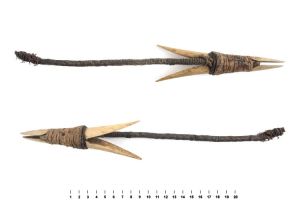
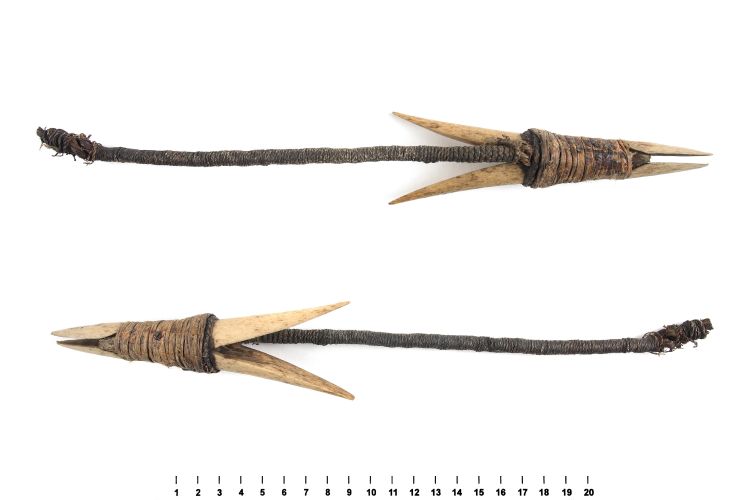
Composite Toggling Harpoon with lanyard.

Composite Toggling Harpoon with lanyard.

This item from the Hunterian Museum in Glasgow traces its provenance provisionally to Captain Cook:

This harpoon head has one large split point, with a curved split socket with pointed tips. It has twisted sinew lashing around the middle and a line of vegetable fibre attached. This type of harpoon would have been used to catch salmon and is stylistically attributable to the Salish people of the North West Coast of America. The harpoon was originally accessioned as donated by Dr. G. Turner, however there are no items from the North West Coast on the 1860 donation list. It may be one of the hooks mentioned by Captain John Laskey in his 1813 account of the museum, in which case it may have been collected on one of the three Pacific voyages of Captain James Cook.

I have to say, I disagree with the description. Based on size alone, at 14 cm for the head, this is much too large to have been for salmon fishing. Stylistically, fish harpoons tend not to have a blade bed, but rather some kind of groove formed by the two valves which supports a cylindrical bone point.  Flat beds such as this one are more consistent with large arming points made of ground slate or ground mussel shell. If intended for a fish, this would be more suitable for Fraser River sturgeon, say.

But I doubt it. I’d suggest in size and manufacture this is much more consistent with a sea mammal harpoon head. I don’t recall seeing any of this size in Coast Salish archaeological sites. If the provenance traces to Laskey and thus to Cook, I’d suggest it is much more likely to be from the Nuu-chah-nulth (Nootka) area of western Vancouver Island, where Cook occupied himself much of the time he spent on the NW Coast proper, and with which it is stylistically consistent. Indeed, even without provenance that is where I would assign it.

And I would suggest in size and manufacture it is more likely to be a large sea mammal – probably whale – harpoon head of a kind we describe out here as “Composite Toggling Harpoons”, composed of two valves forming the barbs with an allowance (usually) for an inset arming point. Something like a sea lion harpoon I would expect to be about 2/3 of this size. Further, Cook never really had much interaction with Coast Salish groups.  These harpoons work by an analogous process to the toggles on a duffel coat: insert the toogle narrow-ways, then it turns side-ways and won’t pull through the loop.  For toggle, read “vicious harpoon” and for loop, read “flesh”.  Because most maritime hunting and fishing technologies require immobilization of the prey and retrieval, the technology tends to quite a bit more complex and intricate and well-engineered than terrestrial hunting technology which is more single purpose (kill!).  The composite harpoons are a great example of this.

Normally too I would expect the valves on one of this size to be made of antler or of wood (yew, or Douglas fir) and not land mammal bone so if these valves are land mammal that is an interesting difference.

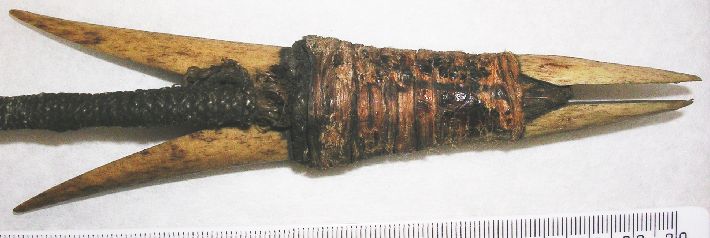
Anyway, all this is by way of saying, it appears the lanyard extends up one side, then crosses through the notch (blade bed) to the other side where it fastens. This would be an interesting functional design aspect encouraging the harpoon head to toggle when tension  is put on the lanyard.  (I emailed the Hunterian to see what they think)
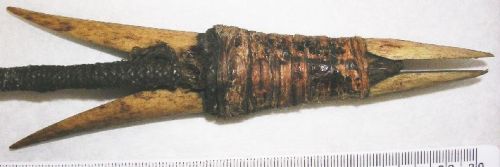
What is that organic matter between the valves? The lanyard?

What is that organic matter between the valves? The lanyard?

Vancouver [Native] Art in the Sixties

GOOGA!

GOOGA!

This 1962 picture of Haida artist Robert Davidson at age 13 caught my eye, not least because he looks a lot like his nephew, Haida archaeologist and great guy Allan “Googa Boy Lefty ClamBone Monica Sunshine” Davidson. Here’s Allan tending to his espresso pot at Richardson Island.  Very shareable.  I am pretty sure this was before I accidentally tossed a grub into his cup.

Maps and Charts at the RBCM

1849 Indian Fort at Cadboro Bay

Indian Fort at Cadboro Bay, 1849

The Royal BC Museum was ahead of the curve in putting significant parts of its collection.  One thing I like is their small but relevant collection of maps and charts.  The 1849 chart inset to the left shows an “Indian Fort” in Cadboro Bay, for example.  There is a good selection of Admiralty Charts from the mid 19th Century, Pemberton’s 1861 map of Victoria (the “Bay” in this section is the real “James Bay”, now landfill under the Empress Hotel , where the bridge shows is now the causeway), and a 1911 map showing the Economic geography of Haida Gwaii (which interestingly includes Sea Otter as part of the fauna “on the west coast” since that species is thought to have been extirpated much earlier).  It is always surprising and sobering to see just how quickly remote areas were divided up and labelled according to their perceived economic value in a way that borders on propaganda, but there is realism too check out the instructions to family men.  Now the bad news: the price of being first is often not being very good.  I suspect when these went online bandwidth was a realy problem.  Each chart is split up into 100kb segments and it is not possible to download the entire thing at once.  The full size images must exist, so how about a quick project at the RBCM to make them downloadable in their entirety?  Same goes for the picture archives.