Tag Archives: First Nations

Society of Ethnobiology Conference: Coming to Victoria

Top notches in a standing western red cedar tree, the result of extracting one or more planks.

Dana sent me a note that the 33rd annual meeting of the Society of Ethnobiology “The Meeting Place: Integrating Ethnobiological Knowledge”, will be held 5–8 May, 2010, in Victoria.I believe some “rockwashy” types are helping out with the organization.  It sounds like a great conference and a chance to build networks between plant people and rock people and bone people – and we sure do need a lot more archaeology of plants out here on the NW Coast, where bones and stones still rule the day.

This year’s conference theme celebrates the potential of ethnobiology to bridge disciplines, ideas, and communities, and to foster an understanding of the connections between the biological and cultural worlds.

In addition to our usual dazzling line up of papers and sessions, here’s a preview of some of the other special events:

  • Wednesday night welcome reception in the First Nations gallery at the Royal British Columbia Museum
  • Special discussion sessions on: Teaching science through ethnobiology, Ethnobiology and ethics, Communicating environmental knowledge through media, Indigenous people’s food systems, and more!
  • Thursday night poster reception at the just opened First People’s House at the University of Victoria
  • Six! fabulous field trip options
  • A banquet of traditional B.C. First Nation’s food followed by a presentation of the Atla’kima “Spirits of the Forest” dance by Kwakwaka’wakw Longhouse dancers

This year’s meetings will be back-to-back with the International Society of Ethnobiology congress in nearby Tofino, B.C., May 9–14.
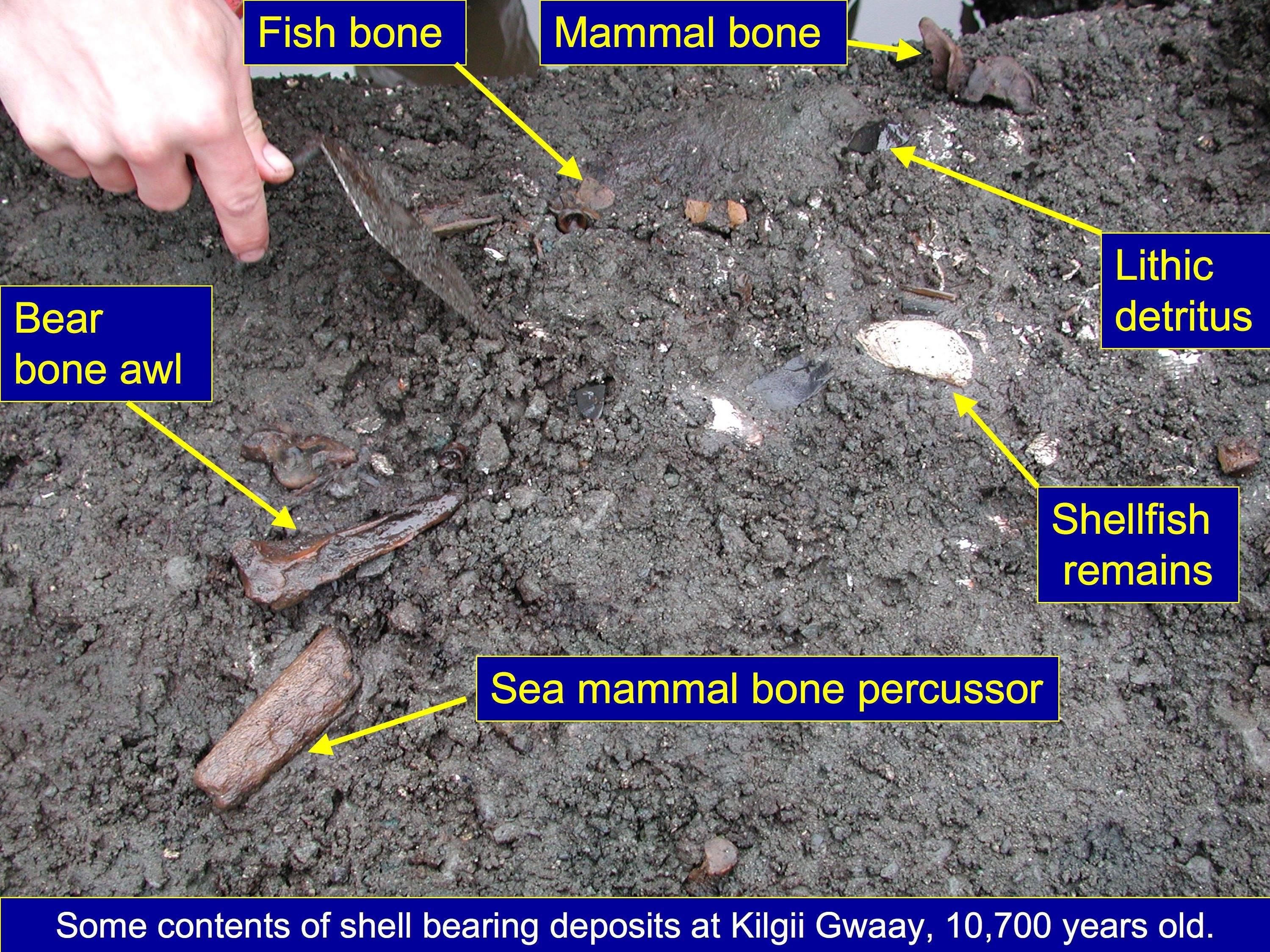
Annotation: Kilgii Gwaay excavations.

Excavation at Kilgii Gwaay, southern Haida Gwaii.

I’ve found that individual powerpoint slides can be saved as JPG images, complete with their annotations.  Since I have a lot of these I may share some.  The above shows excavation in the shell-rich component of the intertidal site at Kilgii Gwaay.  The combination of shellfish remains and saturation in slightly alkaline sea water has produced remarkable preservation for a site which is firmly dated via about 20 carbon samples to 9450 14C BP, or around 10,700 calendar years ago.  In this picture you can see some of the evidence: bone tools, stone tools, and the remains of shellfish, fish and mammals which, together with birds, formed the basis of the diet at this summertime camp.

Continue reading

Raven-Walking & Geological Transformation

Haida History starts at least 14,500 years ago. (Image credit: Daryl Fedje).

Three things we know about Haida Gwaii:

1.  About 14,500 calendar years ago it was a temperate tundra environment, with no trees.  The first trees, pine, appear about 14,000 years ago and there is progressive forest infilling thereafter, with the modern species mixture in place by about 3,000 years ago.

2. It has an impoverished suite of large land mammals – historically, these were limited to black bear, caribou, marten, ermine, a vole and a shrew.  We know that 13,000 years ago there were also deer and brown bear on the islands, and quite likely other species as well.

3.  It used to be much larger than in the present.  With lower sea levels at the end of the last ice age, Hecate Strait was largely dry land, exposing a large, unglaciated, coastal plain that became rapidly flooded.

It seems to me that we can add a fourth thing we know:

Continue reading

New Westminster, 1903

Aboriginal women at New Westminster, 1903.

There is something about the above picture that is so evocative: Native women washing clothes or getting water while in the background the first construction of the Fraser River Bridge at New Westminster rises.  With a different caption this could be the Ganges River, or the Colorado: always women, always squatting, always the back turned to the viewer and the colonial future in the background.

From the idiosyncratic New Westminster online photo archives – this uses the LoC system so you have to search for, say, “Indians” rather than “First Nations”.

New Westminster, ca. 1865

MacLeans: Natives and Suits vs. Environmentalists

Catface (left) and Lone Cone, Clayoquot Sound. Village of Opitsaht in the foreground, Tofino to the right. Source: flickr.

MacLean’s is a magazine that is well past its “use by” date and true to that form they have put up a remarkably provocative and axe-grindy article on economic development in First Nations territories.  Mind you, I think it is entirely true that First Nations want meaningful economic opportunities and I hope they get them.  Some environmentalists seem to think that aboriginal people are noble savages who will play the role of wildlife in parkland.  Leaving aside the MacLeans implicit question of why the hell should they be au naturale when settlers have raped all the rest of the land, the fracture lines between the First Nations and Environmental groups have been clear to me since  I worked on the Meares Island case 20 years ago.  Anyone working on that project could see that the envirnmental movement and the First Nations were going to have a trainwreck at some point in the future.  A balance of park land and economic use is what we should expect on settlement lands.  What right do we have to hold the First Nations to a higher standard than to ourselves? Are the Squamish Nation’s billboards less lovely than Surrey, or North Vancouver, let alone the wasteland that is Squamish itself?  But MacLean’s magazine: way to completely ignore longstanding, demonstrated First Nations stewardship of the land.  That article is a complete waste of 10 minutes of my life, but I am linking to it anyway.

dSpace: The Indian History Film Project

Haida Town of Chaatl. Source: NMC

There is an interesting archive of interview transcripts housed in dSpace at the University of Regina.  Most of the interviews were by CBC Radio’s Imbert Orchard and so share the flaws of Journalism and Anthropology.   The preamble says,

The original intent of The Indian History Film Project was to conduct interviews with First Nations elders across Canada and to produce a television series portraying Canadian history from a First Nations’ perspective.

The Indian History Film Project was an initiative of Direction Films and was conceived and developed by Tony Snowsill. The project leaders were Tony Snowsill and Christine Welsh. The project evolved over time, and eventually it was decided to access libraries and archives across the country to incorporate existing interviews with First Nations elders. All interviews, whether original or archival, were cross indexed by word and theme and housed in the C.P.R.C [Canadian Plains Research Centre].

A number of these interviews are with Haida people, notably Solomon Wilson and Florence Edenshaw, who discussed her arranged marriage, the meaning of Tow Hill, and the artistic tradition of her family, the Edenshaws and Davidsons.  It appears tapes of these are also available through the BC Archives, but not online.

Note: anytime you see (Indian) it means that a Haida word was not transcribed — an eerie effect.  Searching for British Columbia brings up 91 documents.

The following excerpt from an interview with Solomon Wilson of Skidegate sees him relating a tale of smallpox blankets:

Continue reading

Archives of “The Native Voice”

Native Voice banner

2018 edit: it appears the PDFs are now only available through the Internet Archive here.

The Native Voice is the official organ of the Native Brotherhood of British Columbia, an organization which has been active since 1931 and continues to do good work, especially in relation to aboriginal fishing rights, and aboriginal fishers themselves.  The NBBC has put PDF copies of  many editions of the Native Voice online from the years 1947-1955.  These archived issues offer a fascinating glimpse into the the mid-20th century state of First Nations politics, and everyday life besides.

To the right, for example, click on the text image to go to an issue wherein the NBBC riffs (positively, in this case) on  a Ruth Benedict article.

The Dionysians Strike Back

The Dionysians Strike Back

It is rare to see such responses (positive or negative) to the Anthropological Literature. Scroll lower in that article for 1947 ‘News from Ahousat”, a statement on segregation in PRince Rupert cinemas, and an odd “humour” column which seems rather offensive and patronizing in retrospect.    I am looking forward to trawling, or trolling, through these archives as the days go by.  Kudos to the NBBC for not only putting these documents online, but for the excellent, clear digitization — clearly someone took care making these files.