Tag Archives: artifacts

Seward Peninsula Mastodon Tusk – “too old”, therefore Too Old.

Worked 35,000 year old mammoth tusk from Alaska. Note scale! Source: Gelvin-Reymuller et al.

This is getting a little out of the area, but I’ve just run across a report by Gelvin-Reymuller et al.  (download PDF) on the finding of a worked mammoth tusk from the north side of the Seward Peninsula.  That is on the west-central Alaska coast near the closest approach to Asia, and hence smack in the middle of Beringia.  The tusk is interesting in its own right, of course, but doubly so when we see that it was dated to well before the last glacial maximum:

Though the age of the tusk is only peripherally relevant to the significance of the reduction described in this paper, the tusk was sampled for dating. A single bone collagen sample from the tusk was dated by Beta Analytic, Inc. following standard pretreatment and analytical procedures. A 5.2 g of sample was first removed from an inner area, well beneath a surficial treatment of Elmer’s Glue-All which the tusk’s discoverer had initially applied to the surface. The resultant AMS date was 35,150 +/- 530 BP (Beta-189092). …… The latest mammoth remains in mainland Alaska are dated to around 11,400 BP.   Since the age of this tusk places it beyond the range of initial human habitation in the New World, as currently understood, we posit that the tusk was worked by later inhabitants of the area.

The authors note that it is possible to diagnose from the reduction strategies used whether ivory was worked when fresh/green or when already subfossilized,  though curiously they draw no such conclusions about this particular piece.  I find it intriguing how a central Beringian artifact made on a 35,000 year old material is so readily characterized as a recent manufacture.  While this piece would pre-date the earliest known record of extreme NE Asia and while I wouldn’t second-guess the authors nor impugn their motives and while it is certainly possible that a fossil mammoth tusk was worked at a much later date, I’m, uh, just sayin’.   This paper is interesting on a number of levels, not least as an example of stickhandling around competing paradigms.

Detail of working method of Alaskan tusk. Source: Gelvin-Reymuller et al

Mt. Rainier Archaeology

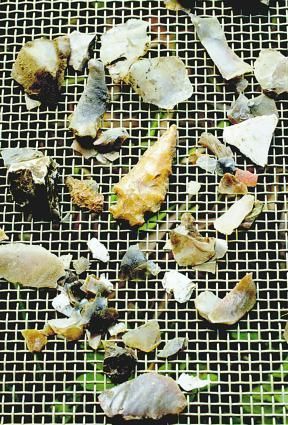
Some artifacts from Mt. Rainier. Source: Tacoma News-Tribune.

The Tacoma News-Tribune has a nice story about high-altitude archaeology on the flanks of Mt. Rainier.  Sites date back to over 9,500 cal.BP (presumably cal. BP, that is) and some include microblade technology.  If I read the article right, the microblade component dates to about 7600 years ago.  There is an older report on Mt. Rainier archaeology here by Greg Burtchard, but it seems this recent work is what has produced the older dates.  It’s also very intriguing to see ancient “cooking pits” including some that the authors suggest were continuously used for the full 9,600 years of occupation:

The site has also produced other ash evidence, coming from cooking pits.

“They’re small and not elaborate, but pretty clearly they were cooking with hot stones. But I don’t know what they were cooking,” Mierendorf said. “That implies more than just traveling through the area.

“These are repeatedly used, including one individual pit used and reused for all 9,600 years. I’ve never seen anything like that in 40 years of professional archaeology.”

It’s good to see work done in the higher elevations, and is reminiscent of Rudy Reimer‘s more theoretically-driven  work in the highlands of Squamish territory. It will be great to see if there is a full report put out soon so I can see the microblades and the cooking pits – if it is put on the web like the earlier report, so much the better!

Pitt Rivers Museum Haida Collection on flickr.com

Any idea what activity is being represented on this Haida argillite carving?

The Pitt Rivers Museum in Oxford is one of the world’s great ethnological museums.  Indeed, it is largely presented as a “museum of a museum”, with artifacts and curios displayed in glass cases in juxtapositions that made sense to anthropologists.  Now I see they are putting some of their collection online – one of many interesting innovations going on at that museum.  The Haida Collection which Cara Krmpotich has worked on consists of 200 really well composed and lit photos on the flickr.com website.  Cara notes that she hopes making this material available in this manner will facilitate its use by Haida people and I expect they will (indeed one person with a Haida name has been commenting on some of the photos).  Coincidentally, I see there has recently been a Haida delegation to the Pitt-Rivers museum.

In any case, the flickr set is a fantastic set of images of Haida art and technology. It would be nice to have the full catalogue information or other information associated with these, or at least a statement that such information is lacking.  While there are visually spectacular items throughout the set, also check these plain spoons from SGang’gwaay, Tanu’uu and Masset,  this bird bone whistle, and this tidy little loop of twine.

Haida wooden labret at Pitt Rivers museum.

Argillite Beaver

Haida argillite pipe representing the SS Beaver. Photo: University of Aberdeen.

The SS Beaver was a prominent early side-wheel trading ship on the NW Coast.  Nice to see it memorialized by Haida argillite pipe in the Marischal Museum collection of the University of Aberdeen, along with some other exceptional Haida pipes.  Apparently donated to the museum by the former Captain of the SS Beaver, William Mitchell, this pipe sports a rotating side wheel carved from whale bone, a beaver figurehead, and someone peeking out of the cabin windows, perhaps Capt. Mitchell himself who probably commissioned this carving.  Some other close ups (in an awkward zoomable interface) are  available on the Scots and Aboriginal People in the Fur Trade site.  More on the SS Beaver here.

A figure looking out the window of the SS Beaver pipe.

Cache of Celts

tongass stone tools

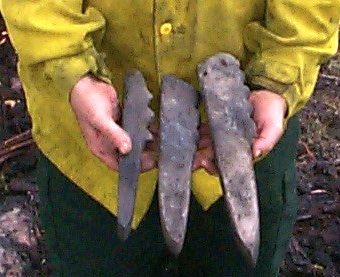
Cache of stone woodworking tools found in Tongass National Forest

So maybe I am obsessed with ground stone celts, who isn’t, but nonetheless I liked this story of the lucky discovery of a cache of large pecked and ground stone woodworking tools in Tongass National Forest in the Alaska Panhandle.   The  article claims the hafting grooves are finger grips, which I think is unlikely.  More likely these are from elbow adzes, such as this one.

tongass stone tools detail


The Brooklyn Museum Collection

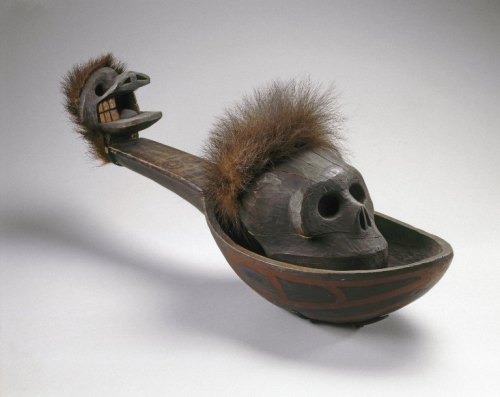
Tsimshian Skull "Helmet".  Click for higher resolution.

Tsimshian Skull "Helmet". Click for higher resolution.

Of all places, the Brooklyn Museum has amassed an impressive suite of NW Coast artifacts and art.  Their online catalogue is mainly lodged under the  “research” and “collections” tabs.  One interesting thing about this collection is that any viewer can ‘tag‘ a picture, building up a folk taxonomy that cross-cuts more traditional museum categories.  This has its advantages of course (e.g., items which are tagged “beards“, or “scary“), but also raises questions about just how comprehensive is any set of results?  And how accurate – this rattle is tagged Tsimshian despite being collected in Bella Bella (Heiltsuk territory).  Still, with a grain of salt it is an idea definitely worth pursuing.  You can also click around on their “visible storage” map.  The images are decent resolution and combined with the tag-surfing possibilities this is a fun and informative site.

Heiltsuk Ladle with Skull. Click for larger resolution.

Heiltsuk Ladle with Skull. Click for larger resolution.

NW Coast Objects in Madrid

Tlingit adze with quillwork and copper insets in the Museo de América, Madrid.

Tlingit adze with quillwork and copper insets in the Museo de América, Madrid.

Even though the Spanish were among the first outsiders to eplore the NW Coast, you don’t hear much about collections they may have made while out here.  So it is welcome to see this (now, 10 year old) writeup on NW Coast items in Madrid’s Museo de América.  The article suggests that many such objects were collected but not retained in Royal Collections, perhaps because they were considered inferior to, say, Aztec and Inka pieces.  Either way, there are some spectacular objects illustrated in the article, though the photographs are not very sharp at all.

Going to the Museo de América’s website shows they have a search function and some online thumbnails.  This link should take you to their 52 pieces labelled as NW Coast, while this takes you to six pieces listed as from BC.   Most of the illustrations are extremely low resolution, though I found one or two which aren’t such as the outstanding Haida waterfowl, below.  Look how fluid the form-line rendering is in this 18th century piece.  Click the images on the Museo site for slightly higher resolution or go to the records page by clicking on “Ficha Completa” and then on “Ampliar Imagen”, where you can zoom in slightly using the magnifying glass.  Also worth checking out, this Tlingit clap-board style “rattle”, this foreshaft and point, and this rather spectacular hat.  Anyway, something to poke more: online catalogues in Spanish Museums.

EDIT:  I see their search function makes links to search results expire after a short time so I crossed them out, above.  Pretty lame, but there you go.  Get into the system via the generic system and then browse around, if you want.

18th Century Haida Waterfowl.

18th Century Haida waterfowl, listed as made from"Ivory".

Harpoon Head from the Hunterian

I have to say, I disagree with your description.  Based on size alone, at 14 cm this is much too large to have been for salmon fishing.  Stylistically, fish harpoons tend not to have a blade bed, but rather some kind of cylinder formed by the two valves.  Flat beds such as this one are more consistent with large arming points made of ground slate or ground mussel shell.  If intended for a fish, this would be more suitable for Fraser River sturgeon, say.
But I doubt it.  I’d suggest in size and manufacture this is much more consistent with a sea mammal harpoon head.  I don’t recall seeing any of this size in Coast Salish archaeological sites.  If your provenance traces to Laskey and thus to Cook, I’d suggest it is much more likely to be from the Nuu-chah-nulth (Nootka) area of western Vancouver Island, where Cook occupied himself much of the time he spent on the NW Coast proper, and with which it is stylistically consistent.  Indeed, even without provenance that is where I would assign it.  And I would suggest in size and manufacture it is more likely to be a large sea mammal – probably whale – harpoon head of a kind we describe out here as “Composite Toggling Harpoons”, composed of two valves forming the barbs with an allowance (usually) for an inset arming point.  Something like a sea lion harpoon I would expect to be about 2/3 of this size.   Further, Cook never really had much interaction with Coast Salish groups.
Normally too I would expect the valves on one of this size to be made of antler or of wood (yew, or Douglas fir) and not bone so that is an interesting difference.
Anyway, all this is by way of saying, it appears the lanyard extends up one side, then crosses through the notch (blade bed) to the other side where it fastens.  I’d be interested in knowing if this is the case since it would be an interesting functional design aspect encouraging the harpoon head to toggle when pressure is put on the lanyard.  If you had higher resolution pictures I would love to see them.
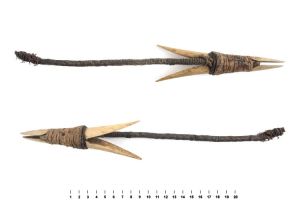
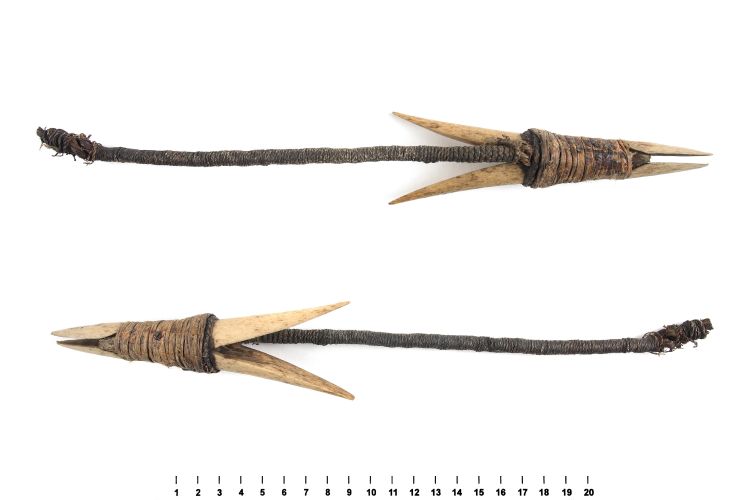
Composite Toggling Harpoon with lanyard.

Composite Toggling Harpoon with lanyard.

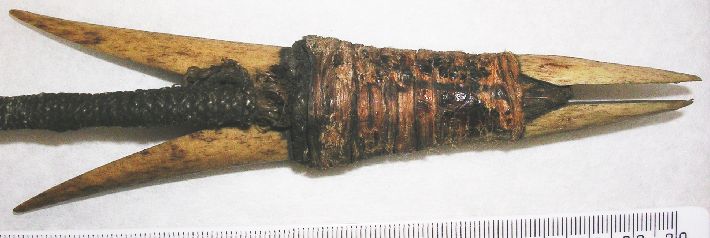
This item from the Hunterian Museum in Glasgow traces its provenance provisionally to Captain Cook:

This harpoon head has one large split point, with a curved split socket with pointed tips. It has twisted sinew lashing around the middle and a line of vegetable fibre attached. This type of harpoon would have been used to catch salmon and is stylistically attributable to the Salish people of the North West Coast of America. The harpoon was originally accessioned as donated by Dr. G. Turner, however there are no items from the North West Coast on the 1860 donation list. It may be one of the hooks mentioned by Captain John Laskey in his 1813 account of the museum, in which case it may have been collected on one of the three Pacific voyages of Captain James Cook.

I have to say, I disagree with the description. Based on size alone, at 14 cm for the head, this is much too large to have been for salmon fishing. Stylistically, fish harpoons tend not to have a blade bed, but rather some kind of groove formed by the two valves which supports a cylindrical bone point.  Flat beds such as this one are more consistent with large arming points made of ground slate or ground mussel shell. If intended for a fish, this would be more suitable for Fraser River sturgeon, say.

But I doubt it. I’d suggest in size and manufacture this is much more consistent with a sea mammal harpoon head. I don’t recall seeing any of this size in Coast Salish archaeological sites. If the provenance traces to Laskey and thus to Cook, I’d suggest it is much more likely to be from the Nuu-chah-nulth (Nootka) area of western Vancouver Island, where Cook occupied himself much of the time he spent on the NW Coast proper, and with which it is stylistically consistent. Indeed, even without provenance that is where I would assign it.

And I would suggest in size and manufacture it is more likely to be a large sea mammal – probably whale – harpoon head of a kind we describe out here as “Composite Toggling Harpoons”, composed of two valves forming the barbs with an allowance (usually) for an inset arming point. Something like a sea lion harpoon I would expect to be about 2/3 of this size. Further, Cook never really had much interaction with Coast Salish groups.  These harpoons work by an analogous process to the toggles on a duffel coat: insert the toogle narrow-ways, then it turns side-ways and won’t pull through the loop.  For toggle, read “vicious harpoon” and for loop, read “flesh”.  Because most maritime hunting and fishing technologies require immobilization of the prey and retrieval, the technology tends to quite a bit more complex and intricate and well-engineered than terrestrial hunting technology which is more single purpose (kill!).  The composite harpoons are a great example of this.

Normally too I would expect the valves on one of this size to be made of antler or of wood (yew, or Douglas fir) and not land mammal bone so if these valves are land mammal that is an interesting difference.

Anyway, all this is by way of saying, it appears the lanyard extends up one side, then crosses through the notch (blade bed) to the other side where it fastens. This would be an interesting functional design aspect encouraging the harpoon head to toggle when tension  is put on the lanyard.  (I emailed the Hunterian to see what they think)
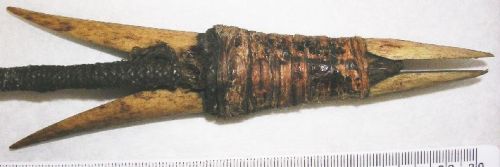
What is that organic matter between the valves? The lanyard?

What is that organic matter between the valves? The lanyard?

dSpace: Labrets by Marina La Salle

Tlingit Woman with Labret, Yakutat 1837

Tlingit Woman with Labret, Yakutat 1837

Labrets, decorative inserts worn in the lip, are an extraordinary artifact type.  It is hard to think of a more intimate or personal artifact, or at least, one that is routinely found.  Further, archaeologists have seized on labrets as status markers and routinely use them for interpretive ends.  Indeed, they are seen as a sign of “achieved status”, since one could (in theory) start wearing a labret at any age, and this has been contrasted with cranial head deformation, which must be initiated in infancy.  This distinction has been claimed to characterize the Locarno Beach to Marpole transition about 2000 years ago in the Salish Sea, for example.   And yet, for all the talk about them, they have languished through the years with only small reports and descriptive accounts of small collections given (an exception after a fashion is Grant Keddie’s catalogue of them downloadable here).  So it is very welcome to see a 2008 UBC MA thesis on labrets by Marina La Salle (4 meg PDF; click on “view/open” near the bottom of the page).  Moreover, this is a thesis which treats them with a suitable dose of social theory and strives for subtlety and nuance vs. the  over-determination of status so often seen in NW Coast Archaeology..

From La Salle 2008 MA Thesis

From La Salle 2008 MA Thesis

Apart from some solid work on their metric dimensions, typology, and a documentation of the astonishing variety of raw materials used to make labrets, there is also welcome and innovative discussion of identity formation and the negotiation of status as active, cultural processes.  This contrasts with earlier studies or casual reference to labrets as simplistic and unambiguous markers of status, worn non-problematically and being basically a badge of identification vs. a negotiable brand.  I wish La Salle had done a few small things, such as always give the artifact numbers in figures and table, and give repositories where possible (follow up work is made so much easier), and her colourful tables are entirely inscrutable, but I credit her very much with taking a fresh approach to an important, perhaps crucial artifact type.  She has a lot to say and I sense a certain frustration (or maybe this is just projection) with UBC’s restrictive 50 page limit on MA theses.  This thesis checks in at over 200 pages anyway, but a limited space for discussion of a lot of data.  Does this mean that MA students now produce more data than they can use and is this a kind of serfdom?  Discuss.

University of Washington Digital Collections

Makah codfish spear (or, more accurately, harpoon)

Makah codfish spear (or, more accurately, harpoon)

The University of Washington has a superb digital collection online, transcending all kinds of different historical, archaeological and popular culture niches.  Searching on “artifact” brings up some 583 images (some of which are links to text etc).  These are downloadable and have stable URLs to which one can link. The resolution could be higher, but the pictures are sharp and clean, at least for those ones they have apparently taken themselves, and they don’t plaster watermarks all over them.  Good work.  The amount of metadata is impressive, and the fact that is is clickable renders this site a fantabulous timewaster of the highest order.  To the left, I was just having a discussion with a student about harpooning fish.  I am under the impression that harpoons were used on large lingcod – after the lingcod were lured to the surface using a cunning little shuttlecock-shaped rising float.  This picture is labelled “Makah codfish spear” though it is self-evidently a harpoon and lanyard.  More (vindication) coming from this excellent site as time goes by.