dSpace: Lundy on Rock Art

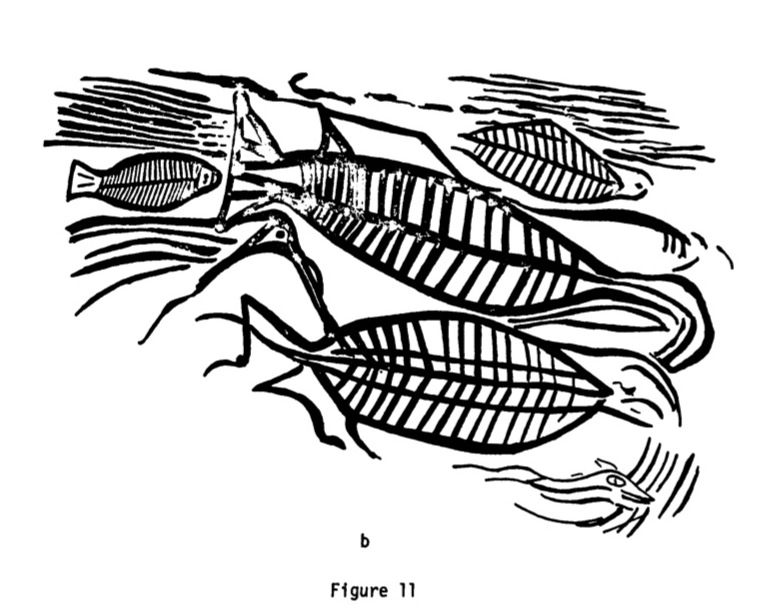
Salmon Petroglyph at Jack Point. From Lundy (1974: 111)

There is a wonderful trend of institutions putting old, grey literature online.  One widely used platform  for doing this is called “dSpace”, though the approach exists under other names.  Some of the best of this material are graduate theses and dissertations.  These are freely available if you walk into the University library, but may be essentially unavailable in any other form.  Unlike a lot of digital initiatives, the majority of these are not limited to students and faculty, but can be accessed by anyone – provided you know they are there.  Consider Doris Lundy’s monumental MA thesis on NW Coast Rock Art, obtained in 1974 from SFU.  Most of this 350+ page thesis was never published in any form.  Now you can download the whole thing from SFU (4 meg PDF). Despite being a rocky scan, the entire text is searchable.  There is some digital protection applied but I found it simple to save a copy to my hard drive.  The image to the left is the famous salmon petroglyph at Jack Point near Nanaimo in Snuneymuxw territory.  This is the petroglyph that would be painted with ochre and adorned with eagle down by ritualists if the salmon runs were late or meagre – one of the only such works which has specific beliefs recorded for it.

Let me know if you have problems downloading this: it works for me on and off campus, so I presume anyone can do it.
Annotate This

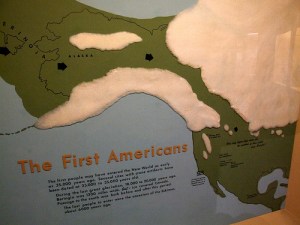
Surely they could have painted a mammoth on this somewhere.....

Surely they could have painted a mammoth on this somewhere.....

Flickr usr Travis S. does a nice, understated job of annotating this hilarious reconstruction of the “Ice Free corridor” from the Santa Barbara Museum of Natural History.  Click on the image to go to the original.  This picture pretty much sums up the absurdity of the Ice Free corridor — magical parting of the white sea while the coast is socked in under a mile of solid fog.  Funny how such reconstructions were made before serious geological investigation of their truth content, and funnier still how archaeologists just slurped up the ice free corridor as the answer to their need to get the FIRST AMERICANS (nevar forget!)  into Wyoming, well,  first.

Crafting an Antler Harpoon Point

Amy Margaris has a nice video online showing the making of a replica barbed bone point, typical of ones used by the Alutiiq People of Alaska’s Kodiak archipelago.  There are lots of flint knapping videos on the web but this is one of the only bone/antler ones I have come across, at least for this area. Shethen  illustrates the different properties of organic materials by hurling them from buildings, which is a nice touch. Following Dr Margaris’ links takes us to the Alutiiq Museum website, which is a very well done set of pages, informative and up to date, covering everything from collections management to repatriation and reburial to mini-reports on digs such as the well-illustrated one at Horseshoe Bay.  My only complaint is, Alutiiq web site folks: don’t bother with the little flash gizmo to make the pictures pop up, they are annoying. They are doubly annoying when the pop-up picture is no bigger than the thumbnail!  What is wrong with people putting these tiny thumbnails up and restricting access to anything finer — you are selling your own research short and making it less likely your website will be visited via links.  If it goes on the web, it is implicit you want people to know, so can the obfuscation and speak in your very best voice!


Leland Gilsen’s Archaeology of Oregon

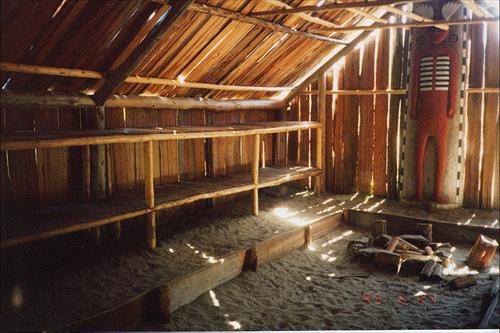
Replica of a Clatsop House.

Replica of a Clatsop House.

Leland Gilsen, former State Archaeologist of Oregon has a pretty impressive website.   His extensive notes on aboriginal house styles are particularly worth a read — well referenced, well illustrated, and thoughtful, and he reproduces a lot of plan diagrams from the grey literature.  He also has good pages on “pyroculture” (deliberate landscape burning), and extensive notes and commentary on culture history, through a culture-ecological lens.  His image-rich virtual museum is a fun and educational slideshow.  Hmmm, someone should do a site like this for BC, or Vancouver Island at least.  Dr. Gilsen seems like a proud processualist of the Arizona school (not that there’s anything wrong with that) and a serious scholar.  At first glance, this web site could easily be used as an undergraduate textbook for a course on the Archaeology of Oregon.  Hats off, if I see you at NWAC, first beer is on me.

Canadian Archaeocryptozoology

Inexplicably, the Canadian Zooarchaeology website is hosting some pro-creationist articles, as well as lively topics such as “Calgary is in Canada” and “Memories of Canada” (cached version).  It looks like some very odd genre of comment spam, but appears to have been approved by the webmaster over there.  You’d think it was random, especially as they spell it “Canadian Zoo Archaeology”, but then there are actual archaeology pictures there as well.  The whole thing is suspicious, since CZ has a webpage just down the hall, so to speak.  You wouldn’t think there would be anything in it to spoof such a small organization.

The Marmes Rockshelter Site

View out of the Marmes Rockshelter site.

View out of the Marmes Rockshelter site.

The Marmes rockshelter in eastern Washington State (map) is one of the oldest and most significant archaeological sites in NW North America. In its inundation by reservoir waters, it is also one of the sadder stories.  Washington State University has put a large amount of Marmes material online, including several photo galleries of work in progress.

The site was found in the early 1950s on land owned by Roland “Squirt” Marmes (pronounced “Mar-muss”)  a local rancher, but it wasn’t until 1962 that a large scale excavation commenced.

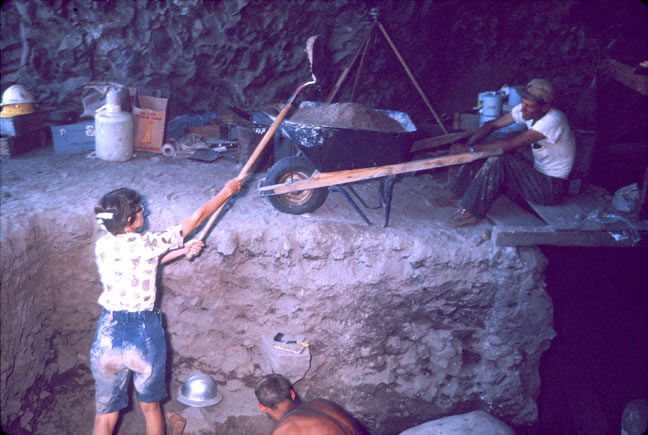
Shovel Bums of the Old School

Shovel Bums of the Old School

In soon order, there was a series of sensational finds of artifacts, fauna and human remains.  The oldest of these dated to 10,750 radiocarbon years ago, or, about 12,700 solar years ago.  At the time, these were the oldest human remains known from the Americas, and the artifacts represented one of the oldest known sites and one that was, interestingly, markedly different from the Clovis Culture type especially in the number and style of large, stemmed projectile points.  Among the other artifacts were distinctive crescentic stone blades, this exquisite bone needle, beads made of Olivella shell, which must have come from the Pacific Ocean.    HistoryLink.org, Washington State’s online encyclopedia, has a good summary article, and the WSU links above also give much more detail.  Indeed, WSU has been doing some wonderful digitization of old projects, which I will highlight in posts to come.  Things I have learned include the ubiquity of pipe smoking in the earlier days of Washington Archaeology.  My only criticism of this wonderful resource is the lack of captions on the photo galleries.  Who are these people, for example; who is under these splendid war bonnets?  Take a moment to tell us in a caption, or the file name.

The story of the inundation of the site by rising river impoundment is also of interest. Continue reading

Archives of “The Native Voice”

Native Voice banner

2018 edit: it appears the PDFs are now only available through the Internet Archive here.

The Native Voice is the official organ of the Native Brotherhood of British Columbia, an organization which has been active since 1931 and continues to do good work, especially in relation to aboriginal fishing rights, and aboriginal fishers themselves.  The NBBC has put PDF copies of  many editions of the Native Voice online from the years 1947-1955.  These archived issues offer a fascinating glimpse into the the mid-20th century state of First Nations politics, and everyday life besides.

To the right, for example, click on the text image to go to an issue wherein the NBBC riffs (positively, in this case) on  a Ruth Benedict article.

The Dionysians Strike Back

The Dionysians Strike Back

It is rare to see such responses (positive or negative) to the Anthropological Literature. Scroll lower in that article for 1947 ‘News from Ahousat”, a statement on segregation in PRince Rupert cinemas, and an odd “humour” column which seems rather offensive and patronizing in retrospect.    I am looking forward to trawling, or trolling, through these archives as the days go by.  Kudos to the NBBC for not only putting these documents online, but for the excellent, clear digitization — clearly someone took care making these files.

Heritage Burnaby

Ground stone wants to be flaked stone.

Ground stone wants to be flaked stone.

Billing itself as “personal history – collective memory”, the Burnaby Archives is a professionally presented and slick website.  As usual, the parochial frame extends only to non-aboriginal settlement.  Curious about whether the land on which Burnaby sits was occupied in more ancient times?  Well, they do link to 42 objects associated with aboriginal people.  Wondering if there might still be aboriginal people there today?  I couldn’t find anything.  I sure wish small town archives, and not so small ones as well, would wake up to the millennia of history under their feet.  Time did not start in 1892, Burnaby, much as some might like to think it did.  Or maybe it is just the prominent epigraph this site cites:  History is made with documents. Documents are the imprints left of the thoughts and the deeds of the men of former times. For nothing can take the place of documents. No documents, no history*.

No archaeology means a big honking hole in history, we might add, a hole shaped like colonial guilt.

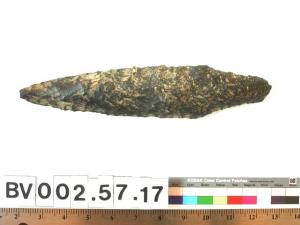
Elongate contracting stem point from Burnaby.

Elongate contracting stem point from Burnaby.

Having said that, two unusual artifacts are illustrated on their site.  Above left is a very distinctive ground stone point with a zig-zag motif.  I don’t recall seeing another one like it.  It almost appears to be a ground stone point designed to resemble a flaked stone point, something of a skeuomorph.   To the right is an elongate, contracting stem  flaked point or “dagger” that  appears to be about 14cm in length.  In size and appearance it is not the most common artifact in the world.

PS: Heritage Burnaby — your web site is nice and all, but breaking direct links to pictures is pretty lame.  Has there been that much bandwidth from hot-linked pictures?  Or are you so possessive about these artifacts you hold in trust for the Stó:lô, Musqueam, and Tsleil-Waututh First Nations?  Higher resolution would be nice as well — surely you have more than 72 dpi, 30 kb versions already taken?

* Incongruously cited as, “Charles Seignobos, Histoire de la civilisation contemporaine (1920). Translated by Eamon de Valera in a letter from prison to his personal secretary enjoining her to safeguard his papers.”

Fieldwork Picture of the Day 8

black bog abbey road

John, Walrus, George and the Sandhill Crane

In which we do our best impression of the Beatles Abbey Road cover on Porcher Island (map).  Lining up like this was necessary because the surface of this bog was so mucky we had to dismantle an old grow-op to make a trail across the surface (yes, we then dismantled our trail).  This bog is a few metres  above sea level, but quite quickly down in the core sample there was a clear break to marine sediments, showing sea level had once been higher than today and then dropped to or past modern.  Carbon dating a piece of sediment from the interface showed sea level had fallen past this point by  10,000 years ago.

Terrestrial (left) overlay marine (right) sediments.

Terrestrial (left) overlay marine (right) sediments.

The picture to the right shows the core sample, with the clear distinction made between the brown, terrestrial, pond deposits to the left (upper) side of the core) while in the right (lower, older) part of the core you can see the sediments turn to a greenish marine clay, which contained small shell fragments and salt-water diatoms.  Taking a number of these core samples from different elevations (and therefore of preumptively different dates of sea level change) allows us to stitch together a curve or graph of sea-level history.  Using this curve, we can then identify ancient coastlines (both underwater and above high tide) with greater certainty and accuracy, allowing for more efficient and productive archaeological survey on these ancient landforms.  On the map linked above, you can see the long linear lakes and ponds paralleling the modern shoreline.  These lakes highlight the former  eastern shores of  Oval Bay at higher sea levels.

Aboriginal history a la mode.

Being a mere archaeologist and not a sophisticated type, I like to reduce complex topics to simplistic graphs.  I showed this one to the first class of my new course on the Archaeology of BC.     The numbers for this are based on the emerging 13,000+ (calibrated) year old archaeological finds in Haida Gwaii,  so I expect the red slice to keep on growing.

If I were a paranoid type, I’d liken it to Pac-Man just getting his teeth into a ghost.

Reverse the colours to get the relative number of BC historians vs BC archaeologists in Universities – though I am all for historical archaeology as well, not to mention history, and BC history in particular.   All really good things.  But it is striking nonetheless to consider how weighted we are institutionally towards  the green slice.  As I said to the students, hearing the BC government natter on obsessively on the radio and in newspaper ads last year about the “150th Anniversary of British Columbia” just made my blood boil every time.  Seriously, Premier, do you want a new relationship with First Nations?  How about acknowledging the red slice of pie?  How about a celebration of 130 centuries of BC history?  Call off the government lawyers and other PR flacks who seem to think the world began 150 years ago.

While we are on the topic of letting the facts speak in the tongue of numbers,  where I work, the ratio of BC archaeology faculty members to all regular faculty members = 1:800.  As the kids say, Hello?

PS: Archaeologists are quintessentially “shovel ready” so maybe some stimulus money goes well with pie.  Try it.