New Westminster, 1903

Aboriginal women at New Westminster, 1903.

There is something about the above picture that is so evocative: Native women washing clothes or getting water while in the background the first construction of the Fraser River Bridge at New Westminster rises.  With a different caption this could be the Ganges River, or the Colorado: always women, always squatting, always the back turned to the viewer and the colonial future in the background.

From the idiosyncratic New Westminster online photo archives – this uses the LoC system so you have to search for, say, “Indians” rather than “First Nations”.

New Westminster, ca. 1865

Somenos Creek: Update

Somenos Creek site. Picture this with 20 houses on it. Photo credit: anonymous.

Further to my post below, here is another news item on the Somenos Creek (Cowichan Valley) situation.  It mostly rehashes the Times-Colonist piece but does have new comments from Eric and from the developer, notably:

Schmidt, who has tried but failed to have the six-acre site, known as Lot B, rezoned for development, said it would be worth up to $3 million if it weren’t for the presence of the artifacts and burial site.

Timbercrest has built about 300 homes on the land so far and would like to put up another 20 on Lot B.

So, lets see 20/300 = 6.7% of the 100 acres.  The 100 acres was bought in the 1970s.  I am going to go out on a limb and suggest that much less than 1 million was paid for the 100 acres back then.  The current valuation of these six acres would value the entire parcel at 45 million.  Let’s halve that:m 22 million.

So this developer has turned a one million dollar piece of land into a 20 million dollar piece of land.  A 2000% return.  And he wants financial consideration and compensation from the public because he happens to have a legally-protected (and morally protected, I might add) site of the highest archaeological significance on the residual piece?

This is the 21st century: Greed is no longer good, Timbercrest Estates Ltd.  Give the land up, get a tax writeoff, and count your blessings you live in a country that is so extremely friendly to rampant development of land, enabling fortunes to to be made.

Mechanical representation in a Haida Pipe

Haida Pipes, 1837. From U. Washington Collection.

I don’t know much about these early historic Haida argillite pipes.  These ones are illustrated in Edward Belcher’s Narrative of a voyage round the world, 1843, v.1, p. 309.  The lower one captured my attention, with its representation of a conveyor belt (?!) – or, more likely, a block-and-tackle/pulley setup.  The playful seriousness of these pipes is astounding – as can be seen in my earlier post on the SS Beaver pipe.  I would like to see a photograph of this one but I have no idea where it may have ended up.

The image is via the superb University of Washington Digital NW collections.

MacLeans: Natives and Suits vs. Environmentalists

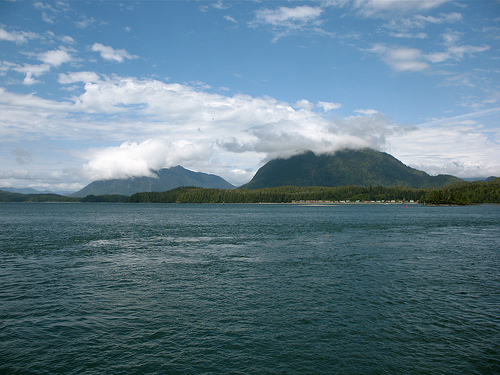
Catface (left) and Lone Cone, Clayoquot Sound. Village of Opitsaht in the foreground, Tofino to the right. Source: flickr.

MacLean’s is a magazine that is well past its “use by” date and true to that form they have put up a remarkably provocative and axe-grindy article on economic development in First Nations territories.  Mind you, I think it is entirely true that First Nations want meaningful economic opportunities and I hope they get them.  Some environmentalists seem to think that aboriginal people are noble savages who will play the role of wildlife in parkland.  Leaving aside the MacLeans implicit question of why the hell should they be au naturale when settlers have raped all the rest of the land, the fracture lines between the First Nations and Environmental groups have been clear to me since  I worked on the Meares Island case 20 years ago.  Anyone working on that project could see that the envirnmental movement and the First Nations were going to have a trainwreck at some point in the future.  A balance of park land and economic use is what we should expect on settlement lands.  What right do we have to hold the First Nations to a higher standard than to ourselves? Are the Squamish Nation’s billboards less lovely than Surrey, or North Vancouver, let alone the wasteland that is Squamish itself?  But MacLean’s magazine: way to completely ignore longstanding, demonstrated First Nations stewardship of the land.  That article is a complete waste of 10 minutes of my life, but I am linking to it anyway.

Heather Pringle: Dogs for the Dead

Smell a corpse, not smell like one, Arbuthnot.

B.C.’s own Heather Pringle has a new blog these days, and her recent post on the use of forensic dogs to detect archaeological sites and human remains in particular, in Washington State, is worth a read:

According to the staff at the Institute for Canine Forensics, dogs can smell human remains that are buried as much as nine feet below the surface.  And they can detect remains as old as 2000 years.  ”Human remains have a scent that never,  ever goes away,  especially a bone,  even after it dries out,” one of the institute’s staff members told The Peninsula Daily News.

dSpace: The Indian History Film Project

Haida Town of Chaatl. Source: NMC

There is an interesting archive of interview transcripts housed in dSpace at the University of Regina.  Most of the interviews were by CBC Radio’s Imbert Orchard and so share the flaws of Journalism and Anthropology.   The preamble says,

The original intent of The Indian History Film Project was to conduct interviews with First Nations elders across Canada and to produce a television series portraying Canadian history from a First Nations’ perspective.

The Indian History Film Project was an initiative of Direction Films and was conceived and developed by Tony Snowsill. The project leaders were Tony Snowsill and Christine Welsh. The project evolved over time, and eventually it was decided to access libraries and archives across the country to incorporate existing interviews with First Nations elders. All interviews, whether original or archival, were cross indexed by word and theme and housed in the C.P.R.C [Canadian Plains Research Centre].

A number of these interviews are with Haida people, notably Solomon Wilson and Florence Edenshaw, who discussed her arranged marriage, the meaning of Tow Hill, and the artistic tradition of her family, the Edenshaws and Davidsons.  It appears tapes of these are also available through the BC Archives, but not online.

Note: anytime you see (Indian) it means that a Haida word was not transcribed — an eerie effect.  Searching for British Columbia brings up 91 documents.

The following excerpt from an interview with Solomon Wilson of Skidegate sees him relating a tale of smallpox blankets:

Continue reading

La Brea Woman: Image Controversy

La Brea Woman forensic reconstruction.

I came across this interesting article chronicling an emerging controversy in Los Angeles.  I never knew that human remains had been found in the La Brea tar pits, but a partial skeleton of a young female had been on display until recently in the George C. Page Museum there.  At some point, a museum  volunteer made forensic-style reconstructive drawings of this young woman.  Now the museum is trying to prevent their publication, a move which some claim is designed to help prevent their repatriation.

Are illustrations of human remains tantamount to display of the human remains themselves?  Is the display of a cast any different?  The forensic reconstructionist apparently used the cast, not the actual skull. But consider the process of making a cast: is not that a greater insult to the dead than merely handling their bones would be?  In any case, these forensic reconstructions contain a little too much interpretive latitude: consider the Kennewick man reconstruction whose resemblance to Patrick Stewart has done nothing to quell the notion Kennewick man was ‘Caucasian’. Further, the forensic reconstructions include disturbing “cutaways” revealing the reconstructive process and producing an otherworldly, inhuman appearance (see below).

Continue reading

Seward Peninsula Mastodon Tusk – “too old”, therefore Too Old.

Worked 35,000 year old mammoth tusk from Alaska. Note scale! Source: Gelvin-Reymuller et al.

This is getting a little out of the area, but I’ve just run across a report by Gelvin-Reymuller et al.  (download PDF) on the finding of a worked mammoth tusk from the north side of the Seward Peninsula.  That is on the west-central Alaska coast near the closest approach to Asia, and hence smack in the middle of Beringia.  The tusk is interesting in its own right, of course, but doubly so when we see that it was dated to well before the last glacial maximum:

Though the age of the tusk is only peripherally relevant to the significance of the reduction described in this paper, the tusk was sampled for dating. A single bone collagen sample from the tusk was dated by Beta Analytic, Inc. following standard pretreatment and analytical procedures. A 5.2 g of sample was first removed from an inner area, well beneath a surficial treatment of Elmer’s Glue-All which the tusk’s discoverer had initially applied to the surface. The resultant AMS date was 35,150 +/- 530 BP (Beta-189092). …… The latest mammoth remains in mainland Alaska are dated to around 11,400 BP.   Since the age of this tusk places it beyond the range of initial human habitation in the New World, as currently understood, we posit that the tusk was worked by later inhabitants of the area.

The authors note that it is possible to diagnose from the reduction strategies used whether ivory was worked when fresh/green or when already subfossilized,  though curiously they draw no such conclusions about this particular piece.  I find it intriguing how a central Beringian artifact made on a 35,000 year old material is so readily characterized as a recent manufacture.  While this piece would pre-date the earliest known record of extreme NE Asia and while I wouldn’t second-guess the authors nor impugn their motives and while it is certainly possible that a fossil mammoth tusk was worked at a much later date, I’m, uh, just sayin’.   This paper is interesting on a number of levels, not least as an example of stickhandling around competing paradigms.

Detail of working method of Alaskan tusk. Source: Gelvin-Reymuller et al

Somenos Creek CRM

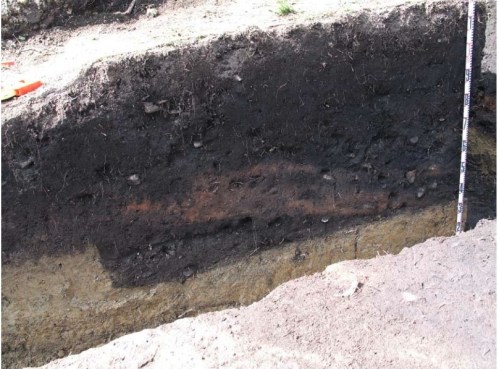
Diagonal exposure of apparent 2000 BP house at Somenos Creek.

I don’t know too much about the Somenos Creek development in the Cowichan Valley which is discussed in this column in the Times-Colonist:

The North Cowichan story goes back to 1972, when Schmidt was among the developers who bought 100 acres of farmland. About 300 homes eventually arose on what became Timbercrest Estates. Not developed was a six-acre piece where human remains were found in 1992, and where archeological investigations later turned up a feature — a hearth, perhaps, or a house foundation — dating back to the time of Christ.

The Cowichan Tribes think there’s more to be found, that it is important to preserve all six acres, perhaps use it for educational purposes, but Schmidt thinks a dozen houses can be built around the perimeter of the area of proven archeological significance. The natives’ hope now is that government will recognize the importance of the property and buy it, an idea they pitched to cabinet minister Kevin Krueger last week. His reaction? “It wasn’t negative, so I think that’s positive,” says Cowichan Tribes lands-research director Diane Hinkley.

Krueger says there isn’t money to buy such lands outright, but he wants to see what can be done to work things out.

For his part, Schmidt just wants to be done, one way or the other. Either the province or Ottawa buys the land, or he applies for a development permit. “I’m into it too deep to just let the land sit there.”

One of the researchers sent me a copy of the report, and there is a fairly compelling set of features unusual in (a) being inland (b) including an inland shell midden component and (c) including a large subsurface sub-rectangular, sharply defined feature which appears to be the remains of a house dating to ca. 2100 BP.  This makes the site of unusually high archaeological significance – not to mention there are numerous human burials (analysed in Doug Brown’s MA thesis) and extensive archaeological deposits of other kinds.  The house feature is remarkably similar to a contemporaneous feature I saw being excavated a few years back at Esquimalt Lagoon.  We know very little about houses from this period, particularly houses found in inland contexts.  What is striking about the newspaper column above is that it reports the developer has managed to put houses onto 94 of 100 acres, and is now champing at the bit to develop, or be compensated for, the last 6 acres.  I mean, seriously, George Schmidt of Timbercrest Estates, you have achieved 94% of the development you sought.  How about leaving the burial ground alone?  You bought the land in the 1970s.  Surely you have made your money back many many times over. A donation of this small parcel as a heritage park would be a classy move.
Somenos house? feature

Somenos feature - note sharpness of vertical section indicating probable use of plank retaining.

Mt. Rainier Archaeology

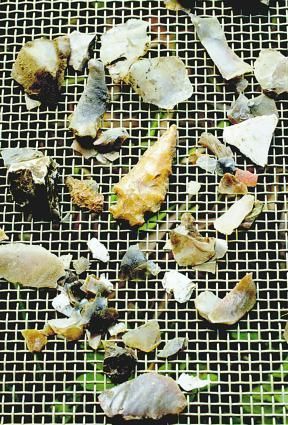
Some artifacts from Mt. Rainier. Source: Tacoma News-Tribune.

The Tacoma News-Tribune has a nice story about high-altitude archaeology on the flanks of Mt. Rainier.  Sites date back to over 9,500 cal.BP (presumably cal. BP, that is) and some include microblade technology.  If I read the article right, the microblade component dates to about 7600 years ago.  There is an older report on Mt. Rainier archaeology here by Greg Burtchard, but it seems this recent work is what has produced the older dates.  It’s also very intriguing to see ancient “cooking pits” including some that the authors suggest were continuously used for the full 9,600 years of occupation:

The site has also produced other ash evidence, coming from cooking pits.

“They’re small and not elaborate, but pretty clearly they were cooking with hot stones. But I don’t know what they were cooking,” Mierendorf said. “That implies more than just traveling through the area.

“These are repeatedly used, including one individual pit used and reused for all 9,600 years. I’ve never seen anything like that in 40 years of professional archaeology.”

It’s good to see work done in the higher elevations, and is reminiscent of Rudy Reimer‘s more theoretically-driven  work in the highlands of Squamish territory. It will be great to see if there is a full report put out soon so I can see the microblades and the cooking pits – if it is put on the web like the earlier report, so much the better!