Brainstorming beads

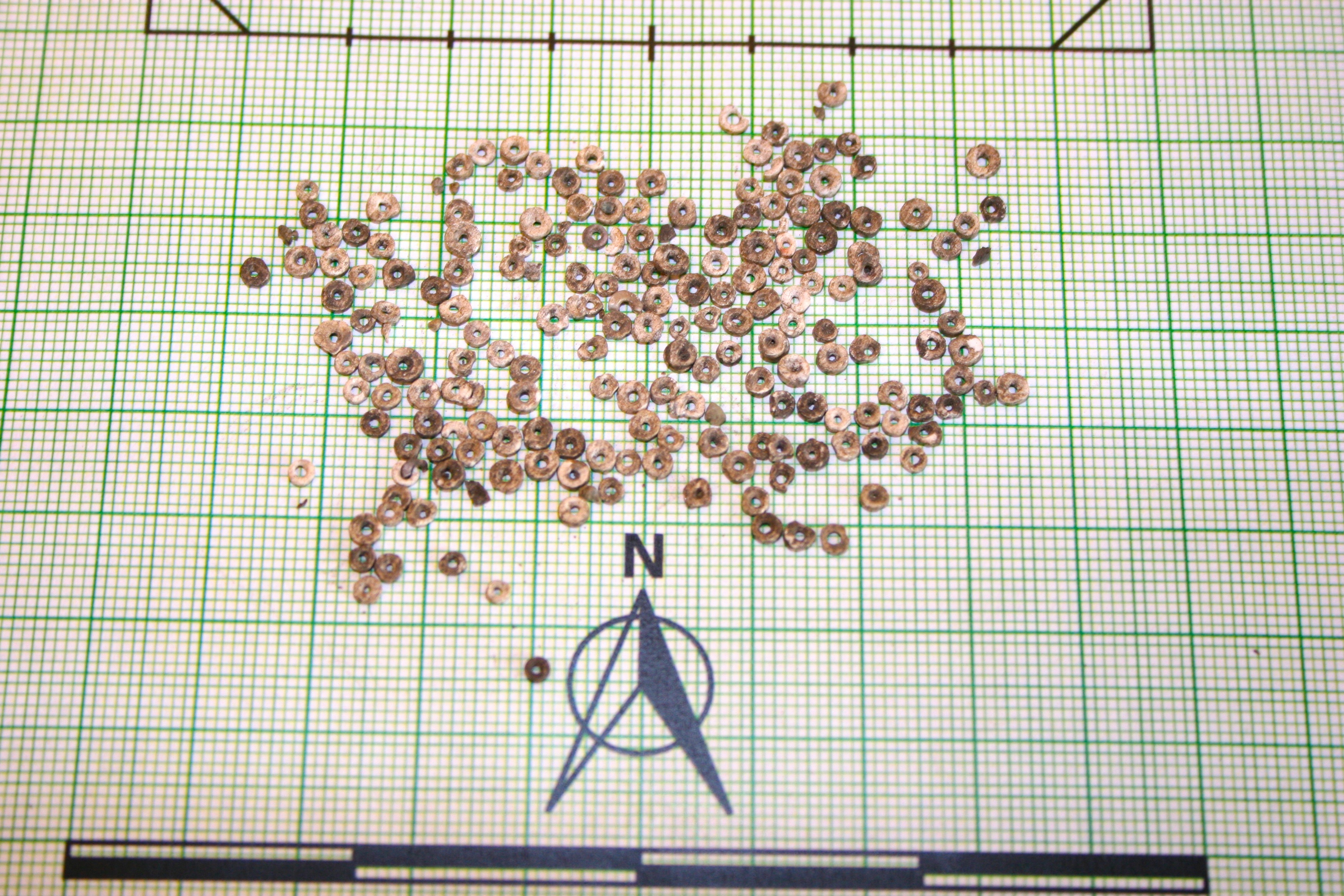
Shell beads from DjRw-14.  Note the interior diameters of less than one millimetre.  Picture courtesy of Terry Clark.  Click to enlarge.

Shell beads from DjRw-14. Large grid is one centimetre, small is one millimetre.  Note the interior diameters of less than one millimetre.   Picture courtesy of Dr. Terry Clark, CMC. Click to enlarge.

The previous post on the remarkable bead-rich burials in shíshálh territory generated a great discussion including contributions from some of the project leaders.  It’d be good to continue that discussion!  But one additional point, as Jesse Morin notes in those comments, and as one of the project leaders Terry Clark raised in an email to me, is the question of, quite simply, how are all these beads getting made?  As you can see in the picture above, these shell beads have a hole diameter of less than one millimetre.  Terry describes some of the holes being not much larger than a human hair!
Continue reading

Bead-rich human burials in shíshálh territory

NW Coast beads

Examples of typical NW Coast archaeological beads, from B. Thom, reference below.

There have been some exciting finds on the Sunshine Coast (northeastern Strait of Georgia) in shíshálh First Nation territory, including a 4,000 year old burial with over 350,000 beads (!), as this short news item explains (PDF).  This is notable for a bunch of reasons:

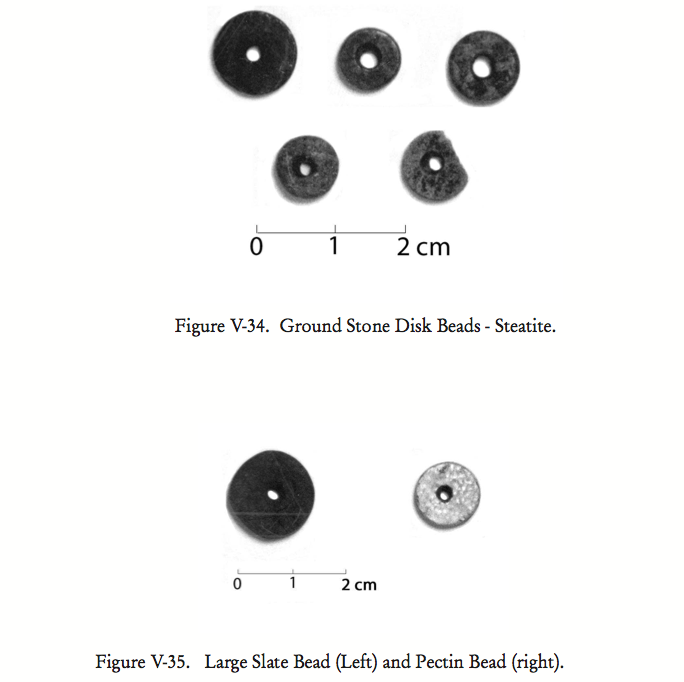
Firstly, each bead represents a significant investment of labour.  Even if we conservatively say that you can make a small stone or shell bead in 5 minutes, then at 12 beads per hour, the individual was buried with some 29,000 person hours of labour investment.  That’s about 194 person-months of work, or just over 16 years of full time employment for one person.  (Incidentally, the five minutes is less than half the time UVIC’s own Brian Thom estimates from a brief experiment in Chapter V, here.)  However we may conceptualize the concepts of “work” and “effort” and their relationship to wealth or prestige in the past, we can’t just write off the full time labour of one person for 16 years, or 16 people for one year.  That’s a huge investment of time which could otherwise be used for fishing, hunting, gathering, or creating useful or durable technologies such as houses, canoes, or what have you.  Such measures of labour investment are commonly, if sometimes simplistically,  used to gauge the importance of the deceased individual in both life and death.  Apparently, in addition to this individual, there are other burials, including a young woman buried in a similar manner, from the site (DjRw-14).

Continue reading

ASBC Victoria Meeting, April 17/2012: Underwater Archaeology in BC

Parks Canada Archaeologist near Huxley Island

So, it’s been a while without a post here so apologies to compulsive page-refreshers and lonely groupies.  I see lots of interesting comments – I’ll try to get caught up soon. For now, here is the announcement about the Victoria ASBC meeting coming up this Tuesday.  It’s great to see that there is going to be some dialogue between the ASBC and the UASBC – two solitudes far too much of the time.

Jacques Marc

Underwater Archaeological Society of BC

Exploring the Underwater Heritage of British Columbia

TUESDAY April 17, 2012, 7:30 pm
Pacific Forestry Centre,
506 West Burnside Road. (map)

Free and Open to the Public

Continue reading

ASBC Victoria, Feb 21, 2012: Archaeology of Nimpkish Area by Jim Stafford

View of Woss Lake. Source: panoramio user cyberhun.

ARCHAEOLOGICAL SOCIETY OF BRITISH COLUMBIA,
VICTORIA CHAPTER

Archaeology of the Nimpkish River Valley, Northeastern Vancouver Island  

Jim Stafford
Coast Interior Archaeology

     TUESDAY FEB. 21, 2012, 7:30 pm
Pacific Forestry Centre,
506 West Burnside Road. (map)

Free and Open to the Public

Continue reading

Highlights from the Kwäday Dän Ts’ìnchi Project

Screenshot from the online document about Kwäday Dän Ts’ìnchi, showing his iron-bladed “man’s tool”, and a small copper bead found with the body. Source: Royal BC Museum.

[Edit Nov 2017: The Book is now available, also through Amazon, etc.]

Many readers of this ever-more occasional blog will be aware of the exciting and profound discovery in 1999 of the well-preserved remains of a young man frozen in a glacier in Northwestern British Columbia.  Found within the traditional territory of the Champagne-Aishihik First Nation, the man was given the name Kwäday Dän Ts’ìnchi, or “Long Ago Person Found.”  In the spirit of discovering what messages from the past that Kwäday Dän Ts’ìnchi might bearing, a remarkable collaborative research project was commenced. Results of this study have been presented at numerous conferences and in the scientific literature, but a landmark event hopefully just around the corner is the publication of a book recounting all the cultural and scientific knowledge borne into the present by this unfortunate young man.

While we wait for the book, it is very exciting to see that the Royal BC Museum has made a non-technical, well-illustrated overview document online which tells the main threads of the story of Kwäday Dän Ts’ìnchi. (edit, try this link instead, RBCM seems to have killed this document?)

Continue reading

ASBC Victoria – Public Talk Tue Nov 15th: Duncan McLaren on Early Archaeology of the Central Coast

Duncan McLaren using Livingstone core on Castor Poop Lake on Porcher Island, B.C.. Daryl Fedje holds the leash.

Next up for the local (Victoria) branch of the Archaeological Society of B.C. is a Tuesday, November 15th talk by Dr. Duncan McLaren of Cordillera Archaeology and the Anthropology Department at University of Victoria.  Duncan’s highly successful  Ph.D. thesis was an interdisciplinary, geoarchaeological approach to the early occupation of the Dundas Island group on the northern B.C. coast. He is now in the early stages of applying a similar research program to the Central Coast of B.C., which promises great advances in knowledge.

The talk is free and open to the public, and you don’t need to be an ASBC member to attend.

Early Period Archaeology and Landscapes on the Central Coast of British Columbia

November 15th, 2011, 7:30 pm
Pacific Forestry Centre,

506 West Burnside Road (Map)

FREE AND OPEN TO THE PUBLIC.

ASBC Nanaimo: In Trouble?

ASBC Nanaimo Members in the Field, 2011: Photo: Colleen Parsley, Source: ASBC Nanaimo.

I posted this as a comment a few days ago, but decided it was worth a post on its own: there is a worrisome news snippet in the Nanaimo paper concerning the Archaeological Society of BC, Nanaimo Chapter. (At least, I infer this is the society in question!).

The full text indicates there will be a public meeting on Monday November 7th at Vancouver Island University which suggests the Nanaimo organization is in tough times:

7 p.m. The Archaeological Society is on the brink of collapse. If you feel the archaeology of Nanaimo and area has significant value, please come share your ideas at Bldg 356 Room 109 on the VIU campus. Continue reading

Anchor Stones

Duwamish composite stone anchor. Source: UW.

Edit October 2018: Hoko Pictures are now here.

I was talking the other day about how under-represented organic technology is in archaeology generally, and especially on the Northwest Coast, where the old adage is that 95% of the technology was made out of plants (trees, wood, bark, roots, grasses, seaweeds).  A classic example of this phenomenon are anchor stones and sinker stones.  While some of these stones had grooves or perforated holes (and are thereby very visible and durable in the archaeological record), many may have been made by the more simple, subtle and expedient method of simply wrapping line or basketry around an unmodified rock.  When the organic component rots away, as it will most of the time, then the archaeologist has, well, an unmodified rock.

Anyway, it was a lucky stroke for my current interest that I came across the above photo from the University of Washington Digital Archives.

Continue reading

Manis Mastodon: a 13,800 year old Archaeological Site on the Northwest Coast

CT slice through Mastodon rib exposing bone point profile. Source: Waters et al. 2011.

For a long time, the Manis Mastodon site near Sequim, Washington was the elephant in the room of the Northwest Coast early period.  The apparent bone point embedded in a mastodon rib was seemingly hard to explain by any non-cultural means, yet maddeningly short of definitive proof, and so was politely ignored. The point has always been a thorn in my side too, which is why I have posted on it three times, once over a year ago, and twice recently.

Maybe I am a bit obsessed with it because if I rise gently from my sofa in Blog World Headquarters, being careful not to spill fine single malt on my pyjamas, then through my window I can see Sequim in the extreme distance, seemingly mocking me.

So all the more cathartic that today, with the publication of a convincing re-analysis of the mastodon rib by Michael Waters et al. in the respected journal Science, we can say that the  site is, indeed, evidence of humans hunting Mastodon on the Northwest Coast 13,800 years ago.  That’s about eight hundred years pre-Clovis.  Like I said before: it’s real.  It’s old. It’s on the coast.  Wow.

Continue reading

BC Archaeology Forum 2011: Squamish, November 11 and 12

Detail of Archaeology Forum announcement. Click for PDF

I recently received the notice that the B.C. Archaeology Forum is to be held this November 11 and 12 in Squamish.  The event will be hosted by the Sḵwxwú7mesh (Squamish) Nation, and is being organized largely by Rudy Reimer/Yumks.  Anyone can register for this event for a highly reasonable $10.00: full information is given in this PDF file. The Forum is a great event, bringing together Consultants, First Nations, Academics and Government Archaeologists in one place to share the latest discoveries and to talk policy and matters relating to the practice of archaeology.  The deadline for presenting is October 28th, but you can decide to simply attend closer to the last minute, I believe.

That said I won’t be making it this year because of an unbreakable commitment.  This highlights an unfortunate part of “Forum Culture” – it is routinely announced only a month or so in advance, even when the location is known much further ahead. Many people have to arrange to take time off, or gain advance permission or funding to travel, organize a ferry load of students, or at least keep their schedule clear for this event.  I think I’ve missed three of the last four for this reason. It’d be great if we could change this, and at least get the location and date out earlier – maybe by the beginning of summer.  Speaking of, next year it would be cool to have it on the Island.  Who’s up for it?