Category Archives: Uncategorized

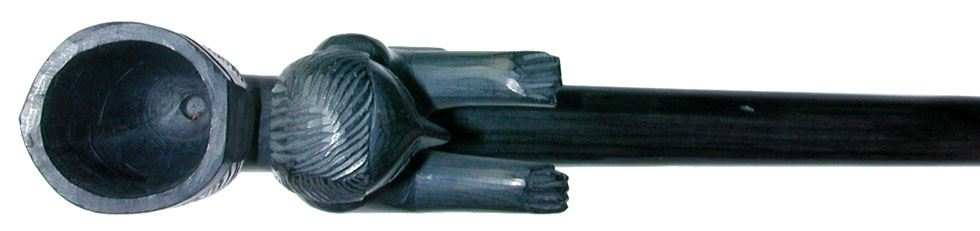
Haida Argillite Pipe: High Resolution Pictures

Detail: Haida Argillite Pipe ca. 1880. http://www.antiquearms.co.uk

I occasionally complain about the lousy pictures that professional organizations put on the web.  I guess I should know that when you have something to sell, you put it’s best face forward; when you don’t, you might not care as much.  Check out the high resolution pictures of this Haida argillite pipe for sale (4,800 GBP).  Multiple angles of the pipe, each one sharp and crisp: you can see each stroke of the knife and the grain of the slate.  Yes there is some glare but the images are much better than most museums make available on the web.  Amazing stuff.

Described as:

19thC. HAIDA ARGILLITE EFFIGY PIPE. #4213 #4213

a bowl carved in the form of a European sailor’s head with large rounded eyes and long straight nose, a figure seated astride the stem also with large rounded eyes and long straight nose and with arms extended wearing European costume with a stripe incised along the sides of the tunic arms and the trousers. Overall 20cm. From the tribes of the Pacific Northwest Coast of North America, principily Northern Columbia and Queen Charlotte Island. 20cm

This pipe was brought back and formed part of the collection of John Madden (1837-1902) of Hilton Park Clones Co, Monaghan Ireland, he left the Irish family estate at the age of 24 to travel by horse across the eastern states of America as far as the Great Lakes just before the start of the Civil War. During his later travels between 1870-1890 he is known to have reached British Columbia where he bought this pipe, it stayed in the family home until the collection was sold at an auction of part of the contents of Hilton Park on the 8th July 1985 where this item was aquired.

For the record, here are the seven views offered by the dealer: 1, 2, 3, 4, 5, 6, 7.

Haida Pipe: detail as if looking down the stem to the bowl.

State Underwater Archaeology Overviews

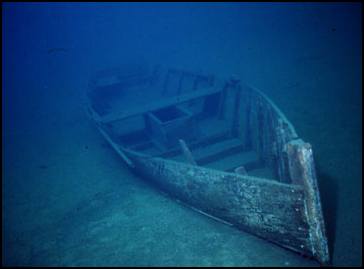
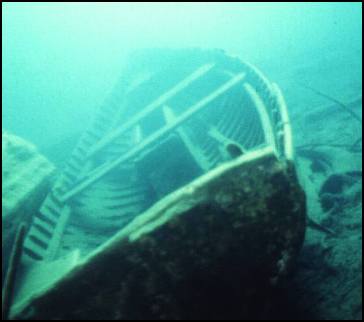
Part of a sunken fleet of recreational dories, Emerald Bay, California.

The US National Parks Service has a useful page summarizing policies and laws regarding “submerged resources” – which includes underwater archaeological sites.  The sections most of interest to the six readers of this blog are probably the pages on Washington State, Alaska, Oregon and California — though the fact that Idaho has a page is, at least, surprising until you remember the importance of paddle-wheelers in the earlier interior historical period all over the west.

Another Emerald Bay dory. Source: http://www.parks.ca.gov/default.asp?page_id=22707

Punchaw Lake Geochemistry

Elongate side-notched points from Punchaw Lake. Source: Montgomery 1978.

Archaeologists are often pretty lousy geologists.  Nowhere is this more apparent in the use of visual cues to classify rock types.  Accurate classification of rock types is an enormous clue to the mobility of past people, to ancient territories, as well as trade and exchange networks.  Even so, very few archaeological studies on the Northwest Coast have looked at geochemical characterization of raw materials, other than for obsidian at least.  The best work done to date is probably Nicole Smith’s M.A. thesis on the Richardson Island site.

It is therefore nice to see some other comparable work being done.  I don’t know much about the Punchaw Lake (near Prince George) project beyond this poster which has been put online  in  the form of a PDF conference poster by Lorenz Bruechert (abstract).  I understand Bruechert did his MA at UNBC on this geochemical study and also there is a much earlier 1978 MA thesis by Patricia Montgomery available online.  It seems Bruechert used the 1970s excavations as a study sample, and the ICP-MS and other work was contracted out to ACME (not that one), a geochemistry consulting company (note: Nicole did the geochem work herself at UVIC so bonus points there).

In any case, Bruechert finds that a sample of the debitage is geochemically sortable into six groups, all of which are closely-related trachydacite or dacite.  There is as much internal differentiation at Punchaw Lake in the geochemistry of this rock type as there is between any two typical sites on the Plateau.  Hence, he suggests three distinct sources with “tens” of kilometres between them.  As the Punchaw Lake site finds itself on the Alexander Mackenzie trail, this is not that surprising to see diversity of raw material (though one could argue there should be even more diversity).  Nonetheless, the point remains that, as the picture below shows, all the material tested by Bruechert would have been classified visually as basalt (lower left on the graph); whereas in fact, none of it is basalt.  It was such findings at Richardson Island which helped allowed Nicole to postulate an “experimental” phase of technological innovation – in her case, a variety of materials including rhyolites, argillites and varvites had all been variously mixed and matched in ways that did not reflect their geochemical origins.

Bruechert Figure 2: rocks called "basalt" (lower left) are actually dacity/trachydacite.

Captain Vancouver and Camas

Saranne, or lily, harvesting on the Strait of Juan de Fuca in May 1792.

I am sure it is well known to local ethnobotanists, but I don’t recall seeing the above account of plant cultivation reference before.  It is from page 123 of Captain Vancouver’s “Voyage of Discovery …. ” (1801 edition, which you can browse online here).

I didn’t figure out the exact locale of this camp but it is probably very close to Port Discovery, near Port Townsend at the north end of Puget Sound.  The camp is carefully noted as a plant-harvesting camp and also a place where shellfish were being processed. The houses are mere lean-tos.  It is interesting to see that the considerable number of “eighty or a hundred” women, men and children were engaged in turning over the earth here, “like swine” (!).  It gives a vivid impression of a well-orchestrated, community-level harvesting event.  Vancouver comments favourably on the product, a sort of paste or flour.

Vancouver refers to one plant as a species of wild onion, while the other two plants being cultivated are termed as resembling “saranne”.  That being a new term to me, I turned to the OED only to find it not listed, which is quite surprising.  Googling turned up some interesting historical references though, in which it is clearly a term used for members of the Lily family (camas is also a member of this family).  For example, see this 1792 clip from Pennant’s Arctic Zoology Volume 3, on the use of Saranne, or Lilium kamchatschense, by the inhabitants of (yes) Kamchatka (let your eyes skim, gentle reader, over the foregoing section on the use and abuse of hallucinogenic mushrooms). Perhaps this term, Saranne, was in use around the North Pacific at that time but it strikes me as odd it did not find its way into the OED.

Anyway, a few pages down from p. 123 you can also find a nice description of the Coast Salish wool dog, which is described as being much like a Pomeranian.

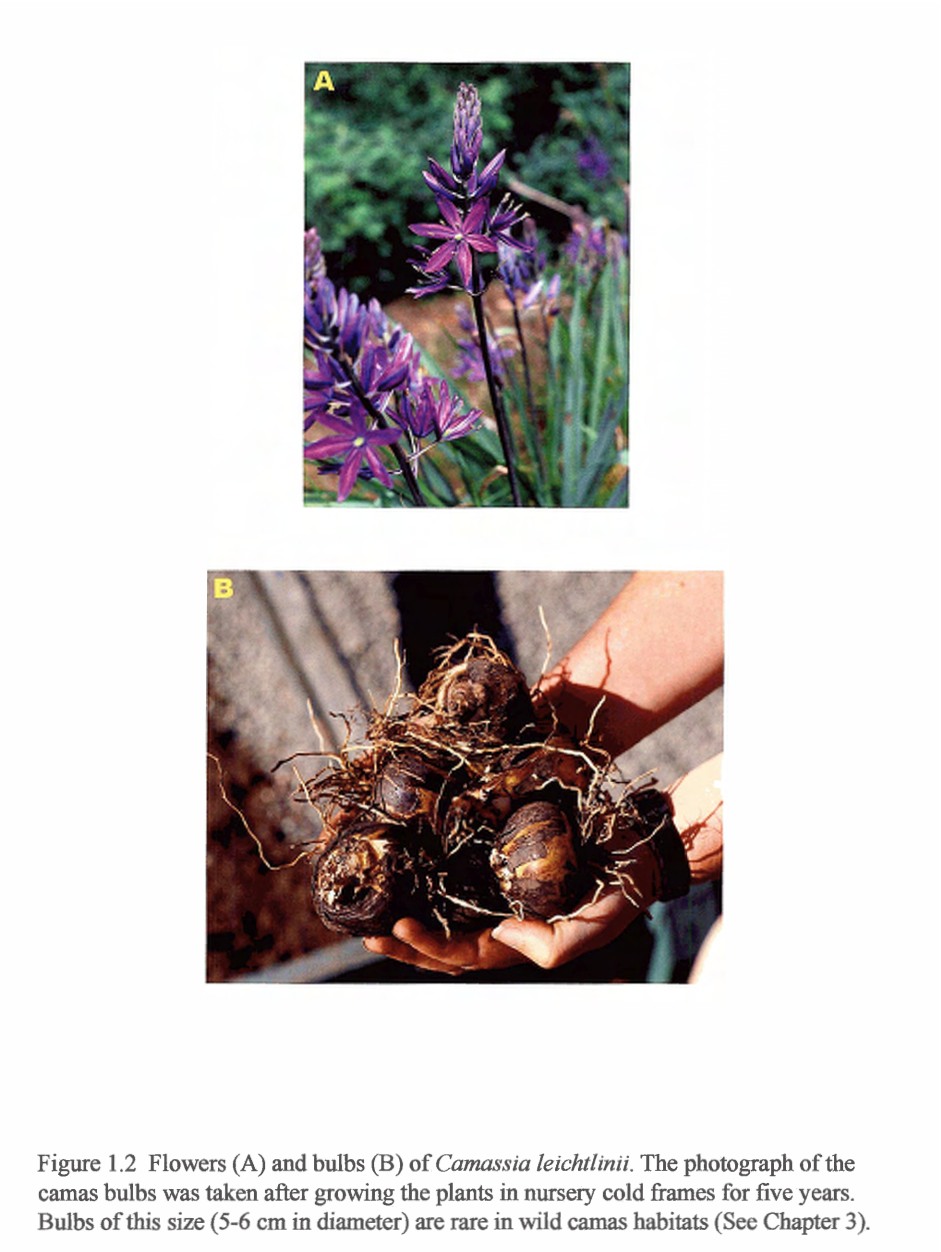
Camas flowers and bulbs. Source: Brenda Beckwith Ph.D. thesis, 2004. http://hdl.handle.net/1828/632

Songhees claim for Cadboro Bay land compensation: update

There is a fairly progressive editorial in the Times-Colonist on the Cadboro Bay land compensation issue.  The editorial cites John Lutz’s excellent book Makuk:A New History of Aboriginal-White Relations, to boot.

Lawyer Rory Morahan, acting on behalf of the Songhees, says the Chekonein village sites and fields were never surveyed, reserved or protected as required by the treaty. “The colony, or the province, appropriated the lands and issued title to the lands to other parties — that is, non-aboriginal colonists,” he says. The statement of claim says the Crown never paid compensation for taking the treaty land between 1851 and 1871.

The case will be complicated, given the variety of historical documents that will be presented to the court. Some basic facts are not in dispute, since even Roderick Finlayson, an early chief factor for the Bay, mentioned the Cadboro Bay village in his memoirs.

Beyond what is written in the treaties, the court might need to consider whether the Lekwungen actually understood what they were agreeing to. Lutz’s research has raised questions about the communication gap between the aboriginals and the whites.

Douglas signed nine treaties with aboriginals on southern Vancouver Island and, as Morahan says, this lawsuit could set a precedent if successful.

The decision could have ramifications elsewhere in the province. The Lekwungen were the first aboriginals in British Columbia to be dispossessed by settlers, but similar actions — land grants given, then taken without compensation — occurred for decades.

If it is proven in court that an injustice has occurred, the governments should act quickly to make things right. After a century and a half, it’s time.

This isn’t the first time I’ve noticed a fairly progressive editorial slant down at the TC – good for them, as the comments on their pieces show, there is a lot of resistance to the notion of fair compensation.

CRM Problem in Cadboro Bay

cadboro bay mess

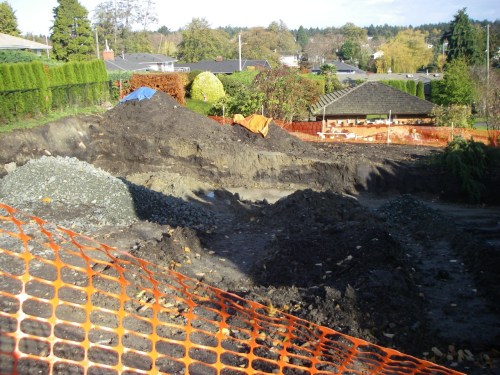
Uncontrolled destruction of Archaeological Site in Cadboro Bay, Victoria.

This week saw an all-too-familiar case of human remains disturbed by residential construction, this time in Cadboro Bay close to the University of Victoria. There are two major known sites in Cadboro Bay and many others must be there as well (I haven’t checked to see what has and has not been recorded). In addition to these known very large sites, it has been known since the 19th century (e.g.,  Cadboro Bay: Ancient City of the Dead — 6 meg PDF) that the slopes leading down from the top of Gordon Head were favoured places for human burials. So, no one could be surprised to find human remains in this area and indeed this is what happened.

A twist on the usual story comes with the reporting that the landowner, identified as Henry Ravenscourt, had had an archaeological impact assessment done and yet then excavated out almost the entire soil and subsoil of the lot in question. According to the Times-Colonist:

The property had been designated an archaeological site in Oct. 2008 when an Archaeological Impact Assessment was conducted there. Under the Heritage Conservation Act, the landowner was required to obtain a permit before digging, however, it appears no permit was granted for the new-home construction.

The Globe and Mail reports that,

Provincial [sic – probably consulting] archeologists who had been monitoring the property alerted police last Wednesday after discovering that workers digging the foundation for a new home had unearthed a human skull, knee and leg bone.

VicNews.com has added information: the Police say the landowner was in possession of the Archaeologist’s report:

Sgt. Julie Fast with Saanich police said the homeowner could possibly face charges through the Heritage Conservation Act because an Archaeological Impact Assessment was done on Hibbins Close in October 2008. That assessment designated it an archaeological site, which means, before any digging or building takes place, a permit issued through the Provincial Archaeological Branch is required.

“From what I understand, the homeworker is supposed to be in possession of the (permit). We are determining if they were aware (of the Archeological Impact Assessment), and if they had the letter,” Fast said.

The permit would designate how deep digging can be done and where a structure can be built without disturbing any remains on the property.

It is hard to say what is really going on here. If an AIA was conducted in October 2008, then surely the landowner had a copy of the report. Were there archaeologists monitoring the site? That would be consistent with a development process whereby archaeologists routinely watch backhoes and then jump in when the skulls start rolling. But surely the archaeologists would not have allowed such complete removal of material in such an uncontrolled way? I visited the site last week and saw how several, perhaps 10, dump trucks worth of material from almost the entire lot had been removed and there were only token piles of backfill. Where did this soil go? It undoubtedly contains human remains and archaeological material.  I trust the Archaeology Branch is tracing its whereabouts.

It is very welcome that the Police are considering charges in this case and I certainly hope that if a landowner or developer ignores an AIA recommendations that they get the book thrown at them as firmly as possible. Contrary to what the newspapers are reporting that the owner is subject to a 2,000 dollar fine, there appears to be a contravention under Section 13(2) of the Heritage Conservation Act, for which the maximum penalty under Section 36(3)a is $50,000 and six months for an individual, and 1,000,000 for a corporation. It is essential that the justice system starts to deal with these people in a serious manner. By completely removing the archaeological material from the property a landowner could in effect raise the property value by more than 50,000.

I share Songhees archaeologist Ron Sam’s cynicism though:

“They know full well there’s bones under there and they just go ahead and do it anyway because they know there’s no penalty,” Mr. Sam said, adding that the band is seeking legal advice. “We can say what we want, but at the end of the day it’s private property and we can’t stop it.”

Perhaps not. But those charged with managing and enforcing the Heritage Conservation Act and those responsible for gathering evidence and laying charges must start to make examples of those who flagrantly destroy the collective heritage.

Also check out this busybody’s letter to the Times-Colonist complaining about the costs incurred and implying the archaeologists are just making work.  Chris Harker of North Saanich, you officially have no idea what you are talking about.

cadboro bay mess 2

Note how close the excavation is to the property line.

The Brooklyn Museum Collection

Tsimshian Skull "Helmet".  Click for higher resolution.

Tsimshian Skull "Helmet". Click for higher resolution.

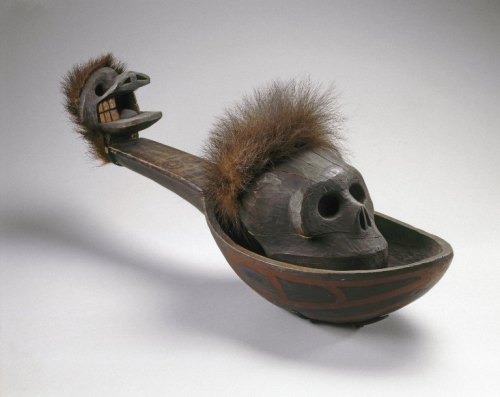
Of all places, the Brooklyn Museum has amassed an impressive suite of NW Coast artifacts and art.  Their online catalogue is mainly lodged under the  “research” and “collections” tabs.  One interesting thing about this collection is that any viewer can ‘tag‘ a picture, building up a folk taxonomy that cross-cuts more traditional museum categories.  This has its advantages of course (e.g., items which are tagged “beards“, or “scary“), but also raises questions about just how comprehensive is any set of results?  And how accurate – this rattle is tagged Tsimshian despite being collected in Bella Bella (Heiltsuk territory).  Still, with a grain of salt it is an idea definitely worth pursuing.  You can also click around on their “visible storage” map.  The images are decent resolution and combined with the tag-surfing possibilities this is a fun and informative site.

Heiltsuk Ladle with Skull. Click for larger resolution.

Heiltsuk Ladle with Skull. Click for larger resolution.

Cook Journal Illustrations from Oz

inside house nootka soundThe Australian National Library has a nice set of the engraved illustrations for the journals of Captain Cook online.   Above is the famous 1778 image of life inside a large house at Yuquot (Friendly Cove) in Nootka Sound.  The image above encapsulates so much about life on the west coast: one group of people on the ground, tending to the fire, looking a little miserable, while another family unit sits on benches in nicer clothes and with their feet dry; the little partition dividing up the large house into dwelling foci; the boxes of stored good and paraphernalia; the fish hanging up in the smoke (and look how they are all different sizes and shapes of fish).  And note the “whaling trophy” at the base of the left housepost, a wooden whale fin apparently studded with sea otter teeth.  A closely comparable example was found at the Ozette site.  That’s the inside of the house — one remarkable thing about the outside of the house is the massive piles of shell midden almost obscuring the dwellings.  We think of middens as flat, but active middens may have been highly mobile, rutted, mounded affairs, which should give us pause, or at least, humility.

Their interface is clumsy (or maybe just slow) and I know you only want the Northwest Coast ones anyhow, so other treats are these masks and frontlets, the well-known man and woman from Nootka, and, below, a sea otter proving that cute overload is no modern invention – thought the listless aspect of the otter suggests that it may have been dead at the moment of portraiture.

cook sea otter

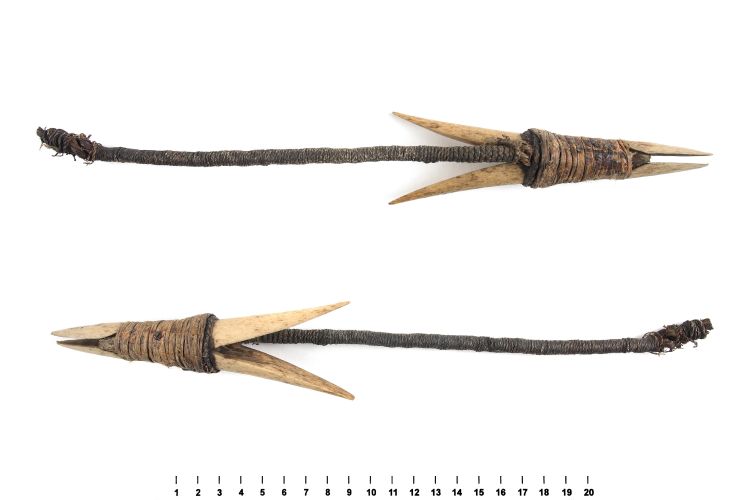
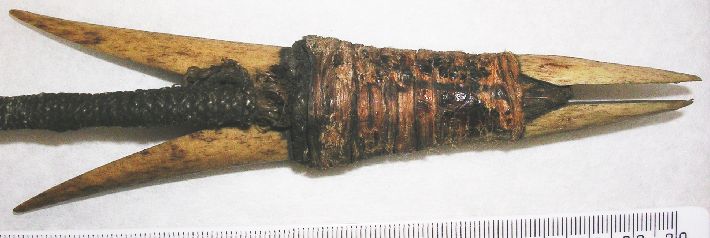
Harpoon Head from the Hunterian

I have to say, I disagree with your description.  Based on size alone, at 14 cm this is much too large to have been for salmon fishing.  Stylistically, fish harpoons tend not to have a blade bed, but rather some kind of cylinder formed by the two valves.  Flat beds such as this one are more consistent with large arming points made of ground slate or ground mussel shell.  If intended for a fish, this would be more suitable for Fraser River sturgeon, say.
But I doubt it.  I’d suggest in size and manufacture this is much more consistent with a sea mammal harpoon head.  I don’t recall seeing any of this size in Coast Salish archaeological sites.  If your provenance traces to Laskey and thus to Cook, I’d suggest it is much more likely to be from the Nuu-chah-nulth (Nootka) area of western Vancouver Island, where Cook occupied himself much of the time he spent on the NW Coast proper, and with which it is stylistically consistent.  Indeed, even without provenance that is where I would assign it.  And I would suggest in size and manufacture it is more likely to be a large sea mammal – probably whale – harpoon head of a kind we describe out here as “Composite Toggling Harpoons”, composed of two valves forming the barbs with an allowance (usually) for an inset arming point.  Something like a sea lion harpoon I would expect to be about 2/3 of this size.   Further, Cook never really had much interaction with Coast Salish groups.
Normally too I would expect the valves on one of this size to be made of antler or of wood (yew, or Douglas fir) and not bone so that is an interesting difference.
Anyway, all this is by way of saying, it appears the lanyard extends up one side, then crosses through the notch (blade bed) to the other side where it fastens.  I’d be interested in knowing if this is the case since it would be an interesting functional design aspect encouraging the harpoon head to toggle when pressure is put on the lanyard.  If you had higher resolution pictures I would love to see them.
Composite Toggling Harpoon with lanyard.

Composite Toggling Harpoon with lanyard.

This item from the Hunterian Museum in Glasgow traces its provenance provisionally to Captain Cook:

This harpoon head has one large split point, with a curved split socket with pointed tips. It has twisted sinew lashing around the middle and a line of vegetable fibre attached. This type of harpoon would have been used to catch salmon and is stylistically attributable to the Salish people of the North West Coast of America. The harpoon was originally accessioned as donated by Dr. G. Turner, however there are no items from the North West Coast on the 1860 donation list. It may be one of the hooks mentioned by Captain John Laskey in his 1813 account of the museum, in which case it may have been collected on one of the three Pacific voyages of Captain James Cook.

I have to say, I disagree with the description. Based on size alone, at 14 cm for the head, this is much too large to have been for salmon fishing. Stylistically, fish harpoons tend not to have a blade bed, but rather some kind of groove formed by the two valves which supports a cylindrical bone point.  Flat beds such as this one are more consistent with large arming points made of ground slate or ground mussel shell. If intended for a fish, this would be more suitable for Fraser River sturgeon, say.

But I doubt it. I’d suggest in size and manufacture this is much more consistent with a sea mammal harpoon head. I don’t recall seeing any of this size in Coast Salish archaeological sites. If the provenance traces to Laskey and thus to Cook, I’d suggest it is much more likely to be from the Nuu-chah-nulth (Nootka) area of western Vancouver Island, where Cook occupied himself much of the time he spent on the NW Coast proper, and with which it is stylistically consistent. Indeed, even without provenance that is where I would assign it.

And I would suggest in size and manufacture it is more likely to be a large sea mammal – probably whale – harpoon head of a kind we describe out here as “Composite Toggling Harpoons”, composed of two valves forming the barbs with an allowance (usually) for an inset arming point. Something like a sea lion harpoon I would expect to be about 2/3 of this size. Further, Cook never really had much interaction with Coast Salish groups.  These harpoons work by an analogous process to the toggles on a duffel coat: insert the toogle narrow-ways, then it turns side-ways and won’t pull through the loop.  For toggle, read “vicious harpoon” and for loop, read “flesh”.  Because most maritime hunting and fishing technologies require immobilization of the prey and retrieval, the technology tends to quite a bit more complex and intricate and well-engineered than terrestrial hunting technology which is more single purpose (kill!).  The composite harpoons are a great example of this.

Normally too I would expect the valves on one of this size to be made of antler or of wood (yew, or Douglas fir) and not land mammal bone so if these valves are land mammal that is an interesting difference.

Anyway, all this is by way of saying, it appears the lanyard extends up one side, then crosses through the notch (blade bed) to the other side where it fastens. This would be an interesting functional design aspect encouraging the harpoon head to toggle when tension  is put on the lanyard.  (I emailed the Hunterian to see what they think)

What is that organic matter between the valves? The lanyard?

What is that organic matter between the valves? The lanyard?

Canadian Archaeocryptozoology

Inexplicably, the Canadian Zooarchaeology website is hosting some pro-creationist articles, as well as lively topics such as “Calgary is in Canada” and “Memories of Canada” (cached version).  It looks like some very odd genre of comment spam, but appears to have been approved by the webmaster over there.  You’d think it was random, especially as they spell it “Canadian Zoo Archaeology”, but then there are actual archaeology pictures there as well.  The whole thing is suspicious, since CZ has a webpage just down the hall, so to speak.  You wouldn’t think there would be anything in it to spoof such a small organization.