Category Archives: Teaching

Buy Your Piece of BC Archaeological History

Sisiutl for Sale

I was browsing to price out some used skiffs, and look what I found – a custom built archaeological research vessel — only $99,000.  (I wonder what she cost to build?) The listing is here, with a PDF backup for posterity here.

I don’t have any memories of the Sisiutl —  never stepped on board — but I know she is close to the hearts of many SFU faculty and former students.

Continue reading

Capilano University Field School Blog

"At each logging camp a familiar discovery was a wood burning stove or oven. The one pictured {above} had stumped some former students of Muckle's in the past because the student who helped recover the stove had read an engraving on the side saying "To Jake". After pondering upon this curious inscription, it was realized that the "J" had incorrectly been read, and the whole etching had actually said "To Bake", commonly found on ovens." Source: http://archaeologyfieldschool.blogspot.com/

I noticed that the Capilano University Archaeology Field School, which just started a few days ago near Vancouver, has a blog.  So far there are three days worth of entries and it looks like it will be a lot of fun to follow along with the students who, under the direction of  Bob Muckle, will be continuing to work on the archaeology of historic logging in the Seymour River Watershed, which flows into Burrard Inlet.  Much of the logging was conducted by Japanese immigrants, making for a nice overlay of ethnicity and capitalism and material culture.

Continue reading

How to Make a Petroglyph

Replica sandstone petroglyph made by Christine Stathers. Photo credit: Stathers.

I’ve often said the graduate student work is the backbone of the archaeological discipline in British Columbia.  Today I get to report on more student work – but this time its a fascinating study done by an undergraduate student at Camosun College here in Victoria.  The student, Christine Stathers, did an experimental archaeology project for her Anthropology 240 course, and she kindly agreed that I could post some of the results here.  The results are highly informative for our interpretation of petroglyphs, I think.

Continue reading

UVIC Archaeology Field School

I hear through the grapevine that the 2010 University of Victoria Field School in Archaeology still has a couple of spaces available.  The project, in conjunction with Parks Canada and with the Hul’qumi’num Treaty Group, will run July 5 to August 13 or so in the southern Gulf Islands.  Students will take Anthropology 343 and 344 at UVIC and there will be a camp fee, to cover the costs of running the project and a camp on a Gulf Island for four weeks – one of the unferried ones: Portland Island.  There is more information about the course at the University of Victoria Anthropology Web site, including a PDF application form you can download.  The course will be taught by Dr. Duncan McLaren, who can be reached at dsmclaren {{at}} gmail dot com for more information.  Other UVIC faculty* and Parks Canada archaeologists will be taking part as well, as well as First Nations apprentices.  This particular course will be focused on skills needed in Cultural Resource Management jobs, as well as the cultural history of the Salish Sea and other related topics.  If you know someone who might be interested, or have students looking for a pretty good  fieldschool, consider circulating this information soon, as I hear the field school needs to finalize its numbers soon and there will be a second look at applications received.

*since this is my personal web site and is not affiliated with my day job, you’ll have to click the links to find out who that might be.

Bears, Humans and Deer: disambiguation at last.

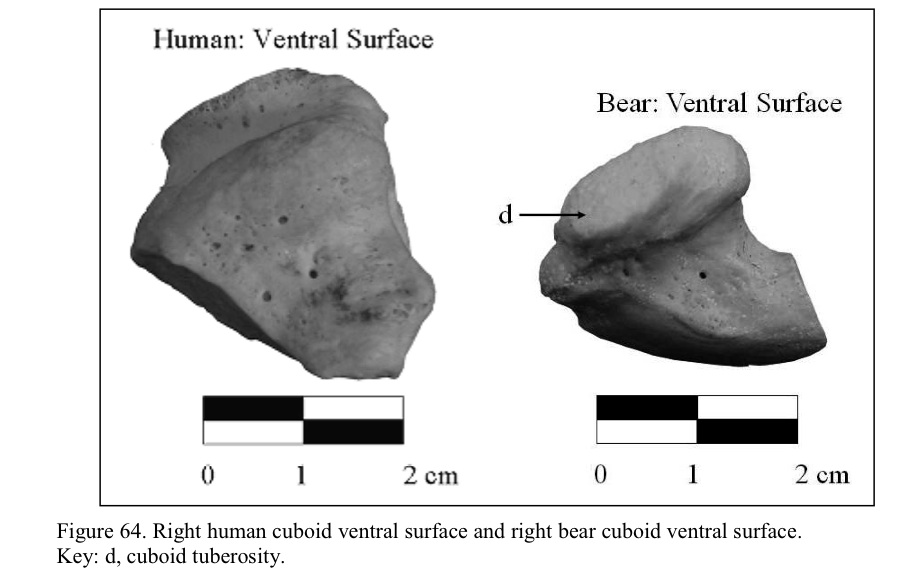
Human and Bear cuboid bones compared. Source: Smart 2009.

Some graduate theses are clearly meant to be both a research excercise and produce a demonstrably useful document.  I’m not saying these are any better than any other kind of thesis, but they do have an aura of public service and virtue about them.  The best example of these which I have seen recently is Tamela Smart’s 2009  Carpals and tarsals of mule deer, black bear and human: an osteology guide for the archaeologist.  If you click here it will start an automatic download of the 3.7 meg PDF from Western Washington University (unfortunately, no way to link to a download page).  (edit: try this link instead)

The premise of this research is that despite obvious differences on the outside, there are surprising similarities between the hand/wrist and ankle/foot bones (carpals and tarsals) of bears, deer, and humans.

Continue reading

Forthcoming Vancouver Archaeology Talks

Once in a while I yawn, stretch, and look across the Moat of Georgia and notice something interesting happening in Vancouver.  This time I see there are two forthcoming events for those within striking distance of the Velvet Rut.

First, UBC is holding its annual Archaeology Day this weekend, Sunday March 21st.  The program, which looks great, can be viewed here.  The event is free and open to the public and is held in the Anthropology and Sociology Building on the UBC Campus.

Second, the Vancouver Chapter of the Archaeological Society of BC is holding a public lecture featuring SFU professor Eldon Yellowhorn.  His topic is “Encountering Modernity: the Piikani Historical Archaeology Project.  The poster is below, click for a legible version.  The talk is Wednesday March 24th at 7.00 at the Museum of Vancouver (who don’t seem to have it listed on their calendar), and it is free and open to the public.

Memo to the ASBC-Vancouver: update your web site if you want people to come to your talks.

Click to enlarge

A Portal to Online Graduate Theses and Dissertations

If you look up you should see two more links have been added along the header of this page, just above the banner picture.

ARCHAEOLOGY THESES is a page of links to freely-available, online PDF copies of graduate dissertations and theses on Northwest Archaeology subjects (with a few palaeo-environment theses thrown in for fun).

OTHER THESES is a similar page, but where the focus is on Northwest Anthropology, First Nations Studies, History and related disciplines.

I am planning another page which will be for online archaeological, ethnographic and historic documents of note, in particular “classic” ethnographic works and major site reports which have been intentionally posted in online contexts.  Probably this will be a few weeks yet.

The impetus for these pages is that I have often said the M.A. thesis in particular is a significant backbone of B.C. Archaeology, and the dissertation even more so.  For years these substantial works languished on library shelves.  Now, libraries are increasingly making them available online, free to the public and the academy alike – that is, not behind password protection.

However, you have to know how to look, and where to look, and often you need to know in advance what you are looking for, in order to find this stuff.  I thought it would be useful to have a very simple portal for these graduate works.  Not only does this make them browsable by the more hardcore of my blog readers, but it will get them some google-love!

Not all theses ever written are available online (mine isn’t!):  as it notes on the pages, there are programs in place at UVIC and UBC to digitize their back-catalogue of theses and dissertations.  It would be great if institutions like Calgary, Toronto and McMaster could get their dSpaces full, and open. Unless, of course, they are ashamed of the quality of their graduate student work 😉

So, these pages will be updated periodically. I am not vouching for the quality of any of the ones I linked — indeed a few of them are exceptionally poorly reasoned,  naive, unsupported, badly written, or long-winded efforts -and  in at least one case, all of the above!  Most are very solid though, in my estimation, and a few are truly excellent.  If you know of useful and relevant graduate work that is freely available and not yet linked, let me know in a comment below, or send me an email qmackie [at] gmail.com.  In the meantime, happy browsing.

Archaeomath’s advice for archaeology graduate school

Fish skeleton tattoo by Russell Fortier. Source: http://lucky7tattoo.net

I linked once before to the excellent quantitative zooarchaeology blog written by a mysterious anonymous figure.  Turns out the anonymous fish guy also has some great advice for graduate students – two pages worth, tailored to different stages.  I found myself agreeing with quite a bit of it.  Here are a few excerpts, but there is much more in the two excellent posts here and here.

Continue reading

March ASBC Talk: GvonP on UP Art

UVIC's own, Langford's own, Genevieve von Petzinger. Source: Goldstream News-Gazette

I had the pleasure of serving on this month’s ASBC speaker’s graduate committee and I know if you are in the Victoria area you will be entertained and educated at this talk – which unfortunately I can’t make due to pre-existing public speaking commitments of my own.  Genevieve has recently been featured on the cover of New Scientist magazine and there has been something of a global storm of publicity stemming from her Master’s research.

ARCHAEOLOGICAL SOCIETY OF BRITISH COLUMBIA, VICTORIA CHAPTER

March 2010 Monthly Meeting: Tuesday, March 16, 2010, 7:30 pm

Pacific Forestry Centre, 506 West Burnside Road.

The talk is free and open to the public.

Genevieve von Petzinger

Making the Abstract Concrete: The Place of Geometric Signs in French Upper Paleolithic Cave Art.

In Paleolithic cave art, geometric signs tend to outnumber figurative images and yet, they remain relatively understudied. To address this gap in our knowledge, I compiled a digital catalogue of all known geometric signs found in parietal art in France, and then trended the results looking for patterns of continuity and change over time and space. I focused on parietal art, as I could be certain of its provenance, and picked France as my region due to its abundance of decorated sites and its natural boundaries of water and mountain ranges. The database is searchable by a variety of criteria such as sign category, method of production, date range, site type, geographical coordinates and region. It is now being converted into an online resource. To provide a visual dimension, it includes a selection of linked photographs and reproductions of the different signs. In this thesis, I detail the chronological and regional patterning in sign type and frequency and the implications of these patterns for understanding where, when and why the making of these signs was meaningful to the Pleistocene peoples who created them.

(editor’s note: you can download her thesis free of charge here)

Biography Having been interested in the cognitive evolution of modern humans since her undergraduate days at the University of Victoria, Genevieve von Petzinger was finally able to explore this in more depth at the Master’s level. Working with Dr April Nowell, again at the University of Victoria, she was able to pursue this interest, and received her MA in June 2009. Using the geometric signs of Upper Paleolithic rock art, Genevieve discovered some very interesting information about these early examples of symbolic behaviour, and presented her findings at the Paleoanthropology Society meeting in Chicago, Illinois in April 2009. This presentation was the catalyst for her research being featured as the Feb. 20th, 2010 cover story in New Scientist magazine. This exposure then led to a strong media follow-up, which included an interview on the Discovery Channel, a feature in the Tuttoscienze supplemental of La Stampa in Italy, an article in the Globe and Mail, and a full page feature in the Vancouver Sun, as well many other popular press articles and radio interviews in French and English, both nationally and internationally. While being slightly overwhelmed by all the attention, Genevieve has been very excited about the positive response, and is just thrilled that other people want to hear her talk about her favourite subject!

For information, phone 384-6059 or e-mail asbcvictoria@gmail.com

Media Links

http://www.newscientist.com/article/mg20527481.200-the-writing-on-the-cave-wall.html?full=true

http://www.timescolonist.com/news/UVic+researcher+taps+into+cave+language/2599510/story.html

Major expansion at the Royal B.C. Museum?

Proposed changes to the RBCM: the clear white structure to the back left is the new curatorial tower & archives; to the right is a new entrance and multi-functional area. Source: Times-Colonist.

The Victoria Times-Colonist had a story Saturday that the Royal B.C. Museum is proposing a major expansion, in which theirs quare footage would more than double, from 379,000 to 895,000 square feet.  The curatorial tower and the low-rise archives building on the NW side of the block would be demolished, replaced by a new multi-function complex which would also form the entrance to the museum.  The collections and curatorial facilities, and the archives, would move to a new 14 story building to the south of the current museum.  The RBCM C.E.O, Pauline Rafferty (an archaeologist by training) notes that ““We are now at a crossroads.  We have outgrown our on-site storage facilities and significant artifacts are stored below sea level.”  The article estimates the cost will be in the hundreds of millions of dollars which is easy to believe. The Times-Colonist weighs in with a strong editorial of support, citing the collapse of the Cologne archives last year with irreparable damage to the history of that City.  So: no-brainer, right?

Continue reading