Category Archives: Northwest Interior

Major expansion at the Royal B.C. Museum?

Proposed changes to the RBCM: the clear white structure to the back left is the new curatorial tower & archives; to the right is a new entrance and multi-functional area. Source: Times-Colonist.

The Victoria Times-Colonist had a story Saturday that the Royal B.C. Museum is proposing a major expansion, in which theirs quare footage would more than double, from 379,000 to 895,000 square feet.  The curatorial tower and the low-rise archives building on the NW side of the block would be demolished, replaced by a new multi-function complex which would also form the entrance to the museum.  The collections and curatorial facilities, and the archives, would move to a new 14 story building to the south of the current museum.  The RBCM C.E.O, Pauline Rafferty (an archaeologist by training) notes that ““We are now at a crossroads.  We have outgrown our on-site storage facilities and significant artifacts are stored below sea level.”  The article estimates the cost will be in the hundreds of millions of dollars which is easy to believe. The Times-Colonist weighs in with a strong editorial of support, citing the collapse of the Cologne archives last year with irreparable damage to the history of that City.  So: no-brainer, right?

Continue reading

Adawkhl Gitsegulka

Gitsegulka ca. 1909. Source: Adawhkl Gitsegulka.

Yesterday, while posting CanadaGood’s flickr set of “totem poles” I found a really interesting document at the web site of the Gitsegulka community of the Gitxsan First Nation on the Skeena River.  Called Adawkhl Gitsegulka, it is a history of the settlement written in 1979, by band members via consultation with hereditary chiefs.  So often we only see these historical pamphlets for settler communities; it is quite fun and interesting and a little bit sad to read through this one written by First Nations themselves.  For example, note how (page 7) the Indian Agent in 1909 respects the hierarchies of the hereditary chiefs, apparently only in order to establish himself as the highest ranking of the lot.  Scroll down to page 35 for a discussion of the motives and means of carving poles.

There is an interesting theme which runs through the whole document: the uneasy relationship between the deeply felt Christianity of many Gitsegulka Gitxsan, and the old ways and practices.  In its informal way, through consultation with numerous elders, with charming illustrations, the Adawkhl Gitsegulka is an intriguing source of information on how the community saw itself in the transformative years of the late 1970s, when land and title claims were once again rising.  Five years on, they were in court claiming rights and title to their territory, and not much more than 10 years later, the landmark, borderline racist, “McEachern decision” of the BC Supreme Court would be handed down (the Gitxsan-Wet’suwet’en case: Delgamuukw vs. the Queen, round 1) which started a transformation of aboriginal rights in Canada.  Delgamuukw 3  in 1997 eventually set the frame for the modern treaty process when the Supreme Court ordered a new trial.  The trial has never happened but the new Supreme Court terms and definitions structure our modern understanding that Aboriginal rights and title were never extinguished and must be reconciled.  The Adawkhl Gitsegulka is an indigenous perspective on a small community about to have its voice heard right across Canada.

The document ends with the slogan of the [then] Gitksan-Carrier Tribal Council:  “Walk on, walk on, on the breath of our grandfathers”.

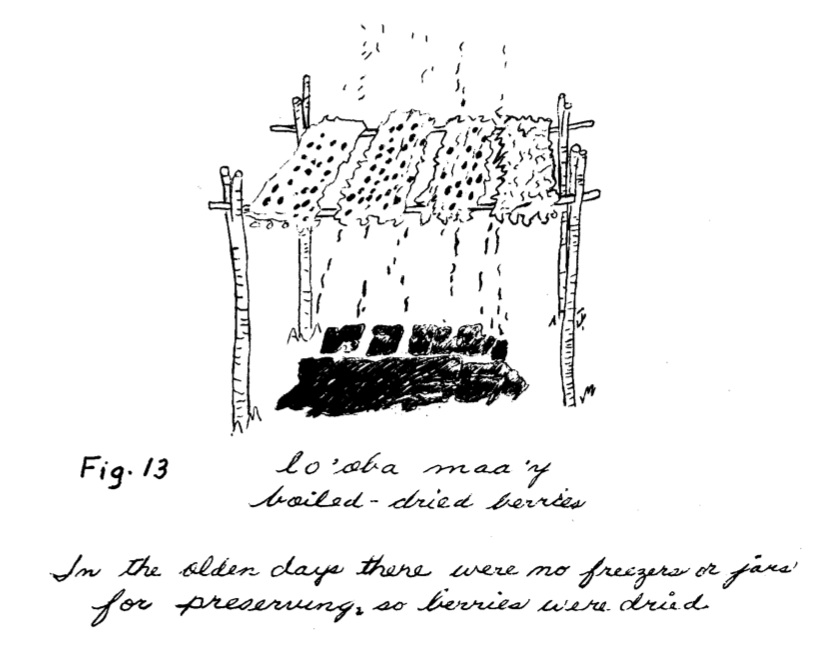
Drying Berries. Source: Adawhkl Gitsegulka.

Interior layout of a house. Source: Adawkhl Gitsegulka.

Lu Zil Män Fish Lake: SW Yukon Archaeology and Oral History

Artifacts from the Lu Zil Män Fish Lake site. Source: Yukon government.

The Yukon government has a good web site up about archaeological and oral historical projects in the  Lu Zil Män Fish Lake area of the Kwanlin Dün First Nation’s territory.  The SW Yukon is a fascinating area where inland Tlingit people ranged from the coast, producing entangled relations with the interior speakers of na-Dene languages.

It’s good to see that the site puts the oral testimony of elders first and the archaeology second – what we’d call the “direct historical” approach if we were in a classroom.  This approach puts living people first in archaeology, using their insights to find locales and to interpret the uppermost layers.  Then, as one digs deeper, memory and history become less detailed and environments were different, and increasingly more generalized explanations from archaeology and ethnology come to bear.  The direct historical approach is usually ascribed to early researchers in the American SW, but a leading exponent and innovator was actually Frederica de Laguna, who began work on the Northwest Coast in the late 1920s, and had a 70 year active career.  The direct historical approach fell out of favour in a period where archaeologists tried to be highly scientific and to seek generalizations about people, but recently there has been renewed interest in it, especially in a community-based archaeological idiom.

Anyway, the Lu Zil Män Fish Lake project looks like it was a lot of fun, culturally informed, and well integrated into the community, while the web site is well written for the non-specialist.  My only complaint is the photos are rather washed out seeming and not very crisp or low resolution.

Find sites and excavation units. Source: Yukon government.

Oregon: Where Past is Present

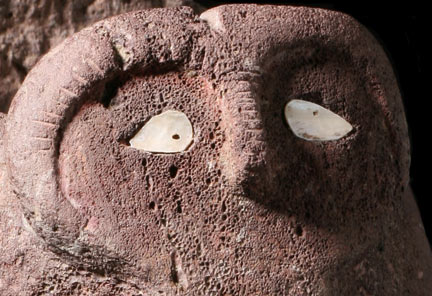
Stone lamp from interior Oregon with inset eyes of abalone shell. Source: OMNCH.

The Oregon Museum of Natural and Cultural History has some very nice exhibits and it looks like their underlying collections are superb.  Their online photo-gallery “Oregon: Where Past is Present” is some pretty nice eye-candy, though I would love to see them give a little more information about each piece.  The sculptural lamp above is simply superb.

So-called "wealth blade" made of flaked obsidian, length 25 cm. Source: OMNCH

Lousy conservation at the Vancouver Museum?

Shoddy conservation of magnificent petroglyph boulder at the Vancouver Museum. Screenshot from VM website.

For some reason mistreatment of rock art just makes me spitting mad.  I posted the other day about a magnificent petroglyph boulder that was removed from its home on the central Fraser River near Lillooet in 1926.  Bad enough that this work of art was ripped from its setting to be a curio in an urban park.  Petroglyphs are not ornaments for your outdoor rock garden any more than they are lifestyle amenities deployed as advertising copy, even if you are a museum.

Now my spies tell me that this petroglyph boulder was moved to the Vancouver Museum in 1992.  Pictures of the boulder on the VM website show it to be in absolutely appalling shape.  It is covered with moss, the designs are visibly eroded and faint, there are signs of exfoliation, and the large crack seen in 1926 seems to be getting larger.   The Vancouver Museum appears to be keeping this treasure in a damp, shady, spot in the outdoors (as they say, it is in a “lower level garden courtyard”) and there is no sign of any attention to basic, fundamental conservation responsibilities. They even have the gall to note in their website description “Today archaeologists are reluctant to reveal the locations of petrogylphs, lest they be disturbed.”  Well I am revealing the location of this petroglyph, which is being disturbed by careless curation!

Seriously: this boulder is one of only a few petroglyphs from that part of the province, where pictographs are much more common.  It was in pristine condition in 1926.  Now it is a moss-ridden crumbling mess.  This boulder is a cultural masterpiece.  It is a provincial treasure.  It is a national treasure.  It is of international significance.  And yet it is being absolutely neglected by a leading cultural institution.  Imagine an Emily Carr painting being treated so poorly.  Imagine a Bill Reid sculpture  treated so shabbily.  It would never happen.  Yet this boulder is as important, is MORE important, and is consigned to rot away metres from state of the art curatorial facilities which are being devoted to white leather pant suits (!!).  It is astonishing to me that they put this boulder on the web at all, suggesting that they don’t see a problem and are therefore unworthy to be in possession of it.  They should make arrangements immediately to have it transferred to a suitable institution or have it returned to its original setting, in what I take to be St’at’imc territory

Vancouver Museum, you have a responsibility of professional stewardship.  Are you living up to it?

Note the eroded engravings and extensive moss/algae cover. Source: VM website screenshot.

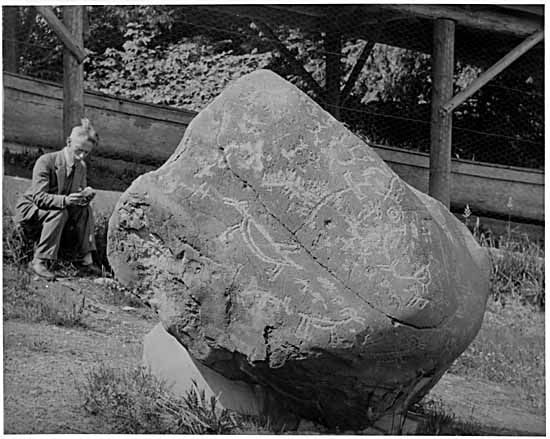
The boulder in the early 1930s, soon after it was brought to Stanley Park. Note the crispness of the designs and the lack of moss.

e-fauna and e-flora of British Columbia

Raven, Corvus corax. Photo: Doug Skilton, via e-fauna BC

Not a strictly archaeological topic, but I was interested to find these online projects: the Electronic Atlas of the Fauna of British  Columbia, and a sister site for the flora.   These are subsites of a larger project called The Biodiversity of British Columbia.  Together, these sites aims to document, with photos, all the marine and terrestrial plants and animals of BC.  They have made a lot of progress – almost any critter or shrub you’ve heard about has  a photo at least, while many have descriptive pages of information and range.  Some sample pages for culturally-significant species: blue camasbalsam root, harbour sealsturgeon, Roosevelt elk, and Pacific banana-slug.  Species with photos only include raven and the hairy spiny doris.

Looking at the “animal photos wanted” page is a reality check though: while the current databse includes almost 9,000 photos, some 11,002 species still need photos to be submitted.  This speaks to the size of the task as well as the stunning breadth of biodiversity in BC.   If you have pictures of unusual animals then consider joining and making a submission – this would be a fantastic distributed project where the hive-mind of amateur naturalists across BC could make a solid contribution to these encyclopedic ventures.  They have some very handy checklists if you are inclined towards completionism.

One complaint: the site navigation is extensive, with multiple kinds of search possible, but the frame structure makes linking to specific pages very awkward or impossible.  Cleaning this up would be a big job but would increase the utility of the site greatly.

Chum salmon in a Burnaby estuary. Photo by Les Deighton via e-fauna.

Stanley Park’s Wandering Petroglyph

Petroglyph Boulder in Stanley Park. Source: Vancouver Public Library

I was intrigued by this 1930s photo of noted Vancouver photographer Philip Timms perched beside a large petroglyph in Stanley Park, not least because it is obviously not from the coast. The caption indicates as much: “rock was brought to Stanley Park from the Cariboo; at the former totem pole site at Lumberman’s Arch.”

A little digging around suggests this boulder was discovered in 1923 in the Lone Cabin Creek area of the middle Fraser River, just south of the Gang Ranch. It was moved to Stanley Park in 1926. As of 2002 at least, it was still there. If anyone knows for sure where it is, let me know.  The complete absence from flickr, for example, suggests to me that the information below sayng it is stashed out of site at the Vancouver Museum may be accurate.  This site has a number of undated pictures of it (not the apparent deterioration from the picture above – it probably doesn’t do well in the rain) and some history and interpretation which I can’t vouch for:

It is thought that this boulder may have been a marker of a Salmon site. Another theory has the stone important in puberty rites. This boulder is probably about 500 years old. This petroglyph was carved in the vicinity of Lone Cabin Creek, north of Lillooet, on the Fraser River. It first gained Euro-Canadian attention in 1923 upon its discovery by H.S. Brown a cariboo prospector. He brought its existance to the attention of William Shelly, the Vancouver Parks Board commissioner of the era. Shelly proposed moving the six-ton rock from its location on the Fraser to a new home in Stanley Park. Three years alter, the move commenced. The rock was first loaded onto a raft to be floated to the nearest railway station. This awkward plan failed as the weight of the boulder caused the raft to sink immediately after loading. The next, more successful attempt involved a team of ten horses and a sled. In the dead of winter, the “Shelly Stone” was dragged to the closest rail line. This whole procedure took over a month and cost Shelly two thousand dollars which was a lot of money at the time. The Shelly Stone arrived safely at Stanley Park. It was set in a foundation of concrete as it was felt this would prevent the enormous rock from being carried off or destroyed. The rock remained at Brockton Pt mislabeled as an Indian Pictograph until moved to the Vancouver Museum basement in June of 1992. During the years in Stanley Park, human contact and urban polution have worn on the petroglyph like sandpaper. It is hoped that the protected environment of the museum will guard its images from further deterioration. Since it is not part of the regular museum exhibition, it currently does not cost to view it.

This boulder must be of the highest spiritual and cultural significance — shouldn’t it be moved back to the Cariboo where it belongs?

State Underwater Archaeology Overviews

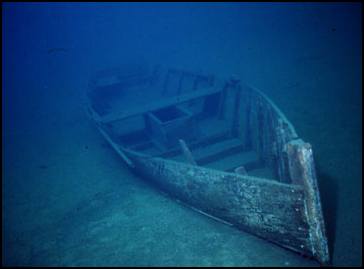
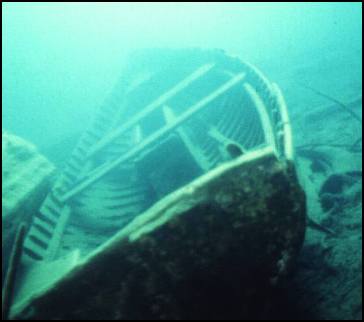
Part of a sunken fleet of recreational dories, Emerald Bay, California.

The US National Parks Service has a useful page summarizing policies and laws regarding “submerged resources” – which includes underwater archaeological sites.  The sections most of interest to the six readers of this blog are probably the pages on Washington State, Alaska, Oregon and California — though the fact that Idaho has a page is, at least, surprising until you remember the importance of paddle-wheelers in the earlier interior historical period all over the west.

Another Emerald Bay dory. Source: http://www.parks.ca.gov/default.asp?page_id=22707

Punchaw Lake Geochemistry

Elongate side-notched points from Punchaw Lake. Source: Montgomery 1978.

Archaeologists are often pretty lousy geologists.  Nowhere is this more apparent in the use of visual cues to classify rock types.  Accurate classification of rock types is an enormous clue to the mobility of past people, to ancient territories, as well as trade and exchange networks.  Even so, very few archaeological studies on the Northwest Coast have looked at geochemical characterization of raw materials, other than for obsidian at least.  The best work done to date is probably Nicole Smith’s M.A. thesis on the Richardson Island site.

It is therefore nice to see some other comparable work being done.  I don’t know much about the Punchaw Lake (near Prince George) project beyond this poster which has been put online  in  the form of a PDF conference poster by Lorenz Bruechert (abstract).  I understand Bruechert did his MA at UNBC on this geochemical study and also there is a much earlier 1978 MA thesis by Patricia Montgomery available online.  It seems Bruechert used the 1970s excavations as a study sample, and the ICP-MS and other work was contracted out to ACME (not that one), a geochemistry consulting company (note: Nicole did the geochem work herself at UVIC so bonus points there).

In any case, Bruechert finds that a sample of the debitage is geochemically sortable into six groups, all of which are closely-related trachydacite or dacite.  There is as much internal differentiation at Punchaw Lake in the geochemistry of this rock type as there is between any two typical sites on the Plateau.  Hence, he suggests three distinct sources with “tens” of kilometres between them.  As the Punchaw Lake site finds itself on the Alexander Mackenzie trail, this is not that surprising to see diversity of raw material (though one could argue there should be even more diversity).  Nonetheless, the point remains that, as the picture below shows, all the material tested by Bruechert would have been classified visually as basalt (lower left on the graph); whereas in fact, none of it is basalt.  It was such findings at Richardson Island which helped allowed Nicole to postulate an “experimental” phase of technological innovation – in her case, a variety of materials including rhyolites, argillites and varvites had all been variously mixed and matched in ways that did not reflect their geochemical origins.

Bruechert Figure 2: rocks called "basalt" (lower left) are actually dacity/trachydacite.

Northwest Anthropology Conference: NWAC 2010

The web site for NWAC 2010, to be hosted at Central Washington University March 24 – 27, 2010 in Ellensburg, Washington,  is up and running.  NWAC is a great conference which we were lucky to host in Victoria a couple of years ago.  In case you are wondering where Ellensburg is (no offence), it’s just to the east of the Cascades from Seattle, north of Yakima, about a 350 km drive from Victoria: map.

The theme of this year’s conference is the very welcome “At a Crossroads”:

Anthropology at the Crossroads” is the theme for the Northwest Anthropology Conference (NWAC), Ellensburg, Washington, March 24 – 27, 2010. While all submissions will be considered, this conference will offer opportunities for multiple perspectives on where we are as a discipline, society, and species, with a special emphasis on people and the environment. The “Anthropology at the Crossroads” conference will include symposia and presentations on subjects from archaeology, cultural and linguistic anthropology, paleoanthropology, primatology, medical anthropology, visual anthropology, and others. We invite submitters to use their own preposition in describing their presentation/symposia as “Anthropology at/of/on/etc the Crossroads.” Studying the past, understanding the present, and preparing for the future, makes Anthropology even more relevant today as the discipline continues to assert the importance of an appreciation for culturally diverse modes of interacting with our environment. Thus, this conference is a crossroads where the exchange of ideas better prepares us, our students, and our work to serve the communities we live in as we maintain our commitment to exchanging and transmitting our under-standings of all people, in all places, and at all times. “Anthropology at the Crossroads” also implies interaction among sub-disciplines and communities in an integrated fashion and in this manner encourages self reflection on the relevance of Anthropology today at a moment when we appear to be at several global crossroads.