Category Archives: Northwest Coast

ASBC Victoria – Public Talk Tue Nov 15th: Duncan McLaren on Early Archaeology of the Central Coast

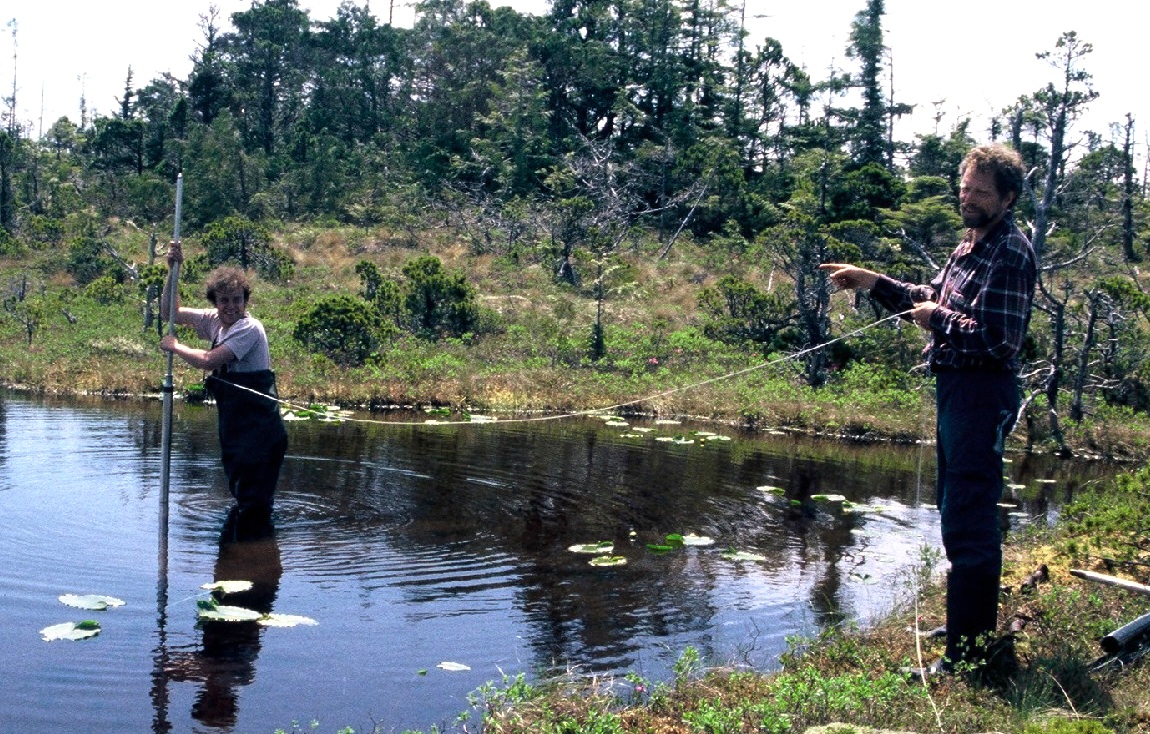
Duncan McLaren using Livingstone core on Castor Poop Lake on Porcher Island, B.C.. Daryl Fedje holds the leash.

Next up for the local (Victoria) branch of the Archaeological Society of B.C. is a Tuesday, November 15th talk by Dr. Duncan McLaren of Cordillera Archaeology and the Anthropology Department at University of Victoria.  Duncan’s highly successful  Ph.D. thesis was an interdisciplinary, geoarchaeological approach to the early occupation of the Dundas Island group on the northern B.C. coast. He is now in the early stages of applying a similar research program to the Central Coast of B.C., which promises great advances in knowledge.

The talk is free and open to the public, and you don’t need to be an ASBC member to attend.

Early Period Archaeology and Landscapes on the Central Coast of British Columbia

November 15th, 2011, 7:30 pm
Pacific Forestry Centre,

506 West Burnside Road (Map)

FREE AND OPEN TO THE PUBLIC.

Anchor Stones

Duwamish composite stone anchor. Source: UW.

Edit October 2018: Hoko Pictures are now here.

I was talking the other day about how under-represented organic technology is in archaeology generally, and especially on the Northwest Coast, where the old adage is that 95% of the technology was made out of plants (trees, wood, bark, roots, grasses, seaweeds).  A classic example of this phenomenon are anchor stones and sinker stones.  While some of these stones had grooves or perforated holes (and are thereby very visible and durable in the archaeological record), many may have been made by the more simple, subtle and expedient method of simply wrapping line or basketry around an unmodified rock.  When the organic component rots away, as it will most of the time, then the archaeologist has, well, an unmodified rock.

Anyway, it was a lucky stroke for my current interest that I came across the above photo from the University of Washington Digital Archives.

Continue reading

Manis Mastodon: a 13,800 year old Archaeological Site on the Northwest Coast

CT slice through Mastodon rib exposing bone point profile. Source: Waters et al. 2011.

For a long time, the Manis Mastodon site near Sequim, Washington was the elephant in the room of the Northwest Coast early period.  The apparent bone point embedded in a mastodon rib was seemingly hard to explain by any non-cultural means, yet maddeningly short of definitive proof, and so was politely ignored. The point has always been a thorn in my side too, which is why I have posted on it three times, once over a year ago, and twice recently.

Maybe I am a bit obsessed with it because if I rise gently from my sofa in Blog World Headquarters, being careful not to spill fine single malt on my pyjamas, then through my window I can see Sequim in the extreme distance, seemingly mocking me.

So all the more cathartic that today, with the publication of a convincing re-analysis of the mastodon rib by Michael Waters et al. in the respected journal Science, we can say that the  site is, indeed, evidence of humans hunting Mastodon on the Northwest Coast 13,800 years ago.  That’s about eight hundred years pre-Clovis.  Like I said before: it’s real.  It’s old. It’s on the coast.  Wow.

Continue reading

BC Archaeology Forum 2011: Squamish, November 11 and 12

Detail of Archaeology Forum announcement. Click for PDF

I recently received the notice that the B.C. Archaeology Forum is to be held this November 11 and 12 in Squamish.  The event will be hosted by the Sḵwxwú7mesh (Squamish) Nation, and is being organized largely by Rudy Reimer/Yumks.  Anyone can register for this event for a highly reasonable $10.00: full information is given in this PDF file. The Forum is a great event, bringing together Consultants, First Nations, Academics and Government Archaeologists in one place to share the latest discoveries and to talk policy and matters relating to the practice of archaeology.  The deadline for presenting is October 28th, but you can decide to simply attend closer to the last minute, I believe.

That said I won’t be making it this year because of an unbreakable commitment.  This highlights an unfortunate part of “Forum Culture” – it is routinely announced only a month or so in advance, even when the location is known much further ahead. Many people have to arrange to take time off, or gain advance permission or funding to travel, organize a ferry load of students, or at least keep their schedule clear for this event.  I think I’ve missed three of the last four for this reason. It’d be great if we could change this, and at least get the location and date out earlier – maybe by the beginning of summer.  Speaking of, next year it would be cool to have it on the Island.  Who’s up for it?

ASBC Victoria – Public Talk Tue Oct 18: Daryl Fedje on Gulf Islands Archaeology

Parks Canada - UVIC Archaeological Project in the Intertidal Zone, 2010.

Next up for the local (Victoria) branch of the Archaeological Society of B.C. is a Tuesday, October 18th talk by Daryl Fedje of Parks Canada Archaeology. Details below; it is free and open to the public.  I know of some of this research to be presented and if I can add an editorial comment:it is now clearly demonstrated that the intertidal zone has very high potential for un-disturbed archaeological deposits, some of which show exceptional preservation.  These include not only classic “waterlogged sites” with woody preservation, but also numerous water-saturated shell middens, and even the remains of intact house features.  I think it’s probable that in the Salish Sea at least, the intertidal zone is a hugely unappreciated zone of interest and I hope the Archaeology Branch and Consulting Archaeologists are working together to make sure it gets a thorough examination. And, if they aren’t, then it would be welcome if First Nations were to apply pressure by demanding routine subsurface testing in intertidal zones as a minimum requirement for shoreline archaeological assessments, perhaps commenting to this effect when reviewing permit applications.  Anyway:

Intertidal Archaeology in the Gulf Islands National Park Reserve

October 18th, 2011, 7:30
pm Pacific Forestry Centre,
506 West Burnside Road (Map)

FREE AND OPEN TO THE PUBLIC.

Abstract:  Recent investigations in the Gulf Islands National Park Reserve included a focus on the intertidal zone. Analyses of cultural and paleoecological data obtained from these investigations has resulted in a more detailed sea level history for the area and, discovery of a suite of archaeological sites associated with sea levels slightly lower than modern. These now-intertidal sites include intact shell middens and apparent house features dating as early as 4,000 years ago.

Bio: The Victoria ASBC Branch president writes,  “Daryl Fedje is a long-time archaeologist with Parks Canada, now based in Sidney, B.C.  He is widely published, with a respected international reputation.  Research in the Gulf Islands that he directs, co-directs, or facilitates is some of the most current work relevant to the Victoria region – but of course with wider ramifications.

More on Manis Mastodon

Image from the Mammoth Trumpet. Source: CSFA. Click to enlarge somewhat.

While we wait patiently for the definitive word on the rumoured exciting new developments regarding the 14,000 year old, pre-Clovis Manis Mastodon site near Sequim, Washington, I thought it was worth a new post to pass on an article a regular reader of this blog brought to my attention.

The Center for the Study of the First Americans, the same organization who is now re-analysing Manis Mastodon, have for many years published a very informative newsletter they call the Mammoth Trumpet.  Some of the early issues are online, including one which has a 1987 report on the Manis site(PDF).  I had not seen this before (the whole archives are worth a post on their own) and the article has some interesting information, including the picture above.

Continue reading

Intriguing rumours about the Manis Mastodon site

Screenshot of Manis news from the website of the Center for the Study of First Americans. Click to go to page.

[October 20 edit: Manis article now out in Science, my post here.]

Quite a while ago I posted about some of the frustrations I felt about the Manis Mastodon site, near Sequim on the Olympic peninsula.  This 1970s find of a Mastodon skeleton had one singularly enigmatic feature: there appeared to be the broken tip of a bone point embedded in one of its ribs.  As I wrote before: yank that sucker out! – so we can determine for sure if this is a human made artifact dating to the same age as the Mastodon – about 14,000 years ago.  Being well pre-Clovis and right near the coast, this find would be of profound importance to our archaeological understanding of the first arrival of people into the Americas.  Now, as you can read above, there is an intriguing hint that Manis has finally been re-examined, and found to be a legitimate Pleistocene archaeological site. It’s real.  Wow.

Continue reading

ASBC Victoria: Public Talk Tuesday Sept 20, Barkley Sound Archaeology

Kelsey, Rodney and Jinky in the older deposits at Hiikwis.

The local (Victoria) branch of the Archaeological Society of B.C. is firing up it’s winter lecture series.  The first talk is on Tuesday, and features UVic’s own Kelsey MacLean, speaking on the enigmatic stone tool assemblage from Hiikwis, in Barkley Sound.  Details below; it is free and open to the public.

Kelsey MacLean

M.A. Candidate, University of Victoria

Chipped Stone in Barkley Sound.

Abstract: In 2008, Hiikwis became the first archaeological site in Barkley Sound with a significant sample of chipped stone materials. This material provides new insights into the culture history of Barkley Sound and the Nuu-chah-nulth peoples. It is well known that settlement patterns changed drastically in Barkley Sound from approximately 1500 to 1000 AD (Marshall 1993:40), which is a period of occupation represented at Hiikwis. Although the population movements both before and during this time have been theorized about before, Hiikwis is causing researchers to reconsider their previous assertions. Analysis of the chipped stone materials aims to determine who created these stone tools, and why there is a relative abundance of these tools at this site in contrast to the surrounding excavated locations. Essentially, why are there chipped stone tools here, but not next door?

Bio: Kelsey MacLean is currently an MA candidate at the University of Victoria. She is an executive member of the Victoria Branch of the Archaeological Society of BC and has a BA in Anthropology and Sociology from the University of Victoria. Her first fieldwork experience was in Barkley Sound in 2008 and she has returned each summer for further research. Her interest in the Tseshaht and the Barkley Sound region led to her pursuing her MA thesis project within this extended archaeological project.

SEP. 20, 2011, 7:30
pm Pacific Forestry Centre,
506 West Burnside Road.

Map

Namu Reburials

SFU Archaeology instructor Rudy Reimer holds a small replica of the handmade bentwood boxes that will be used to store ancestral Aboriginal remains. Source: SFU flickr stream.

There have been several newspaper stories recently noting the impending repatriation and reburial of human remains excavated from the famous Namu village site of the Heiltsuk Nation, on the central coast of B.C.   For example, here is one from the Vancouver Sun (PDF), another from the Globe and Mail (PDF) and a media release from Simon Fraser University itself, whose archaeology department conducted most of the excavations at this large site in the 1970s and 1980s, mainly under the direction of Roy Carlson. As ever, each newspaper source contains slightly different information.

Continue reading

Old site on Calvert Island, Central Coast of B.C.

UNBC student Cory Hackett excavates a unit in shell midden (photo credit: B. Alway, via UNBC)

There’s a good, recent article in the Globe and Mail (PDF) on some exciting preliminary findings by Dr Farid Rahemtulla of UNBC at a site on Calvert Island (map).

The site, thought to be the “lost village” of Luxvbalis, is in territory of the Heiltsuk and Wuikinuxv (formerly Oweekeenow/Awikenox) peoples.  The project was intended to re-locate this village, which figures prominently in Oral History.  Continue reading