Category Archives: Lower Mainland

Museum of Vancouver Web Site (Fail)

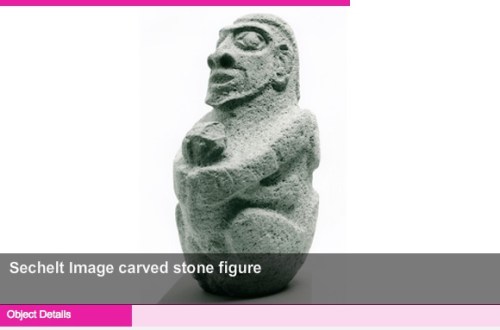
The Sechelt Image. Detail of Screenshot from the Museum of Vancouver. (click for full screen or scroll down)

The Museum of Vancouver has a pretty slick and punchy website from a design point of view, very “Web 2.0” with bright colours and links to twitter and facebook and the like.  But in some respects it fails, and fails badly.   Consider the image above: the “Sechelt Image”, a stone sculpture and one of the most famous objects in BC Archaeology.  A single low-resolution picture is offered, a link to which is not possible, and downloads of which are  deliberately made difficult.  And in this protective bubble,  the object can only be seen as a pale, grainy image, surrounded by the Museum’s loud and crass colour scheme. (Update: see full screenshot below: the Vancouver Museum overlays its neon social web over the Sculpture much like Vancouver itself overlays aboriginal culture).

Fine – I am used to that ridiculous phenomenon wherein Public Institutions think they own the images that they are entrusted with – if the image is allowed to be seen by the descendent communities (and in this case I wonder if it really is) then why can it not be seen in high resolution, free from the magenta borders and the exhortations to tweet!?

But the real problem is that the web designers, with their stupid and un-necessary banner reading “Sechelt Image carved stone figure”, obscure an important area of the sculpture, including the all-important vulva which reveals, as noted by Wilson Duff, that this sculpture is powerfully hermaphroditic.  It is not just bad and regressive museology to cover up an important part of an object, but I believe it is deeply disrespectful as well.  By obscuring part of the image and by imprisoning it within their branded frame and obfuscating web design, they, the (hopefully) temporary guardians of this powerful piece of art, are visually co-opting it for what amounts to advertising purposes.  There is no reason to put your label over top of that which you claim to be displaying for its own sake; no reason other than marketing zeal and lack of control over the web designers.

You might think it was just prurience over the frankly sexual image, but below we see another image from their website with no shocking! vulva! to conceal, which has been similarly branded and bounded by the MoV.  Maybe I am just mad at them still because they’re using a petroglyph boulder as a rock garden (note the obscuring “petroglyph” banner) but really: their website is an egregious example of stealth appropriation and blatant disrespect under the disguise of progressive design and social networking.  And I’m just a dumb archaeologist: I’d love to see a Visual Anthropologist dissect the public face they are so eager for the world to see, the face they insist must frame every image on their website.

The Skytte stone bowl. Screenshot from the Museum of Vancouver website. Click for full screen.
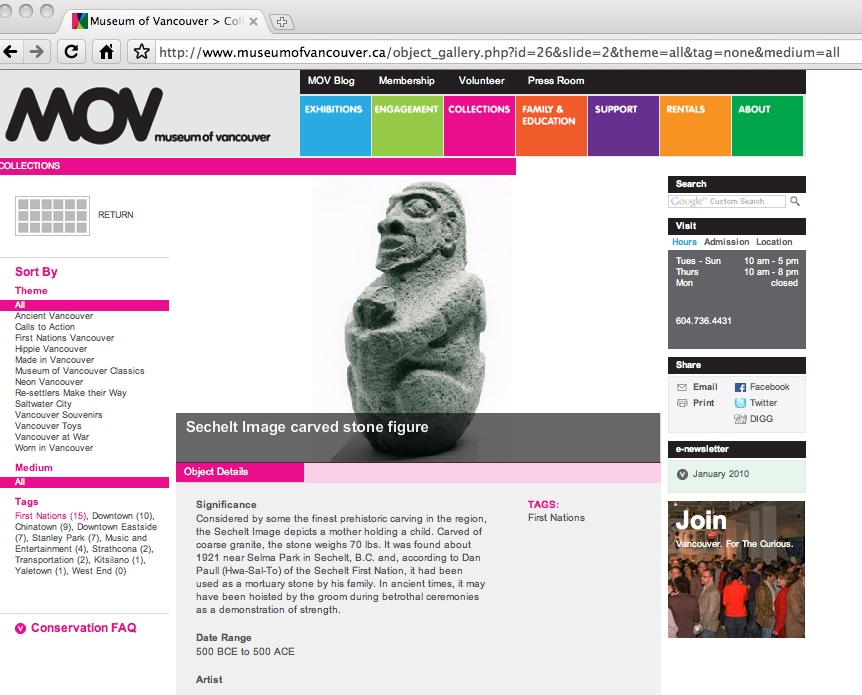
The Website sends the Message: "This is Not a Place of Honour. There is No Dignity Here."

Lousy conservation at the Vancouver Museum?

Shoddy conservation of magnificent petroglyph boulder at the Vancouver Museum. Screenshot from VM website.

For some reason mistreatment of rock art just makes me spitting mad.  I posted the other day about a magnificent petroglyph boulder that was removed from its home on the central Fraser River near Lillooet in 1926.  Bad enough that this work of art was ripped from its setting to be a curio in an urban park.  Petroglyphs are not ornaments for your outdoor rock garden any more than they are lifestyle amenities deployed as advertising copy, even if you are a museum.

Now my spies tell me that this petroglyph boulder was moved to the Vancouver Museum in 1992.  Pictures of the boulder on the VM website show it to be in absolutely appalling shape.  It is covered with moss, the designs are visibly eroded and faint, there are signs of exfoliation, and the large crack seen in 1926 seems to be getting larger.   The Vancouver Museum appears to be keeping this treasure in a damp, shady, spot in the outdoors (as they say, it is in a “lower level garden courtyard”) and there is no sign of any attention to basic, fundamental conservation responsibilities. They even have the gall to note in their website description “Today archaeologists are reluctant to reveal the locations of petrogylphs, lest they be disturbed.”  Well I am revealing the location of this petroglyph, which is being disturbed by careless curation!

Seriously: this boulder is one of only a few petroglyphs from that part of the province, where pictographs are much more common.  It was in pristine condition in 1926.  Now it is a moss-ridden crumbling mess.  This boulder is a cultural masterpiece.  It is a provincial treasure.  It is a national treasure.  It is of international significance.  And yet it is being absolutely neglected by a leading cultural institution.  Imagine an Emily Carr painting being treated so poorly.  Imagine a Bill Reid sculpture  treated so shabbily.  It would never happen.  Yet this boulder is as important, is MORE important, and is consigned to rot away metres from state of the art curatorial facilities which are being devoted to white leather pant suits (!!).  It is astonishing to me that they put this boulder on the web at all, suggesting that they don’t see a problem and are therefore unworthy to be in possession of it.  They should make arrangements immediately to have it transferred to a suitable institution or have it returned to its original setting, in what I take to be St’at’imc territory

Vancouver Museum, you have a responsibility of professional stewardship.  Are you living up to it?

Note the eroded engravings and extensive moss/algae cover. Source: VM website screenshot.

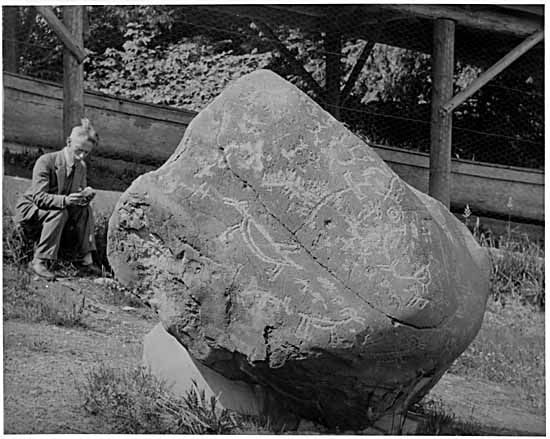
The boulder in the early 1930s, soon after it was brought to Stanley Park. Note the crispness of the designs and the lack of moss.

Stanley Park’s Wandering Petroglyph

Petroglyph Boulder in Stanley Park. Source: Vancouver Public Library

I was intrigued by this 1930s photo of noted Vancouver photographer Philip Timms perched beside a large petroglyph in Stanley Park, not least because it is obviously not from the coast. The caption indicates as much: “rock was brought to Stanley Park from the Cariboo; at the former totem pole site at Lumberman’s Arch.”

A little digging around suggests this boulder was discovered in 1923 in the Lone Cabin Creek area of the middle Fraser River, just south of the Gang Ranch. It was moved to Stanley Park in 1926. As of 2002 at least, it was still there. If anyone knows for sure where it is, let me know.  The complete absence from flickr, for example, suggests to me that the information below sayng it is stashed out of site at the Vancouver Museum may be accurate.  This site has a number of undated pictures of it (not the apparent deterioration from the picture above – it probably doesn’t do well in the rain) and some history and interpretation which I can’t vouch for:

It is thought that this boulder may have been a marker of a Salmon site. Another theory has the stone important in puberty rites. This boulder is probably about 500 years old. This petroglyph was carved in the vicinity of Lone Cabin Creek, north of Lillooet, on the Fraser River. It first gained Euro-Canadian attention in 1923 upon its discovery by H.S. Brown a cariboo prospector. He brought its existance to the attention of William Shelly, the Vancouver Parks Board commissioner of the era. Shelly proposed moving the six-ton rock from its location on the Fraser to a new home in Stanley Park. Three years alter, the move commenced. The rock was first loaded onto a raft to be floated to the nearest railway station. This awkward plan failed as the weight of the boulder caused the raft to sink immediately after loading. The next, more successful attempt involved a team of ten horses and a sled. In the dead of winter, the “Shelly Stone” was dragged to the closest rail line. This whole procedure took over a month and cost Shelly two thousand dollars which was a lot of money at the time. The Shelly Stone arrived safely at Stanley Park. It was set in a foundation of concrete as it was felt this would prevent the enormous rock from being carried off or destroyed. The rock remained at Brockton Pt mislabeled as an Indian Pictograph until moved to the Vancouver Museum basement in June of 1992. During the years in Stanley Park, human contact and urban polution have worn on the petroglyph like sandpaper. It is hoped that the protected environment of the museum will guard its images from further deterioration. Since it is not part of the regular museum exhibition, it currently does not cost to view it.

This boulder must be of the highest spiritual and cultural significance — shouldn’t it be moved back to the Cariboo where it belongs?

Geist: Memory and the Valley Photo Essay

Sxwòyeqs (The Place that Everyone Died) | Stave Lake. Source: Geist Magazine.

A while ago I linked to a beautiful photo-essay from Geist Magazine on decaying towns on the BC coast.  I see they have another excellent photo essay, this one on the subject of the superposition of Euro-Canadian towns and spaces onto Aboriginal archaeological sites and significant places.  The text by Sandra Shields and David Campion is sensitive and evocative and the photographs are well taken — in some ways they are banal – an overpass, and access road – yet knowing what lies underneath triggers emotional reactions. UVIC’s own Duncan McLaren is featured as well so it must be a good article – Stave Lake (above) has two of the oldest archaeological sites in Canada (each more than 12,000 years old), parts of which miraculously survived the reservoir inundation.

The Geist authors are interviewed here, which is also well worth reading:

Interviewer: it’s not only peo­ple that are miss­ing in “Memory and the Valley”; you touch on the dis­ap­pear­ing salmon, the white pine, the waters drained away. There’s def­i­nitely that tone of loss through­out the whole work.

Campion: That is why we’re hav­ing the exhibit here in the old city hall in Chilliwack, with a wall of the orig­i­nal pio­neers look­ing down on the work. It’s because you strug­gle with these two nar­ra­tives. One says: When Canada started, we came to a land that had no peo­ple in it and we strug­gled really hard and made a won­der­ful life for our­selves and a future for our chil­dren. Whereas, for abo­rig­i­nal peo­ple, it’s a story of huge pain and suf­fer­ing, and a huge loss of peo­ple to dis­ease, even before con­tact. Then res­i­den­tial schools, cul­tural mod­i­fi­ca­tion, and so on.

So you’ve got this prob­lem at the base of Canadian soci­ety. For soci­ety as a whole to move for­ward, we need to find a way to acknowl­edge that loss, not just to have it mean some­thing in that on/off, negative/positive sense. As non-Natives, we need to find a way to absorb the real­i­ties of our com­ing here into our national narrative.

The notion of a “palimpsest” in archaeology is common, borrowed from manuscript studies: parchments would be scraped clean and re-used, yet, the older writing can still be seen and read, a ghostly precursor image.  Writing over writing, material culture over material culture, names over names and the living over the dead.  Every time you walk across the concrete apron in front of the MacPherson Library at UVIC you walk across an archaeological site.  Every time you leave the Elliot Lecture hall you walk across a site.  The Legislature is on a site, the Fraser Arms Hotel, the Willows Beach Tea House, all superimposed, a collective blotting.  Our feet tread the scraped parchment of the dead.

Leq’á:mél | Nicomen Island

Wapato, Camas, Tyee

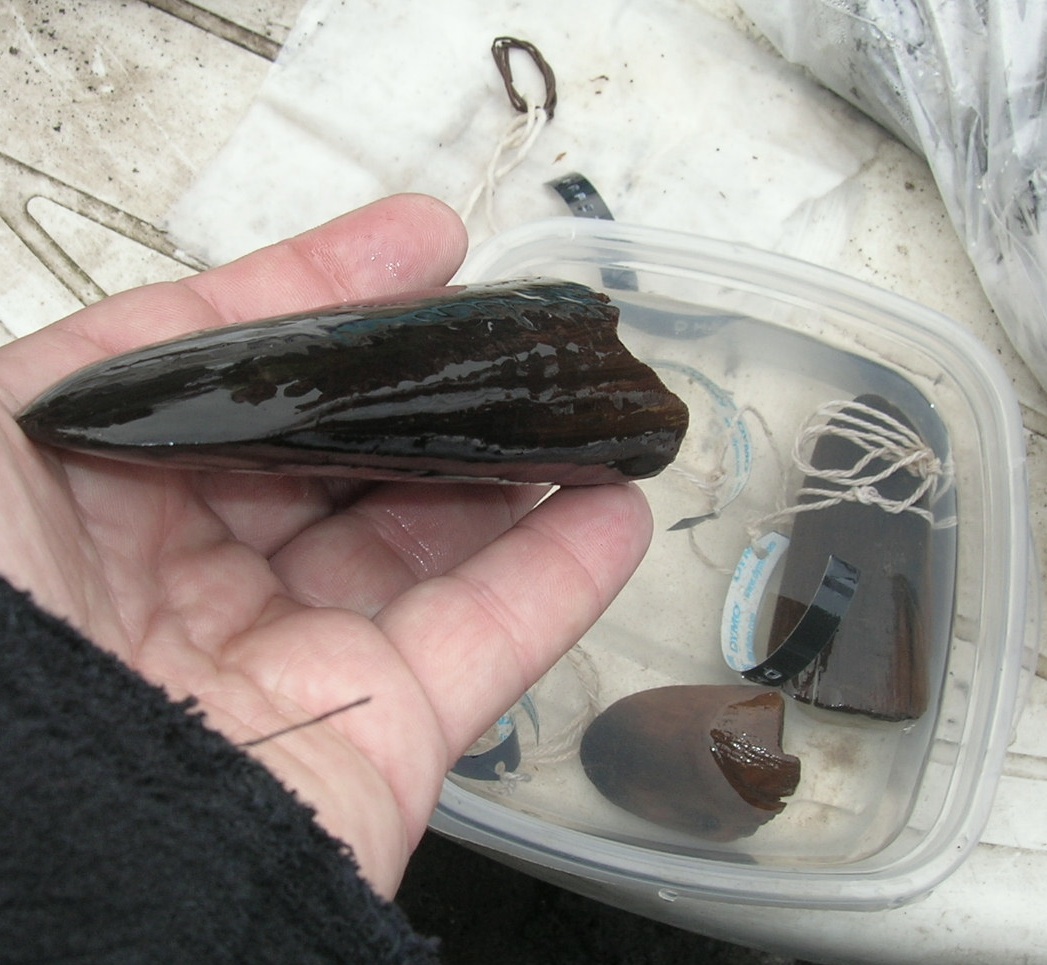
4,000 year old Wapato tubers from archaeological site in Katzie territory.

The Tyee has a nice feature on invigoration of traditional use of Wapato (“Indian Potato”) and Camas.  I visited an open house at an archaeological site in Katzie territory a year or two ago and so here’s a couple of pictures of 4,000 year old Wapato tubers and a digging stick of presumably the same age which would have been used to help cultivate the wet beds.  At that site (almost completely destroyed by the new Golden Ears suburban commuter bridge), there were signs of the creation of enhanced “water gardens” for Wapato, and not just the harvesting of what occurs naturally.  Similarly, camas productivity was greatly enhanced by selective weeding and by the practice of tilling and selective bulb harvesting as well as deliberate burning to manage the camas fields.  All in all, exploitation of many plant foods (and shellfish) formed a practice intermediate between farming and gathering, and thereby are a powerful line of evidence for traditional use of large areas of SW British Columbia.  The Tyee article seems to me to be clear, accurate and informative.  I recommend it.

Tip of a wooden digging stick, ca. 4000 years old, Katzie territory. Two others of the dozens found can be seen in the background.

UCLA-Stó:lō Field School at Welqámex

s’iltexwáwtxw

I see UCLA is running a fieldschool again this coming summer in Stó:lō territory at Welqámex, a village site on the  small island in the Fraser River near Hope.  Instruction is by Anthony Graesch (UCLA) and Dave Schaepe  (Stó:lō Research and Resource Management Centre).  The UCLA web site has been down as much as up recently (because it has so  many bells and freakin’ whistles it doesn’t know if it is coming or going — idiot web designers make such fragile shit these days), so you can also check the AIA web site.  Here is a direct link to their pamphlet (PDF).

Note the students wearing protective ochre daubing.

Chief Thunder Voice

Bing Crosby being invested as Squamish Chief Thunder Voice.

In 1948, Bing Crosby, then a first-rank international star, visited Vancouver – and ended up being invested as Squamish Chief Thunder Voice, among other civic performances.  The Vancouver City Archives has the video (1.00 minute in).

By the way, what is up with coastal First Nations adopting feather war bonnets?  Is this a kind of weird double reverse emulation: trying to look more stereotypically Chiefly in the eyes of the majority population?  Is it intra-aboriginal cultural appropriation?  Or do they just look freakin’ awesome?  Note the tomahawk as well in the picture above.  Someone should write a paper on “Plains Paraphernalia as  Signifiers of Rank on the Historic Northwest Coast”.  Or maybe they have, already.  I’d read it.

New Westminster, 1903

Aboriginal women at New Westminster, 1903.

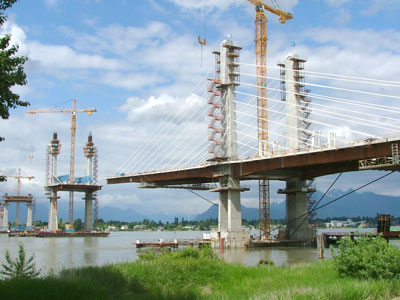
There is something about the above picture that is so evocative: Native women washing clothes or getting water while in the background the first construction of the Fraser River Bridge at New Westminster rises.  With a different caption this could be the Ganges River, or the Colorado: always women, always squatting, always the back turned to the viewer and the colonial future in the background.

From the idiosyncratic New Westminster online photo archives – this uses the LoC system so you have to search for, say, “Indians” rather than “First Nations”.

New Westminster, ca. 1865

Tla’amin Archaeology

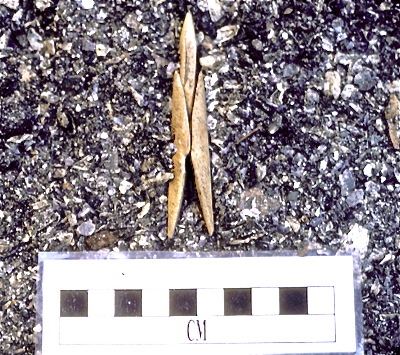
Toggling Composite Harpoon head, articulated in situ.

Toggling Composite Harpoon head, articulated in situ.

The Tla’amin (Sliammon)  First Nation on the Sunshine Coast (map) have been engaged in a wonderful community-based archaeology project with Dana Lepofsky at SFU and her team.  It’s not surprising when you think of what a great person Dana is – brilliant, yet nice, warm, generous. (Hi Dana!)

The website for this project is well worth browsing to see what meaningful partnerships with First Nations looks like.  I think it is a model for the future of BC Archaeology to work together – for then the project becomes not all about the past, but all about the present.  As they say – the past is over; it only exists in the present. Old things exist, but they exist now.   So how can we, as archaeologists, use our particular skills to help communities and the public appreciate the past as a meaningful part of the present, and hence of the future?  This impressive web site shows many great ways how.

Check out this page on Kleh Kwa Num – Scuttle Bay, for example, whih deftly points to the parallel stories of oral history, ethnohistory, and archaeology.  Or, this video of “what happens when an archaeological site is logged?”  As Elsie Paul, a Tl’amin elder says, their ancestral land was hammered for a century and what did aboriginal people get from it?  “Nothing”.  And as Dana says, it became very difficult to find intact archaeological sites around Powell River and the industrial areas, in particular.

These downloadable posters are also really well done, as is their prospectus/report (PDF) – very accessible stuff.   I do wish they didn’t use the silly flash interface for their pictures, though they do allow access to them otherwise – this project is really turning archaeology on its head!

Upside Down Archaeology in Tla'amin Territory.

Upside Down Archaeology in Tla'amin Territory.

Heritage Burnaby

Ground stone wants to be flaked stone.

Ground stone wants to be flaked stone.

Billing itself as “personal history – collective memory”, the Burnaby Archives is a professionally presented and slick website.  As usual, the parochial frame extends only to non-aboriginal settlement.  Curious about whether the land on which Burnaby sits was occupied in more ancient times?  Well, they do link to 42 objects associated with aboriginal people.  Wondering if there might still be aboriginal people there today?  I couldn’t find anything.  I sure wish small town archives, and not so small ones as well, would wake up to the millennia of history under their feet.  Time did not start in 1892, Burnaby, much as some might like to think it did.  Or maybe it is just the prominent epigraph this site cites:  History is made with documents. Documents are the imprints left of the thoughts and the deeds of the men of former times. For nothing can take the place of documents. No documents, no history*.

No archaeology means a big honking hole in history, we might add, a hole shaped like colonial guilt.

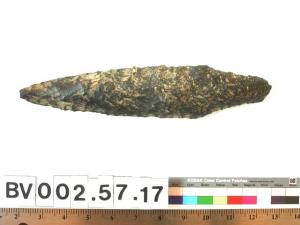
Elongate contracting stem point from Burnaby.

Elongate contracting stem point from Burnaby.

Having said that, two unusual artifacts are illustrated on their site.  Above left is a very distinctive ground stone point with a zig-zag motif.  I don’t recall seeing another one like it.  It almost appears to be a ground stone point designed to resemble a flaked stone point, something of a skeuomorph.   To the right is an elongate, contracting stem  flaked point or “dagger” that  appears to be about 14cm in length.  In size and appearance it is not the most common artifact in the world.

PS: Heritage Burnaby — your web site is nice and all, but breaking direct links to pictures is pretty lame.  Has there been that much bandwidth from hot-linked pictures?  Or are you so possessive about these artifacts you hold in trust for the Stó:lô, Musqueam, and Tsleil-Waututh First Nations?  Higher resolution would be nice as well — surely you have more than 72 dpi, 30 kb versions already taken?

* Incongruously cited as, “Charles Seignobos, Histoire de la civilisation contemporaine (1920). Translated by Eamon de Valera in a letter from prison to his personal secretary enjoining her to safeguard his papers.”