Category Archives: Archaeology

NW Geology Field Trips Lead to Chert?

The Aldergrove Glacial Erratic. source: geocaching.com

This is something a little different, leading to something cool: the NW Geology Blog has assembled quite a few self-guided geological fieldtrips, mostly in the Seattle to Vancouver corridor.  There are two in the Fraser Valley: the Aldergrove glacial erratic, and the Shasta erratic in Coquitlam.  The other BC field trip is to the recent, massive debris flow at Capricorn Creek.

But it was one of the Washington State trips which caught my eye though: a trip to a formation of Stilpnomelane at Blanchard Mountain, Skagit County, near Bellingham Washington.  The reason this caught my eye: the formation is intersected by massive, green chert beds.

Continue reading

Big Bucks for Early Coast at OSU

Screenshot of PSAL Web Page.

It looks like big Northwest Coast projects on old sites are in the works at Oregon State University.  I came across a new blog which is the public face of something called the Pacific Slope Archaeological Lab with the mission of “Discovery, recovery, and interpretation of First Americans archaeology in the New World’s Far West.”  The blog points to a large number of projects which have been initiated or are planned under this research umbrella.  How is such a wide-ranging and ambitious research project possible?  A million dollar endowment making a fund under the direction of OSU Associate Professor Loren Davis isn’t hurting.

Continue reading

Salmon species now knowable from vertebrae

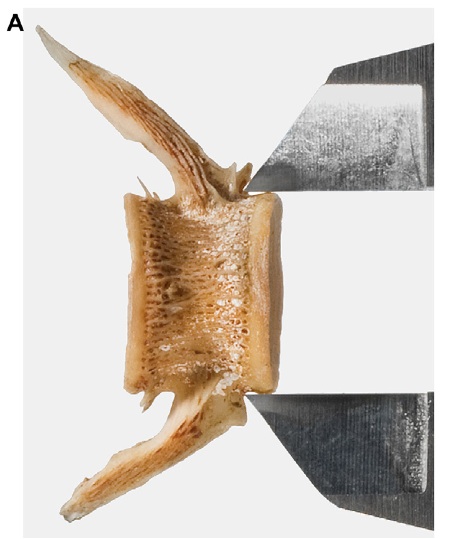
Measurement of vertebral height. Source: Huber et al. 2011

Salmon are a crucial cultural keystone species across most of the Northwest,  of very high importance to many coastal and interior cultural groups for thousands of years.  Many archaeological sites are chock full of salmon bones, and the oldest of these are around 10,000 years old.  As a cultural story, the importance of salmon is obvious.  Increasingly though, the archaeological data are also invoked to tell the history of salmon themselves.  The very long-term view of the archaeological record provides  knowledge of their ranges, their relative abundance, their life histories, etc.  These data can then be harnessed as part of conservation and fisheries management of these threatened species of fish.

Each species offers different things to people: some run early, some late; some are more fatty, some leaner; some run in huge compact numbers, others tend to dribble by; some can be caught in large numbers in the open ocean, others can only be caught efficiently in streams.  There’s just one problem with using salmon bones in archaeology: until recently, you really couldn’t tell one species of salmon from another based only on their bones.

Continue reading

Raven Bluff: another dated Alaskan fluted point site

Northern fluted point from Raven Bluff site. Source: flickr usr The Arctic Archaeologist.

Some time ago I posted about the Serpentine Hot Springs site in Northwestern Alaska, at which several fluted points have been found, apparently dating to about 12,000 years ago.  That’s about a thousand years more recent than Clovis, which is the best known of the early “fluted point” archaeological cultures from the Americas. I was interested to come across another site – Raven Bluff – which has recently come to light from the same general area, and which also has fluted points.  At Raven Bluff, at least one of  these dates to between about 12,000 and 12,500 years ago – also younger than Clovis, which is mainly confined to a narrow window around 13,000 years ago.

Continue reading

Florida Mammoth Engraving is Real?

Vero Beach, Florida, mammoth engraving. Source: National Geographic.

I’ve been vaguely aware that in 2009 at Vero Beach (map) near Miami, a sensational find came to light of a bone with a mammoth engraved onto it.  So far there has not been a lot to say about it but now I read that Dennis Stanford at the Smithsonian has inspected it and found no reason to think it is not genuine (yes, that kind of double-negative convoluted opinion).

Anyway, the story is interesting in its own right and perhaps has some lessons for us on the NW Coast as well, which I’ll discuss at more length below.

Continue reading

Elfshot goes “ground stone”

Ground slate ulu blades in progress. Source: Tim Rast, Elfshot.

I’ve mentioned before the terrific Back East archaeology blog Elfshot, in which Tim Rast documents his journey of “making a living as a 21st century flintknapper”.  Flintknapping is all well and good, of course, but the real magic lies with ground stone, which for many years has been marginalized in archaeology as being, well, obvious and uninteresting.  I think one paper I read digresses with an anecdote about the author’s toddler son independently inventing the technology!   If it is so obvious, though, then why is it only selectively implemented by people in certain environments, at certain times, to certain degrees of intensity?

Continue reading

Oregon Earthquakes and Tsunamis

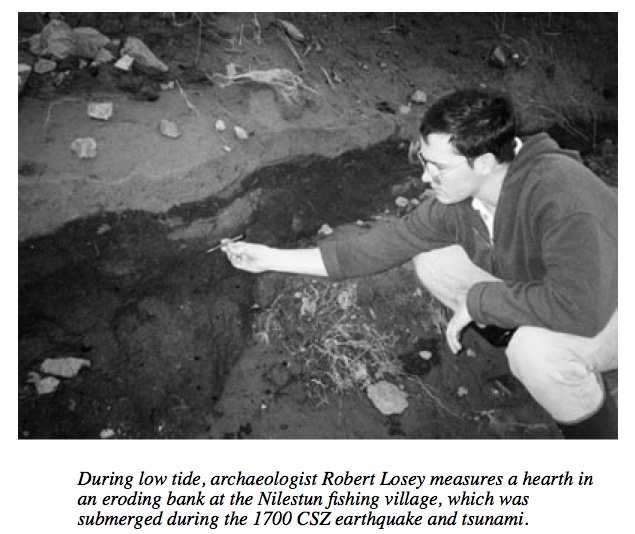
Source: Byram 2007.

Every few centuries, on average, the Northwest Coast gets shocked by a massive mega-thrust earthquake, on the order of 8 to 9 on the Richter scale.  On occasion, these produce a devastating tsunami wave.  It wouldn’t be surprising then if such disruptive events featured in aboriginal oral histories and also in the archaeological record itself.  There is a growing body of research on this topic which I am not planning on reviewing at this time, but a nicely focused starting point is a series of papers in the Oregon Historical Quarterly, available online.

Continue reading

The Skagit River Atlatl

The Skagit River Atlatl. Image © UBC Museum of Anthropology, Photographed by Derek Tan. CC Licenced.

An atlatl, or spear thrower, is a device used to increase the velocity, and hence range or striking power, of a projectile.  These are usually made of wood or other organic material, and hence they seldom survive in the archaeological record.  Some years ago though, one was dragged up in a fishing net from waterlogged conditions in the Skagit River estuary in northern Washington State near Anacortes.  As the UBC Museum of Anthropology describes:

Made of yew, a hard yet flexible wood, the weapon survived 1,700 years buried in alluvium in the Skagit estuary until it was dredged from these silts by a seine fisher’s net in 1939 in the Lower Skagit between Townhead Island and Bald Head Island. It is believed that it hung in a fish shed, perhaps to dry slowly thus preventing some deterioration, until archaeologists became aware of it in the 1950’s.

Rather incongruously, the Southwest Archaeology blog Gambler’s House has had two in-depth posts about this artifact, here and here.  It’s worth reading both as they give excellent background and tons of links.

Continue reading

Revisiting the Salt Spring Island Archives

Part of the Charles Sampson collection from Salt Spring Island. Source: saltspringarchives.com

Salt Spring Island is a large island in the Salish Sea, close to Vancouver Island’s southeast corner (map).  Quite a while ago I highlighted the photographs of the “Bob Akerman” museum, which comes via the comprehensive Salt Spring Island archives.  There are a few other photo records of archaeological collections there which I thought were worth a quick look.  For example, the picture above from the Charles Sampson Collection shows some fairly spectacular ground slate points to the left, and what may be a Charles phase (ca. 4,000 year old)  contracting stem point to the bottom right.  It’s not just archaeological collections that the archives has going for it, though. Continue reading

Mossback nails it . . .

Mossback's column at Crosscut.com

Some time ago I mentioned Seattle’s reporter on the “Heritage Beat”, Knute Berger, who posts by the name Mossback. Over the summer, while I was gone, mossback produced a really to-the-point column on heritage preservation: Help wanted: A ‘Sierra Club’ for historic preservation to fight development.  Unusually for heritage conservation advocates, Mossback cares as much about indigenous archaeology as about historic buildings, and he does a terrific job writing about both.  Take for example, the following quote, from the above article, which speaks to many of the same issues currently plaguing the Glenrose Cannery site (it’s long, so you’ll have to click below):

Continue reading