Category Archives: alaska

Sealaska Heritage Institute Blog

Stone artifact recently donated to the Sealaska Heritage Institute Special Collections. Source: SHI.

Sealaska Heritage Institute (SHI) is a regional Native nonprofit organization founded for the Tlingit, Haida and Tsimshian people of Southeast Alaska. SHI was established in 1981 by Sealaska Corp., a for-profit company formed under the Alaska Native Claims Settlement Act (ANCSA). SHI, formerly Sealaska Heritage Foundation, administers Sealaska Corp.’s cultural and educational programs.

I know this because I got linked the other day by SHI’s Special Collections Research Center Blog, which I hadn’t seen before.  While not updated as frequently as this corner of the internavel is, it contains a lot of great posts going back to 2007 – you can see links to their archives down on the lower right hand side of their front page.

The most recent post concerns the artifact shown above.  It looks to my eye like a, possibly unfinished, hand maul. They seem a little uncertain about the function though, so someone should go over to their site and give some opinions – they take comments.  People with dirty minds are excluded from this request.

Continue reading

Listening to Our Ancestors: An exhibit at the National Museum of the American Indian

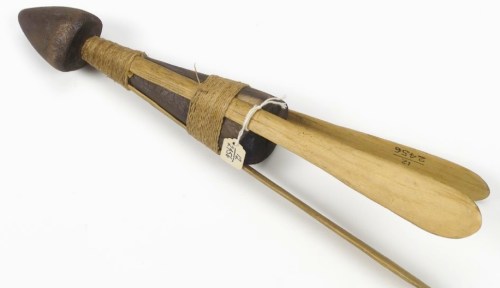
Coast Salish Cod Lure. Source: NMAI

Listening to Our Ancestors” is a nice online exhibit which resulted from a process by which 11 west coast First Nations and Tribes came to the National Museum of the American Indian (a fairly recent, major addition to the Smithsonian Institution in Washington D.C.) and created mini-exhibits reflecting their own worldviews and the categories they deemed important.  As such, each community’s sub-page is a glimpse into their specific cultural heritage and priorities – indigenous curation, you could say.

While much of the focus is on ceremonial items, some communities also choose to focus some attention on their more everyday technology, which is more in line with my own interests.

Continue reading

Yuungnaqpiallerput: Yup’ik Science and Survival

Inflating the stomach of a beluga whale. Source: Yupikscience.org

Yuungnaqpiallerput (The Way We Genuinely Live): Masterworks of Yup’ik Science and Survival” is a fascinating and informative (and large!) website companion to a 2008 exhibition by the same name at the Anchorage MuseumBooks and catalogues are also available and look to be excellent.

I know that Yup’ik territory, on the southern flanks of the Bering Straits, is a long way from the Northwest Coast.  But there are many similarities in the ingenious tricks and tools of the trade needed for a maritime lifestyle, and this exhibition deftly combines historical, archaeological and ethnographic accounts into a compelling vision of people at ease on land and sea.

.

Continue reading

Montana Creek Fish Trap, Alaska

Montana Creek Fishtrap being excavated, 1989. Source: Sealaska

In 1989 a nearly complete fish trap was found in Montana Creek, near Juneau Alaska in Aak’w Kwáan Tlingit territory. The cylindrical trap, measuring 3 metres long and 1 metre in diameter, was excavated and found to date to about 600 years ago.  The trap was preliminarily reported in Kathryn Bernick’s 1998 book Hidden Dimensions (UBC Press).  Fishtraps were supported by wood and/or stone weir structures which also  act to direct fish into the trap.  The trap would be removed at the end of each season and stored nearby or at camp.  Of course, being wood, they intrinsically don’t preserve very well except in anaerobic and wet conditions.  They are therefore rather rare since they would need to be left in the creek after use in order to preserve.  So this one is very unusual, and especially so since it was essentially complete (other than being flattened).  All credit to the finder, Paul Kissner, for being alert, recognizing the trap, and reporting it promptly.

But now, the fishtrap has become very much a living object.

Continue reading

The Schieffelin Brothers Yukon River Prospecting Trip of 1882

Tanana woman returning from the hunt, 1882. Source: AKDC

Browsing in the Alaska Digital Archives I found an interesting photo album documenting a prospecting trip up the Yukon River by the Schieffelin Brothers, Ed and Al, who just a few years earlier had founded the famous desert mining town of Tombstone, Arizona.  Two pictures from this album struck me as particularly interesting, though the whole thing is worth browsing.

The first of these is the remarkable picture above, showing a Tanana woman with a long-gun, powder horn, and a couple of large rabbits.  While anthropologists and archaeologists have grudgingly revised their “Man the Hunter” stereotypes in recent years, it is nonetheless rare to see such a frank portrait of a competent woman with her prey.  I’ll be using this one in class, starting next week.

Continue reading

Alaskan Ice Patches

Barbed bone or antler point with copper tip from Alaskan Ice Patch. Source: Dixon, NPS

All over  Northwestern North America, from Colorado to the NWT, global climate change is rapidly melting glaciers, and their less mobile cousins, permanent patches of ice which accumulate and never completely melt.  Some finds from these ice patches have revealed exceptionally-preserved organic technology dating from recent times to more than 8,000 calendar years ago.  Additionally, of course, there is the remarkable story of Kwädąy Dän Ts’ìnchį, Long-Ago Person Found, a man who died on a glacier in the Tatsenshini area hundreds of years ago.  All of these would make good posts for the future!

For today, though, I found an article online (PDF) about the lesser known Alaskan ice patches, which have been researched primarily by E. James Dixon.  Continue reading

Fluted Points from the Bering Land Bridge

Fluted points from the Serpentine Hot Springs Site, Seward Peninsula, Alaska. Source: Bering Land Bridge NPS

For many years, archaeologists considered the so-called “Clovis” Culture to be the remains of the first humans to enter the Americas.  These people were said to come via the Bering Land Bridge, a subcontinental land mass which joins North America to Northeast Asia.  Clovis culture was distinguished by a very characteristic type of stone spear point which had a long flake removed from the base on each side, forming a “flute” which considerably thinned the base of the point. Such fluting was a hallmark of Clovis and another, slightly more recent, culture: Folsom.

Clovis was thought to have arrived into the Americas from the present-day Yukon area through an “ice free corridor”.  However, for many years,  Clovis points and the rest of Clovis culture, were unknown from north of the ice sheets and there was a sustained research agenda to find Clovis, or to find Clovis antecedents, in Yukon, NWT or Alaska.  While the occasional fluted point became known from surface finds, those from solid archaeological context did not.

It is therefore interesting to see a site, Serpentine Hot Springs, has come to light on Alaska’s Seward Peninsula (the bit that sticks out closest to Asia – map) which has revealed numerous fluted points.  Continue reading

Historic Sketchbook of Heywood W. Seton-Karr

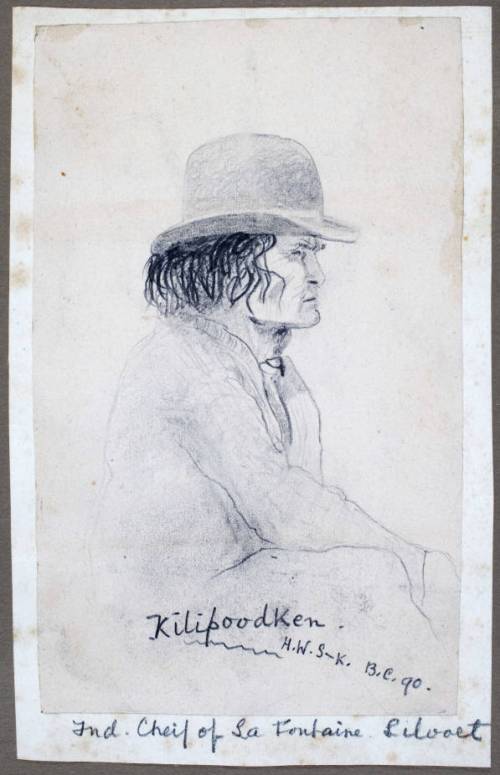
Portrait of Kilipoodken by Heywood Seton-Karr, ca. 1890. Source: Alaska Digital Archives.

I’ve just come across a remarkable sketchbook in the Alaskan digital archives.  It covers the wide-ranging travels of one Heywood W. Seton-Karr, a British Army officer, big game hunter, amateur archaeologist, and talented artist (about whom, more below).  While I could probably fill 10 blog posts from this sketchbook, (and may do so!) a very interesting find is the portrait sketch above.  The caption reads,

Kilipoodken. Ind. [Cheif]  of La Fontaine Libooet. H.W.S-K. B.C.90.

This certainly refers to the Xaxli’p First Nation, also known as the Fountain First Nation, one of the Lillooet (not Libooet!) Tribal Council from the central Fraser River region of British Columbia.  Since googling for “Kilipoodken” only returns the Alaska Digital archives source, it seems to me possible that this mislabelled portrait is unknown to the Xaxli’p Nation, where it is more than likely some of this Chief’s descendants still live.   I hope they find this portrait.

Otherwise, there is much of interest in these sketchbooks. Continue reading

Green cod heads and the case of the missing halibut

Copper kettle full of cod heads. Source: Alaska OHA.

I was feeling sick yesterday and this picture didn’t help: from the Castle Hill excavations at Sitka, Alaska (previously 1, 2) is the nearly complete copper kettle.  Inside, the archaeologists found the green-stained bones from the heads of three codfish (true cods, Gadidae, are 35% of the fish assemblage).  One of the great things about archaeology is to get these tiny slices of life: someone’s kettle of fish, set aside one day 200 years ago.

At a bigger scale, archaeology isn’t always so straightforward though.  Interestingly, from the site as a whole, only 1% of the fish bones are from halibut (11 bones in total).  This is despite the fact that:

Cod dominated the Castle Hill assemblage, and yet, Emmons (1991:148) stated that cod was considered an unimportant part of the Tlingit diet if salmon and halibut were available. Historic records confirm that cod was popular in Sitka, because it was available almost year around (Gibson 1976:40, Khlebnikov 1994). Halibut was also popular because of its year around availability and was sold to the Russians in large numbers. Between 22,000 and 138,000 pounds of halibut were purchased each year from the Tlingit from 1846 to 1866 in addition to the yearly average of 13,000 pounds of halibut the company procured itself (Gibson 1987:94). The emphasis on halibut brought to Sitka and sold to the Russian-American Company would lead to the prediction that halibut should dominate the assemblage, yet this is not the case. It may be a case where cod were readily available and not worthy of special consideration in historic documents.

Two things strike me about this.  One is that the Tlingit, using largely traditional methods at the time, were able to produce up to 138,000 pounds of excess halibut for trading purposes.  That’s a lot of fish.  The other is that so much halibut renders down to so few bones.  Halibut is long known on the NW Coast as being strongly under-represented in archaeological sites, probably because it may have been butchered on the beach and the bones, which separate cleanly from the meat, would end up in the intertidal zone and be washed away or eaten by dogs.  It also seems possible  that the Tlingit were trading in dried, boneless halibut (which makes the tonnage involved all the more impressive).  And certainly the entire site was not excavated, so there may be a mother lode of halibut bones somewhere.  But this case makes an interesting cautionary tale in zooarchaeology: we seldom have an accurate sense of the scale of the incoming fish quantities to compare to what is left in the ground, and when we do, the degree of difference between the written and material records is often quite startling!

Tlingit women and children cleaning fish on the beach, ca. 1907. Ignore the racist caption. Source: U. Washington.

Two Views of Double-Headed Eagles

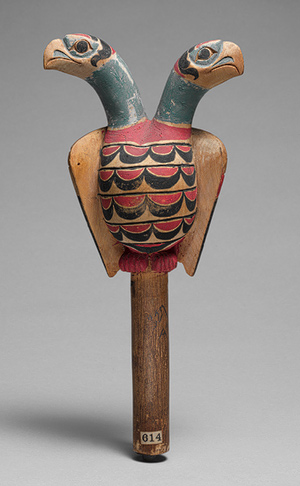
19th century Tlingit double-headed eagle rattle. Source: Metropolitan Museum

The image above is of a Tlingit rattle, with the motif of a double-headed eagle.  With the vast repertoire of supernatural beings who could be invoked in the Northwest Coast art, one could be forgiven for thinking this was another of these figures from the rich mythology and history of the Tlingit people.

In fact, this Tlingit rattle is undoubtedly based on the Imperial Russian coat of arms.  As I noted yesterday, the Russians were the earliest Europeans into many parts of Alaska.   After the Russian-Tlingit Battle of Sitka in 1804, peace talks were conducted and Aleksandr Baranov, the first governor  of colonial Russian Alaska and manager of the Russian-America Company, presented the Kiks.adi Sitka Tlingit leaders with a large medallion, on which was found the Russian imperial symbol (below).

Tlingit accounts of the treaty have been presented by Alex Andrews and Mark Jacobs, Jr. In a transcribed interview, Alex Andrews (1960:6-7) explains that the Indians did not know the value of the plaque presented by the Russians, and it was believed to be a retribution or atonement for the dead. He further stated that Baranov came to Peril Straights to negotiate the treaty. Mark Jacobs account of the treaty was related in a speech at the Second Russian-American Conference in 1987:

It was finally decided by the Kiks.adi’s to return and sit down for the peace talks. It was at this peace treaty that the present Castle Hill was given to Baranov in exchange for a double-headed eagle badge, which is depicted on the totem pole [in Totem Square, Sitka]. It was explained to mean, “From now on and forever, we will be brothers. You look one way and we the other way.” The round knob on the bottom of the totem pole represents Castle Hill. The only piece of real estate ever given to the Russians [emphasis in original document]… The double-headed eagle badge, received from the peace talks, is now in the State of Alaska Museum in Juneau [Jacobs 1987:9].

Since that time, the double-headed eagle has been a  motif widely used in Tlingit art.

I like to think that the Russians did not fully know what they were doing.  Early treaties commonly took advantage of very different indigenous views on the nature of property and land ownership  in order to dispossess people of their land under the fig leaf of western law.  In this case though, I wonder if the shoe is not on the other foot.  Crests were inherited rights on much of the Northwest Coast, yet they could also be traded or shared or given away.  The right to display a Crest was a valuable property right that helped establish a lineage’s relative status.

By acquiring the Crest of the Imperial Russian lineage as compensation for their dead, the Tlingit Chiefs may have in effect subordinated the entire Russian aristocracy: a stunning coup in Tlingit terms.  The Russians may never have noticed that they had become Lesser Chiefs in their own colony.

Imperial Russian medallion presented by Baranov to Sitka chiefs in 1804. Source: Juneau Empire.

The top image is from the small but sweet exhibition of NW Coast musical instruments at the Metropolitan Museum of Art.