Tag Archives: Salish Sea

The Bison at Ayer Pond on Orcas Island is archaeological.

Cranium of 14,000 year old Bison antiquus from Ayer Pond, Orcas Island, Salish Sea. Source: Kenady et al. 2010 (in press)

One of the challenges in archaeology is to take a familiar landscape and, by considering the known data from the paleo sciences, make it strange and unfamiliar and ripe with possibilities for strange and unfamiliar archaeology.  Right here in the southern Salish Sea there is an excellent example of this coming to light.  As the ice retreated at the end of the last glacial period, the Salish Sea saw dramatic changes in sea level (both higher, and lower), in vegetation (tundra, grassland, and forest) and in the animals present on that dynamic landscape.

Location of known Bison antiquus remains in Salish Sea. Source: Wilson et al. 2009.

For years now, we have known that one of the large land mammal species of the Salish Sea around 14,000 years ago was bison — and not just any bison, but Bison antiquus, the extinct giant bison.  A number of remains of this creature have been found, mostly on the Saanich Peninsula and on Orcas Island,  which is one of the largest islands in the Salish Sea, sitting just south of Saturna Island, close to the Canadian Border.  Since these remains mostly clocked in at around 13,000 to 14,000 years ago, most archaeologists were interested in them primarily for their coolness factor and not because they seriously thought there might be relevance to early human presence here – these bison pre-date the Clovis Culture which was the consensual evidence for the first peopling of the Americas.  I have previously posted on this with reference to Clovis in Puget Sound, to the controversial Manis Mastodon site, as well as to the nearby Wenas Mammoth and even the Paisley Cave finds in Oregon – evidence is coming together for both a Clovis and a pre-Clovis occupation of the Salish Sea and environs.

Now with a new paper by Kenady et al. in press, these numerous bison finds take on a new importance: one of them is most likely archaeological.

Continue reading

Salish Villages of Puget Sound

Overview map of Coast Salish Villages of Puget Sound. Click to go to the page of interactive maps at coastsalishmap.org

Tom Dailey has put together a large and very interesting site which documents the Coast Salish villages of Puget Sound.  The core of the site is a series of clickable maps (see the left hand side black/white map grid), each of which is marked with little village icons.  Clicking on these icons takes you to a master document with a synopsis of the settlement name and, usually, a couple of sentences about the village.  These are referenced to scholarly literature and other sources.  It is striking to see all these villages on one map, and notable how many are shown on rivers and lakes.

Continue reading

Puget Sound Clovis

In Red: Surface Finds of Clovis Projectile Points. After Croes et al. 2008.

I posted yesterday about the Manis Mastodon site and its possible status as a pre-Clovis site on the Olympic Peninsula.  Clovis projectile points are so distinctive that most archaeologists have no problem assigning even an isolated find of such a point, lacking in any kind of stratigraphic context or any associated dates, to the Clovis archaeological culture.  We know from sites elsewhere in North America that Clovis dates to a pretty narrow window, perhaps only 13,200 to 12,800 calendar years ago.  It has always been very closely associated with the ice-free corridor route for the First Peopling of the Americas and is predominantly known from classic sites in places like Colorado, New Mexico and Texas. So it may come as a surprise to some that Clovis is pretty well represented in Puget Sound and north to Bellingham Bay, although only from surface or other finds without provenience.

Continue reading

A Saanich Peninsula short-faced bear

Post removed by request.

Continue reading

dSpace: Adams on Gabriola Petroglyphs

Gabriola Petroglyph Design Elements. Source: Adams 2003.

One recent M.A. thesis I was really looking forward to reading is by Amanda Adams entitled Visions cast on stone : a stylistic analysis of the petroglyphs of Gabriola Island, B.C., from UBC Anthropology 2003, and available for free download here.

I was particularly interested to read the instructions she received on proper deportment when visiting the rock art:

Sites were visited in a manner and with a personal code of conduct adhering to Snuneymuxw wishes. Petroglyph sites were not visited at either dawn or dusk. A respectful demeanor was expected as was an “open heart and mind” (Bill Seward, Snuneymuxw elder, personal communication 2002). I was asked to give my full attention to the petroglyphs and their sacredness, not allowing daily distractions to interfere with my concentration on the ancient imagery. These expectations were met to the best of my ability. (18-19)

While many archaeologists are under the impression that there is little to no ethnographic information about petroglyphs, I have long felt that more likely such knowledge is private or highly privileged and not readily shareable.  In this self-serving sense, it was gratifying to see that Adams was able to record some such information:

Snuneymuxw Elder, Bill Seward, asserts that many petroglyphs were made by shamans, hunters and vision seekers (personal communication 2002) while Elder Ellen White maintains that the carvings were places where people both sought and gained power. She explained that “men would be stripped – even in cold weather and laid on top of each petroglyph – learning the spirit world, connecting to the area.” She also noted that the pitted ‘dots’ surrounding several of the carvings were “points of access”, places where one could dip their fingers into pools of “energy” and reservoirs of strength (Archaeology Forum group tour 2002).  (p 13)

Another welcome aspect of Adams’ thesis is her direct comparison to portable art.  Continue reading

Lasqueti Island Archaeology

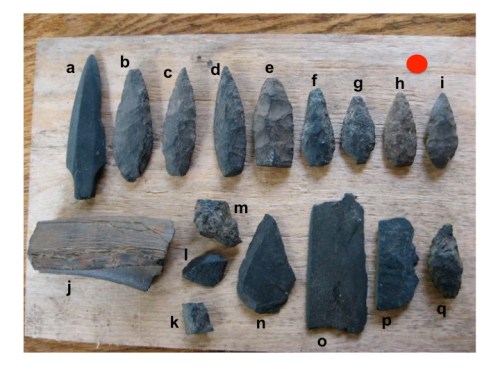
Projectile points and other artifacts from Lasqueti Island.

So many of the Gulf Island of the BC Coast are essentially unknown to archaeologists.  This goes for the larger ones as well as the small: I’d count Lasqueti, Hornby, Texada, Saturna, and Prevost Islands among those, while even major islands like Mayne Island and Quadra Island are often known only from one site, dug long ago.

This doesn’t mean there hasn’t been any work, or that there aren’t interesting and revealing collections of archaeological material already in existence.  So it is great to see that Dana Lepofsky of SFU has put together a small web site on the archaeology of Lasqueti Island.  She deftly combines some ethnographic and traditional practice information with a series of photographs of private collections of artifacts.  Among these are projectile points apparently assignable to the Charles Phase, which dates around 5400 to 3600 years ago.  Also note the beautiful ground stone adze or chisel in this picture: the luminous green nephrite (B.C. “jade”) would have been imported from the Central Fraser River, probably no closer than the Hope area.  This flaked and ground sandstone club is an unusual find, probably used in hunting or fishing, but perhaps also in warfare.

If you click the photographs, then a window will open; if you click the “image details” link on the pop-up window then you will be taken to more information about that photo, if available.  There are also two PDFs linked, one to the role of herring in traditional subsistence, and another on mapping a fishtrap.  These stem from Lepofsky’s ongoing work (and excellent website) in Tla’amin territory on the Sunshine Coast (previously), where she will be running an archaeological fieldschool again this summer.  While this only scratches the surface of Lasqueti Archaeology, it does point to the usefulness of looking at what citizens have picked up over the years as a guide to some of the time depth and activities of an area.

Sadly, of course, some of the artifacts picked up may have resulted from, or even caused, unnecessary disturbances to the archaeological record.  Lepofsky provides a helpful “call before you dig” article as well – specific to Lasqueti yet applicable elsewhere.  In typical Dana fashion, as a Lasquetian herself, the number to call is her own!

Lasqueti Island intertidal fishtrap. Photo: Dana Lepofsky.

Rock Art on Gabriola Island in 1792

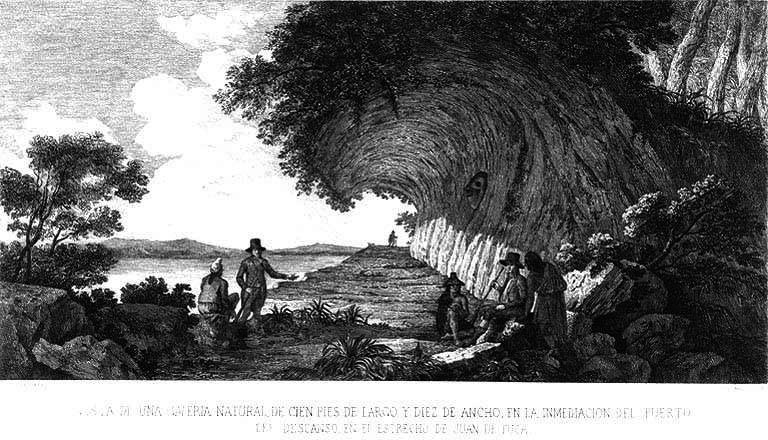
Descanso Bay Rock Art, 1792. Source: U. Washington

From the University of Washington, an unexpected image of a large Gabriola Island rockshelter containing rock art, entititled:

Northwest Coast carvings on cliff near Descanso Bay, Gabriola Island, British Columbia, in engraving made 1792.

Cardero, Jose, b. 1767 or 8

Notes: Photograph of engraving of explorers and indians viewing a carved head and other petroglyphs on the side of a cliff. The caption says it is a view of a natural gallery, one hundred feet long, and ten feet wide near Descanso Bay.

Caption on image: Vista de una galeria natural, ce cien pies de largo y diez de ancho, en la inmediacion del puerto del Descanso, en el estrecho de Juan de Fuca Image from Alessandro Malaspina’s Viaje politico-cientifico alrededor del mundo, 1885, f.p. 200

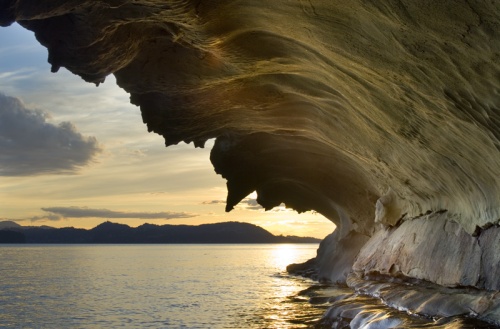
I presume this is the “Malaspina Galleries” near the ferry terminal – I didn’t know there was rock art there though and maybe there isn’t, anymore.  Perhaps this place, or this one? Or, perhaps the unusual pitted and pocked natural sandstone fooled the Spanish, though it sure looks like there is a large image in the middle of that engraving.   Quick, Gabriolans, trot down there and check it out.

Malaspina Galleries, Gabriola Island. Photo: Kevin Oke.

Tse-whit-zen whale

Tse-whit-zen whale sculpture.  Source: Peninsula News, Port Angeles.

Whale sculpture from the Tse-whit-zen archaeological site, Port Angeles. Source: Peninsula News.

The Tse-whit-zen site is a former Klallam Tribe village that was discovered by the construction of a graving dock at Port Angeles, Washington State.  The subsequent disturbance and archaeological project led to an astonishing series of events with over 300 human burials recovered, many more disturbed, 65,000 artifacts recovered and after a huge investment the abandonment of the graving dock project at a cost some estimate in excess of 100 million dollars.  This is a story I want to know more about and will probably post on from time to time.

But for today, set aside the sad history and feast your eyes on the above small sculpture of a whale discovered during the summer of 2009 at Tse-whit-zen during mopping up remediation.  The artist has captured the essence of whale!  The article doesn’t say, but there may be a socket on the lower back of the whale just in front of the tail – perhaps this was the handle for a small chisel, or a knife.  I also wonder if it doesn’t go the other way up — the mouth is asymmetric and the arching back of a diving whale would be a more natural posture.  Either way, this is a happy little sculpture, probably dating from about 2,000 years ago.

The Gabriolan

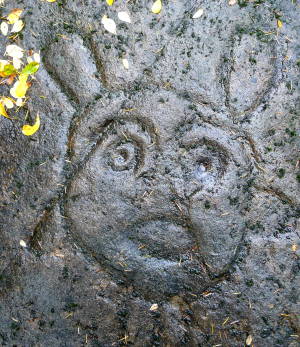
Gabriola Petroglyph. Source: The Gabriolan.ca

Another blog linked to me the other day: The Gabriolan. This is a lovely blog, whose mysterious author has a great eye for the quirky and beautiful things about that Island. I especially like the various pictures of unusual things found in the woods, like antlers on trees. On my quick browse through the site I noted the excellent photograph of a Gabriola Island petroglyph which I am posting above. This is not a petroglyph I am familiar with though I don’t have my books in front of me.  I’ll look it up.  With its double-rendered eyes and protruding ears, it may be Mouse-Woman.  But anyway, anonymous Gabriolan, thanks for the link, and look after those petroglyphs.

Capital Regional District Report

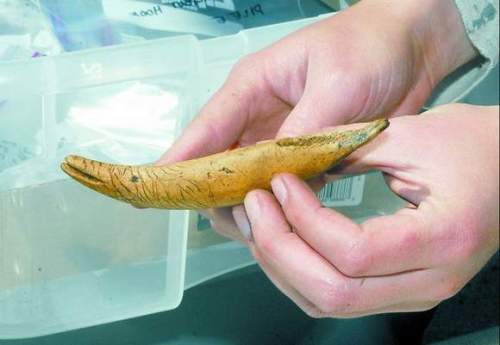
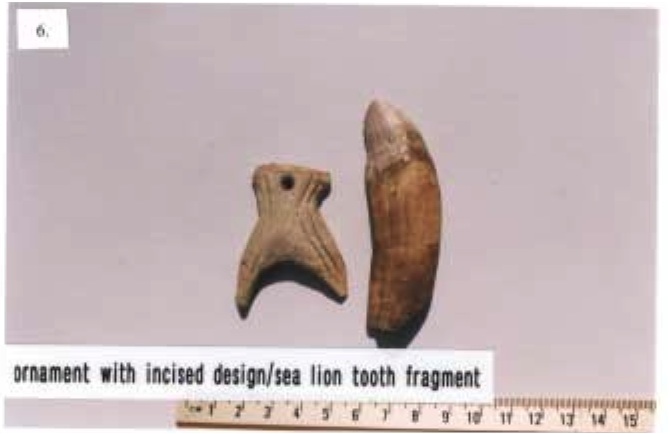
Decorated antler?, and a worked sea lion tooth from the Elchuk collection, Mill Hill.

I just came across this interesting document from 1999 by Liz Crocker (PDF) which is a cultural history of three CRD Parks: Mill Hill, Francis/King and Thetis Lake.  While I wouldn’t put a lot of stock in the archaeological component of this report, there are at least two notations of considerable interest.

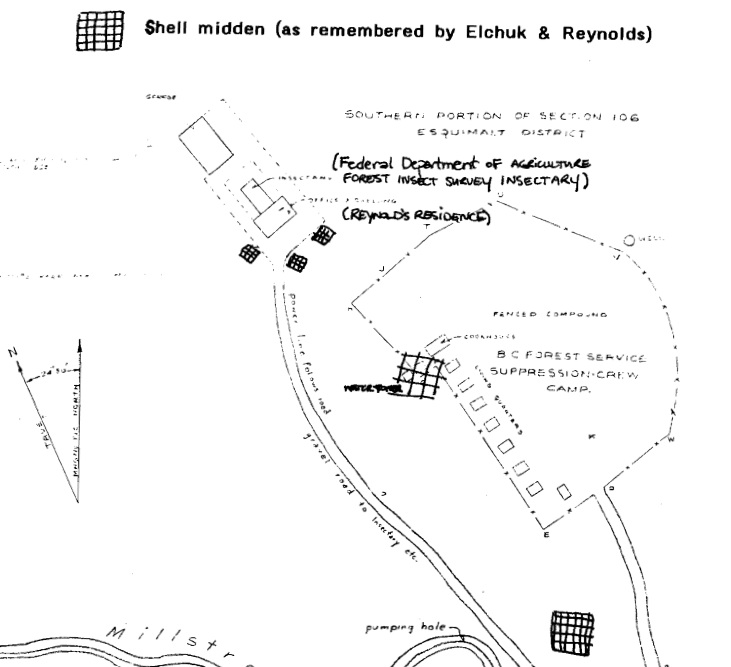
The first is the documentation of an unrecorded shell midden at Mill Hill, not DcRu-70 but another site, including a sketch map of the location which is about 2 to 3 kilometres inland.  There are also reports of unrecorded inland shell middens at Thetis Lake Park. Since such sites are rare and poorly know,  then this is something worth following up.  Indeed, I wish the CRD took their stewardship role seriously enough to commission an intensive, comprehensive, and professional inventory of the archaeological heritage of all their Parks.  This kind of baseline information is so essential that I honestly don’t understand how they think they can discharge their duties without it.

The other point of interest in Crocker’s report is the documentation of a fairly large private collection, also from Mill Hill and also well inland.  Included in this collection are Locarno-style artifacts as well as more recent ones such as a flat-topped handmaul.  Appendix 2 of the linked report includes some snapshots  of this collection.  Despite the poor quality, it is great to see private collections being documented.  The small decorative piece shown above is interesting and unusual, and the abundance of organic remains suggests again that these were collected from or near a shell midden.  Again, something to follow up. If only there were a Ph.D. student at UVIC, say, who was interested in inland shell middens…..

Sketch map of reported but unrecorded inland shell midden patches at Mill Hill.